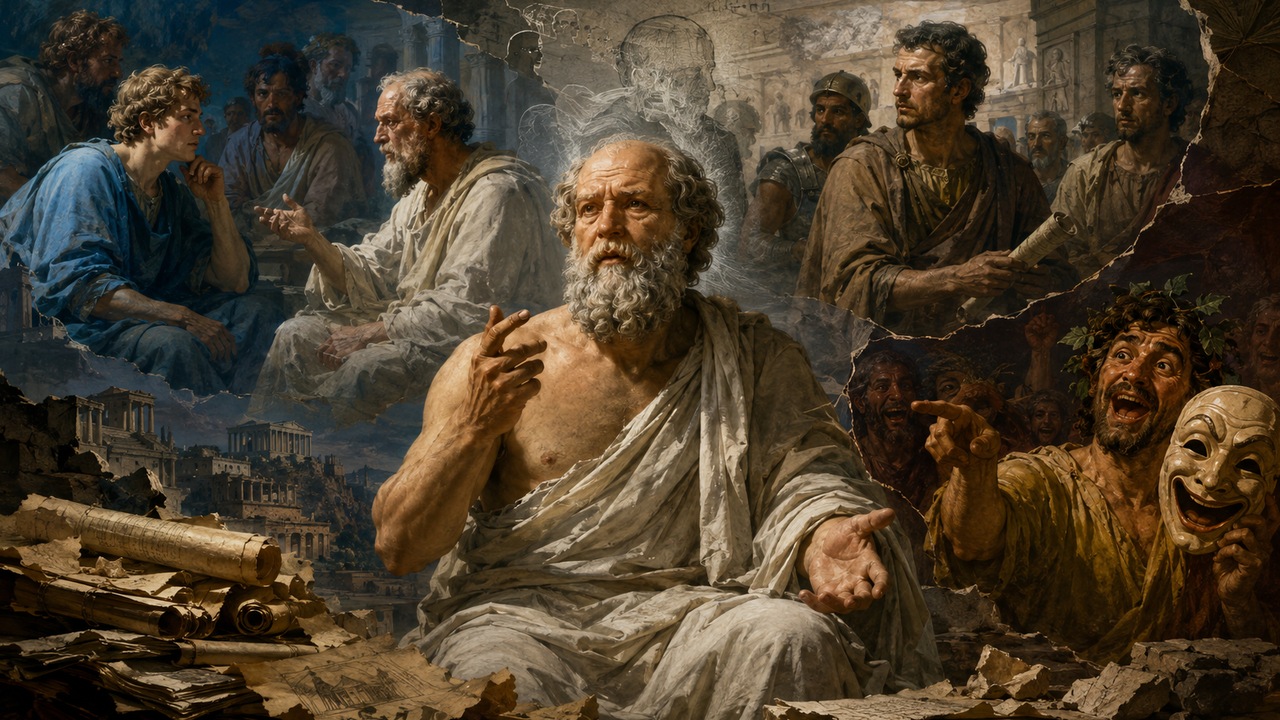
There is no notebook of Socrates that we can use to check what he really defended. The Athenian philosopher who died in 399 BC did not leave a philosophical corpus of his own, and almost everything we associate with his thought comes through other people. This changes the question: instead of just asking “what did Socrates think?”, we need to ask “who says that Socrates thought this, in what kind of work and for what purpose?”.
This difficulty has a name: the Socratic problem. Plato, Xenophon and Aristophanes all knew the same man, but produced very different portraits. One transforms Socrates into the great interlocutor of philosophical dialogues; another presents him as a moral, practical and disciplined advisor; the third turns him into a comedy character, associated with the new Athenian intelligentsia. None of these texts are neutral recordings of actual conversations.
The first caution: “Socrates wrote nothing” is a useful simplification
The central point is correct: we do not have treaties, dialogues or philosophical expositions written by Socrates. The tradition that has come down to us is therefore indirect. There is even a small literary complication. In the Phaedo, Plato has Socrates, already in prison, talking about a hymn to Apollo and Aesop's fables that he would have versified. Even if we accept this information, it does not create a Socratic philosophical work capable of solving the problem. What is missing is precisely a text in which Socrates presents his ideas and methods on his own.
This absence matters because ancient authors did not separate biography, philosophy,
memory and literary construction as a modern historian would try to do. The so-called Socratic speeches or dialogues formed a genre of their own. Several followers of Socrates wrote works of this type, but most of them have been lost. Plato and Xenophon survived to a large extent; other authors known only from fragments show that the dispute over who Socrates was began shortly after his death.
What, after all, is the Socratic problem?
The Socratic problem is the difficulty of distinguishing the historical Socrates from the “Socrates” constructed by different authors. It is not born just because texts from the philosopher himself are missing. It was born because the main sources disagree on important points and belong to genres with different objectives.
An old and tempting solution would be to look only for what Plato, Xenophon and Aristophanes have in common and call that nucleus historical. The method seems safe, but it produces little: the three sources rarely describe the same scene or emphasize the same features. Furthermore, coincidence does not prove independence. Authors can share traditions, respond to each other, or select different aspects of a well-known public figure.
For this reason, today it is more prudent to speak in degrees of confidence. Some facts and traits appear with relatively strong support; others depend almost entirely on one author; and certain doctrines attributed to “Plato's Socrates” may reflect Platonic philosophy rather than a teaching by the historical master.
Aristophanes: the oldest and most inconvenient source
The Clouds, by Aristophanes, was performed in 423 BC, about twenty-four years before Socrates' death. It is the oldest preserved source to make him a prominent character. This gives him a unique advantage: Aristophanes could portray a Socrates still in full public life, before Plato and Xenophon were of the age at which they would become his followers.
But the advantage comes with an obvious problem. The Clouds is a comedy. His Socrates directs a kind of school of thinkers, investigates natural phenomena, appears linked to arguments capable of turning the worst reasoning into the best and participates in a satire on education, religion and customs. The aim is to provoke laughter and social criticism, not to preserve a biographical transcript.
This does not make Aristophanes useless. On the contrary, caricature only works if the audience recognizes something. Socrates must have already been a well-known figure for his appearance, his habits, and his association with an intellectual type of life to work on the stage. The play is also important because Plato's Socrates himself, in the Apology, complains about the ancient accusations that made him seem like an investigator of the things of heaven and earth and explicitly mentions Aristophanes' comedy.
The best way to use The Clouds, therefore, is not to ask whether every detail is true. It is to ask what public reputation could be attached to Socrates in Athens and why he served as a comic symbol of the “new learning”. The play is strong as evidence of Socrates' social image and weak as a literal catalog of his doctrines.
Xenophon: the Socrates who needs to be defended
Xenophon offers a very different portrait. At the beginning of the Memoirables, he starts directly from the accusations against Socrates and tries to show that they did not fit with his life. It describes a man who conversed in public spaces, was concerned with behavior, discipline and practical usefulness, and sought to improve those around him.
This Socrates is less dizzyingly philosophical than that of many Platonic dialogues. It talks about self-control, friendship, household management, leadership, piety and concrete decisions. In Xenophon, Socratic philosophy appears strongly linked to a way of living and a moral formation applicable to everyday life.
For a long time, this led interpreters to treat Xenophon as a simple witness: as he was also a historian, he would seem more reliable than Plato in recovering facts. The conclusion is excessive. Xenophon's Socratic writings are also literary works and have an apologetic intention. He wants to defend the memory of Socrates and show its usefulness. There is no reason to assume that the narrative criteria of his military stories are automatically the same as those of his Socratic scenes.
Still, Xenophon is indispensable because he prevents Plato from monopolizing the figure of Socrates. When the two authors converge on a general habit or trait, confidence increases. When they diverge, the divergence is information: it shows that “the Socrates” of tradition was already the result of selection and interpretation.
Plato: the richest source and also the biggest trap
Plato is the main reason why Socrates became a central figure in the history of philosophy. In a large part of his dialogues, Socrates is the character who questions, refutes, leads reasoning and forces his interlocutors to explain what they think. Without Plato, we would know much less about the intellectual power attributed to this way of talking.
The problem is that the dialogues are not minutes. Plato composes scenes, chooses characters, organizes arguments and puts speeches into the mouths of real people. The fact that he reconstructed many Athenian names, relationships and places with great precision does not mean that he literally reproduced opinions and conversations.
The Apology deserves special attention because it dramatizes a concrete event: the trial of 399 BC. In it, Socrates explains his reputation, responds to the ancient images of naturalist and sophist, describes his practice of examining people considered wise and presents philosophical activity as a mission that he would not abandon. For being linked to
a specific historical episode, the work is often treated as one of the best windows into the historical Socrates. Still, it remains a composition by Plato, not an official court transcript.
Another difficulty appears when we compare the dialogues themselves. The Socrates who merely questions and ends without a positive doctrine is not always the same character who, in other works, participates in more elaborate theories about the soul, knowledge or Forms. For a long time, an influential strategy was to consider the “early” dialogues closer to the historical Socrates and the “middle” and “late” ones more representative of Plato's philosophy. This division remains useful as a reading hypothesis, but does not definitively resolve the problem. The exact chronology of the dialogues and the boundary between the character's voice and the author's thoughts are discussed.
Aristotle helps, but does not work as an eyewitness
Aristotle was born in 384 BC, fifteen years after the death of Socrates. He couldn't meet him in person. Its importance lies in another point: when writing about the history of philosophy, it distinguishes certain Socratic practices from Platonic developments.
In Metaphysics, Aristotle associates Socrates with ethical investigation, the search for universal definitions and the use of arguments that he calls inductive. It also states that Socrates did not separate universals and definitions as independent entities, whereas Plato would have taken this step with the theory of Forms. If this distinction preserves a reliable tradition of the Academy, it is valuable precisely because it offers an ancient criterion for not placing all Platonic metaphysics in the account of Socrates.
But Aristotle also has a clear limit: much of what he knew about Socrates probably circulated in the environment of Plato and his followers. He is a later source, useful for comparison and history of ideas, not a fourth in-person witness who can break the tie between Plato, Xenophon and Aristophanes.
What can we rebuild more safely
Socrates was above all an oral and public presence
Plato and Xenophon converge in presenting Socrates as someone who practiced philosophy by talking. Xenophon places it in public promenades, gymnasiums and the agora; the Platonic dialogues repeatedly place him in situations of encounter and questioning. Even the caricature of Aristophanes depends on the image of a man recognizable by his intellectual activity in front of others. This makes it very plausible that the oral, interpersonal and public character was a real part of his practice.
The examination of moral concepts belongs to the most plausible core
The search for definitions of courage, justice, piety, virtue and other ethical notions appears prominently in the Platonic tradition and matches the later testimony of Aristotle, who presents Socrates as focused on ethical issues and definitions. Xenophon, although less abstract, also portrays conversations focused on conduct and moral improvement.
This does not mean that we can transform every argument in a dialogue into “Socrates’ doctrine”. The safest level is the general method of putting beliefs to the test, asking for explanations and relating the investigation to the way of living. The more specific and systematic the thesis, the greater the need to ask whether we are reading Socrates, Plato, or a combination of the two.
Reputation for intellectual nuisance is historically strong
Aristophanes places him at the center of a satire on education and new ideas; Plato has Socrates link his public hostility to his habit of examining people who thought themselves wise; Xenophon feels the need to defend him from the accusations. The three authors disagree about the meaning of this discomfort, but implicitly agree that it existed. Socrates was not remembered as a discreet and consensual teacher.
What we cannot say with the same certainty
It is not safe to treat Plato's dialogues as a word-for-word record. It is also not safe to assume that every theory defended by a character named Socrates belongs to the historical Socrates. The theory of Forms is the classic example of the problem: Aristotle associates it with Plato's development and distinguishes this metaphysical separation from the Socratic search for definitions.
It is also risky to transform the so-called “Socratic method” into a unique, rigid technique codified by its author. The dialogues show different strategies: short questions, refutations, analogies, hypotheses, narratives and positive arguments. The unity is more in the commitment to the rational examination of what someone claims to know than in a fixed recipe of steps.
Even popular phrases require caution. The formula “I only know that I know nothing” is a later condensation of an attitude present in the Apology, not a sentence that we should automatically treat as a literal quote from Socrates. The difference seems small, but it sums up the whole problem: even the most famous phrase comes to us filtered through texts and traditions.
How to read any statement about “Socrates’ thought”
First, identify the source
When a page says “Socrates believed that...”, the next question should be: according to whom? If the basis is a dialogue by Plato, it is necessary to know which dialogue and in what context. If it is Xenophon, it is worth noting the apologetic and practical nature of the portrait. If it is Aristophanes, we are faced with comedy and caricature. If it is Aristotle, it is a later evaluation.
Then consider the author's genre and interest
A comedy exaggerates for effect. A defense of a master's memory selects favorable material. A philosophical dialogue can use historical characters to investigate problems that go beyond biography. None of these characteristics eliminate the source; they tell you how the font should be read.
Finally, look for convergence without demanding unanimity
When independent or partially independent authors point to the same general trait, the reconstruction gains strength. When there is disagreement, the solution is not to automatically choose the preferred author. It is about preserving the difference and adjusting the degree of certainty. Reconstructing Socrates is a work of triangulation, not transcription.
So do we know what Socrates thought?
We know something, but not in the way we know what Plato or Aristotle wrote. About these authors, we can return to the text of their own work. About Sócrates, we work with testimonies, characters, memories and interpretations.
The most solid result is not a complete philosophical system with indisputable authorship. It's a high-probability historical profile: an Athenian who made conversation and questioning a public practice, focused much of his attention on problems of conduct and virtue, became a provocative intellectual presence, and was remembered by disciples and adversaries in incompatible ways precisely because his philosophical life made a strong impression.
The Socratic problem is not a flaw that some researcher has yet to fix. It is the condition of the surviving evidence. Plato, Xenophon and Aristophanes are not transparent windows into the same man; there are three angles. The better we distinguish these angles, the more precise the little - but significant - we can say about the historical Socrates becomes.