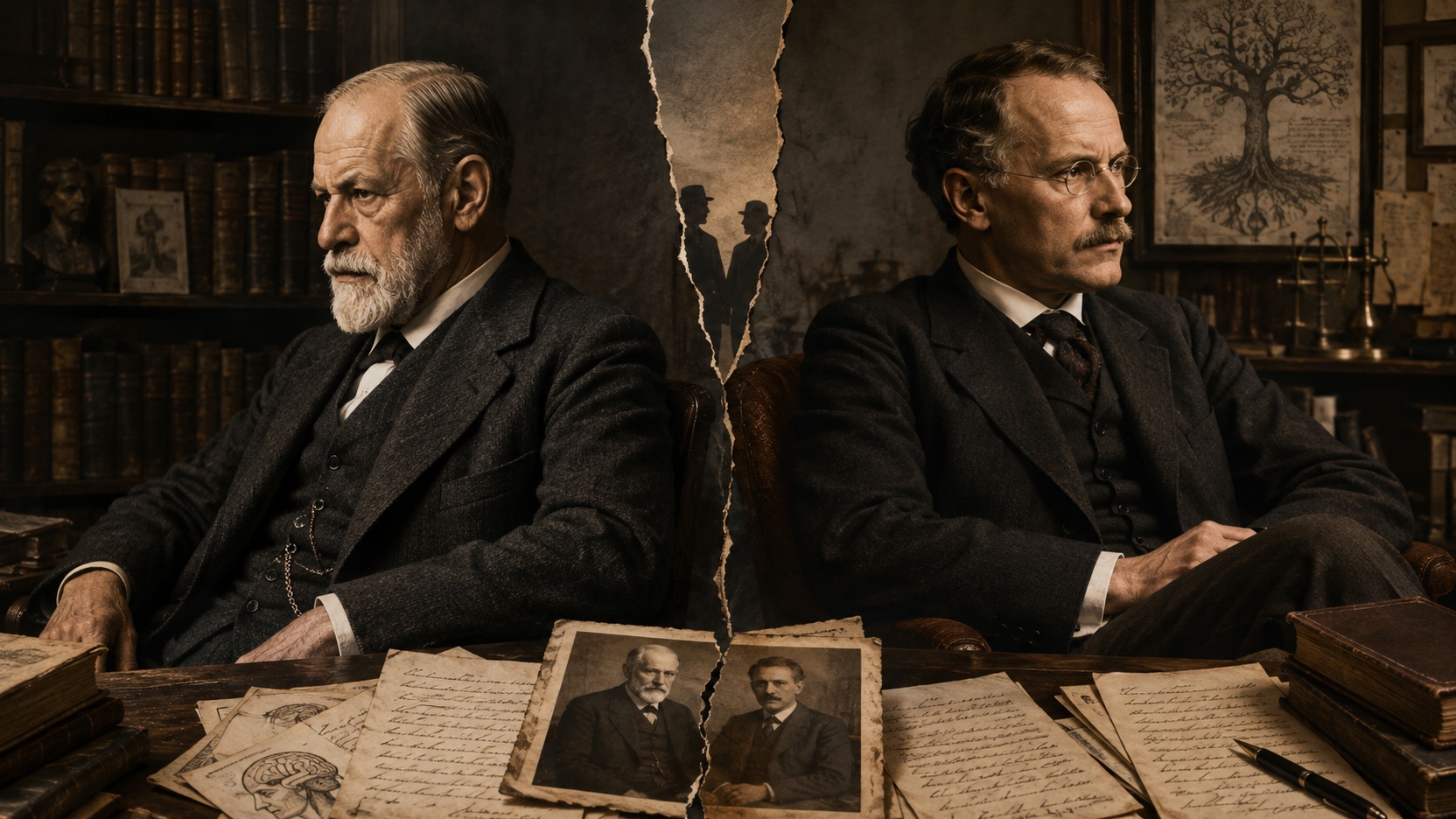
Freud and Jung broke up because a theoretical divergence that seemed manageable turned, between 1911 and 1913, into an incompatibility over what could still be called psychoanalysis. Libido was the most visible point: Freud defended the centrality of sexuality and its destiny in explaining neuroses, while Jung began to expand libido to a more general psychic energy. Around this difference, disagreements grew about incest, symbolism, myth, religion, repression and the way to interpret the unconscious. The letters show that the scientific discussion has also become a crisis of trust and authority. The personal relationship was practically severed in January 1913; the editorial separation advanced at the end of that year and Jung's institutional departure from the International Psychoanalytic Association was only completed in 1914.
Before the rupture, there was a very strong alliance
History is often summarized as a duel between two rival systems, but this framing hides how much Freud and Jung worked together before becoming adversaries. They began exchanging publications and correspondence in 1906. On March 3, 1907, they met in person in Vienna. Their first meeting was famous for the long conversation, lasting about thirteen hours, in Freud's office.
Jung was not just another enthusiastic reader. He worked at Burghölzli, the important psychiatric hospital in Zurich run by Eugen Bleuler, and had been applying methods of association and interpretation to patients with dementia praecox, a diagnosis that would soon be reformulated in the field of schizophrenia. For Freud, approaching the Swiss group meant an opportunity to take psychoanalysis beyond the small Viennese circle and bring it closer to university psychiatry.
Freud publicly acknowledged this role. In his 1914 account of the history of the psychoanalytic movement, written after the rupture, he recalled that cooperation between
Vienna and Zurich expressed themselves in the Jahrbuch für psychoanalytische und psychopathologische Forschungen, a periodical launched in 1909 and edited by Jung. Even in a strongly controversial text against his former collaborator, Freud still admitted the importance of Jung and Bleuler for the initial expansion of psychoanalysis.
The partnership also gained an international showcase in 1909, when Freud and Jung traveled to the United States for the celebrations at Clark University, in Worcester, accompanied by Sándor Ferenczi. The trip consolidated the image of an expanding movement and of Jung as one of its central names.
1910 elevated Jung from collaborator to institutional heir
The official founding of the International Psychoanalytical Association, the IPA, in Nuremberg, in 1910, increased the weight of the relationship. Jung was elected the first president of the new association. The choice had scientific, political and symbolic value: he represented a Swiss aspect with psychiatric insertion and helped to project the movement beyond Vienna.
This leadership position also made it more difficult to treat future disagreements as simple disagreements between colleagues. When the first president of the international organization began to reformulate concepts that Freud considered fundamental, the discussion began to involve the very identity of psychoanalysis.
Hence the question "why did Freud and Jung break up?" It can't be solved just by looking at temperaments. The theoretical conflict had institutional consequences because Jung was not a peripheral disciple. He held a central position, edited one of the movement's main publications and was seen as someone capable of leading psychoanalysis to a next generation.
The decisive divergence: what the word libido should mean
For Freud, sexuality was not a replaceable detail
In the Freudian theory of that period, libido was linked to the energy of sexual drives and the paths that this energy took, finding satisfaction, repression, fixation, displacement or sublimation. Freud could and did revise aspects of his own theory many times, but he did not treat infantile sexuality and sexual libido as optional pieces that could be removed without altering the entire edifice.
His 1914 text makes this very clear. When explaining why he no longer recognized the Zurich school as a legitimate continuation of psychoanalysis, Freud accused Jung of replacing sexual libido with an abstract notion. He also related the divergence to themes such as repression, dream interpretation, family complexes and the way of understanding the unconscious. It is important to read this document as Freud's position after the breakup, not as a neutral description shared by both sides. Still, it shows precisely what Freud thought was at stake.
For Jung, libido needed to be broader
Jung walked in another direction. In Transformations and Symbols of the Libido, published in parts in 1911 and 1912 and later extensively revised, he expanded the scope of the libido beyond sexual energy. The formulation came closer to a general psychic energy, capable of appearing in different interests, images, symbols and forms of adaptation.
This change was not a simple exchange of vocabulary. If psychic energy could assume a broader meaning from the beginning, the explanatory role of sexuality would be downgraded. Freud saw this as a renunciation of one of the findings that distinguished psychoanalysis from other psychologies. Jung saw amplification as necessary to explain phenomena that, in his assessment, did not adequately fit into a sexual-centered reading.
The letters show that they both knew the matter was explosive. In June 1912, Freud wrote to Jung specifically about the "libido question", signaling that the nature of the change still needed to be clarified. In August, Jung registered by letter that he did not agree with the theoretical position related to the problem of incest and returned to the idea of libido regression. The divergence was no longer hidden in side notes: it was an explicit theme of the correspondence.
Incest, myth and religion widened the gap
The conflict over libido was connected to another difference: how to interpret images and narratives that appear sexual, familial, or incestuous. Freud insisted that sexual and family complexes had psychic reality and a causal function in neurotic conflict, even when they appeared transformed by symbols. Jung began to explore the mythological and symbolic dimension of these images with greater autonomy.
In Transformations and symbols of the libido, myths, heroic figures, religious images and cultural materials do not appear just as ornaments. They participate in an attempt to understand broader patterns of transformation of psychic life. The Library of Congress summarizes one of the book's intentions as an effort to expand libido to expressions of psychic energy that are not limited to the sexual drive.
Freud interpreted this expansion critically. In 1914, he argued that Jung's school removed sexual content from family complexes to make it compatible with ethical and religious interests. The formulation is clearly combative and must be attributed to Freud, but it helps to understand why he considered the change to be more serious than a terminological dispute.
Reducing the rupture to the phrase "Freud thought about sex and Jung about spirituality", however, impoverishes the debate. The real difference was methodological and theoretical: what weight to give to sexuality, how to explain psychic energy, how to relate present and childhood, and what status to grant to symbols and myths in the interpretation of the unconscious.
The letters show when the conflict stopped being just theoretical
December 1912: trust was already broken
On December 18, 1912, Jung wrote a harsh letter to Freud. The document, preserved and displayed by the Library of Congress, is treated by the institution as evidence that the relationship had reached a point where separation was imminent. Jung criticized the way Freud dealt with patients and disciples, and the discussion was no longer just about concepts.
This moment is important because it prevents two opposite simplifications. The first would be to say that everything ended because of an abstract theory of libido. The second would be to explain the breakup solely by personal resentment. The letters show the two layers interacting: doctrinal disagreement, intellectual authority, and deteriorating trust.
January 1913: Freud ends the personal relationship
The clearest turnaround came in January. A letter from Freud dated January 3, 1913 effectively severed the friendship. On January 6, Jung responded by accepting his desire to abandon personal relationships. From then on, there were still editorial and institutional issues to resolve, but the bond of friendship and intimate collaboration was broken.
That is why 1913 is the most appropriate date to mark the end of the intellectual partnership. Not because all positions were abandoned at that moment, but because the correspondence made it clear that the personal trust that sustained the collaboration no longer existed.
October 1913: the break reaches the Jahrbuch
The separation continued to have effects throughout the year. In September 1913, Jung presided over the international congress in Munich and was re-elected president of the IPA. The institutional appearance of continuity, however, hid a deeply divided movement.
On October 27, Jung wrote to Freud after learning that his good faith was being questioned and announced that he would step down as editor of Jahrbuch. The gesture affected precisely one of the structures that, since 1909, had symbolized the collaboration between Vienna and Zurich. The editorial partnership ended after the friendship.
1913 was the break; 1914 completed institutional separation
To say that Freud and Jung "broke in 1913" is correct if we are talking about their personal relationship and intellectual partnership. But the institutional shutdown was slower. Jung remained president of the IPA for a few months, a position to which he had been re-elected at the Munich congress.
In April 1914, he resigned as president of the association. In August, he also left his membership status. Thus, the rupture occurred in stages: first trust and personal collaboration, then the editorial bond and, finally, the formal position within the international psychoanalytic organization.
This chronology also explains why different sources seem to give different dates for the "end". They may be talking about different events. January 1913 marks the personal break; October 1913, the editorial break; April and August 1914, the institutional shutdown.
What really separated them
Libido no longer has the same meaning
This is the most documentable axis. Freud considered sexuality and sexual libido fundamental to explaining neuroses and unconscious conflicts. Jung began to work with a broader energetic conception. The dispute appears in works and letters from 1912.
Childhood sexuality and family complexes lost the same weight for Jung
Jung did not simply erase sexuality or incest from his analyses, but he refused that they function in the same way and with the same theoretical centrality defended by Freud. For Freud, this reformulation diminished precisely the core that made psychoanalysis a specific theory.
Symbols and myths gained explanatory autonomy
Jung began to treat mythological and religious materials as important components for understanding transformations of the psyche. Freud also worked with myth, culture and religion, but continued to link these materials to his instinctual model and sexual and family complexes. The disagreement, therefore, was not about whether or not to use myths, but about the role they should play in the theory.
The authority to define "psychoanalysis" became part of the conflict
The dispute was also institutional. Freud had created the field and understood that some theses were constitutive of psychoanalysis. Jung, when modifying them, still intended to dialogue with the movement and occupied central positions. Freud ended up drawing a line: Jung's reformulations could be a new psychology, but they should not continue to be presented as the same psychoanalysis.
This point helps to understand why the breakup was so difficult. They weren't just disagreeing about a hypothesis. They were disputing the continuity, name and direction of a scientific movement in formation.
What should not be projected backwards
Today, Jung is remembered for concepts such as archetypes, collective unconscious, individuation and psychological types. It is tempting to imagine that Freud and Jung were already discussing in 1912 with all these mature systems perfectly delineated. Chronology does not support this image.
The Library of Congress itself notes that Jung later related Transformations and symbols of the libido to the discovery of the collective unconscious, but that the term came later. This means that the break opened space for the further development of analytical psychology; does not mean that the entire mature Jungian theory was already ready and was the direct cause of the separation.
The same care applies to biographical explanations that diagnose a long-distance relationship. The pair has been described countless times in terms of father and son, rebellious successor, father complex, rivalry or transference. These readings can be useful as interpretations, especially in a field that has taken relational dynamics seriously. But they do not replace documents. When the question is why they broke up, letters, books, editorials, and positions offer a more verifiable basis than turning each personal episode into definitive psychological proof.
Freud's 1914 text is a source and also part of the dispute
Shortly after the institutional separation, Freud published The History of the Psychoanalytic Movement. The essay is indispensable because it records its own version of the growth of psychoanalysis and its ruptures with Alfred Adler and Carl Jung. At the same time, it is not a neutral act: Freud wrote it to demarcate theoretical boundaries and defend what he considered the legitimate identity of psychoanalysis.
For this reason, this text is most valuable when read together with Jung's correspondence and publications. Freud shows what he considered non-negotiable; Jung shows, in his own texts, the direction he was taking; the letters show when the theoretical difference became a personal rupture.
This combination avoids a frequent mistake: choosing the later memory of just one of the two and transforming it into a complete explanation.
After Freud, Jung did not simply return to the previous point
The separation allowed Jung to develop his own school, analytical psychology. In the following years, he would deepen concepts that are now associated with his name and move even further away from the Freudian framework. Freud, in turn, would continue to revise his theory of libido, narcissism, drives and psychic structure without abandoning the constitutive importance of sexuality and unconscious conflict.
This also corrects another caricature: that Freud stood still while Jung innovated. The two continued to change. What was broken was the possibility of making these changes within the same theoretical language and the same institutional structure.
So why did Freud and Jung break up?
The most solid answer is that the rupture resulted from the convergence of three processes. First, Jung reformulated libido in ways that Freud judged incompatible with the centrality of sexuality in psychoanalysis. Second, this change was accompanied by differences about incest, repression, symbolism, myth, religion, and the function of family complexes. Third, the theoretical discussion was mixed with a crisis of confidence and authority, visible in the letters of December 1912 and January 1913.
There is no need to choose between “it was personal” and “it was theoretical”. The documentation shows that it was both, at different levels. The theory explains why disagreement mattered so much; the personal relationship explains why it is no longer negotiable; positions and publications
show how the conflict turned into an institutional division.
In 1913, the partnership that had helped to internationalize psychoanalysis ended. In 1914, administrative separation was completed. After that, Freud and Jung continued to influence psychology in different ways, and the rupture itself became part of the history of both traditions.