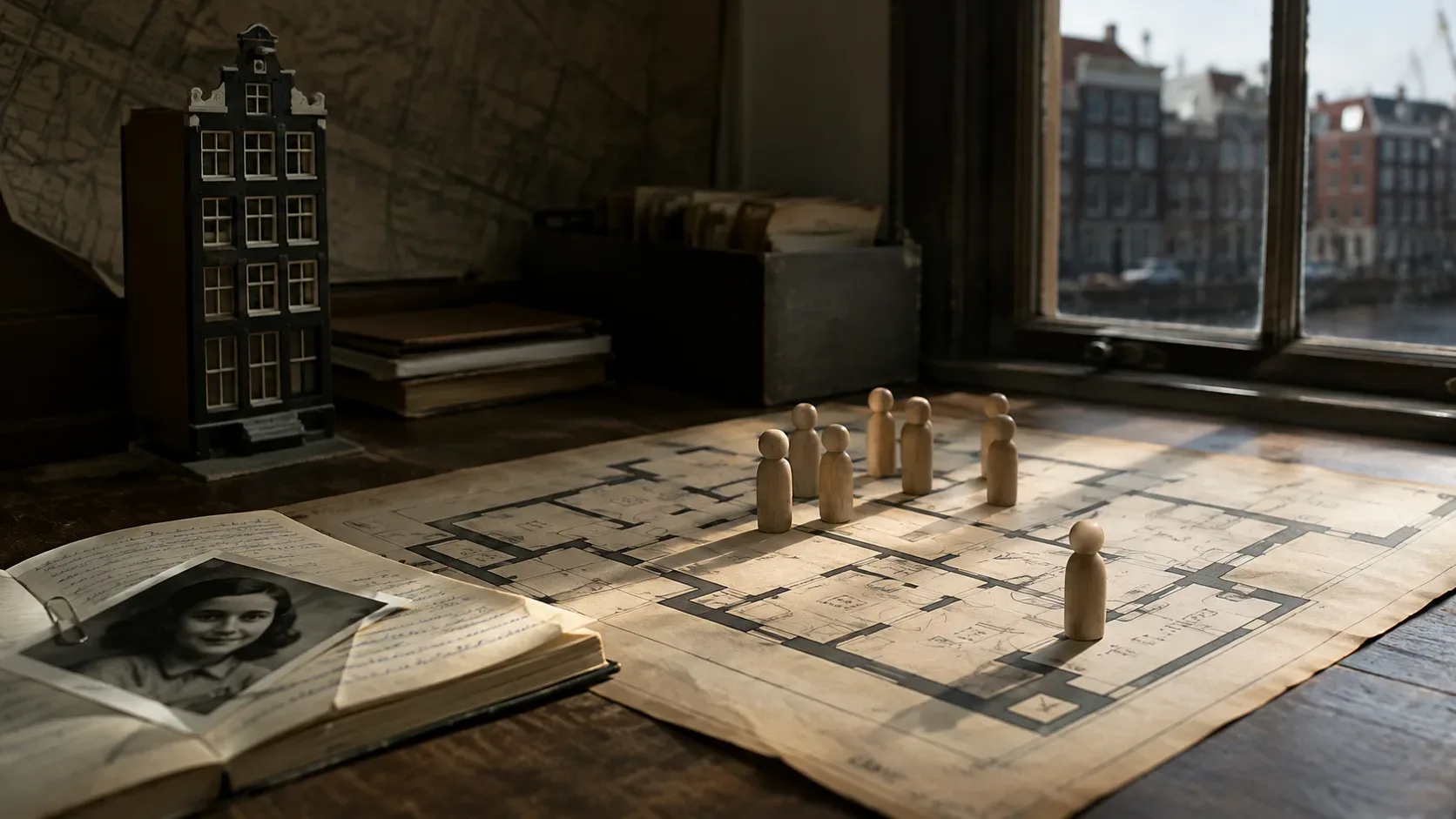
On August 4, 2026, it will be 82 years since the imprisonment of Anne Frank and the other seven people who lived hidden at number 263 Prinsengracht Street, in Amsterdam. It is possible to reconstruct much of that morning: the approximate time of the police officers' arrival, the agents identified, the route taken inside the building and the immediate destination of the prisoners.
The question that has spanned the decades — who denounced Anne Frank? — does not, however, have a proven answer. It has not even been demonstrated that a deliberate tip-off led to the operation. The Anne Frank House claims that no official document from the prison was preserved and that the different scenarios depend mainly on later testimonies, some of which are contradictory.
This distinction is essential. The arrest is a documented fact. The complaint is a hypothesis. The identity of a possible informant remains unknown.
What happened on August 4, 1944
Friday, August 4, 1944, was Anne Frank's 761st day in the Secret Annex. She and her family had been hiding there since July 6, 1942. Between approximately 10:30 am and 11 am, a team linked to the German security police arrived at the building at Prinsengracht 263. The operation was commanded by the Austrian Karl Josef Silberbauer and included at least two Dutch police officers later identified: Gezinus Gringhuis and Willem Grootendorst. The total number of participants remains uncertain.
In the ground floor storage room, the agents spoke to employee Willem van Maaren, who directed them to the office floor. The current reconstruction of the Anne Frank House states that there is no indication that Van Maaren or the other warehouse workers knew of the presence of those in hiding. At the office, the police interrogated Victor Kugler, one of the company's directors and one of the group's assistants, and took him during the search of the building.
The agents arrived at the landing where a revolving bookcase hid the entrance to the annex. Later testimony differs on how much they already knew. Kugler testified that he tried to delay the search, but also said that the officers “knew.” The absence of a contemporary record prevents determining whether they knew the exact location or found the passage while searching the building.
Upstairs, Otto Frank helped Peter van Pels with his studies. According to Otto's recollection, a man entered the room with a gun and ordered the residents to come down. The hidden eight were reunited: Otto, Edith, Margot and Anne Frank; Hermann, Auguste and Peter van Pels; and Fritz Pfeffer.
Silberbauer emptied Otto's briefcase to store money and valuables. Anne's notebooks and papers, which were inside her, fell to the floor. This seemingly secondary gesture helped preserve the diary: the agents took the folder but left the writings behind.
At around 1 pm, after more than two hours of operation, the eight residents and helpers Johannes Kleiman and Victor Kugler were taken away. Miep Gies and Bep Voskuijl were not arrested. Later, they entered the empty annex, collected the scattered notebooks and sheets, and put them away in hopes of returning them to Anne.
Timeline of the last days in hiding
| Date and time | What can be stated |
|---|---|
| August 1, 1944 | Anne wrote her last known diary entry, three days before her arrest. |
| August 2 and 3 | There is no equivalent daily report that allows us to reconstruct these two days in detail. The absence of a record does not prove that anything unusual happened. |
| August 4th, between 10:30 am and 11 am | The police team entered number 263 Prinsengracht and began the search. |
| Late morning | The police arrived at the revolving bookshelf, entered the Secret Annex and gathered the eight residents. |
| Around 1pm | The hidden eight, Kleiman and Kugler were placed in a vehicle and driven to the security service headquarters on Euterpestraat. The exact type of vehicle is discussed in the testimonials. |
| Afternoon of August 4th | Miep Gies and Bep Voskuijl collected Anne's papers that had been left in the annex. |
| August 5 | The eight were transferred to the Weteringschans detention center; Kleiman and Kugler were trapped in another establishment. |
| August 8 | The eight residents of the annex were sent to the Westerbork transit camp. |
| September 3 | They were deported on the last train that left Westerbork for Auschwitz. Only Otto Frank would survive the war. |
The helpers who supported the Secret Annex
The Anne Frank House knowledge base identifies six helpers: Miep and Jan Gies, Johannes Kleiman, Victor Kugler, Bep Voskuijl and Johan Voskuijl. They did not perform the same tasks, but formed a network that provided food, distribution coupons, books, information, money and administrative protection.
| Helper | Documented participation |
|---|---|
| Miep Gies | He bought food, took books and maintained daily contact with those in hiding. After his arrest, he kept Anne's writings and went to the security service headquarters in an unsuccessful attempt to help the detainees. |
| Jan Gies | Provided books and coupons, attended lunches in the annex, and helped protect businesses against anti-Jewish measures. He arrived for lunch during the operation and was warned by Miep. Afterwards, he watched the prisoners leave from afar. |
| Bep Voskuijl | I took bread, milk and materials for correspondence courses. During the operation, he managed to leave the building with Kleiman's wallet and, later, helped collect Anne's writings. |
| Johannes Kleiman | He participated in the preparation of the hideout and was the main contact in emergency situations. He was arrested on August 4, refused to give other addresses and was eventually released due to health problems. |
| Victor Kugler | He administered part of the companies, helped to obtain resources and suggested hiding the entrance with a revolving bookshelf. He was arrested, sent to Amersfoort and escaped during a transfer in March 1945. |
| Johan Voskuijl | Bep's father and warehouse manager, he was the only worker in that area who knew about the hiding place. He was the one who built the rotating bookcase that disguised the entrance. |
The exclusive focus on uncovering a whistleblower often leaves this network in the background. For more than two years, the helpers needed to keep companies running, justify purchases, obtain rationed food and prevent employees, neighbors and authorities from noticing unusual movements.
Who denounced Anne Frank: documented, hypothesis or unknown?
| Question | Classification | What the evidence allows us to say |
|---|---|---|
| Did the arrest take place on August 4, 1944? | Documented | The date is confirmed by the testimonies of Otto Frank and his assistants and by later documents, although there is no official record preserved of the operation. |
| Who commanded the operation? | Documented | Karl Silberbauer led the team; Gringhuis and Grootendorst are among the Dutch police officers identified. |
| Was there a phone call reporting those in hiding? | Hypothesis | The story derives mainly from late and inconsistent statements by Silberbauer. No record, recording or contemporaneous notes of the alleged call were preserved. |
| Did the team already know where the bookshelf was? | Unknown | Some testimony suggests that the agents were well informed; other details indicate that the operation was improvised. |
| Did the operation investigate coupon fraud or clandestine work? | Hypothesis | The 2016 search found circumstances consistent with this scenario, but stated there was no primary source proving this was the reason for the search. |
| Has a whistleblower been conclusively identified? | Unknown | None of the people accused over the decades has been linked to arrest by a conclusive body of evidence. |
| Was Arnold van den Bergh the whistleblower? | Accusation refuted | The hypothesis presented in 2022 was contested by historians and rejected by the Anne Frank House. In January 2026, Amsterdam City Council declared that he had been unfairly accused. |
Where did the anonymous tip story come from
The most repeated version says that, on the morning of August 4, someone called the security service and reported that there were Jews hiding at 263 Prinsengracht. Reports of this type actually occurred during the occupation. The problem is turning a common practice into proof that it occurred exactly this way in the case of the Secret Annex.
The history of the call depends mainly on statements by Karl Silberbauer made almost twenty years later. In August 1963, he mentioned an alleged phone call from a Dutch man. Months later, he stated that he did not know the person's nationality. On other occasions, he was uncertain about the call and the origin of the information. His superior Julius Dettmann, who allegedly received the complaint, died in 1945 without being questioned about the case.
No telephone records or operational notes were found to confirm the call. Furthermore, much of Amsterdam's private telephone lines had been disconnected in 1944, although this did not make a call impossible. What the telephone limitation does is weaken the image that any citizen could simply call a public SD number and provoke immediate action.
The prudent formulation, therefore, is not “an anonymous whistleblower called”, but: Silberbauer later stated that there may have been a call, without the existence, authorship or direct relationship of this call to the operation having been proven.
The hypothesis of coupons and illegal work
In 2016, the Anne Frank House reformulated the survey question. Instead of starting with “who betrayed?”, he asked: based on what information did the security service decide to search the building?
The study found evidence that clandestine activities also occurred in companies located at the address. There was irregular trade in ration coupons and protection for workers trying to avoid being sent to forced labor in Germany. Anne's diary mentions the arrest, in March 1944, of two men linked to the illegal supply of coupons. Some of the agents involved in the August operation had also worked in economic investigations.
This set opens up the possibility that the police went to the building to investigate another crime and found the annex during the search. But the report itself points out that there is no primary source stating that the August 4 operation was motivated by economic fraud, coupon trading or clandestine work. Accidental discovery is a plausible alternative, not a proven solution.
The accusation against Arnold van den Bergh and the 2026 correction
In January 2022, a group calling itself Cold Case Team presented Jewish notary Arnold van den Bergh as the likely person responsible for the complaint. The book associated with the investigation released an estimate of 85% to 87% probability, relying mainly on a typed copy of an anonymous note and the hypothesis that the Jewish Council had lists of hiding places. The original note was never found.
Historians contested the links in the argument: the existence and circulation of the supposed lists, the date of the note, the whereabouts of Van den Bergh and the interpretation of documents from the period. An academic report published in March 2022 concluded that the accusation was unsupported and that assumptions had been successively treated as facts. The Dutch publisher withdrew the book from circulation, and the Anne Frank House stated that Van den Bergh could not be charged based on the information available.
When part of the Cold Case Team archive was opened for consultation, experts invited by the Amsterdam Municipal Archive pointed out incomplete documents, problematic translations, discrepancies between reports and sources and gaps that prevent the entire research process from being reconstructed.
On January 13, 2026, Amsterdam City Hall went further: it officially stated that the book had unfairly accused Van den Bergh and announced measures aimed at his historical reparation. The update reinforces why titles that present his name as solving the mystery are outdated and factually inadequate.
Why there may never be a definitive answer
The difficulty does not arise from a lack of interest. Investigations were carried out shortly after the war, again after the location of Silberbauer in 1963 and in different historical projects in the following decades. The problem lies in the quality and survival of the evidence.
There is no contemporary arrest report that explains the origin of the order. The alleged phone call left no known record. Witnesses gave statements years or decades later, when the idea of betrayal was already consolidated in books, reports and adaptations. Some central people had died before they could be interrogated. Others remembered the number of police officers, the team's behavior and the transport used differently.
In light of this, “unknown” does not mean that any theory is valid. It means that a responsible conclusion must respect the file limits. A hypothesis can be coherent and still not be proven.
The most productive question is no longer just “who exposed Anne Frank?” and started to include others: why was that building chosen, what did the agents expect to find and what information did they have when they arrived? It is this change that allows us to investigate the story without fabricating a culprit to fill the documentary gap.
What remains indisputable is that eight people were persecuted for being Jewish, lived in hiding for more than two years and were imprisoned by a Nazi occupation structure supported by local collaborators. It is also documented that a network of helpers risked their own safety to support them and preserved the writings that would make Anne's voice known worldwide.
Save this chronology to consult when a new “definitive solution” for the case returns and receive new stories reconstructed from documents.