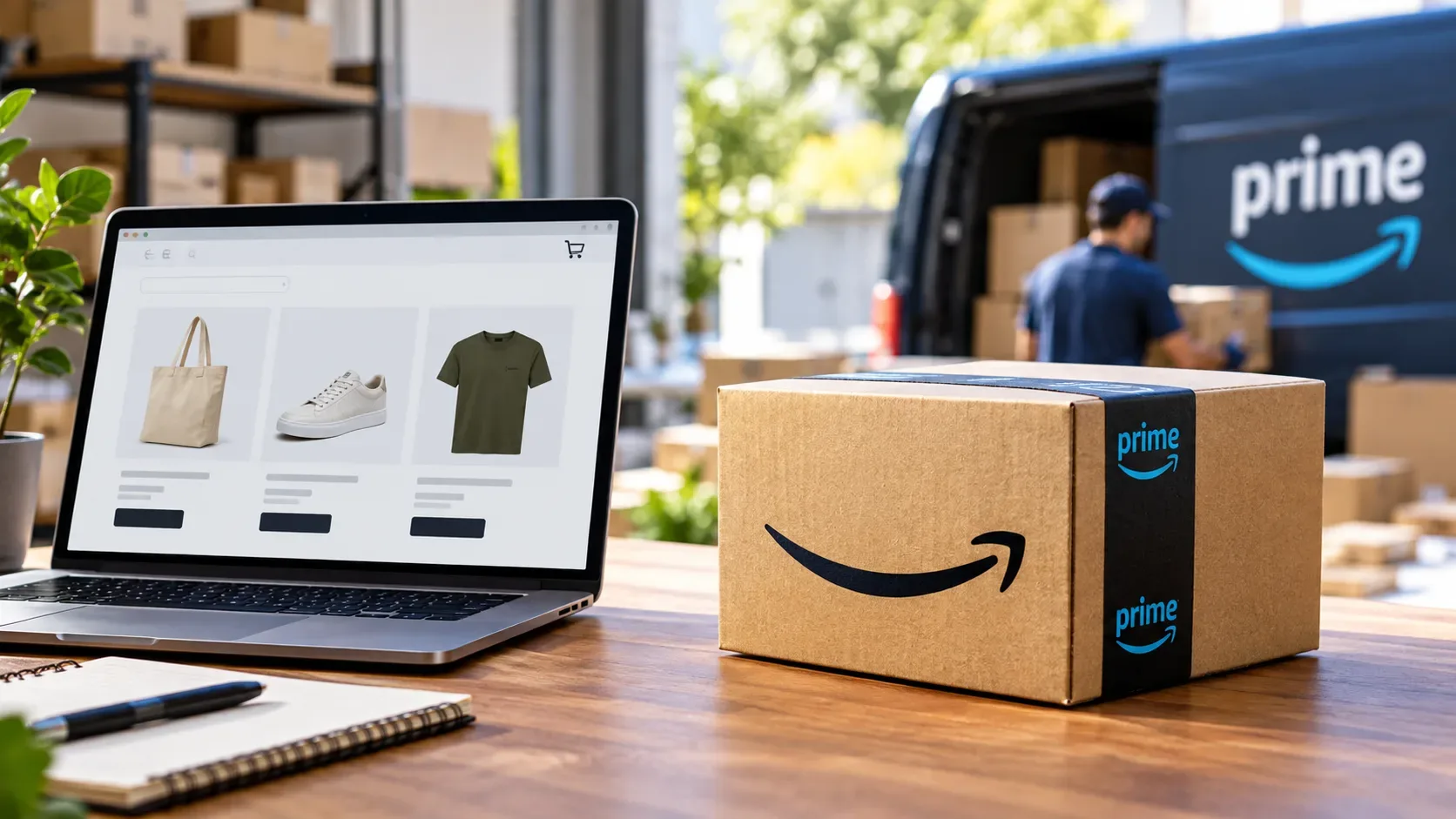
On September 24, 2026, Amazon announced a new way to offer Prime delivery on merchants' own websites in the United States. The feature is aimed at new or existing Multichannel Fulfillment, or MCF, merchants and lets them display the Prime badge and offer fast, free delivery to Prime customers without a separate feature fee beyond standard MCF charges. This is separate from MCF Preferred Pricing, a discount and credit program for eligible sellers.
Who can offer Prime delivery on their own website
According to Amazon's announcement, the new option is available to merchants selling in the United States that use Multichannel Fulfillment. Amazon Supply Chain Services customers can also enroll in MCF to use the option. MCF itself does not require every business to sell products on Amazon.com: Amazon's public documentation says the fulfillment service can also be used by businesses selling through other channels.
In practice, the core requirement is to have the operation connected to MCF and inventory that can be fulfilled through Amazon's logistics network. The September 24 announcement does not say that every online store in every country automatically receives the feature. The announced scope is the U.S. market.
How Prime delivery works on a merchant website
| Stage | What happens | Who keeps the customer relationship |
|---|---|---|
| Product page | The store can display the Prime badge on eligible items or flows. | The merchant keeps its own website and product presentation. |
| Delivery choice | The shopper selects Prime delivery as a shipping option. | Checkout remains on the merchant's site. |
| Verification | After the order is placed, Amazon checks whether the shopper has a Prime membership. | The merchant does not need to replace payment processing, order management, or store policies just to enable this delivery option. |
| Fulfillment | Amazon picks, packs, and ships the order from the merchant's inventory in the logistics network used by MCF. | Order confirmation and tracking come directly from the merchant. |
| Post-purchase | Under the announced MCF with Prime model, the merchant keeps its existing customer service and returns experience. | The merchant continues to manage those flows, unlike the broader Buy with Prime model. |
At launch, Amazon said merchants could enable the option through the Amazon MCF and Buy with Prime app for Shopify. The company also cited integration through the Selling Partner API and said options from partners such as Fulfil, LingXing, and WebBee were launching later.
What “at no additional cost” means
The phrase does not mean fulfillment is free for the merchant. It means Amazon did not announce a separate extra fee for adding the Prime delivery option beyond normal MCF charges.
MCF fees still apply. Amazon's public pricing page says fulfillment costs vary by product size, shipping weight, units per order, and delivery speed. The same page also lists discount programs and possible additional charges, so the final cost should be calculated using the current rate card and the merchant's actual order profile.
In other words, “free Prime delivery” describes the shipping benefit offered to an eligible Prime shopper. The merchant's operation remains subject to MCF fulfillment fees and applicable commercial terms.
Preferred Pricing is separate from Prime delivery
The September 24 announcement presented MCF Preferred Pricing as a separate offer. Amazon said Fulfillment by Amazon, or FBA, sellers can enroll in the program and save by combining a discount on MCF fulfillment fees with FBA credits for each unit shipped. The release described combined savings of 15% to 25% on fulfillment fees for the first six months, with no contracts or long-term commitments, one-click enrollment through Seller Central, and benefits applied automatically as eligible orders are shipped.
That percentage should not be read as a universal 25% discount on every order. Amazon's own wording describes a savings range and ties the benefit to program usage. In addition, the public MCF pricing page consulted on September 27, 2026 describes 2026 Preferred Pricing differently: up to 15% off MCF fulfillment fees plus up to a US$1 FBA credit per MCF unit shipped, for up to 12 months. The page also says terms and conditions apply.
Because the two official pages use different descriptions for the percentage and duration, the operational reference for a specific account should be the offer and eligibility criteria shown in Seller Central at the time of enrollment. The launch announcement explains what Amazon introduced, but it does not replace the current account-specific terms.
Prime delivery and fulfillment discounts do not have the same eligibility
| Feature | Audience described by Amazon | Main benefit | Important limit |
|---|---|---|---|
| Prime delivery on a merchant website via MCF | New and existing MCF merchants selling in the U.S., including ASCS customers that enroll in MCF. | Prime badge and fast, free delivery option for eligible Prime shoppers, with no separate feature fee beyond normal MCF charges. | It does not make merchant fulfillment free and it was not announced as a global offer. |
| MCF Preferred Pricing | Eligible sellers, with the September 24 announcement specifically highlighting FBA sellers. | Discounts on MCF fees and FBA credits under the program's terms. | The benefit varies and depends on eligibility, usage, and offer terms. It is not a fixed 25% reduction on every order. |
How to estimate the real cost before enabling it
- Calculate the base MCF fee. Use size, weight, units per order, and delivery speed with Amazon's current rate card and calculator.
- Separate the service fee from the shopper benefit. A Prime shopper may receive fast, free shipping, but the merchant still pays the applicable fulfillment charges.
- Check Preferred Pricing eligibility. If the account has access, review in Seller Central the discount, credit, unit limit, and time period actually offered to the business.
- Do not automatically add percentages. The launch announcement describes combined savings from a fee discount and FBA credits. That does not mean every MCF fee is reduced by 25% in a linear way.
- Consider the sales channel and post-purchase model. If the goal is to keep checkout, customer service, and returns under the merchant's control, MCF Prime delivery was presented with that continuity. If the business wants Amazon to manage more of the post-purchase experience, Buy with Prime is a different service.
MCF with Prime versus Buy with Prime
The names may sound similar, but Amazon's announcement separates the experiences. With Prime delivery through MCF, the merchant keeps its payment processing, order management, store policies, confirmation, tracking, customer service, and returns, while Amazon uses its logistics network for fulfillment and verifies Prime membership after the order is placed.
With Buy with Prime, Amazon describes a broader experience that includes Prime delivery and additional post-purchase support, including shopper customer service and returns. The decision therefore should not be based only on displaying a Prime badge: the merchant also needs to decide how much of the customer journey it wants to keep under its own operation.
What changes for a store already using MCF
For a U.S. store already using MCF and holding inventory in Amazon's network, the main change is the ability to add Prime benefits to its own channel without replacing the existing checkout just for that purpose. Fulfillment costs are still calculated under MCF. Separately, sellers that meet Preferred Pricing criteria may receive discounts and credits, but they should verify their account-specific terms before forecasting savings.
The safest reading of the announcement is therefore to separate three ideas: the Prime badge and delivery option are a shopping experience feature; standard MCF charges still apply; and Preferred Pricing is a separate commercial program with variable eligibility and benefits.