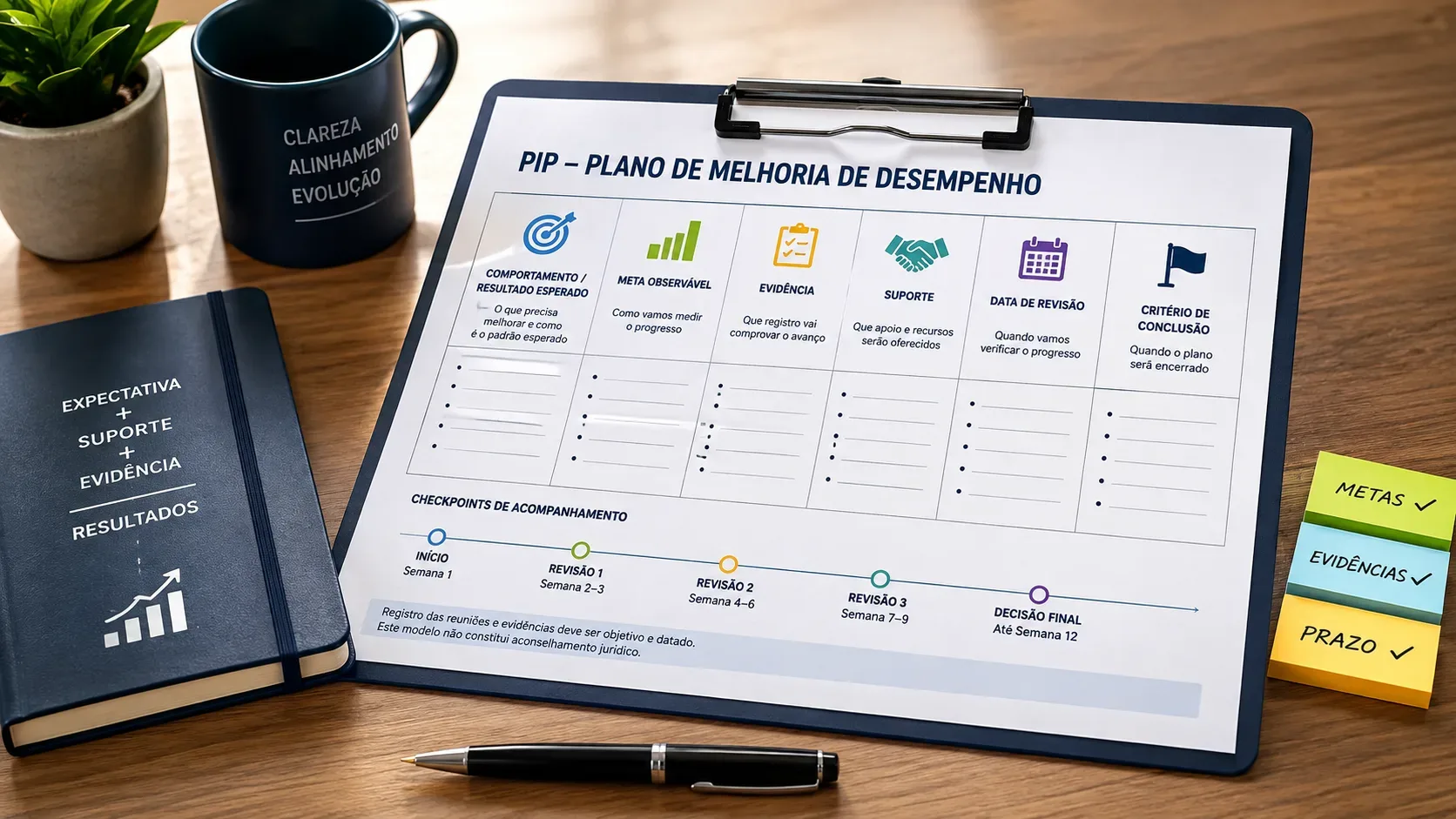
A PIP (performance improvement plan) works best when it turns a vague concern — “performance needs to improve” — into a verifiable agreement about what must change, how progress will be observed, what support will be provided, when reviews will take place, and what counts as completion. The management goal is to reduce ambiguity: the employee should be able to read the plan and understand exactly which behaviors or outcomes will be assessed.
This design is consistent with recent performance-management guidance. The CIPD emphasizes clear objectives, support, resources, and regular conversations; Acas recommends specific objectives and written records of discussions; and a U.S. Office of Personnel Management (OPM) guide, written for the U.S. federal context, structures a PIP around measurable goals, a timeframe, resources, check-ins, and documentation. These principles help create a useful plan, but they do not make any single template universally appropriate for every employer, role, or jurisdiction.
What a one-page PIP needs to answer
A concise PIP can be organized around six questions. They fit on one page because each field should record only what is necessary to track improvement.
| Field | Question it should answer | Example of a clear statement |
|---|---|---|
| Expected behavior or outcome | What needs to happen differently? | “Submit the complete weekly report by Friday at 4 p.m., using the team checklist.” |
| Metric or standard | How will we know the expectation was met? | “100% of reports on time and with no missing required fields for four weeks.” |
| Evidence | What record will demonstrate progress? | Submission history, completed checklist, and correction requests. |
| Support | What resources will the manager or employer provide? | Process training, updated template, and a 20-minute weekly review. |
| Review date | When will progress be discussed? | Weekly check-ins and a formal review at the end of week four. |
| Completion criterion | What condition allows the plan to be considered completed? | Maintain the agreed standard for four consecutive cycles and demonstrate independent use of the process. |
1. Start with the performance gap, not a label about the person
Avoid statements such as “is disorganized,” “lacks commitment,” or “has a bad attitude.” They describe an interpretation rather than an observable event. A verifiable PIP starts with work-related facts: late deliverables, recurring errors, omitted process steps, required communication that did not occur, or results below a previously established standard.
A useful statement separates three elements: the existing expectation, evidence of the gap, and its impact. For example: “The team procedure requires critical tickets to be logged in the system within 30 minutes. In five incidents over the past three weeks, logging occurred after that window, making shift handoff more difficult.” This is more useful than “needs to be more responsible” because it allows both sides to discuss what occurred and what must change.
2. Turn the expectation into an observable goal
PIP goals need to be specific enough that two people reviewing the same evidence are likely to reach a similar conclusion. That does not mean every job should be reduced to rigid counts. The CIPD itself notes that, for complex work, learning or behavioral objectives can be more suitable than narrow production targets.
Use an appropriate combination of four types of standards:
- Timeliness: when a deliverable or response must occur.
- Quality: which minimum criteria the work must meet.
- Quantity: volume or frequency, when it genuinely represents the work.
- Observable behavior: an action that can be identified in concrete situations, such as escalating a risk, recording a decision, or confirming requirements before starting a task.
“Improve communication” is vague. “Post a project-risk update within one hour of identifying a blocker that threatens the deadline” is observable. “Be more proactive” is vague. “At the weekly check-in, present status, next steps, and blockers for assigned deliverables” can be tracked.
3. Define the evidence before tracking begins
One common mistake is to decide the goal now and only later debate what evidence “counts.” That creates room for retrospective and inconsistent evaluation. For each expectation, identify the evidence source in advance.
Good evidence usually comes from records already connected to the work: system data, delivery history, quality checklists, tickets, reports, reviewed samples, meeting notes, or stakeholder confirmation when that feedback is a normal part of the process. Evidence should be proportional to the goal; there is no need to create extraordinary surveillance to measure something the workflow already records.
Also distinguish results from activities. Attending training is evidence that support was received, not necessarily that performance improved. Improvement may instead be demonstrated by correct application of the process after the training.
4. Write support as a concrete commitment
A PIP should not list demands only. If the expectation requires knowledge, a tool, access, priority alignment, or a management decision, the corresponding support should appear in the plan. This makes tracking more informative: if a promised resource was not available, that fact matters when interpreting progress.
Support can include training, shadowing an experienced colleague, examples of acceptable work, a checklist, documentation, system access, reprioritization, manager availability for questions, and feedback at defined intervals. Prefer verifiable commitments: “The manager will review the first deliverable of each week within one business day” is clearer than “The manager will provide support as needed.”
5. Choose a timeframe that captures real work cycles
There is no magic number of days for every PIP. A timeframe is verifiable only if it gives the employee a real opportunity to demonstrate the behavior or result more than once. If an activity occurs daily, a few weeks may generate enough evidence; if it occurs monthly, a short period may not contain enough cycles.
The OPM guide cited above states that, in the U.S. federal context covered by that document, a PIP will normally span 30 business days. That should not be converted into a universal rule. Employers and jurisdictions may have their own policies, contracts, collective agreements, or requirements. For management purposes, the practical question is: “How many real opportunities to demonstrate the expectation occur within this period?”
Instead of recording only an end date, create checkpoints. A simple structure is:
- start: align on expectation, evidence, support, and calendar;
- short check-ins: compare facts with the standard and remove obstacles;
- midpoint review: identify the trend and adjust support without retroactively rewriting the criterion;
- final review: compare the full evidence set with the completion criterion defined at the start.
6. Separate a checkpoint from a “new judgment”
A checkpoint should not introduce previously unstated goals. It should answer: what happened since the last discussion, what evidence exists, where progress occurred, what gap remains, and what support will be used before the next review. Acas recommends keeping a written record of what is discussed and sharing it with the employee, which helps reduce disagreement about the history.
A checkpoint note can be brief: “Goal 2 met in three of four deliverables; one deliverable had two required fields missing. Checklist use started on Aug. 18. Next step: review those two fields before submission. Manager will sample one deliverable next week.”
7. Define the completion criterion before the final date
Without a completion criterion, a PIP can become a subjective assessment that someone “seems better.” The plan should state what evidence is sufficient to consider the expectation sustained. The criterion can combine outcome and consistency, for example: “meet the quality standard on four consecutive deliverables” or “follow the procedure in at least 95% of eligible cases for six weeks, with no unlogged critical incident.”
Avoid promising a specific administrative outcome when it depends on internal policy, HR, or law. The PIP can define what it means to meet the performance expectation; later decisions about employment status, pay, promotion, discipline, or other consequences should follow the applicable rules of the organization and jurisdiction.
One-page PIP template
For each material gap, complete one row using the fields below. If the plan requires many rows, there may be too many issues for a single improvement cycle; prioritizing the highest-impact gaps usually makes tracking clearer.
| Observed gap | Expectation / goal | Evidence | Support | Reviews | Completion criterion |
|---|---|---|---|---|---|
| [Fact and period] | [Behavior or outcome + standard] | [Record to be reviewed] | [Resource + owner + timing] | [Checkpoint dates] | [Objective condition for considering it met] |
| Example: 4 of 10 reports submitted late over the past 3 weeks | Submit the complete report by Friday at 4 p.m., using the checklist | Submission time + checklist + error-return history | Updated template; Monday priority review; weekly check-in | Weeks 1, 2, and 3; final review in week 4 | 4 consecutive reports on time, complete, with no missing required fields |
Traps that weaken the plan
- A goal that depends on someone else: “customer approves 100% of proposals” may be outside the employee’s control. Measure what the employee can execute, such as quality, timeliness, and process adherence.
- A brand-new metric invented only for the PIP: when possible, use standards and records that already belong to the role.
- Selective evidence: do not record only failures. The history should also show when the standard was met.
- Generic support: “ask for help” is not a substitute for a resource, owner, and availability.
- Moving success criteria: changing the definition of success at the end makes the plan difficult to verify.
- Check-ins without a record: memories of conversations diverge; objective notes preserve continuity.
- Using a PIP for issues that are not performance problems: conduct, conflict, health, accessibility, discrimination, safety, or other matters may require different processes and specialist review.
Manager checklist before presenting the PIP
- Was the expectation compatible with the role and previously communicated in an understandable way?
- Is the gap described with facts and a timeframe, without personal labels?
- Does every goal have an observable standard?
- Is the evidence source defined?
- Does each support item have an owner and timing?
- Does the period include real opportunities to demonstrate improvement?
- Are there checkpoints before the final review?
- Is the completion criterion written before the plan starts?
- Does the plan follow applicable internal policy and receive HR review when needed?
The core principle: a PIP should be auditable through facts
A PIP “without traps” is not a document that guarantees a particular outcome. It is a management tool in which expectations, evidence, support, timing, and completion criteria are known in advance. The less it relies on adjectives and informal memory, the more useful it becomes for guiding genuine improvement and for explaining, at the end of the period, why a goal was considered met, partially met, or not met.
Note: this content addresses performance-management structure and practice, not legal advice. Before using a PIP in a specific case, review internal policies, contracts, collective agreements, accessibility obligations, and applicable law with qualified professionals when necessary.