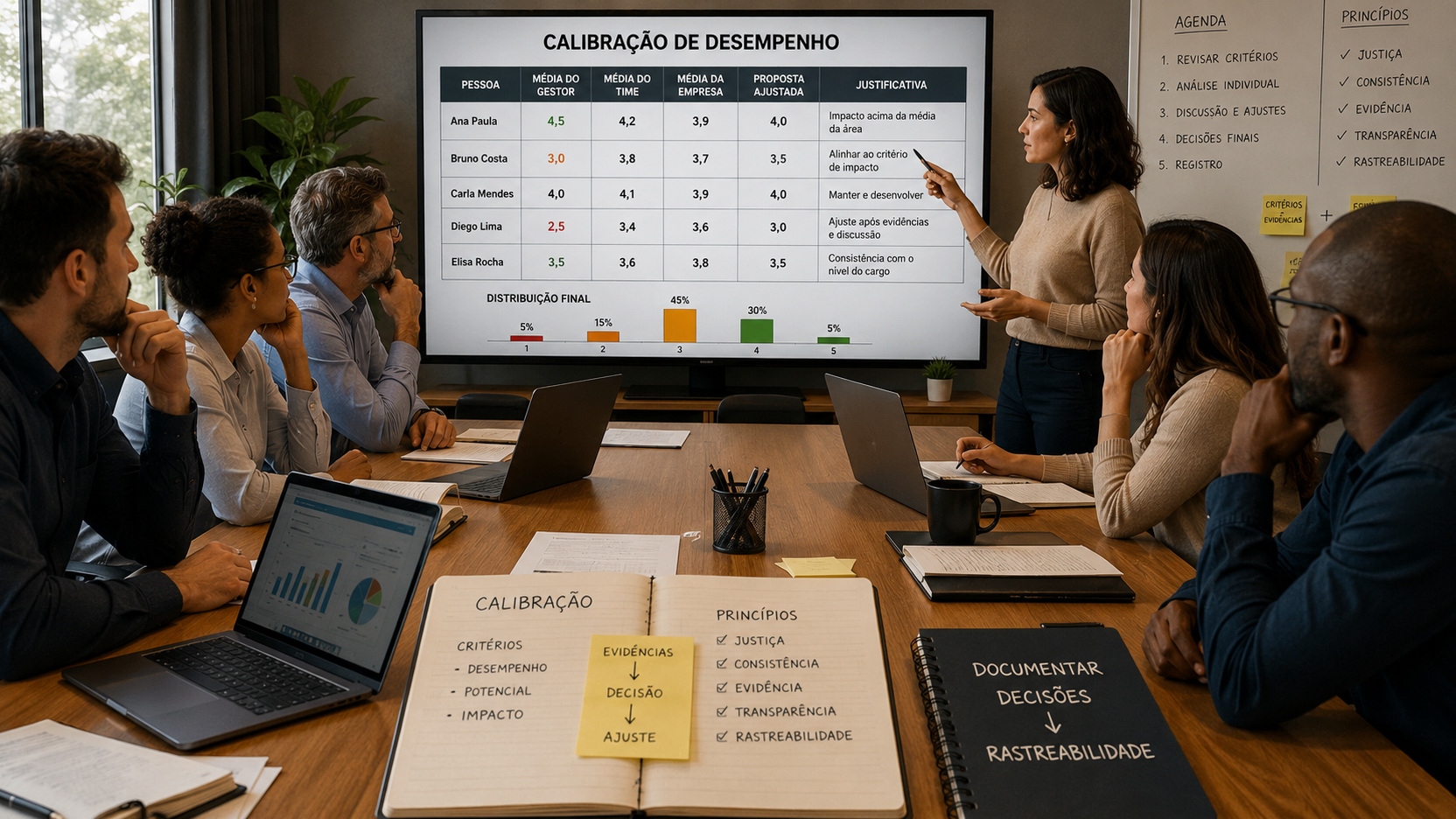
An individual meeting can address deliverables, difficulties, feedback and career. This does not mean, however, that it should function as an informal and permanent performance evaluation.
The difference is in the purpose of the conversation. 1:1 monitors the work and organizes support. Timely feedback addresses a specific situation. Formal assessment applies criteria to a specified period. The development plan transforms a need or aspiration into learning actions.
When these functions are mixed, two problems arise: the professional does not know when he or she is actually being evaluated and the manager accumulates notes without context, as if each conversation were part of a dossier. Structured reviews continue to have a place in performance management, but they should be complemented, not disguised, by regular conversations.
The main rule: registration must follow the purpose
The name used by the 1:1 company, check-in, alignment or development conversation does not alone resolve the issue. Before recording any information, answer:
Why does this conversation exist and what decision should the record support?
If the purpose is to remove an impediment, the record needs to preserve the decision and who is responsible for the action. If feedback on a delivery occurred, the observed fact, the impact and the agreed adjustment are necessary. If it is an assessment, the period, criteria and evidence must appear. If it is development, the document needs to show learning objectives, actions and monitoring.
This separation also reduces the risk that a formal assessment will raise criticisms that have never been presented previously. The CIPD evidence review recommends distinguishing management conversations – relating, for example, to classification, remuneration or promotion – from conversations aimed at improving performance and supporting development.
Comparative table: what to record in each instrument
| Instrument | Main purpose | When to use | What to log | Expected result | What to avoid |
|---|---|---|---|---|---|
| 1:1 Meeting | Monitoring priorities, obstacles, support and working relationships | In recurring conversations between manager and professional | Decisions, commitments, impediments, responsible parties, deadlines and topics to be revisited | Clarity for the next period | Secret grading notes, personality judgments, and non-work reports |
| Timely feedback | Strengthen or adjust a specific performance | Close to a relevant situation, at the appropriate time for the context | Observed situation, behavior or delivery, impact, expectation, support and monitoring | Maintaining a good practice or concrete change | Generalizations such as “always”, “never” or “does not have a profile” |
| Formal assessment | Examine performance over a period according to previously defined criteria | In the organization's official cycle | Period, function, goals, criteria, evidence, result, manifestation of the person evaluated and applicable decisions | Consistent and traceable assessment | Surprises, criteria created after the facts and use of decontextualized comments |
| Development plan | Develop skills or prepare a professional path | When there is a learning objective that requires continued actions | Target competency, current status, objective, activities, resources, progress indicator and review dates | Traced learning | Turn the plan into punishment, automatic promise of promotion or generic list of courses |
The framework does not mean that four platforms or four extensive documents are needed. It means that each piece of information must be kept in the correct context, with coherent access, purpose and storage time.
What to Record in a 1:1 Meeting
The 1:1 should produce a short operational record that is understandable to both parties and useful for the next conversation.
A good summary might contain:
- meeting date;
- priorities discussed;
- deliveries that advanced;
- impediments identified;
- decisions made;
- support that the manager must provide;
- actions assumed by the professional;
- responsible persons and combined dates;
- subject that should return to the agenda;
- possible indication that another process will be opened, such as structured feedback or development plan.
1:1 can also include insights into workload, cooperation, autonomy and clarity of priorities. The record, however, should focus on working conditions and possible actions, not on diagnoses about the person.
What shouldn't be included in the routine note
Avoid registering:
- unverified rumors or claims as if they were facts;
- comments about personality with no clear relationship to observable conduct;
- details of private life that are not necessary for a work action;
- hypotheses about physical or mental health;
- labels such as “difficult”, “unstable”, “weak” or “uncommitted”;
- a performance rating that the person does not know they are receiving;
- criticisms that should have been communicated directly;
- content copied from third-party messages without context.
A phrase like “seems disinterested and disorganized” is unlikely to guide action and may incorporate bias. A more useful record describes what happened: “The last two project updates were sent after the agreed time; it was agreed that the progress will be updated in the system by 4pm on Thursdays.”
How to record timely feedback
Feedback is not synonymous with reprimand. It is information about a performance that can be used to maintain, correct or improve performance.
Available evidence indicates that feedback can generate positive or negative effects, depending on factors such as specificity, credibility, perception of fairness and recipient participation. Quality matters more than simply increasing frequency. Two-way processes, in which the person can present context and respond, tend to be perceived as fairer.
A feedback record can follow this sequence:
- Situation: when and in what context it occurred.
- Observation: which deliverable, decision or behavior was noticed.
- Impact: what was the consequence for work, client, deadline, safety or team.
- Listen: what context or perspective was presented by the professional.
- Expectation: what should be kept or changed.
- Support: what the manager or organization will provide.
- Follow-up: when the topic will be reviewed.
Fictional example
Inadequate registration: “Needs to be more professional and have more sense of ownership.”
Useful record: “At the project meeting on July 30, two scope changes were not communicated to the rest of the team. This led to the continuation of a task that would have been suspended. It was agreed to record changes in the project channel and confirm receipt with those responsible. The manager will review the flow next week.”
The second example does not attempt to guess intent or character. It preserves the relevant fact, the impact and the next expected behavior.
What belongs to formal assessment
Formal evaluation is a process defined by the organization to examine the work performed in a given period. It can consider deliverables, objectives, role responsibilities, competencies and other previously communicated criteria.
The record must meet:
- evaluated period;
- position, responsibilities or scope considered;
- criteria used;
- applicable goals and indicators;
- favorable evidence and points for improvement;
- relevant changes to priority, staff or resources;
- evaluation or classification, when provided for by policy;
- comments from the evaluated professional;
- resulting decisions;
- points that will be addressed in development.
Formal evaluations require consistent criteria, correct information and the possibility of participation by the person being evaluated. The CIPD further highlights that administrative decisions and development conversations may require different approaches; trying to do both simultaneously can harm both the reception of feedback and the perception of fairness.
The 1:1 meeting contributes to this process by avoiding surprises and keeping objectives up to date. It should not, however, become a silent collection of evidence for future classification.
What to record in the development plan
The individual development plan, or PDI, begins when there is a competency, experience or professional objective that requires evolution over time.
Guidance from the United States Office of Personnel Management defines this type of plan as an instrument to align professional objectives, learning expectations, and competencies between professional and supervisory personnel. It can bring together short-term activities and longer career aspirations.
A useful plan should answer:
- What will be developed?
- Why is this important?
- What is the current situation?
- What result will demonstrate progress?
- What experiments will be performed?
- What support and resources will be available?
- Who follows the plan?
- When will the reviews occur?
Actions do not need to be limited to courses. These may include supervised practice, project participation, mentoring, guided reading, peer observation, internal presentation or gradual expansion of responsibility.
The PDI should also not promise automatic promotion. Competence growth, career movement and vacancy decisions are related but different topics.
Save preparation script
Before the next 1:1, manager and professional can prepare short answers to the questions below.
Professional preparation
- Which result or advance deserves to be highlighted?
- What is the priority until the next conversation?
- What is blocking or delaying work?
- What decision or support do I need from the manager?
- What feedback would you like to receive?
- Is there a skill or experience I want to develop?
- Are there any previous commitments that need to be reviewed?
Manager preparation
- Which appointments from the last conversation are still open?
- Was there a priority change that needs to be explained?
- Is there an obstacle that depends on management decision?
- Do I have a specific, verifiable, and useful observation to share?
- Is there something I should ask, rather than assume?
- Does the matter belong to 1:1 or does it need a separate process?
- What concrete commitment can I make?
Conversation ends
Before finishing, confirm:
- what was decided;
- who will do each action;
- until when;
- what support will be made available;
- which will be resumed at the next meeting;
- whether any matter will be escalated to HR, health and safety, integrity channel or formal process.
The summary can be shared soon after. This allows factual errors to be corrected and reduces different interpretations of what was agreed.
Occupational health: 1:1 is listening, not diagnosis
Individual conversation may reveal overload, conflict, lack of autonomy or difficulty accessing resources. These signs deserve attention, but the manager should not attempt to diagnose a clinical condition or transform the meeting note into an informal record.
The World Health Organization recommends tackling mental health at work through organizational interventions, training of managers and workers, adequate support and measures to return or remain at work. The International Labor Organization defines psychosocial hazards based on the design and management of work, not just the individual characteristics of those who report suffering.
In Brazil, the new NR-1 text came into force on May 26, 2026 and included work-related psychosocial risk factors in Occupational Risk Management. The Ministry of Labor and Employment informs that records of consultations, wiretaps and meetings can help to demonstrate the participation of workers, but isolated documents do not replace an effective and technically based process of identifying, evaluating and controlling risks.
Therefore, 1:1 scores can act as a signal to management, but they do not replace the GRO/PGR, the assessment of real working conditions or the performance of professionals responsible for health and safety.
When there is a health-related report, record only the minimum necessary to make the work possible and forward the matter to the appropriate channel. Health information is sensitive personal data under the General Data Protection Law.
Privacy: record what is necessary, not everything said
A 1:1 record linked to an identified person is personal data. Under the LGPD, collection, storage, consultation, evaluation, control, alteration and deletion are among the operations considered data processing.
This requires clear purpose, necessity, quality, transparency, security and prevention. In practical terms, the organization must avoid excessive collection, limit access, enable the correction of inaccurate information and protect records against undue consultation or disclosure.
Some practical safeguards:
- use the system approved by the organization;
- inform who can access the registry;
- separate temporary personal notes from the institutional record;
- do not store sensitive data in generic fields;
- record facts and decisions with professional language;
- set retention and deletion policy;
- allow correction of inaccuracies;
- restrict unnecessary exports and copies.
There is no universal deadline that this guide can define for the safekeeping of every 1:1 note. The appropriate period depends on the purpose, internal policy and applicable obligations, and must be validated by HR, privacy and legal counsel.
When to take the subject out of 1:1
The individual meeting is no longer the only suitable space when a topic arises that requires its own procedure.
This may occur due to:
- possible harassment, discrimination, violence or retaliation;
- immediate risk to health or safety;
- need for formal performance handling;
- internal investigation or investigation;
- health-related accommodation request;
- conflict of interest;
- protected or highly sensitive information.
In these situations, the manager must explain the next course of action and the confidentiality limits foreseen by the organization. The mistake is leaving a serious allegation lost in a routine note or, at the opposite extreme, turning every difficult conversation into a disciplinary procedure.
A simple system for not mixing documents
The organization can adopt four destinations for records:
- 1:1 Summary: decisions, actions and support.
- Feedback recording: specific situation and follow-up.
- Evaluation form: criteria, evidence and cycle result.
- Development plan: learning objective and actions.
At the end of each meeting, ask: Are there only operational commitments or does an issue need to be moved to one of these specific processes?
This simple decision improves transparency, reduces excessive annotation, and makes every document more useful. 1:1 continues to be a human and recurring conversation — without silently assuming the role of assessment, record or disciplinary process.
Save the preparation script in this guide and use it before your next one-on-one meeting. It helps you come to the conversation with clearer priorities, obstacles, and requests for support, without creating a bureaucratic form to fill out out of necessity.