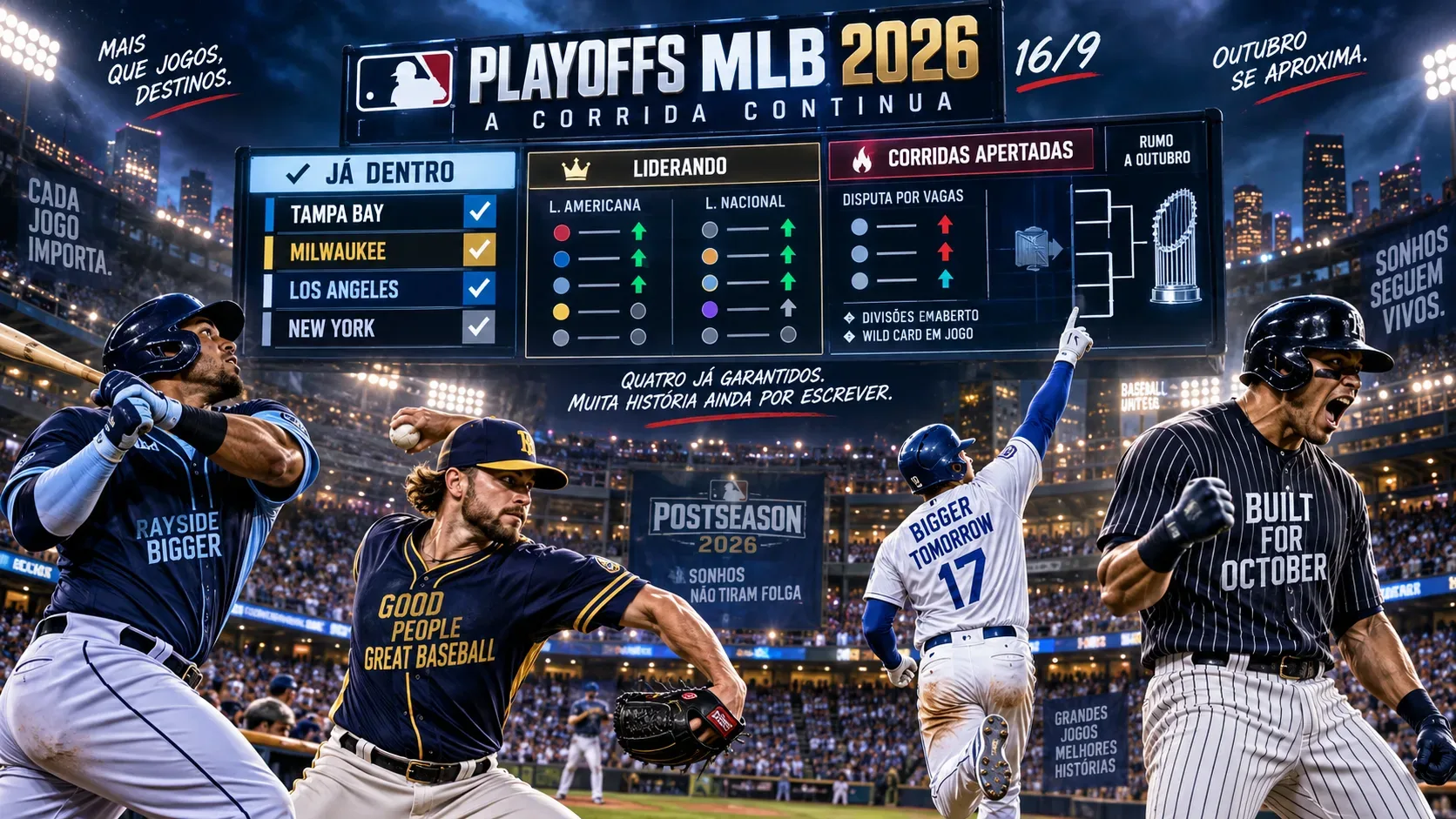
Time-sensitive update: this snapshot uses MLB's picture published on the morning of September 16, 2026. Because games are played the same day and the standings change daily, the margins below should be read as a snapshot of that moment, not as a permanent situation.
Four teams had already clinched postseason berths: the Tampa Bay Rays, Milwaukee Brewers, Los Angeles Dodgers and New York Yankees. Of those four, only Milwaukee had also clinched its division, securing the NL Central on September 15. The Rays, Dodgers and Yankees were mathematically in, but their final seed and/or division title were still unsettled.
Already in: the four teams that had clinched
| Team | League | What was secured on Sept. 16 | Clinch date |
|---|---|---|---|
| Tampa Bay Rays | AL | Postseason berth; final position still open | Sept. 11, 2026 |
| Milwaukee Brewers | NL | Postseason berth and NL Central title | Sept. 11, 2026; division on Sept. 15 |
| Los Angeles Dodgers | NL | Postseason berth; final position still open | Sept. 14, 2026 |
| New York Yankees | AL | Postseason berth; final position still open | Sept. 14, 2026 |
MLB updates its official list whenever another club mathematically secures a berth. The most reliable reference for that status is Tracking the 2026 postseason field.
Who would be in the bracket if the season ended at this snapshot
Beyond the four clinched teams, MLB identified the clubs that occupied playoff position at that moment. That does not mean the berth was secure: it simply shows who led a division or held one of the three Wild Card spots in each league entering September 16.
| League | Division leaders | Wild Cards |
|---|---|---|
| American League | Rays (East), White Sox (Central), Astros (West) | Yankees, Red Sox, Guardians |
| National League | Brewers (Central), Dodgers (West), Braves (East) | Cubs, Phillies, Padres |
The 2026 format sends 12 teams to the postseason: three division champions and three Wild Cards in each league. The two division winners with the best records in each league receive first-round byes; the remaining teams play the Wild Card Series, scheduled to begin September 29.
The tightest races on September 16
- AL Central: the Chicago White Sox led the Cleveland Guardians by only 0.5 game, the smallest division margin on the board.
- AL West: the Houston Astros held a 1-game lead over the Texas Rangers. Houston already owned the head-to-head tiebreaker against Texas, an important edge if they finished level.
- Final AL Wild Card: Cleveland held the third spot, 1.5 games ahead of Texas. Toronto was 2 games back, Baltimore 3 and Detroit 4.5, keeping several clubs close to the cutoff line.
- Final NL Wild Card: the San Diego Padres led the Arizona Diamondbacks by 2.5 games. The two clubs still had a three-game head-to-head series from September 25-27, with that matchup also relevant to the tiebreaker.
- AL East: even with both the Rays and Yankees already clinched, Tampa Bay still led the division by 3.5 games. Their race therefore affected the division title and seeding, not basic postseason qualification.
Those margins show why “clinched” and “currently in position” are different states. A club can already be guaranteed October baseball and still be fighting for a division, a bye or home-field position; another can sit in a Wild Card spot without any mathematical guarantee.
September 16 games that can change the order
MLB itself highlighted three games because of their ability to move meaningful races:
- White Sox at Guardians: a direct AL Central matchup. Because Cleveland also held the final Wild Card, the result affected both the division and the league's cutoff line.
- Braves at Cubs: Atlanta led the NL East, while Chicago held the top NL Wild Card only 0.5 game ahead of Philadelphia. The result could shift seeding and the race to host a Wild Card Series.
- Red Sox at Rangers: Boston occupied the second Wild Card; Texas was chasing the final berth and remained alive in the AL West. For the Rangers, each game could affect two paths into October.
For changes during the day, the practical references are MLB's official standings and the dedicated Wild Card standings.
A tiebreaker can matter almost as much as half a game in the standings
Since 2022, MLB has not used an extra tiebreaker game to decide division titles, playoff berths or seeding. The first criterion is head-to-head record during the season, followed by additional criteria when needed. That makes it important to look beyond the games-back column.
In the Sept. 16 snapshot, for example, the White Sox had already secured the tiebreaker over the Guardians, and the Astros owned it over the Rangers. Among Wild Card teams, the Yankees had the tiebreaker over the Red Sox, while the Cubs had secured head-to-head advantages over the Phillies, Padres and Diamondbacks. If teams finish tied, those details can set the order without an extra game.
How to use this snapshot without losing the update
The main point on September 16 was straightforward: four teams were mathematically in, but eight places in the 12-team field had not yet been clinched. The most immediate pressure was in the AL Central, AL West and the final Wild Card spots in both leagues.
Because MLB continually updates its playoff picture, any later visit should recheck clinched teams, leaders, margins and tiebreakers. This article deliberately preserves the September 16, 2026 date so it works as a verifiable snapshot of the race that day.