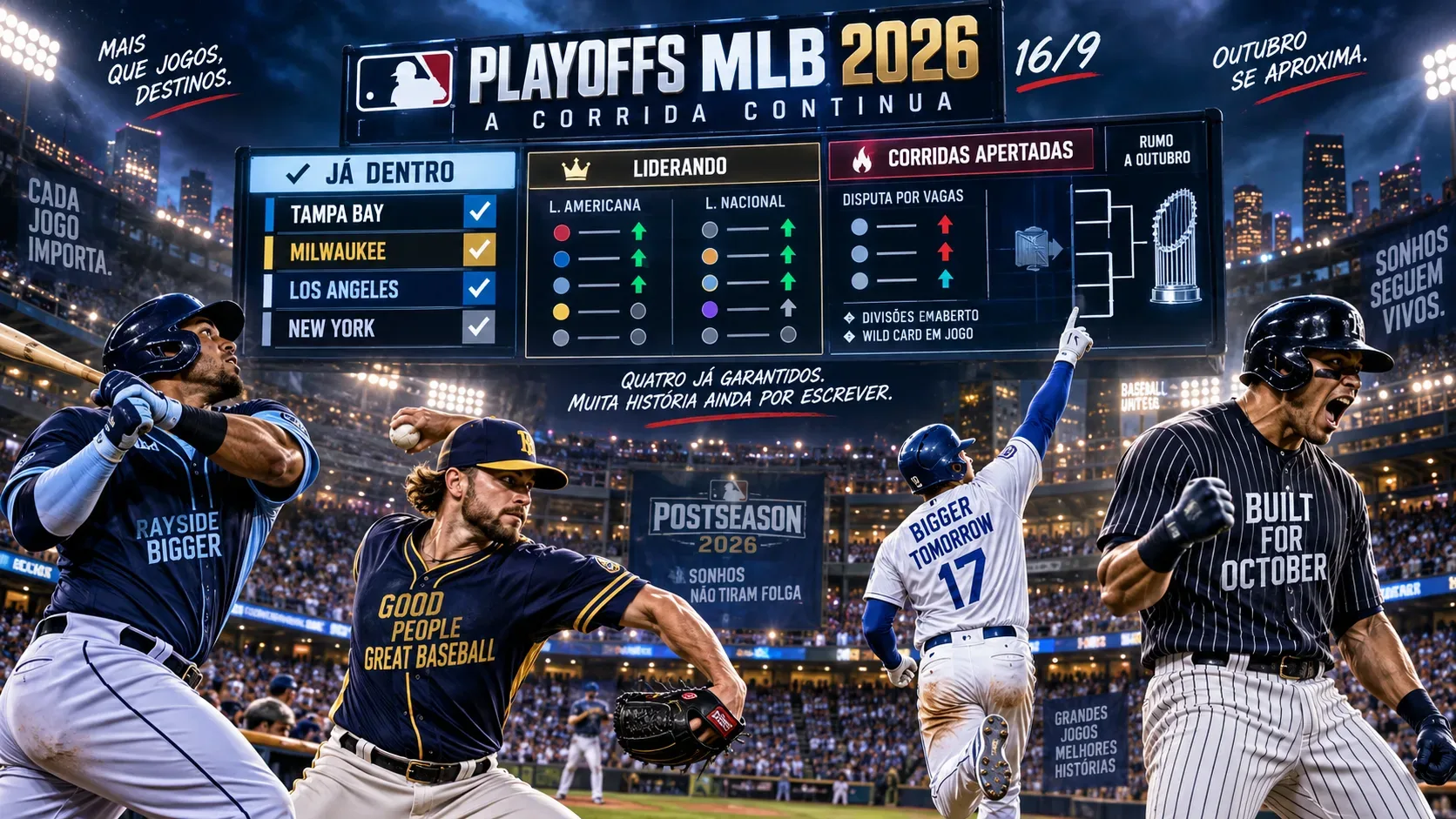
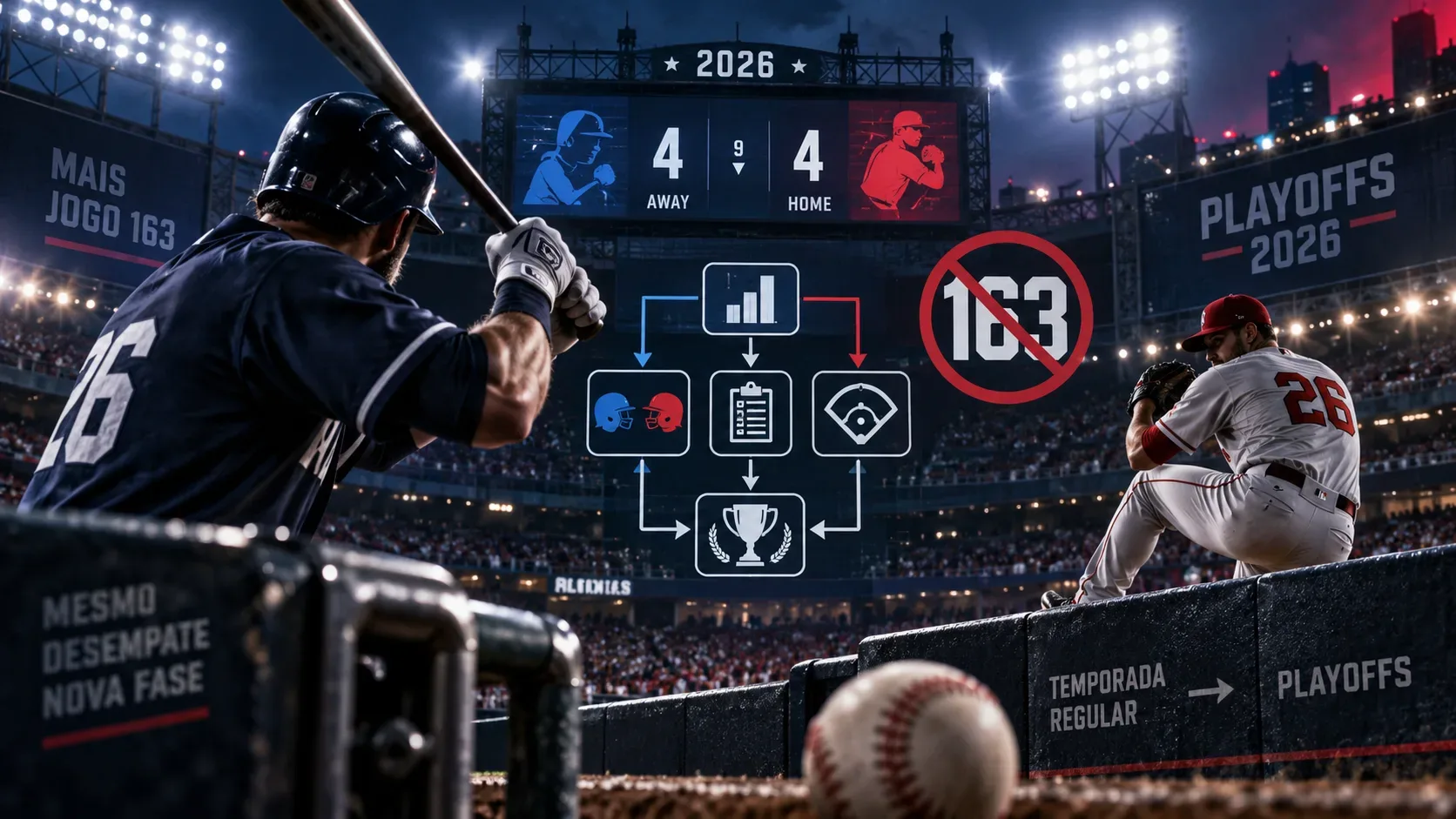
In the 2026 MLB season, a tie in wins and losses at the end of the regular season does not trigger an extra game to decide a berth, division title, or postseason position. Since the playoff field expanded to 12 teams in 2022, the league has settled those situations with tiebreakers based on regular-season results. The first one is head-to-head record.
This applies to any tie that changes the postseason field: a division lead, the final Wild Card berth, the order of division winners, seeding among qualifiers, and other combinations that determine who advances or where a club is placed. MLB detailed the procedure again in its official September 8, 2026 update.
What is the two-team tiebreaker order?
When two teams finish tied and must be separated for postseason purposes, MLB applies the criteria below in sequence. As soon as one criterion creates a difference, the tiebreak is settled.
| Order | Criterion | How it works |
|---|---|---|
| 1 | Head-to-head record | The team with the better record in the season series between the tied clubs is placed ahead. |
| 2 | Intradivision record | If head-to-head does not separate them, each club's record against teams in its own division is compared. |
| 3 | Intraleague record | If they are still tied, the comparison moves to games against teams in the same league: American League for AL clubs and National League for NL clubs. |
| 4 | Last half of intraleague games | The clubs' records in intraleague games after the All-Star break are compared. MLB notes that this is not necessarily the exact mathematical midpoint of the schedule. |
| 5 | Last half plus one | If the tie remains, the final intraleague game before that segment is added. If needed, the process keeps moving backward one intraleague game at a time until the tie is broken. |
Practical example: head-to-head can settle everything
Imagine Team A and Team B finish with identical records while competing for a Wild Card berth. If Team A won the season series between them, Team A is placed ahead in the tiebreaker. No extra game is required.
If their season series is tied, the system moves to the second criterion: intradivision record. If the tie persists, intraleague record comes next, followed by the late-season intraleague segments.
Why does intradivision record matter even for teams from different divisions?
This detail often causes confusion. The second criterion does not compare only games between the tied teams, nor does it require them to play in the same division. MLB compares each club's performance against opponents from its own division. Therefore, in a Wild Card tie involving clubs from different divisions, each team's intradivision record can still decide the order.
How does a three-team tie work?
With three clubs, MLB first looks at the results among the teams involved. If one team has a better record against each of the other two, that club has the advantage and qualifies in the situation being resolved.
If no team has that advantage over both of the others, the comparison moves to winning percentage in games among the tied group. If two clubs remain tied, the two-team tiebreaker procedure is then applied between them.
There is a specific path when all three have identical records against one another: intradivision record, intraleague record, record in the last half of intraleague games, and, if necessary, the process of moving backward one intraleague game at a time.
If three teams are tied in a situation involving both a division championship and one Wild Card berth, the procedure first identifies the division winner. The remaining two clubs then revert to the two-team tiebreaker to determine the Wild Card berth.
What if four teams finish tied?
For four teams competing for one position, MLB first checks whether one club has a better record against each of the other three. If that does not settle it, the order moves to winning percentage in games among the tied clubs, intradivision record, intraleague record, the last half of intraleague games, and finally the progressive one-game-at-a-time lookback through intraleague games.
If the group is reduced at any point to two or three clubs that remain tied, the dedicated two-team or three-team procedures take over.
Why is there no longer a Game 163?
The so-called Game 163 was an extra regular-season game used in certain situations to settle ties affecting qualification. That format was discontinued when MLB expanded the postseason field from 10 teams to 12 in 2022.
MLB's stated reasoning is both operational and competitive: using already-played regular-season results lets the postseason begin promptly after the regular season ends and avoids extending the wait for division winners that receive a bye through the Wild Card Series.
In practice, that turns regular-season games into potential future tiebreakers. A series played months earlier can determine a berth, a division championship, or seeding without the teams having to play an additional game.
What can a tiebreaker decide in the current playoff format?
Six teams from each league qualify: three division champions and three Wild Cards. The two division winners with the best records receive byes into the Division Series. The third division winner is the No. 3 seed and faces the No. 6 seed, while the No. 4 and No. 5 seeds meet in the other Wild Card Series. The Wild Card Series are best-of-three, with all games hosted by the higher seed.
That means a tiebreaker is not only about deciding who gets into the postseason. It can also determine a division champion, a first-round bye, Wild Card order, and which club hosts a Wild Card Series.
Checklist for reading the standings late in the season
- The same record does not mean Game 163: MLB uses regular-season tiebreaking criteria.
- Start with head-to-head: it is the first tiebreaker between two teams.
- Division and league records come next: intradivision and intraleague performance are the following stages.
- Persistent ties look at late intraleague games: MLB uses the last half of those games and can move backward game by game.
- Three- and four-team ties have dedicated procedures: results within the tied group become especially important before the broader criteria.
- Tiebreakers also affect seeding: they are not limited to the final Wild Card berth.
In short
In 2026 MLB, the path is straightforward: if two teams finish tied in a postseason-relevant situation, head-to-head record is the first question. If it does not decide the tie, the league proceeds through intradivision record, intraleague record, and late-season intraleague segments. Multi-team ties use additional comparisons among the clubs involved. The old Game 163 is no longer part of the process.