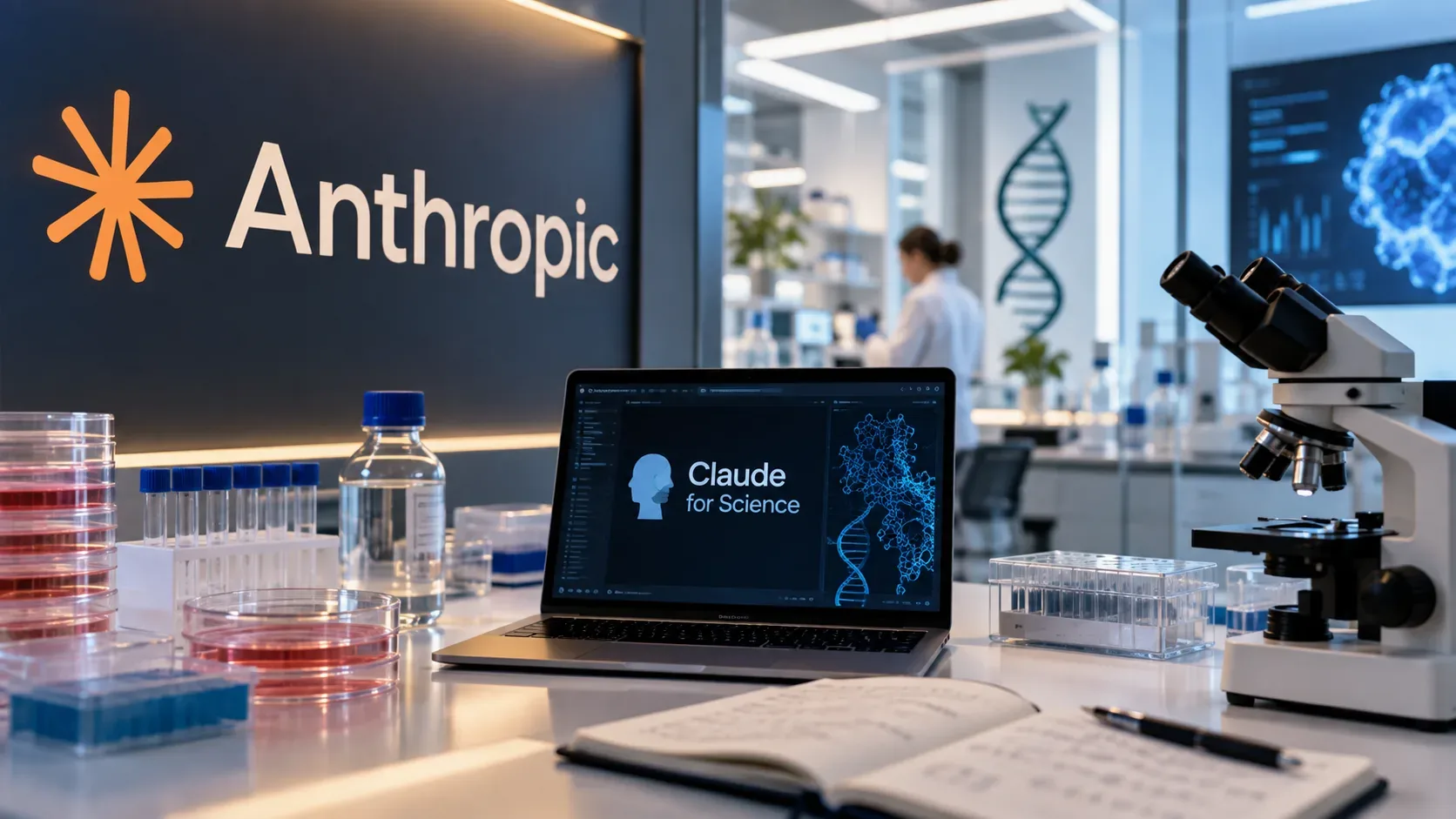
Anthropic confirmed on September 18, 2026 that it operates a biology wet lab in the San Francisco Bay Area. The move adds a physical layer to the company's life sciences strategy, which already included the acquisition of Coefficient Bio and the launch of Claude Science. The three efforts complement one another but serve different functions: the lab enables real experiments, the acquisition adds a team and expertise in computational biology, and Claude Science organizes digital research work.
What changed in Anthropic's biology strategy
Until now, much of the discussion around AI in biology had focused on computational tasks such as literature search, data analysis, protein design, and orchestration of specialized models. The wet lab moves Anthropic closer to the stage where hypotheses and designs must be tested in the physical world.
According to Reuters, the lab carries out physical biology work and combines in-house activities with experiments performed by external partners. Eric Kauderer-Abrams, Anthropic's head of life sciences, said real lab work remains the final test in biology. The company also said it is still in the early stages of automating the execution of laboratory work.
| Area | What it is | What it is for | What it does not yet do |
|---|---|---|---|
| Wet lab | A physical biology laboratory in the San Francisco Bay Area. | Run and validate real experiments, test automation processes, and shorten the gap between a computational hypothesis and experimental evidence. | It has not been presented as a lab dedicated specifically to drug discovery, and Anthropic says it does not run clinical trials. |
| Coefficient Bio | An AI biology startup acquired by Anthropic in April 2026. | Add a team, expertise, and tools focused on biological research and capabilities that can support drug development. | The acquisition does not mean Anthropic bought a ready-made drug pipeline, and it does not replace experimental, preclinical, or clinical testing. |
| Claude Science | A scientific research app launched in beta on June 30, 2026. | Integrate data, tools, code, and compute in an environment with agents, auditable history, and reproducible workflows. | It does not physically validate a result on its own. Biological findings still depend on experiments and scientific review. |
Why the wet lab is the new piece
A wet lab is a laboratory equipped for experiments with real biological and chemical materials. That differs from working only in silico, meaning with simulations, databases, and computational models. For an AI company, having internal experimental capacity can shorten the cycle between forming a hypothesis, running an experiment, analyzing the result, and deciding what to test next.
Reuters reported that Anthropic wants to explore how far Claude can direct robotic units that carry out experiments with limited human intervention. The company, however, says human supervision and involvement remain essential for safety. Kauderer-Abrams described AI-driven lab automation as an area that is still in its early stages.
This matters because models can generate promising hypotheses or designs, while real biology imposes constraints that software cannot fully capture. A molecule may look suitable in a model and still fail on expression, stability, binding, toxicity, or other tests. The lab creates a more direct path to measure those differences.
Where Coefficient Bio fits into the expansion
Anthropic confirmed its acquisition of Coefficient Bio, a startup that was using AI to make drug discovery and other biological research more efficient. The deal was reported in April 2026. TechCrunch reported that the transaction was worth about $400 million in stock, a figure Anthropic did not confirm.
The clearest gain is internal capability. Coefficient Bio brings people who had already worked at the intersection of machine learning, computational biology, and drug discovery. That can help Anthropic develop scientific tools and workflows that are closer to the needs of biotech and pharmaceutical researchers.
The important distinction is that acquiring capability is not the same as acquiring a medicine. Buying Coefficient Bio does not turn Anthropic into a pharmaceutical company with approved products. It strengthens the human and technical infrastructure used to build systems that support research and development.
What Claude Science actually does
Claude Science was introduced by Anthropic on June 30, 2026 as a workbench for scientists. The app brings together tools and packages used in research, provides flexible access to computing resources, and creates auditable artifacts so analyses can be traced and reproduced.
According to the company's documentation, the product can connect workflows involving PubMed, Jupyter, R, cluster terminals, scientific databases, and specialized models. The beta became available on macOS and Linux for Pro, Max, Team, and Enterprise plans. The system includes specialist agents, connectors, and a reviewer agent that checks items such as citations, calculations, and consistency between figures and code.
In practice, Claude Science acts as the computational coordination layer. It can help researchers search literature, build analyses, run pipelines, use GPUs, and orchestrate structural biology models. That is not the same as proving that a biological hypothesis works in cells, tissues, animals, or humans.
How the three pieces connect
The strategy can be understood as a cycle. Claude Science organizes reasoning, data, models, and compute. The team added through Coefficient Bio increases Anthropic's ability to develop and adapt tools for biology. The wet lab adds the stage where results can be tested physically and used as feedback for new rounds of analysis.
- Formulation and analysis: agents and models help synthesize literature, generate hypotheses, design molecules or proteins, and run analyses.
- Candidate selection: computational tools prioritize which ideas are worth experimental resources.
- Physical experiment: the wet lab or external partners test real materials and protocols.
- Feedback: experimental results return to the analysis and refinement cycle.
An example of why this bridge is needed appeared in an experiment Anthropic published in August. In a protein design campaign run through Claude Science, designs generated by Claude were sent to Adaptyv Bio and Twist Bioscience for experimental validation. Anthropic reported confirmed binders for 14 of 15 tested targets. The result is useful as a demonstration of workflow, but it was published by Anthropic itself and does not mean every AI-generated design will perform similarly.
What Anthropic is not doing yet
The expansion does not mean the company is taking over the entire pharmaceutical development chain. Anthropic told Reuters that it is not running clinical trials for now and wants to avoid directly competing with pharmaceutical and biotech companies that bring drugs to market. The company has also not disclosed which specific diseases are being worked on in the lab or the stage of those projects.
There is also a difference between automating parts of a laboratory and operating science autonomously. Anthropic says human oversight remains essential. In parallel, the company maintains specific controls for higher-risk biological work. On September 17, it launched the Life Sciences Verification Program, which gives verified organizations access to more capable models for certain life sciences tasks under access, monitoring, and review rules.
What this changes for the market
The main signal is that Anthropic is no longer treating life sciences only as a market for selling models and connectors. The company is building its own experience in scientific infrastructure, automation, and experimental validation. That could improve products for biotech and pharmaceutical customers, but it also increases the need to clearly separate internal research, customer services, and competitive boundaries.
The most useful indicators to watch are reproducible experimental results, new details about the wet lab's role, integration between Claude and laboratory equipment, validation partnerships, and any change to the current boundary of not running clinical trials. For now, the move is best understood as an expansion of Anthropic's scientific capability, not the creation of a full pharmaceutical company.