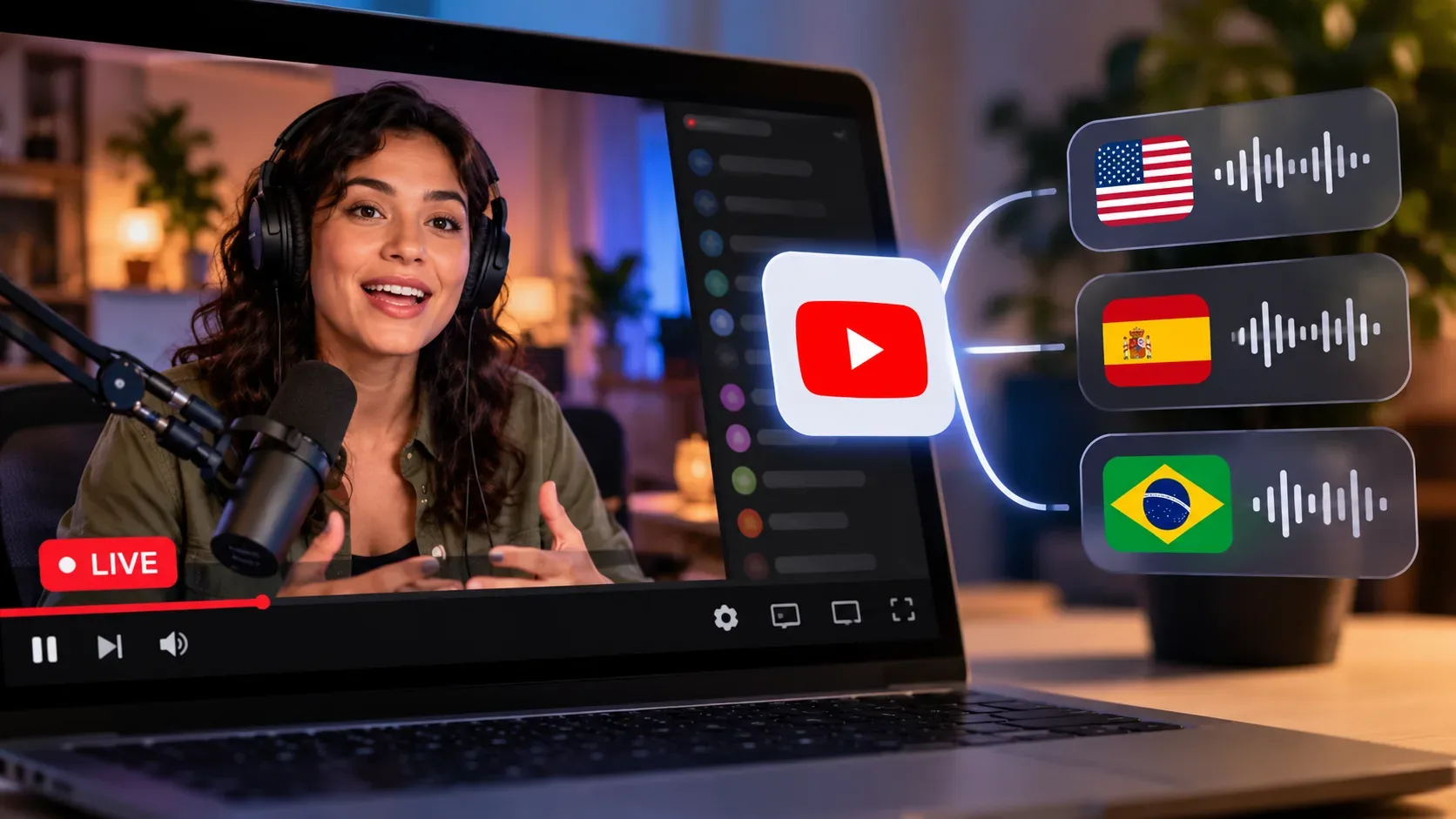
On September 23, 2026, YouTube announced plans to pilot real-time automatic dubbing for live streams starting in early 2027. Introduced at Made On YouTube 2026, the feature is intended to translate a creator's speech as a stream unfolds, allowing viewers to listen in their preferred language. This is an announced pilot, not a feature already available to everyone.
What YouTube announced for live streams
According to YouTube, live auto-dubbing aims to reduce language barriers between streamers and international audiences. In an announcement for creators, the YouTube team specified that the initial pilot will cover English and Spanish in early 2027. It did not provide a full list of countries, participating channels, translation pairs, or an exact date for broad availability.
The company says more than 40% of live watch time comes from viewers outside a channel's home country. YouTube presents this figure as context for the announcement, not as a measurement of the new dubbing feature's performance. The platform also reported that in August 2026, an average of more than 600 million signed-in viewers watched live content each day, including archived streams.
How real-time translation is expected to work
The official description is straightforward: a presenter's speech will be translated automatically in real time, and viewers will be able to listen to the stream in their preferred language. The goal is to provide translated audio during the broadcast instead of requiring viewers to wait for a video to be processed after publication.
YouTube has not publicly specified translated-audio latency, language-selection controls in the player, live manual corrections, preservation of the original voice, or how it will handle multiple speakers talking simultaneously. Portuguese support in the initial pilot is also unconfirmed. None of these details should be treated as guaranteed features.
How this differs from automatic dubbing for uploaded videos
YouTube already offers automatic dubbing for uploaded videos: translated audio tracks are created, and viewers can switch between original and dubbed tracks when available. In its documentation for that video feature, the company explains that the tracks are generated after upload and published according to the creator's settings.
The new aspect of live streams is when translation takes place. The announced aim is to generate audio in another language while the person is speaking live. Rules and limitations documented for uploaded-video dubbing do not, on their own, establish how the live pilot will work or who will be eligible.
Availability and unanswered questions
As of September 26, 2026, the feature remained an announced test scheduled to begin in early 2027. The YouTube team's communication describes live dubbing as an experimental feature starting with small pilot groups before any wider rollout. It has not published a universal schedule or an activation option applicable to all creators.
For streamers, the practical takeaway is to follow YouTube's announcements and potential invitations before planning a broadcast around the feature. Viewers likewise have no announced guarantee that any live stream will automatically be available in Portuguese. Automated translation deserves careful scrutiny when names, technical terms, or sensitive information matter; YouTube's uploaded-video dubbing documentation already acknowledges possible errors, but does not quantify the accuracy of the new live pilot.