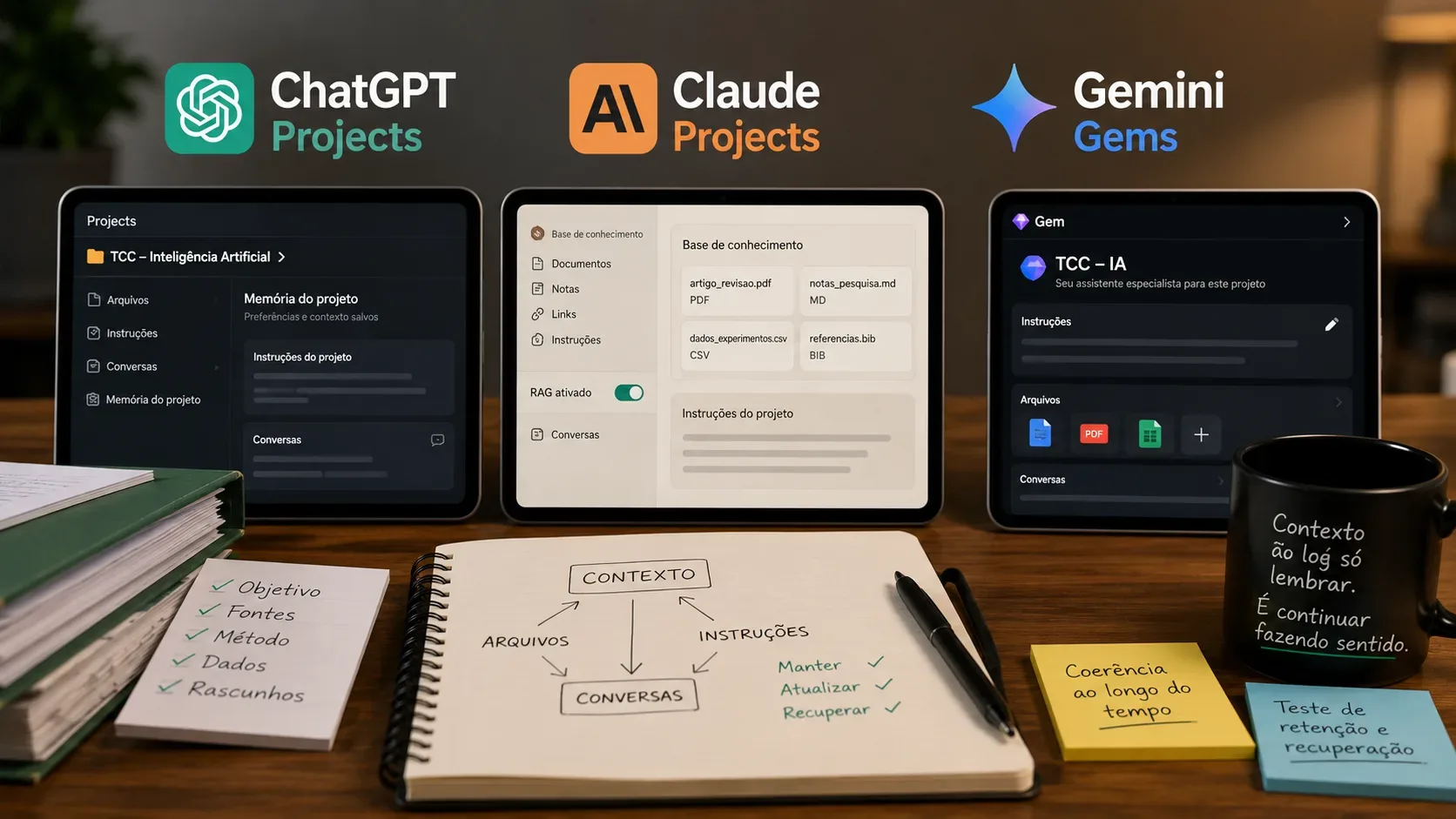
If your main criterion is continuing a long-running project across multiple chats without manually copying every prior decision, ChatGPT Projects currently has the clearest architecture for cross-chat continuity. OpenAI's documentation says projects have built-in memory, can reference other chats within the same project, and, in project-only memory mode, isolate that context from outside conversations. Claude Projects follows a different philosophy: project knowledge files and instructions apply across chats, but Anthropic explicitly says chat context is not shared with another chat unless the information is added to the project knowledge base. Gemini Gems sits in between: Gems reuse instructions and knowledge files, and Google's current documentation for classic Gems says they maintain context from past chats, while Gemini's general personal memory feature does not operate inside Gems.
That does not mean any product “remembers everything,” nor that any of them replaces a well-maintained source of truth. For long projects, the more useful question is narrower: does the system retrieve the right decision, update stale information, resolve instruction conflicts, and avoid pulling context from the wrong place?
What it means to maintain context in a long project
A persistent-context comparison should not stop at counting files or measuring the context-window size. For work that lasts weeks or months, four behaviors matter more:
- Cross-chat retrieval: does a decision made in chat A reappear correctly in chat B?
- Updating: when an old rule is replaced, does the system favor the newer version?
- Instruction conflicts: are global instructions, project instructions, and chat-level requests applied predictably?
- Isolation: can one project prevent data or preferences from another context from contaminating the answer?
These criteria measure continuity and fidelity, not just storage capacity.
ChatGPT Projects: cross-chat continuity is an explicit part of the product
In its official documentation, OpenAI describes Projects as spaces that bring chats, files, and instructions together and states that project memory can use previous conversations from the same project. With project-only memory, chats can reference other chats in that project, cannot reference outside conversations, and cannot be referenced by chats outside the project. Project instructions apply only inside that project and override global custom instructions.
This combination is especially useful when important knowledge is created during the work itself: editorial decisions, corrections, formatting preferences, scope changes, and conclusions recorded in different conversations. Instead of requiring every decision to be converted into a reference file, the project's conversation history can participate in retrieval.
There is an important caveat: being able to reference history does not guarantee that every relevant detail will be retrieved in every response. Memory and context selection remain probabilistic mechanisms. In critical projects, decisions that cannot be lost should still be consolidated into an explicit source of truth.
Source: OpenAI — Projects in ChatGPT.
Claude Projects: shared context is the knowledge base, not the other chats
Claude Projects is more deliberate. Anthropic describes projects as self-contained workspaces with chat histories, a knowledge base, and project instructions. Anything added to project knowledge can be used across project conversations. When that corpus approaches the context limit, Claude can automatically enable RAG and retrieve only relevant passages, expanding the capacity of the knowledge base.
The central difference is stated directly in Anthropic's documentation: context is not shared across chats within a project unless the information is added to the project knowledge base. In practice, this lowers the expectation that a decision made casually in one chat will be remembered in another. For continuity, the user must promote important decisions into a document, text entry, or other project-knowledge content.
This design can be an advantage when a project needs governance. The knowledge base becomes a more controllable layer: you have a clearer idea of what should be available across chats and can remove or replace stale material. The tradeoff is more curation work and a higher chance that a recent decision stays trapped in the chat where it was made.
Sources: Anthropic — How can I create and manage projects? and Anthropic — RAG for Projects.
Gemini Gems: instructions and knowledge persist, but “memory” refers to different layers
Gems let you save instructions and attach knowledge files so Gemini can respond with more context. Google's current documentation for classic Gems also says they maintain context from past chats. At the same time, Gemini's general personalization feature based on memory of past chats has an explicit limitation: it is not available in Gems.
Those two statements are not necessarily contradictory. They point to different layers: one is continuity associated with the Gem itself; the other is Gemini's account-wide personal memory. For anyone evaluating isolation, that distinction matters because a Gem should not be treated as the same thing as the account's general memory.
Compared with ChatGPT Projects, the less-documented area is the operational rule for conflicts and replacements over many chats: which old facts stop being retrieved after a correction, how competing versions are prioritized, and what exact boundaries exist between conversations in different Gems. The capability therefore looks promising, but it deserves practical testing before it is treated as an implicit repository for critical decisions.
Sources: Google — Tips for creating custom Gems, Google — Classic Gems and Gems from Google Labs, and Google — Memory of past Gemini chats.
Practical comparison: which architecture favors each test?
| Test | ChatGPT Projects | Claude Projects | Gemini Gems |
|---|---|---|---|
| Retrieve a decision from another chat | A documented behavior of project memory | Not shared by default; the decision must be added to project knowledge | Classic Gems have documented past-chat continuity, but retrieval rules are described in less detail |
| Replace stale information | History may contain competing versions; explicit consolidation is still advisable | More controllable when the old source is removed or updated in the knowledge base | Needs hands-on testing to see how conflicting versions are prioritized |
| Keep environment instructions | Project instructions are project-specific and override global custom instructions | Project instructions apply across project chats | Saved instructions define the Gem's behavior |
| Isolate contexts | Project-only memory documents explicit boundaries | The project is self-contained and chats do not casually share context | General personal memory does not operate in Gems; other boundaries should be validated in use |
So which one keeps long-running work in context best?
For automatic continuity across multiple conversations, ChatGPT Projects is the strongest choice based on officially documented behavior. It is designed so chats within the same project can reference one another and offers a dedicated mode for keeping that context inside the project boundary.
Claude Projects is stronger when “context” means a curated, controllable knowledge base. It does not promise that one chat will remember another; instead, it encourages users to turn what matters into shared project knowledge. That can reduce drift and make an official source easier to update, provided the team actually performs the curation.
Gemini Gems is competitive for repeatable workflows built around fixed instructions and files, and current documentation already indicates past-chat continuity for classic Gems. Still, because Gemini's personal memory is separate and does not operate inside Gems, and because replacement and conflict rules are less explicit in the pages reviewed, it is worth validating the behavior in your own workflow before depending on implicit memory.
A reproducible benchmark that goes beyond a feature table
If the decision matters, the best test is to use the same fictional project in all three products and measure errors rather than declared features. A simple protocol can use four rounds:
- Initial information: record that the client uses the codename “Aurora,” prefers Thursday deliveries, and forbids unsourced quotations.
- Replacement: in another chat, change the codename to “Orbit” and delivery to Tuesday. Then ask in a third conversation which rules are currently valid.
- Conflict: add a project instruction requiring short answers and, in one chat, deliberately ask for a long answer. Record which layer the product prioritizes and whether it explains the conflict.
- Isolation: create a second project with a different codename and different rules. In the first project, ask about information that exists only in the second and count any leakage.
Repeat each test several times and record three metrics: factual accuracy, use of the latest version, and context leakage. If an answer is correct only because the information was reintroduced in the current prompt, it should not count as persistent retrieval.
How to choose without overestimating memory
- Choose ChatGPT Projects when decisions emerge across many chats and you want the environment to try to reuse that history automatically.
- Choose Claude Projects when the team prefers an explicit source of truth and is willing to promote important decisions into the knowledge base.
- Choose Gemini Gems when the core workflow is a reusable set of instructions and files and you plan to validate, in your real case, how far cross-chat continuity goes.
With all three options, the safer practice for long projects is to separate convenient memory from an authoritative record. High-impact decisions, current requirements, and facts that supersede older versions should live in a clearly maintained project document or source. Memory helps continue the work; it should not be the only governance layer.
Limit of this comparison
This analysis compares the architecture and behaviors described in official documentation reviewed on August 31, 2026. It is not a substitute for a controlled benchmark run on equivalent accounts across all three services. Memory features, plan availability, and context rules can change, so the protocol above is the appropriate way to turn this documentation-based comparison into a practical, reproducible measurement.