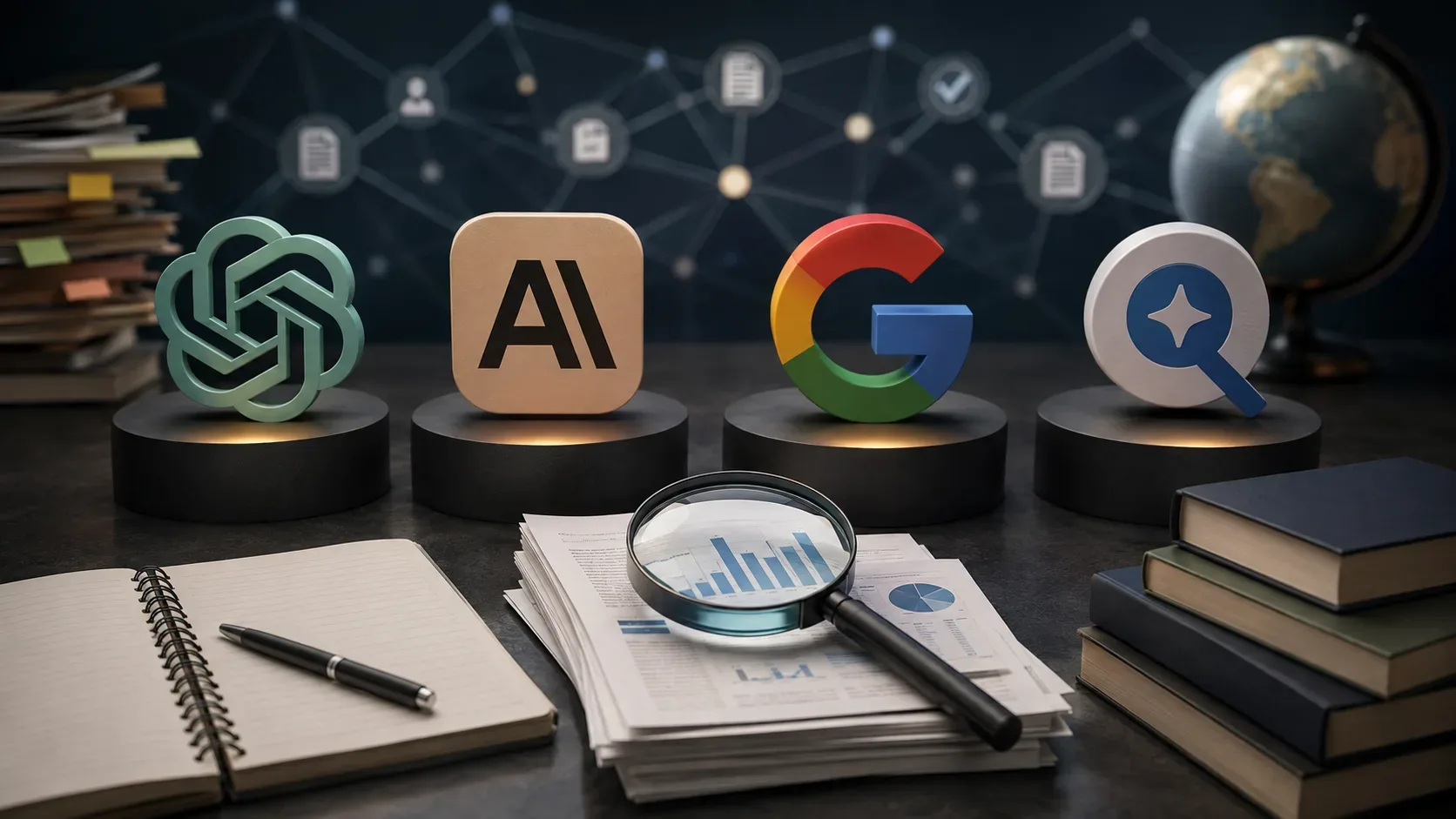
An answer with 30 sources may seem more reliable than one with ten. The problem is that quantity of citations, quality of sources and factual support are not the same thing.
ChatGPT, Claude, Gemini, and Perplexity now offer web search capabilities capable of producing documented or sourced answers. But the presence of a link does not act as a verification seal. A study published in May 2026 found an important difference: tested frontier models maintained more than 94% of valid links and more than 80% of thematic relevance, while the rate of claims actually supported by sources was between 39% and 77%.
So for verifiable work, the useful question is not just “which AI cites the most?” Is it: does the cited source support exactly the statement made, is it appropriate to that fact and remains current?
There is still a limitation that needs to be made explicit in this comparison. A proprietary experiment with 20 to 30 identical questions within the four commercial interfaces was not run here. The available benchmarks also do not place the current versions of ChatGPT, Claude, Gemini and Perplexity, in the same conditions, in Brazilian Portuguese and on the same date. The numbers below are to identify patterns and risks, not to declare a permanent winner.
What each tool offers today
The four platforms came to deep search through different paths.
ChatGPT's Deep Research lets you search the public web, uploaded files, and connected apps. The user can review the plan before execution and even restrict the search to specific sites or prioritize certain domains. The final report includes citations or links to sources and a section with references used.
Claude's Research is available on paid plans and requires web search enabled. According to Anthropic documentation, the system conducts multiple queries that are linked together and can combine the web with connected internal context, such as Gmail, Google Calendar and Google Docs. Survey responses are delivered with user-verifiable citations.
In Gemini, Deep Research uses Google Search as its default source, but can also work with Gmail, Drive, uploaded files, and NotebookLM notebooks. The service creates an editable search plan before execution. Current documentation states that a search typically takes five to ten minutes, and may take longer for complex tasks.
Perplexity Research iteratively searches, reads multiple sources, and generates a report. Free users have limited access, while Pro expands this usage. In July 2026, the company updated the resource to Advanced Deep Research, stating that it now consults more sources and cross-references information.
Functional comparison is clearer side by side:
| Tool | Useful feature for auditing | What the external evidence shows | Comparison limit |
|---|---|---|---|
| ChatGPT | Editable plan, choice of fonts and possibility to restrict or prioritize sites. | On DeepResearch Bench, OpenAI Deep Research scored 77.96% in Citation Accuracy and 40.79 effective citations in the tested configuration. | The benchmark is a snapshot of a previous configuration, not the current interface as of August 2026. |
| Claude | Research performs successive searches and can combine web and connected context. | In another study, Claude Opus 4.5 reached 76.8% in the Fact Check criterion; other Claude models varied. | The test used models in a standardized agent with search, not the current Claude Research product. |
| Gemini | Google Search by default, selectable fonts and editable search plan. | On DeepResearch Bench, Gemini 2.5 Pro Deep Research had 81.44% in Citation Accuracy and 111.21 effective citations. | The sheer volume of sources does not mean that each claim is equally well supported. |
| Perplexity | Research-oriented product with free limited access and Advanced Deep Research updated in 2026. | On the DeepResearch Bench, Perplexity Deep Research scored 90.24% in Citation Accuracy and 31.26 effective citations. | The current version of the product was modified after the configuration evaluated by the benchmark. |
This table does not allow us to conclude that one tool is “97% reliable” or that another is objectively better. Even the definition of metrics changes between studies.
Too many citations and correct citations are different problems
DeepResearch Bench is particularly useful because it separates two measures. The first is Effective Citations, associated with the number of citations considered useful. The second is Citation Accuracy, focused on attribution accuracy. The benchmark brought together 100 advanced-level tasks, in 22 areas, 50 in English and 50 in Chinese.
In the evaluated configuration, Gemini 2.5 Pro Deep Research produced an average of 111.21 effective citations, more than three times the number recorded by Perplexity Deep Research, which was 31.26. Even so, Perplexity had the highest Citation Accuracy among the Deep Research agents in that table: 90.24%, compared to 81.44% for Gemini and 77.96% for OpenAI Deep Research.
This exposes a common evaluation error: counting links.
A tool can bring more references and cover more points without necessarily making a more precise attribution in each sentence. The reverse direction is also possible: a more selective report might cite fewer sources but better connect them to the claims.
The most important test happens after clicking on the source
The work “Cited but Not Verified”, published on arXiv on May 7, 2026, evaluated 14 models in 130 search queries. For each citation, the authors separated three questions: does the link work? Is the content relevant to the topic? And does the source actually support the claim associated with it?
It is in the third question that the appearance of trustworthiness begins to fall apart.
Claude Opus 4.5, for example, scored 98.7% on working links and 95.7% on relevance, but 76.8% on Fact Check. GPT-5.4 reached 100% of functional links and 93.7% of relevance, but 47.7% in Fact Check. Gemini 3.1 Pro recorded 94.1%, 80.7% and 48.5% respectively.
These numbers should not be transferred directly to ChatGPT Deep Research, Claude Research, or Gemini Deep Research. The study placed the models in an agent with its own search and rules for generating citations. Its most useful contribution is methodological: valid link and page related to the subject still do not prove that that page confirms the data attributed to it.
This is precisely the type of error that goes unnoticed in a quick review. The reader opens the reference, recognizes a legitimate organization, sees that the subject is similar and closes the check. For auditing, you must locate the excerpt that supports the number, date, causal relationship, or conclusion used in the report.
Researching more can also make the synthesis worse
Another result deserves attention because it goes against the intuition that more research always improves an answer.
In the same study, researchers progressively increased the maximum number of tool calls for GPT-5.4 and Claude Opus 4.6, from two to 150. On average, Fact Check accuracy dropped approximately 42% between the lowest and highest search depths, while link validity and relevance remained high.
On GPT-5.4, Fact Check went from 78.6% with two calls to 16.7% with 150. On Claude Opus 4.6, it dropped from 80% to 57.9%. The authors themselves treat the result as evidence of a possible effect of information overload during synthesis.
It doesn't mean that searching a little is better. It means that collection depth and synthesis accuracy need to be measured separately.
A tool can find an excellent set of documents and still mix numbers, context or conclusions when writing the final report.
Which tool makes the most sense for each type of work?
Without controlled testing of current interfaces, the most defensible criterion is to choose the required flow and then verify the result.
ChatGPT has a functional advantage when the searcher needs to control in advance where the search should occur. The possibility of restricting the search to certain sites or prioritizing them is useful, for example, to instruct the system to start with public bodies, official documentation, scientific articles or selected databases.
Gemini gains relevance in flows in which Google Search and documents from the Google ecosystem need to be part of the same investigation. Gmail and Drive can be added as sources in addition to files and NotebookLM.
Claude offers a Research stream that crosses successive searches and can query both the web and internal connected context. This can be useful when the question relies on both organizational documents and external evidence.
Perplexity maintains an experience especially focused on search and research. Research is available on a limited basis for free users and expanded on Pro; the July 2026 Advanced Deep Research update added more searching and cross-referencing.
This is flow suitability, not reliability ranking. To confirm that one of these options better supports citations in Brazilian Portuguese today, it would be necessary to run an experiment on the four interfaces.
How to take a 24-question test in PT-BR without favoring one platform
A useful editorial benchmark should not just use easy questions with a known answer. A sample of 24 queries can be distributed among six task types: current facts; location of primary sources; synthesis of multiple sources; themes with divergent sources; less documented Brazilian or local subjects; and questions where the correct answer requires acknowledging that a source does not confirm a particular claim.
After that, each verifiable assertion must be audited separately. The protocol may follow this sequence:
- Run exactly the same prompt across all four tools, recording date, plan, search mode, and settings.
- Save the full answer and the start and end times.
- Separate verifiable factual statements from the text.
- Identify which statements were cited and which were left without a source.
- Open each reference and check if the link works.
- Check whether the page addresses the topic and, above all, whether it supports the specific statement.
- Classify the source as primary, secondary or just reproducing another source.
- Check publication or update when the date changes the answer.
- Record contradictions ignored or treated by the tool.
- Measure actual testing time and cost, without trying to convert different subscription limits into a false single metric.
The central metrics would be citation coverage, percentage of supported claims, rate of primary sources, inaccessible links, timeliness, handling of contradictions, latency and cost.
It is also worth repeating part of the questions. A study published on August 6, 2026 compared ChatGPT usage conditions in interface and API and performed three executions per prompt. Within that experimental design, repeated responses were inconsistent in up to 21% of the prompts. The result is not a benchmark of the four tools, but it demonstrates why a single run may be insufficient to evaluate probabilistic systems.
Time and cost need to be included in the test, not assumed
Plans and limits change frequently and do not even follow the same business structure.
As of August 9, 2026, ChatGPT Plus costs $20 per month and includes Deep Research where available. Claude Pro costs US$20 monthly, or equivalent to US$17 per month for the annual plan, and includes Research. On the Brazilian Google One page, Google AI Pro appears for R$96.99 per month and includes access to Deep Research. Perplexity Research has limited use on the free plan and expanded access on Pro; The company's documentation states a starting price of US$20 per month for Pro.
These values do not make the cost per search directly comparable. There are differences in quotas, regions, included features and usage policies. For an editorial comparison, it is best to record how much it was necessary to pay to perform the defined batch of questions and how many tasks could be completed under the same conditions.
Time must also be recorded in the experiment. Google officially reports a usual five to ten minute range for Gemini Deep Research reports. Anthropic describes Research as a process of minutes. The current Perplexity page contains two conflicting estimates in the same paragraph — “less than three minutes” for most tasks and “about four to five minutes” to generate a response — which is all the more reason to measure latency directly rather than using the commercial promise as the result.
The final criterion remains evidence
The products have made great progress in the presentation of fonts. Today there are editable plans, search tracking, integration with internal documents, dozens of automatic searches and extensive reports. None of this eliminates the step of checking the relationship between a statement and its reference.
OpenAI itself has recognized, since the Deep Research presentation, that the system can hallucinate facts, make incorrect inferences and have difficulty distinguishing authoritative information from rumors.
Therefore, an AI-generated search should be treated as an assisted investigation with a source trail, not as a completed check.
For an exploratory query, it may be enough to read the report and open the decisive links. For journalistic publishing, academic research, business decisions, or legal, medical, or financial topics, the review needs to reach the original source and test each material claim.
The best system for this type of work will not necessarily be the one that finds the most pages or writes the longest report. It will be what, in that task and configuration, leaves the least distance between what you assert and what your own evidence actually allows you to assert.