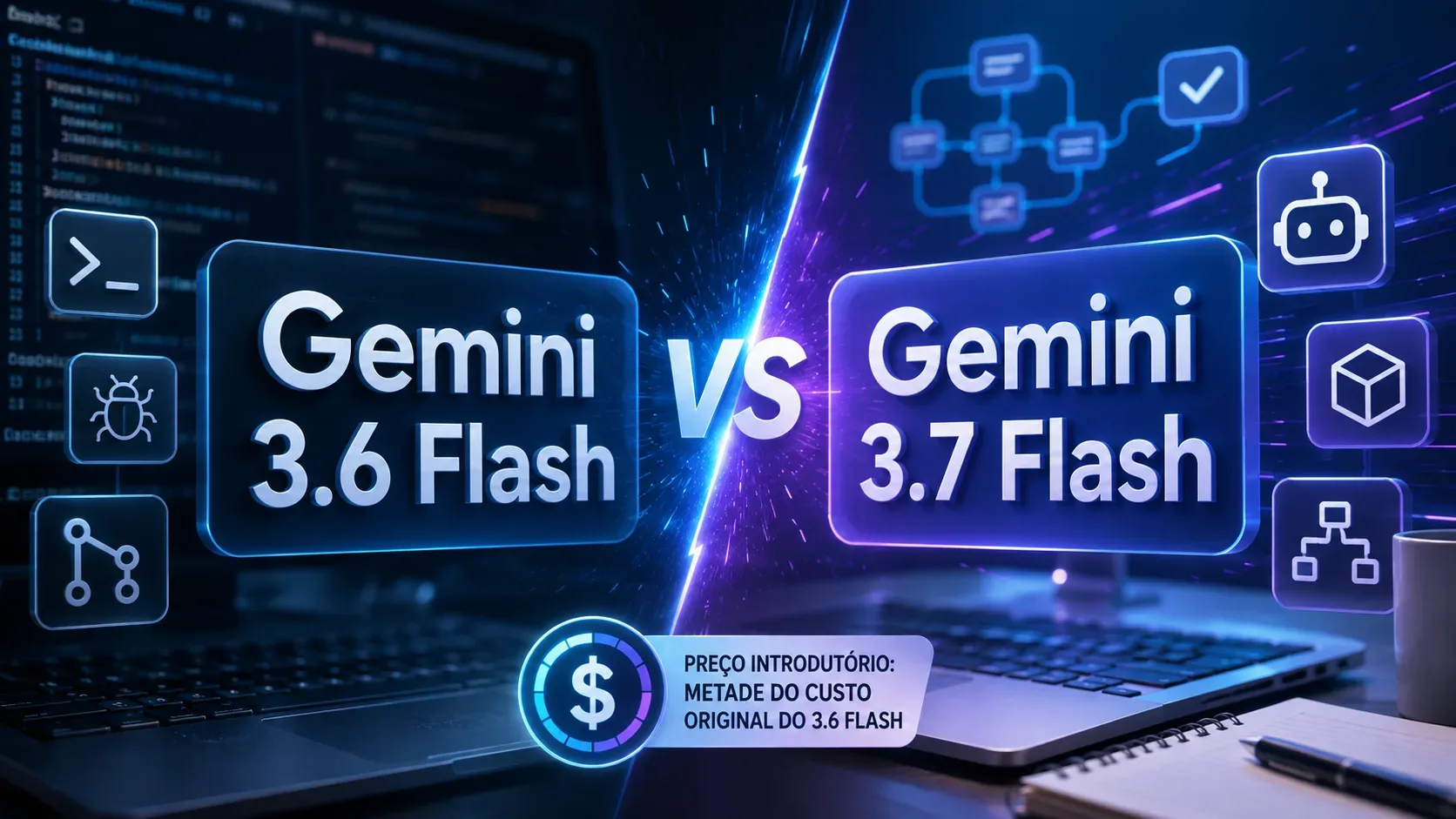
Gemini 3.7 Flash arrived on August 13, 2026, just three weeks after 3.6 Flash, with a focused promise: improve coding and complex agentic workflows without changing the tool family or expanding the context window. The meaningful change is therefore not “more API features,” but stronger execution quality in tasks such as debugging, issue resolution, web application generation, and multi-step automation. There is also an important pricing nuance: the introductory rate announced for 3.7 was also applied to 3.6 Flash, so during the promotion both models have the same per-token price on the Google surfaces documented today.
Gemini 3.7 Flash vs. 3.6 Flash: what actually changed
3.6 Flash launched on July 21, 2026 as a workhorse model for agents, emphasizing token efficiency, coding, knowledge work, and multimodal tasks. 3.7 Flash keeps that foundation, but Google positions it as its most capable Flash model for coding and agents, with gains in software engineering, web development, and workflow execution.
| Area | Gemini 3.6 Flash | Gemini 3.7 Flash | Practical interpretation |
|---|---|---|---|
| Coding and issue resolution | It had already improved precision and reduced loops versus 3.5 Flash. | Google reports 65.3% versus 49.0% for 3.6 on DeepSWE v1.1, and 43.6% versus 34.4% on FrontierCode 1.1 Main. | The gain matters most when a wrong answer triggers another edit, test, or tool cycle. |
| Web and UI | Strong general coding and multimodal performance. | Google reports more functional layouts, more feature-complete apps in fewer prompts, and an Elo of 1588 versus 1538 on WebDev Arena. | It is a stronger candidate for generation from mocks, visual review, and tasks where design fidelity reduces rework. |
| Dense documents | Also targeted knowledge work and multimodal analysis. | On GDP.pdf, Google reports 34.0% versus 22.0%. | It may help agents that need to extract, reason over, and act on complex PDFs, but the gain should be validated on your document type. |
| Workflow automation | Built for agentic execution and tool use. | On AutomationBench, 30.4% versus 17.0%, plus more disciplined planning, instruction following, and tool calls according to Google. | The expected benefit is less supervision, fewer retries, and a higher completion rate for multi-step tasks. |
| Context and tools | 1,048,576 input tokens, 65,536 output tokens, with tools such as function calling, code execution, computer use, search grounding, and URL context. | 1M context, 64k output, and the same built-in tool suite as 3.6. | Do not choose 3.7 expecting an exclusive new tool. |
These figures are benchmarks and measurements published by Google. They indicate the direction of improvement, but they do not guarantee the same gap in a specific repository, agent, tool stack, or prompt set.
What “better for coding” means in practice
The 3.7 Flash improvement is most relevant when the model must preserve technical context, modify existing code, and close the execution loop rather than simply generate an isolated snippet. Google highlights debugging, issue resolution, higher first-pass accuracy, and more production-ready code.
- Bugs with reproduction and tests: ask the model to identify the root cause, propose a patch, and run or interpret the test suite. The useful metric is how many cases reach a valid solution without human intervention.
- Refactors and migrations: compare unnecessary file changes, regressions, and correction loops. 3.6 already launched with a focus on reducing unwanted edits; 3.7 aims to push that further.
- Web apps from a visual reference: 3.7 is explicitly tuned for adherence to mocks, screenshots, and design systems. Evaluate functionality and visual parity, not just whether the code compiles.
- Repositories with multiple tools: when the workflow includes search, code execution, file reading, and external functions, a small per-step improvement can materially affect end-to-end completion.
For agents, the main change is execution — not a new tool list
The 3.7 Flash documentation says it uses the same built-in tool suite as 3.6. The stated difference is behavior: it adapts better to roadblocks, clarifies intent when needed, follows instructions more faithfully, and puts more effort into multi-step planning and tool calls. That matters because the cost of an agent is not just the price of one answer; it is the sum of tokens, tool calls, latency, retries, and possible human intervention.
There is also a reasoning-configuration difference worth noting. 3.7 Flash supports low, medium, and high thinking levels, with medium as the default. Current documentation lists 3.6 Flash with minimal, low, medium, and high. For a fair A/B test, start with a common level such as medium, then test latency or quality extremes separately.
Introductory pricing: half the original price does not mean half of 3.6 today
When 3.6 Flash was announced on July 21, Google listed a price of $1.50 per 1 million input tokens and $7.50 per 1 million output tokens. On August 13, 3.7 Flash launched at $0.75/1M input and $3.75/1M output, described as half the original 3.6 cost.
However, the current migration documentation adds a decisive detail: the new promotional rate was also applied to 3.6 Flash. Through December 31, 2026, 3.7 and 3.6 are listed at the same introductory rate on the documented surfaces. Starting January 1, 2027, the indicated standard rate is $1.50/1M input and $7.50/1M output.
In other words, “half the price of 3.6” compares 3.7 with the original launch price of 3.6, not with a current price gap between the two. During the promotion, per-token price is not the tiebreaker. The useful metric is cost per completed task.
A simple calculation is: token cost = (input tokens ÷ 1,000,000 × input rate) + (output tokens ÷ 1,000,000 × output rate). For agents, add tool, infrastructure, and retry costs. If 3.7 spends more reasoning in one attempt but prevents retries and extra tool calls, it can still be cheaper per task; if the workload is simple and 3.6 already succeeds on the first pass, the advantage may disappear.
Which workloads are most likely to benefit from 3.7 Flash
- Software engineering with execution feedback: bugs, issues, tests, migrations, and refactors where the result can be objectively verified.
- Multi-step agents: tasks involving planning, function calls, research, document reading, and recovery from intermediate failures.
- Design-driven web development: UI generation from a screenshot, mock, or design system, plus audits of implementation-to-reference parity.
- Complex document workflows: reports, PDFs, tables, and multimodal content that ends in a structured action or decision.
- Processes where retries are expensive: when each failure launches new executions, tools, or human review, higher first-pass accuracy can matter more than small latency differences.
When keeping 3.6 Flash still makes sense
3.6 Flash remains GA and has no announced shutdown date. If your system already meets quality, latency, and cost targets, there is no automatic economic reason to migrate solely because of the promotion, since the introductory rate was equalized. Keeping 3.6 can be rational while you evaluate 3.7, especially for simple, high-volume, or heavily tuned workflows.
Another point is the minimal thinking level documented for 3.6 and absent from the current 3.7 list. For extremely latency-sensitive workloads with limited reasoning needs, that deserves a separate test rather than assuming the newer model will always be the best choice.
A test suite for choosing between 3.7 and 3.6
Do not decide from a single public benchmark. Use real tasks and run a controlled A/B test.
- Freeze the environment: same commit, files, tools, permissions, and base prompt.
- Use a comparable reasoning level: start with medium, which both models support.
- Separate task categories: bug fixing, refactor, feature generation, UI from a mock, tool-using workflow, and document analysis.
- Repeat tasks: generative models vary across runs; a single attempt can hide regressions or gains.
- Measure end-to-end success: passing test, resolved issue, functional interface, completed workflow, or correctly processed document.
- Track efficiency: input and output tokens, total latency, tool calls, retries, function errors, and human interventions.
- Calculate cost per success: divide total execution cost by the number of tasks completed within your quality threshold.
If 3.7 raises the success rate and reduces loops enough to offset any extra reasoning consumption, migration is justified. If 3.6 already solves the workload with low variance, keeping it may be the more efficient choice.