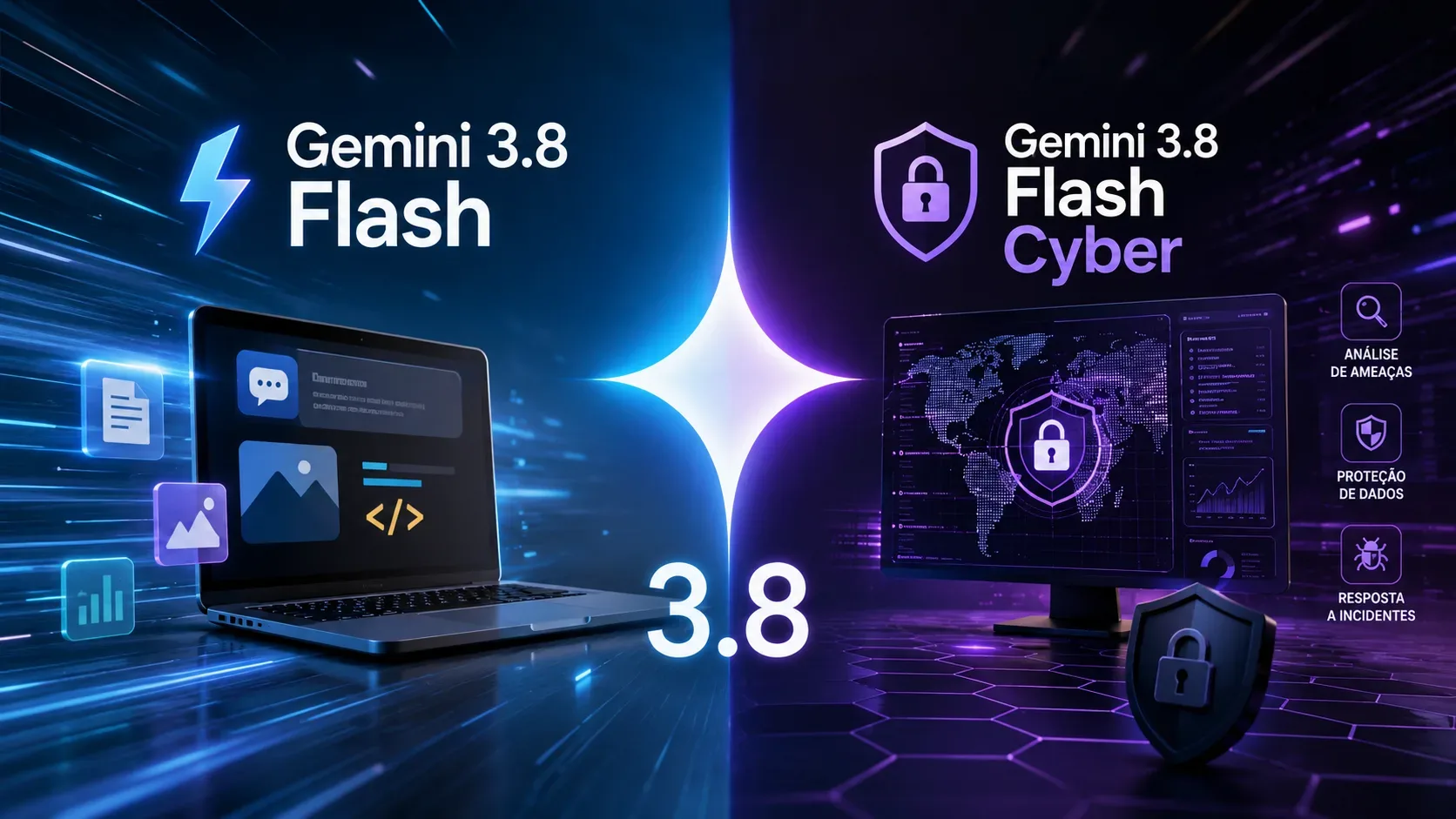
Gemini 3.8 Flash and Gemini 3.8 Flash Cyber were announced by Google on September 2, 2026 and share the same foundational intelligence, but they were designed for different deployment contexts. 3.8 Flash is the broadly available variant for software engineering, autonomous agents, and complex reasoning. 3.8 Flash Cyber is a specialized defensive cybersecurity variant, with prioritized and limited access for trusted defenders through the Fairwind Program.
The most important distinction, therefore, is not performance alone: it involves scope, access, and the level of safety mitigation. For most developers and companies, 3.8 Flash is the conventionally available option. Cyber is intended for organizations with advanced defensive needs and should not be treated as simply a “more powerful” version of regular Flash.
Gemini 3.8 Flash and 3.8 Flash Cyber: official differences
| Criterion | Gemini 3.8 Flash | Gemini 3.8 Flash Cyber |
|---|---|---|
| Main focus | Software engineering, agents, multi-step reasoning, and complex enterprise workflows | Vulnerability discovery, automated patching, and advanced cyber defense |
| Audience and access | Developers, enterprises, and eligible users across Gemini products | Trusted defenders, with prioritized access through the Fairwind Program |
| Availability | Gemini API/Google AI Studio, Android Studio, Gemini Enterprise, and consumer products identified by Google | Limited-access program for government authorities, critical infrastructure operators, software maintainers, and selected partners |
| Public pricing | $0.75 per 1 million input tokens and $3.75 per 1 million output tokens through Dec. 31, 2026; from Jan. 1, 2027, $1.50 and $7.50, respectively | Google describes the variant as having Flash-class speed and cost, but the public materials reviewed do not provide a separate self-service pricing table for Cyber |
| Safety mitigations | Safeguards against misuse, including CBRN risks and cyber offense | More permissive cybersecurity mitigations, which is why access is restricted to trusted defenders |
These characteristics are described by Google in the model announcement, the official Gemini API pricing page, and the introduction to the Fairwind Program.
What Gemini 3.8 Flash is for
Google describes 3.8 Flash as its most intelligent Flash model to date, engineered for long-horizon software engineering, autonomous agents, and complex enterprise workflows. That means it is optimized not only to respond quickly, but also to stay with tasks that require many steps, repeated tool use, and revision of its own work.
Scenarios aligned with that positioning include software maintenance and refactoring, agents that combine research and tools, specialized analysis, report generation, and automation of tasks with multiple dependencies. The Gemini API model documentation lists the stable endpoint as gemini-3.8-flash.
Google also says 3.8 Flash “works harder” on complex tasks, performing additional reasoning steps and iterative tool calls. That matters for cost: the same per-token rate as the previous generation does not guarantee that every task will cost the same. A longer run can generate more reasoning or output tokens and perform more steps before reaching a result.
How much Gemini 3.8 Flash costs
In the Gemini Developer API, the paid introductory price for 3.8 Flash is $0.75 per 1 million input tokens and $3.75 per 1 million output tokens, including thinking tokens, through December 31, 2026. Starting January 1, 2027, the published prices rise to $1.50 per 1 million input tokens and $7.50 per 1 million output tokens.
The pricing page also shows a free tier for certain Gemini API use cases and conditions, as well as specific prices for caching and Google Cloud modes. Because limits, regions, and purchasing modes can vary, a production cost comparison should use the official page that matches the environment actually being purchased, rather than relying only on the nominal input and output rates.
What changes with Gemini 3.8 Flash Cyber
3.8 Flash Cyber uses the same foundational intelligence but is specialized for cyber defense. Google highlights two areas: autonomous vulnerability discovery and automated patching. In evaluations disclosed by the company, the variant achieved frontier-level performance on CyberGym and exceeded a 70% success rate on an internal benchmark spanning codebases in 20 programming languages. On CWE-Bench, which focuses on patching, Google reports a 47.2% pass@1 score.
Those figures should be read as evaluation results disclosed by the vendor, not as a guarantee of performance on every codebase or environment. Practical results depend on language, test quality, available context, permissions, connected tools, and human review.
The decisive point is access. The Fairwind Program is a limited program for governments and trusted partners. The announcement lists government authorities, critical infrastructure operators, and software maintainers among the prioritized audiences. There is therefore no basis for assuming that any Gemini API account can select 3.8 Flash Cyber in the same way it can select regular 3.8 Flash.
Does Cyber cost the same as Flash?
The announcement says 3.8 Flash Cyber combines its specialized capabilities with Flash “speed and cost.” However, the public pricing documentation reviewed provides clear self-service rates for Gemini 3.8 Flash, while Cyber is presented within a controlled-access program. Without a public pricing table dedicated to that variant, it is more accurate not to turn “Flash speed and cost” into an assumed universal rate.
For an organization eligible for Fairwind, pricing, capacity, contractual terms, and usage conditions should be confirmed through the program’s access channel or the corresponding Google Cloud offer.
Why Cyber has more restricted access
According to Google, standard 3.8 Flash includes safeguards against misuse in high-risk areas, including cyber offense. Gemini 3.8 Flash Cyber, by contrast, operates with a more permissive set of mitigations for cybersecurity because it needs to perform specialized defensive tasks that can technically approach dual-use capabilities.
That does not mean unrestricted authorization. Access restriction is part of the safety mechanism: broader capabilities are made available to trusted entities for a defensive purpose. Google connects this design to its Frontier Safety Framework.
Which variant should you choose?
- Use 3.8 Flash for general coding, agents, enterprise automation, analysis, and complex multi-step tasks.
- Consider 3.8 Flash Cyber only if your organization has a genuine advanced cyber-defense need and qualifies for Fairwind’s controlled access.
- Do not choose Cyber merely because you expect “more intelligence”: specialization, safeguards, and distribution are different.
- Compare cost per task, not just price per token: agentic tasks can consume more steps, tools, and tokens.
How to use these capabilities safely
Even for defensive work, models with autonomy and connected tools require operational controls. A responsible deployment should limit the scope to systems the organization is authorized to test and protect.
- Define authorization and scope: analyze only repositories, systems, and environments for which explicit permission exists.
- Use least privilege: agents do not need administrative credentials when restricted permissions are sufficient.
- Prefer isolated environments: validate changes, patches, and automation in a sandbox or staging environment before production.
- Keep human review: discovered vulnerabilities, proposed fixes, and automated changes should go through testing and review appropriate to their risk.
- Protect secrets and sensitive data: do not expose keys, tokens, personal data, or confidential information beyond what the task requires.
- Log actions: records of tool use, changes, and approvals support audits, incident response, and failure investigation.
- Treat prompt injection as an operational risk: Google’s announced robustness improvements reduce risk but do not remove the need to separate trusted instructions from external content and constrain what tools are allowed to execute.
Availability: where each model appears
For developers, Google offers 3.8 Flash through the Gemini API and Google AI Studio, and also cites Android Studio and agentic workflows. Enterprises can access it in Gemini Enterprise. For consumers, the launch also mentions availability to Google AI Pro and Ultra subscribers in selected experiences.
3.8 Flash Cyber follows a different route: prioritized access through the Fairwind Program. This distribution difference matters as much as the technical difference because it determines who can actually deploy each variant.
What the comparison comes down to
Gemini 3.8 Flash and 3.8 Flash Cyber are not two equivalent choices in the same menu. Flash is the general, broadly accessible model in the 3.8 generation, with public per-token pricing and a focus on software, agents, and reasoning. Cyber is a defensive specialization, with more permissive security mitigations and controlled access for trusted partners.
To decide, use the right order: define the task, verify access eligibility, estimate real cost per run, and apply security controls. That framing helps avoid both overestimating Cyber and underestimating 3.8 Flash for complex technical work.