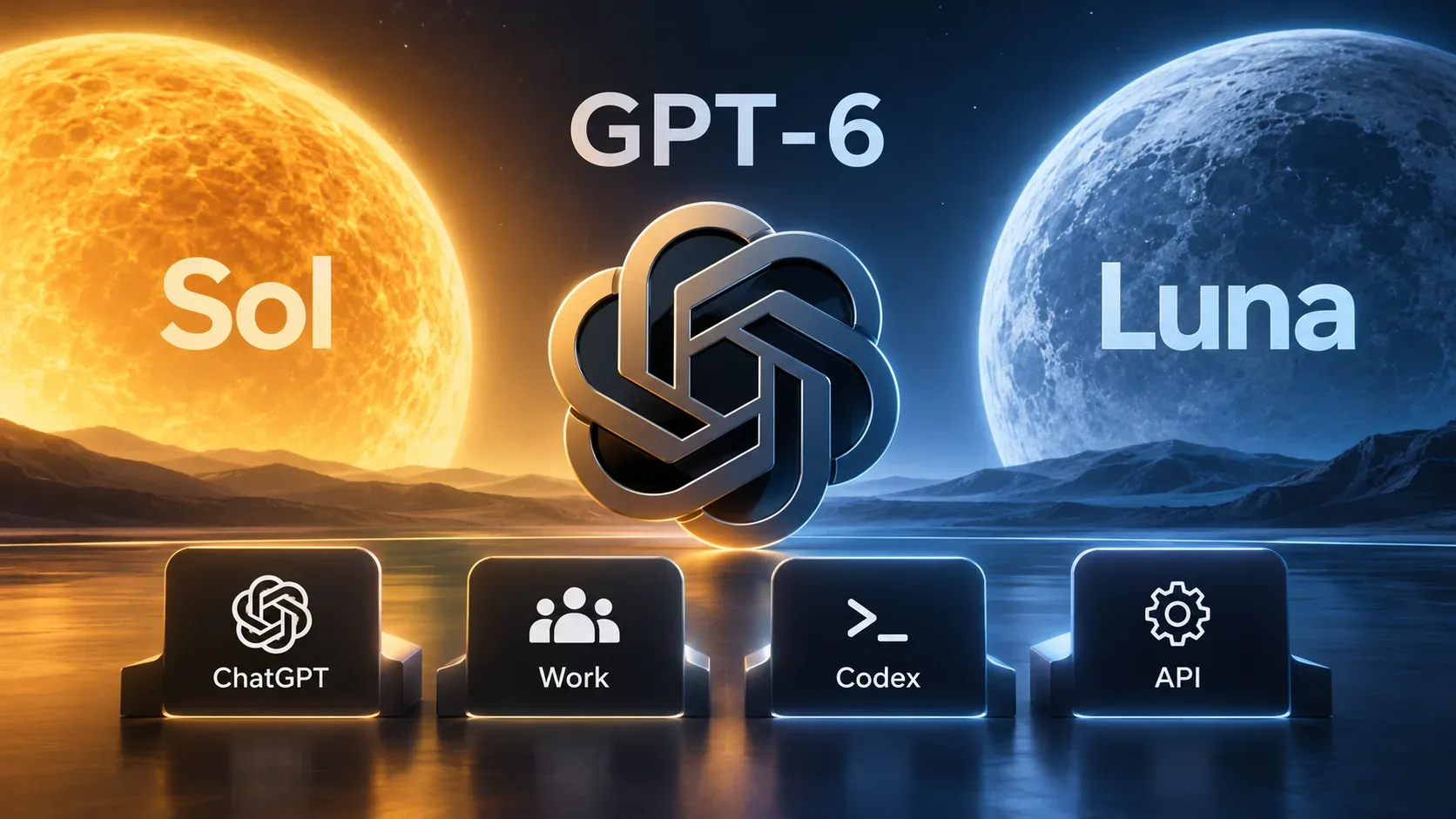
On September 22, 2026, OpenAI announced GPT-6 Sol and GPT-6 Luna as new members of the GPT-6 family. Initial availability is not the same across the ecosystem: both models were announced for ChatGPT Work, Codex, and the API, while GPT-6 Luna also received a specific access path for Free and Go users in the desktop app. At the same time, OpenAI said Sol and Luna were not yet available in regular Chat at the time of the announcement.
Where GPT-6 Sol and Luna are available
| Product or area | GPT-6 Sol | GPT-6 Luna | Plans and announced status |
|---|---|---|---|
| ChatGPT Work | Available | Available | Plus, Pro, Business, Enterprise, and Edu, with a gradual rollout during September 22 |
| Codex | Available | Available | Plus, Pro, Business, Enterprise, and Edu, with a gradual rollout during September 22 |
| Desktop app for Free and Go | Not announced for these plans | Available | Free and Go users can access GPT-6 Luna in the desktop app |
| Regular Chat in ChatGPT | Not yet available in the announcement | Not yet available in the announcement | OpenAI explicitly separated the models in Work and Codex from the models available in Chat |
| OpenAI API | gpt-6-sol | gpt-6-luna | Available in the API since September 22 |
Work and Codex do not mean availability in regular Chat
This is the point most likely to cause confusion. ChatGPT release notes say GPT-6 Sol and GPT-6 Luna arrived in ChatGPT Work and Codex and that these models are separate from the models available in Chat. As a result, an eligible user may find Sol or Luna in Work or Codex without seeing them in the model selector of a regular conversation.
The launch page reinforces the same distinction by stating that the models were not yet available in Chat. Availability announced on September 22 should therefore be read product by product, rather than as a general release across the entire ChatGPT interface.
What the gradual rollout means
OpenAI announced Sol and Luna as available from September 22 in eligible products and plans, but also said the rollout would happen gradually during the day to keep the service stable. In practice, two accounts on the same plan could receive access at different times. The official guidance was to try again later if the model did not yet appear in ChatGPT Work or Codex.
This gradual rollout does not change the announced list of plans. It only separates the official availability date from the moment the feature becomes visible in each account.
What are the API identifiers
In the OpenAI API, the published model names are gpt-6-sol and gpt-6-luna. The API changelog records both on September 22, 2026 and says they accept text and image inputs and generate text through both the Responses API and Chat Completions.
Under the standard pricing listed for prompts with up to 272K input tokens, GPT-6 Sol costs $2 per 1 million input tokens, $0.20 per 1 million cached input tokens, and $10 per 1 million output tokens. GPT-6 Luna costs $0.10, $0.01, and $0.50, respectively. Prices can depend on processing conditions and prompt sizes described in the API documentation.
How to check access without mixing up the products
- Plus, Pro, Business, Enterprise, and Edu: look for GPT-6 Sol and GPT-6 Luna in ChatGPT Work and Codex. If they are not visible yet, the rollout may still be in progress.
- Free and Go: the additional access announced is GPT-6 Luna in the desktop app.
- Regular Chat: not seeing the models in the selector is consistent with the September 22 announcement, which said Sol and Luna were not yet available there.
- API: use the exact identifiers gpt-6-sol and gpt-6-luna.
Official sources
Availability details come from the official GPT-6 Sol and Luna announcement, the ChatGPT release notes, and the OpenAI API changelog.