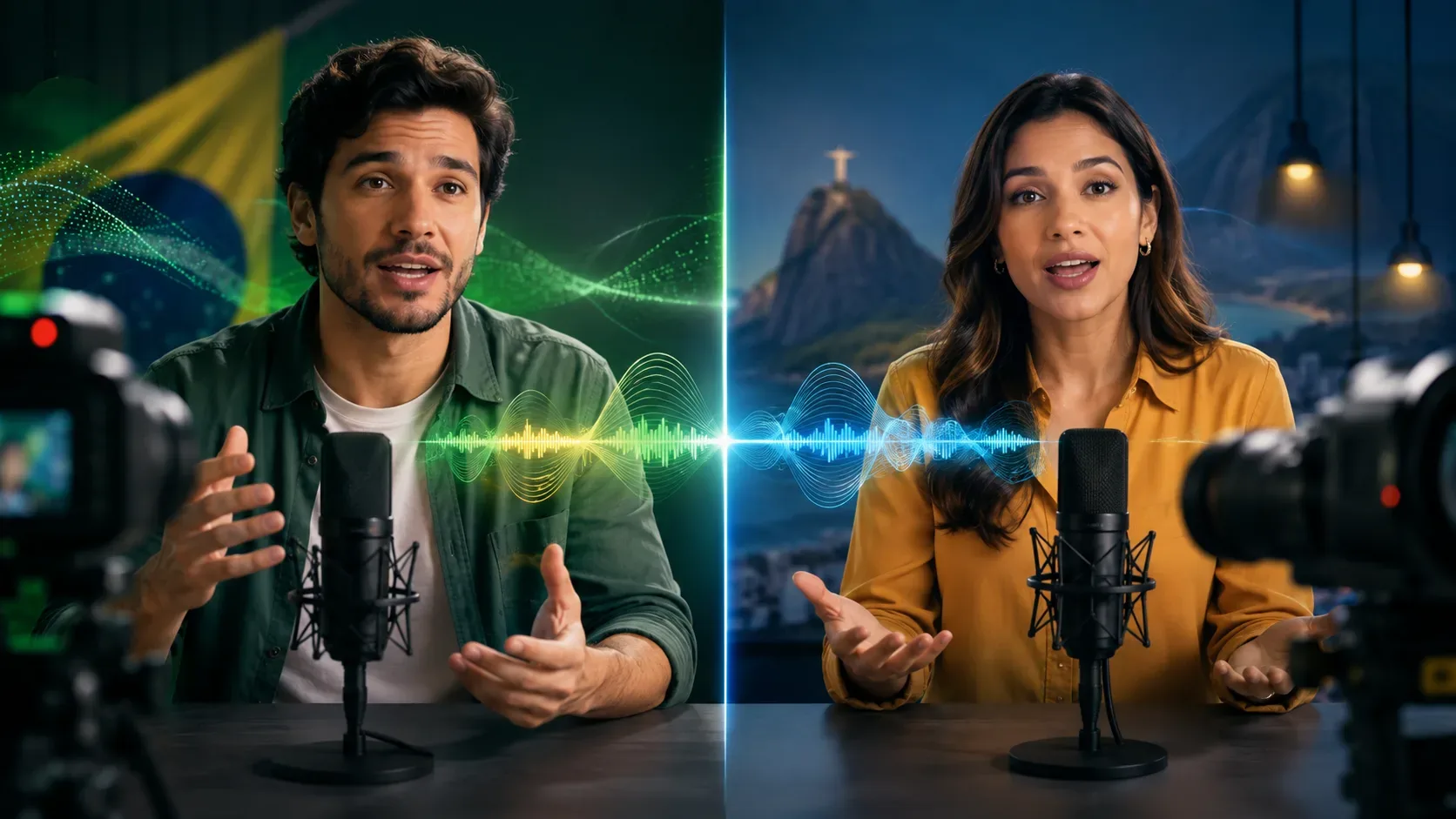
Short answer: if you want to generate the scene, voice, and Brazilian Portuguese dialogue in the same process, Veo 3.1 is currently the more defensible first choice between the two — but that does not mean Google guarantees Brazilian Portuguese. The API documentation says Veo 3.1 generates audio natively and accepts dialogue instructions, while also stating that only English has been fully evaluated; other languages may work, with variable results. With Kling 3.0, the limitation is more explicit: native audio is documented for Chinese, English, Japanese, Korean, and Spanish, with Portuguese absent from the list.
That changes the verdict depending on the workflow. If the requirement is a Brazilian Portuguese voice generated together with the video, Veo 3.1 deserves the first test. If you already have a Portuguese recording and mainly need lip-sync, longer duration, and scene control, Kling 3.0 remains competitive because its lip-sync workflow accepts user-uploaded audio. So there is no universal winner: the better option differs between native PT-BR audio and video dubbed with a prepared voice track.
What the official sources actually guarantee
In the Veo 3.1 Gemini API documentation, Google describes video generation with native audio, examples of character dialogue, and synchronized soundtracks. The same page lists 4-, 6-, or 8-second clips and says audio is generated natively with the video. However, the limitations section adds an important caveat: English has full support, while other languages have not been evaluated. In other words, Portuguese may work, but there is no official guarantee of quality, pronunciation, or stability equivalent to English.
In Kling AI's official FAQ, the company separates two workflows. Native Audio in VIDEO 3.0 and VIDEO 3.0 Omni generates the scene, dialogue, facial performance, and supporting sound together; in that mode, the listed languages are Chinese, English, Japanese, Korean, and Spanish. Lip Sync, by contrast, accepts a user-uploaded recording of dialogue, narration, or singing. Kuaishou's Kling 3.0 launch announcement also confirms multilingual native audio, multi-character dialogue, and videos up to 15 seconds.
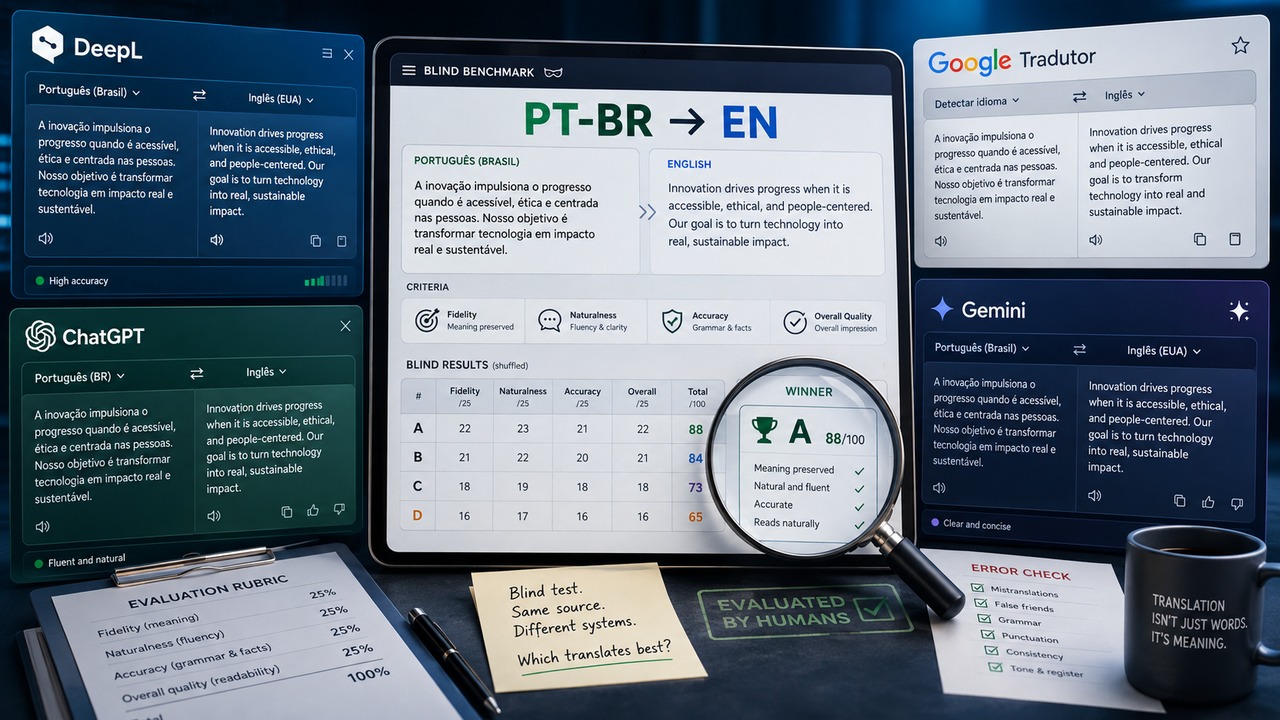
Veo 3.1 vs Kling 3.0 for Portuguese speech: a practical comparison
| Criterion | Veo 3.1 | Kling 3.0 | Impact for PT-BR |
|---|---|---|---|
| Native audio generated with video | Yes; in the Gemini API, audio is generated with the video | Yes, in VIDEO 3.0 and VIDEO 3.0 Omni | Both use integrated audiovisual generation |
| Portuguese in native audio | Not certified; English is the only fully evaluated language | Not included in the official Native Audio language list | Veo is the more plausible bet, but without an official guarantee |
| Multi-character dialogue | Documentation shows dialogue and synchronized sound | Supports multi-character dialogue and speaking-order control in supported languages | Kling is strong at dialogue direction, but native Portuguese is the barrier |
| Using an existing Portuguese voice recording | Not the main documented Veo workflow for producing synchronized speech | Yes; Lip Sync accepts uploaded audio | Kling becomes more relevant when the PT-BR voice is already prepared |
| Single-generation duration | 4, 6, or 8 seconds | Up to 15 seconds | Kling gives more room for a complete line or dialogue exchange |
| Narrative control | Visual references, first/last frame, and extension in compatible workflows | References, multi-shot direction, and storyboard tools in the 3.0 ecosystem | Kling tends to provide more room for longer scenes and shot planning |
“Supports Portuguese” is not the same as “generates Portuguese well”
Three different questions are often mixed together. The first is whether the system accepts a prompt written in Portuguese. The second is whether it can generate a voice speaking Portuguese. The third, and most demanding, is whether it can produce natural, intelligible Brazilian Portuguese with a coherent accent and synchronized lips. A Portuguese-localized interface does not answer the last two questions.
For Veo 3.1, the documentation supports the inference that languages other than English may work, but Google itself warns that they have not been evaluated. One good generation therefore does not prove consistency. With Kling 3.0, the boundary is clearer: Portuguese does not appear among the native-audio languages. Asking for Portuguese speech in that mode may lead to refusal, bad pronunciation, a language switch, or other behavior that should not be treated as a supported feature.
When Kling 3.0 can be better even without native Portuguese audio
If the project allows a two-step workflow, the comparison changes. Kling lets you upload your own recording for lip-sync. That creates a more controllable path for advertising, UGC, training, and corporate video: record or generate the Brazilian Portuguese voice in a dedicated audio tool, review the wording and pronunciation, and only then synchronize the character.
This workflow loses the convenience of “one generation does everything,” but it can gain predictability. It also takes advantage of Kling 3.0's up-to-15-second duration, useful for a complete commercial line, a short exchange between two characters, or a scene with more breathing room. When a project must preserve a client-approved voice, uploaded audio can matter more than native voice generation.
When Veo 3.1 is the more logical choice
Veo 3.1 makes more sense when the goal is to quickly produce a clip where image, performance, speech, sound effects, and ambience are born together. Google recommends putting specific lines in quotation marks and describes synchronized soundtrack generation. For ad prototypes, sketches, social videos, and short scenes, this reduces steps.
The operational caveat is that Portuguese is not an officially evaluated language in the current documentation, so each team has to measure its own success rate. If a campaign requires an exact sentence, brand name, number, address, or technical term, one good sample is not enough; repeated testing and a dubbing fallback are advisable when verbal fidelity is critical.
How to run a fair PT-BR benchmark
A defensible comparison should not rely on one attractive video from each tool. Run the same battery of prompts, with the same framing, equivalent duration, and approval criteria defined before viewing the results. If a model does not offer native Portuguese, that should count as a test result rather than being hidden by external dubbing.
- Short monologue: one person saying a 10-to-15-word sentence in Brazilian Portuguese, with no music.
- A/B dialogue: two characters, one line each, measuring whether the correct person speaks each line.
- Difficult pronunciation: proper names, consonant clusters, numbers, and one foreign word commonly used in Brazil.
- Noise and effects: speech with simple ambient sound to check whether the voice remains intelligible and synchronized.
- Repeatability: at least five generations of the same prompt to measure how many outputs are truly publishable.
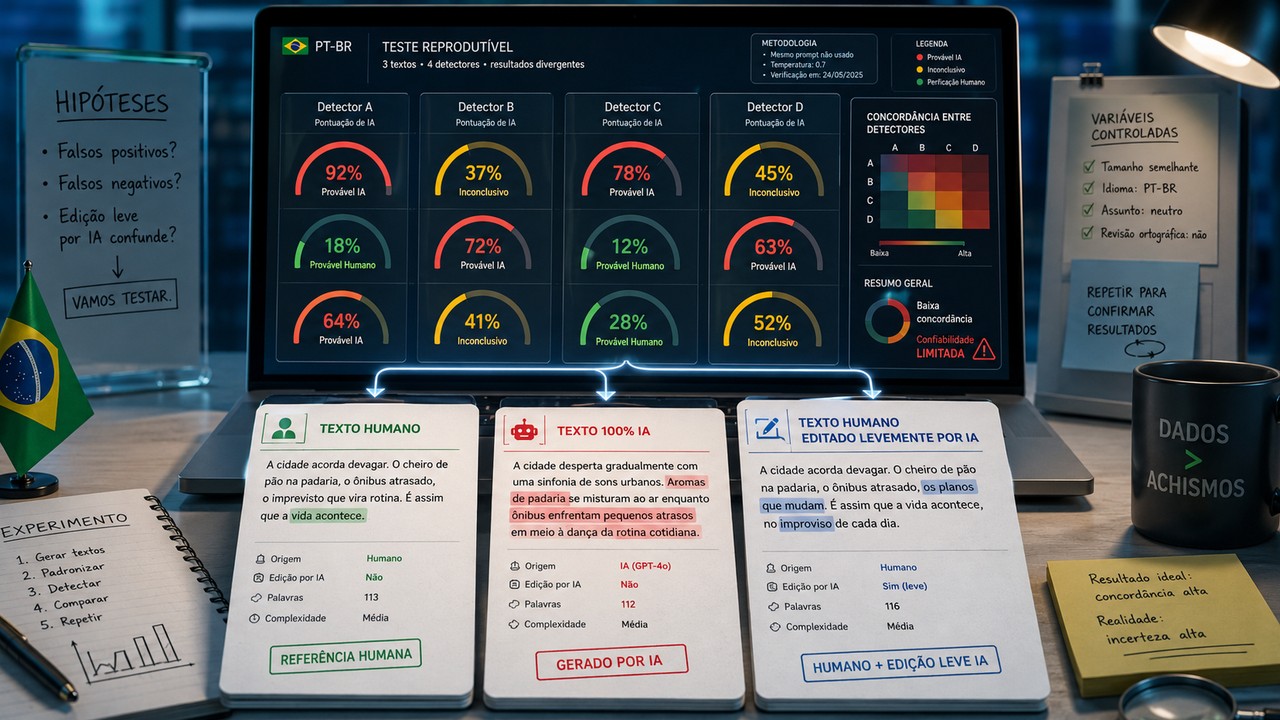
For each video, score text fidelity, accent naturalness, intelligibility, lip-sync, speaker attribution, facial stability, ambient-sound quality, and cost per approved take. The last metric is more useful than price per credit: a cheap model that requires many regenerations can cost more per usable video.
Verdict by use case
- I want to generate a PT-BR voice with the video, without an external track: start with Veo 3.1. It has the stronger documentary basis for attempting this workflow, but treat Portuguese as unguaranteed and test consistency.
- I need Portuguese to be explicitly listed as an officially supported native-audio language: neither product meets that requirement in the sources reviewed on September 1, 2026.
- I already have an approved Brazilian Portuguese voice and only need to animate/synchronize the character: Kling 3.0 becomes a strong alternative thanks to uploaded-audio lip-sync and up to 15 seconds of duration.
- I need longer conversations or a multi-shot scene: Kling 3.0 has a structural advantage in duration and narrative tools; for PT-BR, combine it with external audio when necessary.
- I need an exact sentence with minimal risk of word substitution: do not rely only on generative audio. Generate or record the voice separately, review it, and synchronize afterward.
The point that could change this comparison
Video models change quickly. Veo 3.1 may expand official language evaluation, and Kling may add Portuguese to Native Audio. The most important criterion is therefore not to preserve a static “best AI” table, but to verify two things before paying or scaling production: which languages are officially supported in the exact workflow you will use and what percentage of takes pass with your real script.
As of September 1, 2026, the safest reading of the primary sources is: Veo 3.1 is the first option to test for native audiovisual generation in Brazilian Portuguese; Kling 3.0 is more predictable when you bring a ready-made Portuguese audio track for lip-sync. This is a product verdict based on documentation and workflow, not an invented laboratory benchmark.