If you want a short answer, here it is: for general Brazilian Portuguese text that requires naturalness, context and handling of idiomatic expressions, ChatGPT is currently the most defensible choice among the four, provided the translation is reviewed. For professional workflows where consistent terminology, glossaries and predictability matter more, DeepL may be the better tool. Google Translate remains very strong in convenience and document translation, while Gemini is a capable contextual alternative, but the public evidence specific to PT-BR is still less conclusive for putting it ahead.
That does not mean there is a universal, definitive score. The tools change models, results depend on the text genre and, in the case of ChatGPT and Gemini, even the instruction given to the system changes the translation. The most useful comparison in 2026 is to separate what has actually been demonstrated in Brazilian Portuguese from what comes from other language pairs or tests conducted by the companies themselves.
What is still missing before there can be an absolute winner
I did not find a public study that brings DeepL, Google Translate, ChatGPT and Gemini together in the same blind, general-purpose, up-to-date benchmark dedicated exclusively to PT-BR to English. That detail matters because combining results from different studies creates an artificial ranking: each study uses its own texts, model versions, evaluators and criteria.
There is also a date problem. A test conducted with ChatGPT-4o or Gemini 1.5 Pro does not automatically measure the version a user encounters today. The same applies to dedicated translators, which update models without turning every change into a new product name. Any responsible conclusion therefore needs to be dated and tied to the type of text that was tested.
The strongest recent evidence specifically about Brazilian Portuguese
The most directly relevant study I found was presented at PROPOR 2026, a conference on computational processing of Portuguese. The researchers evaluated 100 Brazilian Portuguese expressions translated into English by ChatGPT-4o, Gemini 1.5 Pro and Google Translate. The corpus included idiomatic expressions, sociolinguistically marked items, metaphors and intensifiers.
The methodology tried to reduce a typical chatbot advantage. ChatGPT and Gemini received a minimal instruction equivalent to "translate this sentence," without additional context, examples or refinement. The translations were generated without post-editing. The evaluation considered adequacy, fluency, coherence and cohesion, and cultural adaptation.
In that sample, ChatGPT and Gemini achieved higher average performance than Google Translate in adequacy and fluency, while Google was more prone to literal transfer. The difference becomes clear in examples such as "chutar o balde": ChatGPT produced a paraphrase close to "give up completely," Gemini moved the meaning toward "lose patience," and Google returned "kick the bucket," an English expression that means to die. With "acabar em pizza," ChatGPT also preserved the idea of something ending without consequences better, while Google kept a literal translation.
The study does not turn ChatGPT into the winner for every kind of translation. It records failures across all systems. In some cases, the LLMs neutralized regional identity; in others, they misinterpreted isolated slang. And the experiment did not include DeepL. Even so, it provides important evidence: when Brazilian Portuguese moves beyond the literal and depends on cultural inference, conversational systems can have a real advantage over more rigid machine translation.
Where DeepL fits into this comparison
DeepL has a different proposition. It is a specialized translation system with terminology-control and professional-workflow features. Current documentation allows users to create glossaries with Portuguese and English and apply preferred translations to specific terms, which is useful for companies, products, technical documentation and texts that need to repeat the same lexical choice across many pages.
There is an important nuance for users starting from PT-BR. DeepL distinguishes "Brazilian Portuguese" as a target-language variety, but when Portuguese is the source language, the documentation states that varieties are not distinguished. In PT-BR to English, therefore, the system receives "Portuguese" as the source and can offer American or British English as the target. This does not prevent good translation of Brazilian Portuguese, but it means the PT-BR label does not function as a source-language selector in this direction.
DeepL itself publicizes blind tests with specialists in which its next-generation model was preferred over Google Translate and ChatGPT-4 and required less editing. That result is relevant, but it should be read as vendor evidence: the test is presented by the company with a stake in the outcome, is not specific to PT-BR to English, and the public results initially highlighted other language pairs. It helps explain the product's strength, but it does not settle the contest for our use case.
Independent studies show why text genre changes the outcome
In a 2025 study on translating tourism texts from Chinese into English, published in Frontiers in Artificial Intelligence, ChatGPT outperformed DeepL and Google Translate on the evaluated dimensions, especially when it received instructions adapted to the context. The authors, however, also observed semantic deviations and argued for human post-editing. It is a good example of how naturalness and persuasive quality can increase at the same time as the risk that the model interprets beyond the source.
Another study, involving medical abstracts translated from French into English, found similar performance from DeepL and Google Translate on automatic similarity metrics, with no statistically significant difference between the systems on those metrics. Human fluency evaluation also showed that small differences can depend on the text set. The point is not to transfer that result to PT-BR, but to show that saying a system is "more accurate" without specifying domain and language pair is a weak claim.
ChatGPT: the best bet for general text with context
For emails, editorial copy, customer service, presentations, product communication and other genres where tone and intent matter, ChatGPT has a practical advantage: you can specify who is speaking, who will read the text, which variety of English you want and which terms must not be changed. That makes it possible to resolve ambiguities that a single-box translator must infer on its own.
The same flexibility is also the main risk. An LLM can make a sentence more elegant and, in the process, soften a negation, add an explanation, change the degree of certainty or adapt an expression beyond what the source authorizes. For high-fidelity translation, the instruction should constrain that behavior: preserve meaning, numbers, names, modality and ambiguities; do not add information; use American or British English as specified; and flag ambiguous passages instead of inventing a solution.
DeepL: better when consistency matters more than conversation
If the work involves many pages, recurring vocabulary, product names, internal legal terms or technical documentation, DeepL gains value by reducing variability. Glossaries and customization features let teams lock in preferences without depending on repeating a prompt in every session. For teams that need translation at scale, that predictability may matter more than producing the most creative or idiomatic sentence on the first try.
Care is still needed with strongly marked Brazilian expressions, humor, wordplay and cultural references. A system specialized in translation may preserve structure and terminology better and still choose a literal solution where an English reader would expect a functional equivalent.
Google Translate: best for convenience and a fast workflow
Google Translate retains an advantage that is hard to ignore: immediate access, broad language coverage and integration with text, websites, images, voice and documents. Official help documents translation of files such as DOCX, PDF, PPTX and XLSX in the browser, with its own limits on file size and page count. For someone who needs to understand content quickly or convert a document without setting up a conversational AI workflow, it remains the simplest option.
The cost of that simplicity appears when a sentence depends on pragmatics, slang or culture. The PROPOR 2026 study showed exactly this pattern in Brazilian expressions: grammatically well-formed outputs could still be semantically wrong because they were too literal. For simple, informational text, that may not be a problem; for advertising, negotiation, sensitive customer service or cultural content, it can be.
Gemini: strong as a second reading and contextual alternative
Gemini shares with ChatGPT the ability to receive context and instructions, and Google's documentation confirms Portuguese support across the Gemini ecosystem. Responses can also be customized with instructions in available platform features. That makes it closer to a translation assistant than to a traditional machine translator.
In the PROPOR 2026 study, Gemini 1.5 Pro was close to ChatGPT-4o in fluency and adequacy, but in the published examples ChatGPT often preserved idiomatic meaning better. Because current versions are not necessarily the ones used in the study, the correct reading is that Gemini demonstrated competitive capability for culturally marked PT-BR, not that there is a fixed and permanent difference between the brands.
How to control errors without relying on the tool's name
The best translation is not simply the sentence that "sounds more English." Fidelity requires checking proper names, numbers, dates, units, negations, conditionals, degree of certainty, cause-and-effect relationships and terminology. In PT-BR, it is also useful to flag expressions that may be slang, regionalisms, irony or figurative language before accepting a version that sounds too natural.
For important content, a safer strategy is to separate translation and review. Generate the first version in one tool, perform a second independent check and compare any disagreement against the source. If the text has legal, medical, financial, reputational or contractual consequences, the final review should be done by a qualified human. Recent studies of AI translation continue to find cases in which a sentence is fluent and still loses intent or precision.
What a truly comparable blind PT-BR to English benchmark would look like
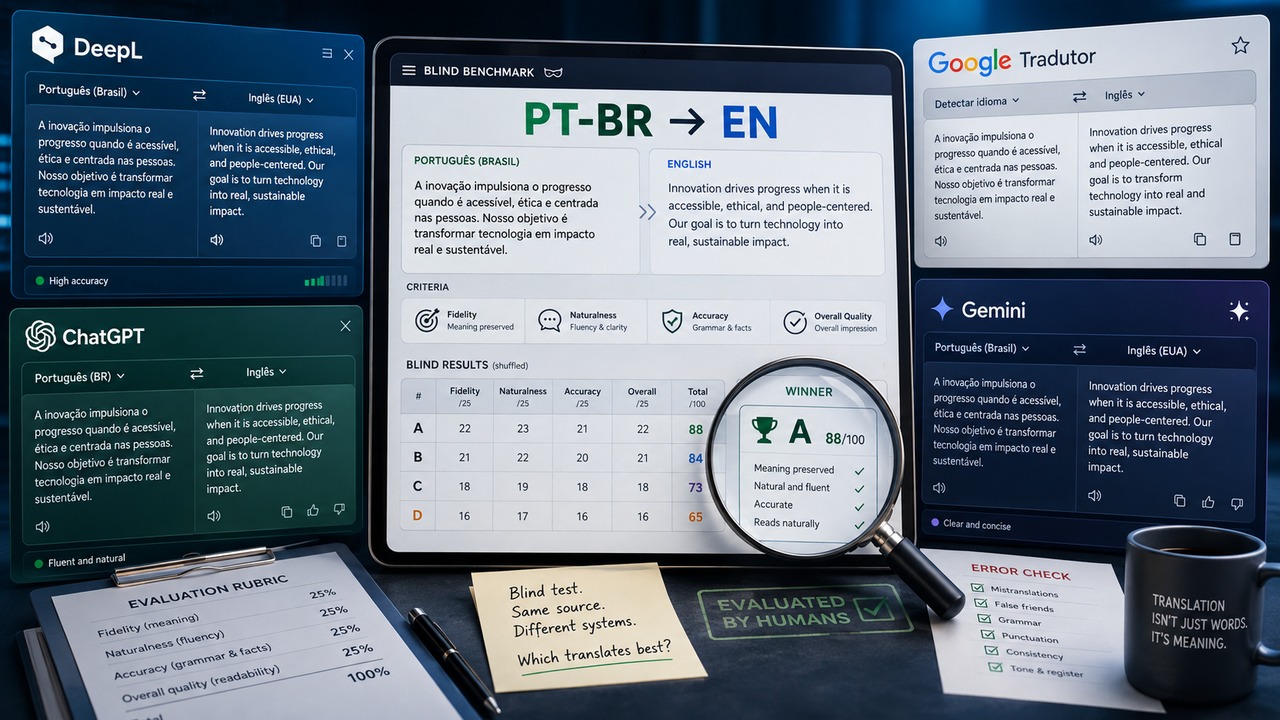
A robust editorial test should use exactly the same texts and conditions for all four systems. The corpus would need to mix genres: news, professional email, customer service, technical text, product description, colloquial speech, idiomatic expressions and a passage with controlled ambiguity. The texts would need to contain numbers, names and verifiable terms so that objective errors could also be audited.
The outputs should be anonymized and shuffled before evaluation. Bilingual evaluators could score fidelity of meaning, naturalness in English, terminology, preservation of tone and severity of errors. The final ranking should separate stylistic preference from factual error. Automatic metrics can help, but they do not replace human judgment on idiomaticity and pragmatics.
For ChatGPT and Gemini, the benchmark would also need to record the prompt, model version and whether there was conversation history. For DeepL and Google Translate, it would be necessary to record the translation mode, language variants and any glossary or customization. Without that record, the test is not truly reproducible.
Verdict: which one I would choose in 2026
For a Brazilian user who wants to translate general text into English with good naturalness and an ability to handle context, I would start with ChatGPT, using fidelity instructions and a final review. The PT-BR-specific evidence available in 2026 reinforces the advantage of LLMs on non-literal expressions, and ChatGPT was the most consistent across the published examples from that study.
I would choose DeepL instead when the main problem was terminology consistency, repetition at scale and a more controlled translation workflow. I would use Google Translate when speed, simplicity and direct document translation were the priority. And I would place Gemini as a strong contextual alternative, especially as a second reading to detect different solutions or ambiguities.
The most important thing is not to turn the brand into a guarantee. In translation, one tool can win on naturalness and lose on fidelity in the same sentence. In 2026, the most useful answer is not "which AI translates everything best," but which combination of tool, context and review reduces the type of error that matters most in your text.