The short answer is: some AI detectors accept Portuguese and claim to have been trained for that language, but this does not mean that a percentage displayed on the screen proves who wrote the text. In August 2026, GPTZero, Copyleaks and Winston AI declare support for Portuguese. Grammarly's detector is described by the company itself as developed for writing in English. Turnitin's AI writing report only accepts English, Spanish and Japanese, therefore Portuguese should not be treated as a valid test of this tool.
This difference matters because the problem is not just whether the text field accepts accents. A serious test needs to measure false positives, false negatives, effect of text size, stability between runs and, most importantly, what happens when a human text is just reviewed by AI. Without this separation, a comparison can produce beautiful numbers and still answer the wrong question.
Accepting Portuguese is not the same as demonstrating accuracy in PT-BR
GPTZero added support for Portuguese in 2025 and published an internal benchmark in which it reported 99.2% accuracy, 99.0% recall and 0.64% false positive for Portuguese. This data is useful for understanding the manufacturer's claim, but it remains an internal test: corpus, model version, cutting criteria and text distribution are defined by the supplier itself. It does not replace an independent replication in Brazilian Portuguese.
Copyleaks lists Portuguese, code pt, among the 30 languages accepted by its AI content detector. Winston AI also includes Portuguese among the supported languages and reports that its models are updated frequently. In both cases, the existence of official support is a point in favor of the operational validity of the test, but it does not alone resolve the issue of reliability in real Brazilian texts.
Grammarly's situation is different. The company has expanded writing, correction and rewriting capabilities for Portuguese, but its own detector comparison published in 2026
describes AI Detector as designed for writing English. This means that a score obtained with PT-BR, even if the interface allows you to paste text, needs to be marked as exploration outside the scope explicitly described for the detector, and not as evidence of validated performance in Portuguese.
At Turnitin, the limit is even clearer. Current documentation requires at least 300 words of prose and restricts the AI Writing Report to English, Spanish, and Japanese. In Portuguese, the correct result of the protocol is not to force a score: it is to record “unsupported language” and exclude the tool from the quantitative comparison in PT-BR. This documentary control avoids turning the lack of support into a false failure or, worse, into a number with no validity declared by the product itself.
Percentages don't measure exactly the same thing
Another common mistake is to put four percentages side by side and treat them as if they were comparable probabilities. They aren't necessarily. There are tools that estimate the fraction of text considered to be generated by AI, others display a “human score”, others classify excerpts or combine labels such as human, AI and mixed. Thresholds can also change between versions and plans.
Therefore, a reproducible test must store two layers of results. The first is the raw value displayed by the detector, exactly as it appears. The second is the operational classification of the product itself, such as “probable AI”, “human”, “mixed” or equivalent. Only after that does it make sense to calculate metrics. Converting all scores to an invented scale of 0 to 100 and taking an average erases methodological differences and creates a precision that the original data does not possess.
False positives and false negatives are easy; AI-reviewed human text is not
False positive is the case in which a text of human origin is classified as AI. False negative is the opposite: a text entirely generated by AI passes as human. These two metrics work when the source is binary and known.
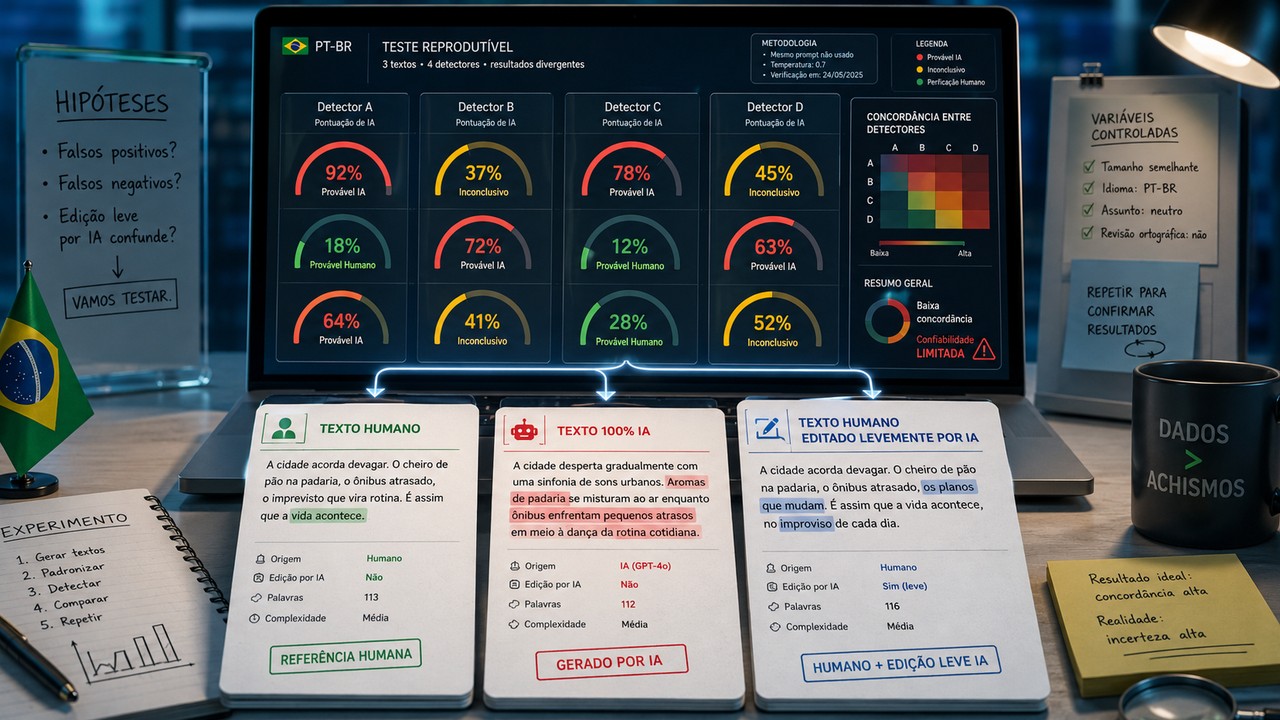
The problem appears in the third, increasingly common group: the author wrote the content, but used AI to correct grammar, clarity, flow or style. In this scenario, calling any detection a “false positive” could be methodologically wrong, because there was AI intervention; at the same time, calling the text “AI-generated” erases the human authorship of the content. The test needs to treat this material as its own category and measure how much the revision changes the score in relation to the original human version.
Recent research shows why this distinction is not theoretical. An August 2026 study of English academic summaries found that light edits, made with a refinement statement, were flagged in 64% to 80% of cases by Pangram and GPTZero. Unedited originals were flagged at 9% to 15%. The same work showed that a subsequent “humanization” stage was able to drastically reduce the detection of texts classified as AI. The study is not in Portuguese and, therefore, does not authorize transporting these percentages to PT-BR, but it shows how the border between authorship and textual surface can confuse the detector.
Another work from 2026, ARB, explicitly separated human text, direct generation by LLM, human text rewritten by LLM, and LLM text rewritten by the same type of model. In
Open detectors tested with an operating point of 1% false positive, the best achieved recall above 91% for direct generation, but dropped to approximately 15% to 31% when the original text was human and had just been rewritten by AI. The result reinforces the need not to mix “who created the content” with “who produced the final writing”.
Independent studies also show that version, model and domain change the outcome
A study published in 2026 in the International Journal for Educational Integrity compared GPTZero, Copyleaks, Turnitin and Pangram on 160 academic texts in English with known origins. In that particular set, all detectors correctly classified the 40 fully human texts. However, for texts entirely generated with a recent version of Deep Research, GPTZero and Copyleaks strongly underestimated the AI content, and Turnitin marked the 40 texts as false negatives according to the criteria adopted by the authors. Pangram performed much better in that experiment.
This result is not a universal ranking. The texts were long, academic, in English, and were generated and tested in a specific period. Tools are updated. The value of the study is different: it demonstrates that a tool can appear excellent in a benchmark and fail when the generating model, domain or way of constructing the text changes.
The RAID benchmark had already reached a similar conclusion on a larger scale. By varying models, domains, generation strategies and attacks, the authors found a loss of robustness in detectors that worked well in conditions closer to training. In other words, “high accuracy” is only informative when you know in which texts, versions and conditions it was measured.
How to assemble a PT-BR corpus that allows honest testing
The first step is to freeze the corpus before opening any detectors. If texts are chosen after seeing the first results, the test is vulnerable to convenient selection. Each item must be given a permanent identifier, word count, creation date, and a record of origin.
Human texts need verifiable provenance
For the human group, the ideal is to use texts from known authors or test participants with a draft history, date and consent for publication. Texts prior to the popularization of large generators can also serve as a control, as long as the domain and style are comparable to other groups. What should be avoided is classifying as “human” an anonymous text found on the internet just because it looks human.
AI-generated texts need to be paired with the same tasks
The group entirely generated by AI must respond to the same proposals used in the human group. If humans write about everyday topics and AI produces academic essays, the detector can learn the domain rather than the source. The record must store the exact model, date, prompt, temperature when available, and raw text without manual editing.
It is also important to use more than one generating model. A detector trained to recognize patterns from one family may perform differently in another. Mixing results without registering the generator prevents finding out whether the error came from the detector or from a change in the distribution of texts.
AI-reviewed human text must be born from a before/after pair
The third group must start from an already frozen human text. The AI receives limited instruction, for example correcting grammar and clarity without adding facts or changing the argumentative structure. The original version and the revised version remain linked by the same identifier. This way it is possible to measure the variation in the score caused by editing, and not compare different texts as if they were equivalent.
The record must include how much the text has changed. A simple measure is the proportion of changed words, supplemented by an inspection of the diff. This allows you to separate light correction from heavy rewriting, two operations that can produce very different effects on detectors.
Text size should be a controlled variable
Short excerpts and long texts should not be included in the same average. A practical division is to test a short, an intermediate, and a long range with defined limits before collection. For example, 120 to 180 words, 350 to 500 words, and 900 to 1,200 words. The exact number can change, but the ranges need to be the same across classes and remain frozen.
This care is especially important because some tools impose their own minimums. Turnitin, for example, requires 300 words of prose for its AI report. As Portuguese is not a supported language by the product, this is not included in the PT-BR quantitative benchmark, but serves as a reminder that “short text” may be outside the scope of certain detectors.
How to run the test without missing the product version
All detectors must be run in the shortest possible time. For each run, record the date, time, plan used, language selected, name or version displayed by the service, tool URL, and a capture of the result. If the product does not state the model version, record the access date and any available public update notes.
The same text must be sent without formatting changes that could introduce another variable. Quotation marks, titles, lists, line breaks and references must follow a single rule. If the goal is to test only prose, remove non-prose elements before freezing the corpus and apply the same rule to all items.
When the tool allows you to repeat the analysis, it is worth running the same item more than once and recording any variations. If the results are identical, that is information. If they change, instability is also a result and should not be hidden by automatic averaging.
A second round weeks later can measure version drift, but should be published as another point in the experiment. Mixing the old score with the new one turns product updates into statistical noise.
The metrics that really answer the question
For human texts, the central metric is the false positive rate: how many were classified as AI among all humans. For fully generated texts, the central metric is the false negative rate: how many escaped as humans among all AI texts. It is also useful to publish sensitivity, specificity and confidence intervals, rather than just aggregated accuracy.
Accuracy alone can deceive. If the corpus has many more human texts than AI texts, a conservative detector can get most of them right by simply marking almost everything as human. The report must show the confusion matrix by class and by size range.
In the AI-reviewed human group, metrics must be paired. The most informative data is how much the score changed from the original to the revised version, how many texts crossed the “AI” threshold after editing, and whether different detectors agreed on the same pairs. This measures sensitivity to AI intervention without pretending that authorship has become purely binary.
You may also want to publish disagreement between tools. If the same text receives 90% AI in one service and “human” in another, this divergence is a finding, not a problem to be erased. The reader needs to see that consensus between detectors is not guaranteed and that an isolated percentage does not have universal meaning.
What can you conclude in Portuguese without inventing your own benchmark
First, there is declared support for Portuguese in GPTZero, Copyleaks and Winston AI. This allows them to be included in a PT-BR test, as long as the report makes it clear that “Portuguese” does not always mean a separately documented calibration for Brazilian Portuguese.
Second, Grammarly now offers several writing features in Portuguese, but describes its detector as designed for English. Any analysis of PT-BR should be marked as exploratory and not placed on the same level as tools that declare detection support for the language.
Third, Turnitin does not offer AI Writing Report for Portuguese. In a Brazilian comparison, the relevant information is precisely this limitation. Forcing the product to produce a number outside the supported language would be less stringent than recording “not applicable.”
Fourth, independent studies from 2026 reinforce that no detector should be boiled down to a generic hit rate. Performance changes with model generator, domain, editing and rewriting. Results in English are important for formulating hypotheses and experimental design, but they do not replace a Brazilian corpus with known origin.
AI detector serves better as a screening signal than proof of authorship
The suppliers' own documentation converges on an important point: the score needs context. Grammarly claims that no detector can conclusively determine whether AI was used. Turnitin recognizes the possibility of false positives, hides low percentages because they are less reliable, and advises that the indicator should not be used alone to take action against a student.
For school, university, publisher or company, this changes the function of the detector. It can indicate which texts deserve additional review, but the investigation must consider version history, sources, drafts, writing process, AI use policy and conversation with the author. The tool observes statistical patterns in the final text; she does not witness the authorship.
In Brazilian Portuguese, the useful question is not “which detector gives the highest percentage?”, but rather “which detector maintains low false positive rate, low false negative rate and stable behavior when changing size, domain, generating model and level
editing?” Only a frozen, paired and versioned test can answer this without turning a commercial score into a verdict.