
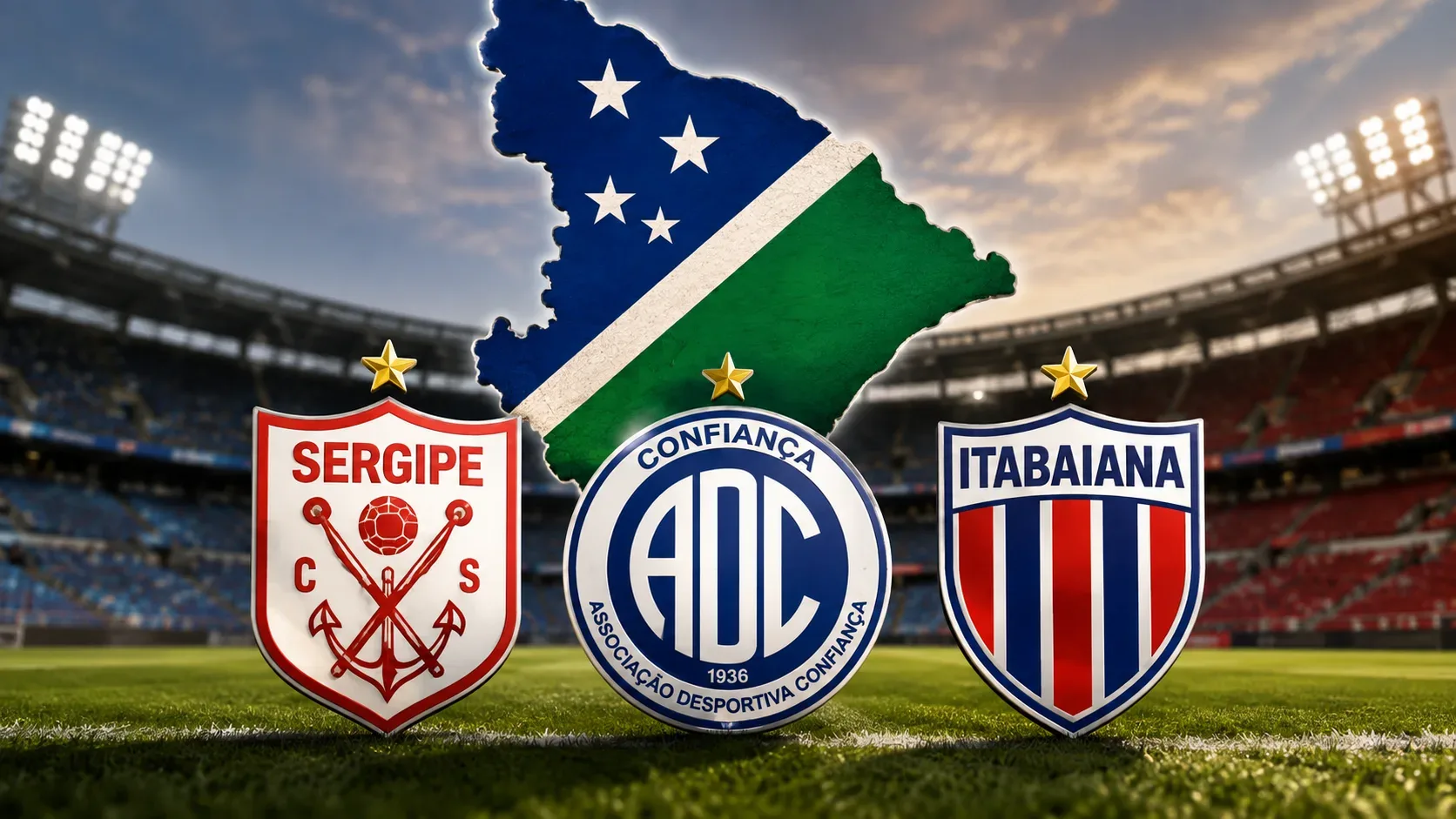
The answer changes with the definition. If “top flight” means the Brazilian Championship in a broad historical sense, including the Taça Brasil in the lineage of national championships, Sergipe has 12 appearances, Confiança 8 and Itabaiana 5. This is the approach used by ge in its survey of Northeastern clubs since 1959.
If the question is narrower — how many times each club played in Série A from the 1971 Campeonato Nacional onward, keeping each season’s divisions separate — the year-by-year record from RSSSF Brasil produces a different tally: Sergipe 9, Confiança 5 and Itabaiana 5. The gap is not simply an arithmetic error: it comes from different treatments of pre-1971 competitions and exceptional formats, especially in 1986 and 2000.
Short answer: there are at least three possible tallies
| Criterion | Sergipe | Confiança | Itabaiana | What is counted |
|---|---|---|---|---|
| Brazilian Championship in a broad historical sense | 12 | 8 | 5 | Post-1971 Série A plus Taça Brasil appearances |
| Série A since 1971, with divisions separated by RSSSF | 9 | 5 | 5 | Only seasons classified as Série A in the annual record |
| UFS thesis table, counting its 1971–2024 rows | 10 | 7 | 5 | Includes Confiança in 1986 and Sergipe/Confiança in the 2000 Copa João Havelange |
That is why a list showing 12, 8 and 5 and another showing 9, 5 and 5 may be describing the same history through different filters. The key is to state the definition before comparing the numbers.
Each club’s Série A seasons from 1971 onward
Using RSSSF Brasil’s classification, which separates the Taça Brasil, Série A, Série B and other levels, the three main clubs from Sergipe state had the following top-flight seasons from 1971 onward:
| Club | Série A seasons | Total |
|---|---|---|
| Sergipe | 1972, 1973, 1975, 1977, 1978, 1979, 1983, 1985 and 1986 | 9 |
| Confiança | 1976, 1977, 1978, 1979 and 1984 | 5 |
| Itabaiana | 1974, 1979, 1980, 1981 and 1982 | 5 |
Under this definition, Sergipe is the state’s club with the most Série A appearances, while Confiança and Itabaiana are tied on five. No club from Sergipe state took part in the 1971 top flight; the state’s first appearance came with Sergipe in 1972. The latest season classified as Série A for a Sergipe club under this criterion was 1986, also with Sergipe.
Itabaiana’s 1982 season illustrates why those championships need careful handling. RSSSF notes that the club played the first phase in Série A and was then relegated to the final phases of Série B. Even so, 1982 is included among Itabaiana’s five top-flight appearances.
Where do the 12, 8 and 5 figures come from?
ge’s survey does not start in 1971. It lists clubs that played in the Brazilian Championship “since 1959” and, in its main table, separates the Taça Brasil, the Roberto Gomes Pedrosa Tournament, the championship from 1971 to 2002 and the round-robin era. Under that historical approach, Sergipe has 12 appearances, Confiança 8 and Itabaiana 5.
There is a historical basis for that approach. In 2010, the CBF recognized Taça Brasil and Torneio Roberto Gomes Pedrosa titles as national titles equivalent to the Brazilian Championship. This does not retroactively make every old format identical to today’s “Série A,” but it supports a continuity-based reading of Brazil’s main national championship before 1971.
For Sergipe and Confiança, the extra three appearances come exactly from the Taça Brasil:
| Club | Pre-1971 Taça Brasil | Série A since 1971 | Broad historical total |
|---|---|---|---|
| Sergipe | 1962, 1965 and 1968 | 9 | 12 |
| Confiança | 1963, 1964 and 1966 | 5 | 8 |
| Itabaiana | — | 5 | 5 |
So 12–8–5 is a sound answer for “appearances in the top national championship in a broad historical sense.” By contrast, 9–5–5 is more precise when the question explicitly says “Série A since 1971.”
Why does the UFS table produce 10, 7 and 5?
A doctoral thesis available through the Federal University of Sergipe institutional repository includes “Table 19 — Participation of Sergipe clubs in Série A — 1971/2024,” organized from O Gol data. If its rows are counted literally, the table produces 10 appearances for Sergipe, 7 for Confiança and 5 for Itabaiana.
The table adds two items that RSSSF’s stricter divisional approach treats differently: Confiança in 1986 and Sergipe and Confiança in 2000. It also contains an internal mismatch worth noting: the thesis text says it is disregarding the 2000 Copa João Havelange, yet the totals stated immediately afterward — ten for Sergipe and seven for Confiança — are exactly the totals obtained by counting the rows that include 2000. This does not make the table useless; it shows why the counting rule must be stated.
1986: why does Confiança appear in some lists but not others?
Brazilian football had an unusual structure in 1986. Confiança played in the Torneio Paralelo, a 36-club competition whose group winners gained places in the continuation of that year’s Brazilian Championship. Revista Série Z notes that the tournament is unofficially treated as Série B, while RSSSF records Confiança in the 1986 Série B rather than Série A.
Other databases group the Torneio Paralelo within the broader “Brasileirão 1986” event. Therefore, including Confiança in 1986 is defensible only if the method explicitly counts the full structure of that edition; it is not the same as saying the club played in the top division under a strict tier-by-tier historical classification.
2000: the Copa João Havelange did not have a conventional Série A
The 2000 season was even more unusual. The Copa João Havelange brought together 114 clubs and was organized by Clube dos 13 after a crisis in the setup of the Brazilian Championship. The participants were divided into modules. The UFS thesis itself notes Sergipe and Confiança among the clubs involved.
But the two clubs from Sergipe state were not in the top module. Competition records such as O Gol place Confiança in the Green Module; Sergipe was also part of that group of modules. So 2000 can be described in two ways: both clubs participated in the Copa João Havelange, but counting that participation as a “Série A” season equivalent to the main module mixes different competitive levels within an exceptional tournament.
Which number should you use?
- Use 12 for Sergipe, 8 for Confiança and 5 for Itabaiana when discussing the broad history of Brazil’s main national championship, including the pre-1971 Taça Brasil.
- Use 9 for Sergipe, 5 for Confiança and 5 for Itabaiana when the question is “Série A since 1971” and you want to keep each season’s divisions separate, as RSSSF Brasil does.
- If you see 10, 7 and 5, the source is likely using or approximating the UFS/O Gol table, which includes the 1986 and 2000 cases. In that situation, it is better to cite the method than to present the totals as universal.
For an editorial comparison of the three clubs, the clearest approach is to show the two main sets side by side: 12–8–5 in the broad national history; 9–5–5 in Série A from 1971 onward. This preserves the place of the Taça Brasil without hiding that databases draw the boundaries of “Série A” differently.
Sources and method
This review cross-checks the RSSSF Brasil year-by-year record, ge’s historical ranking, the UFS thesis and references specific to the 1986 and 2000 formats. Because these databases do not use exactly the same taxonomy, the totals are presented together with the criterion that produces them instead of forcing one count as universally correct.