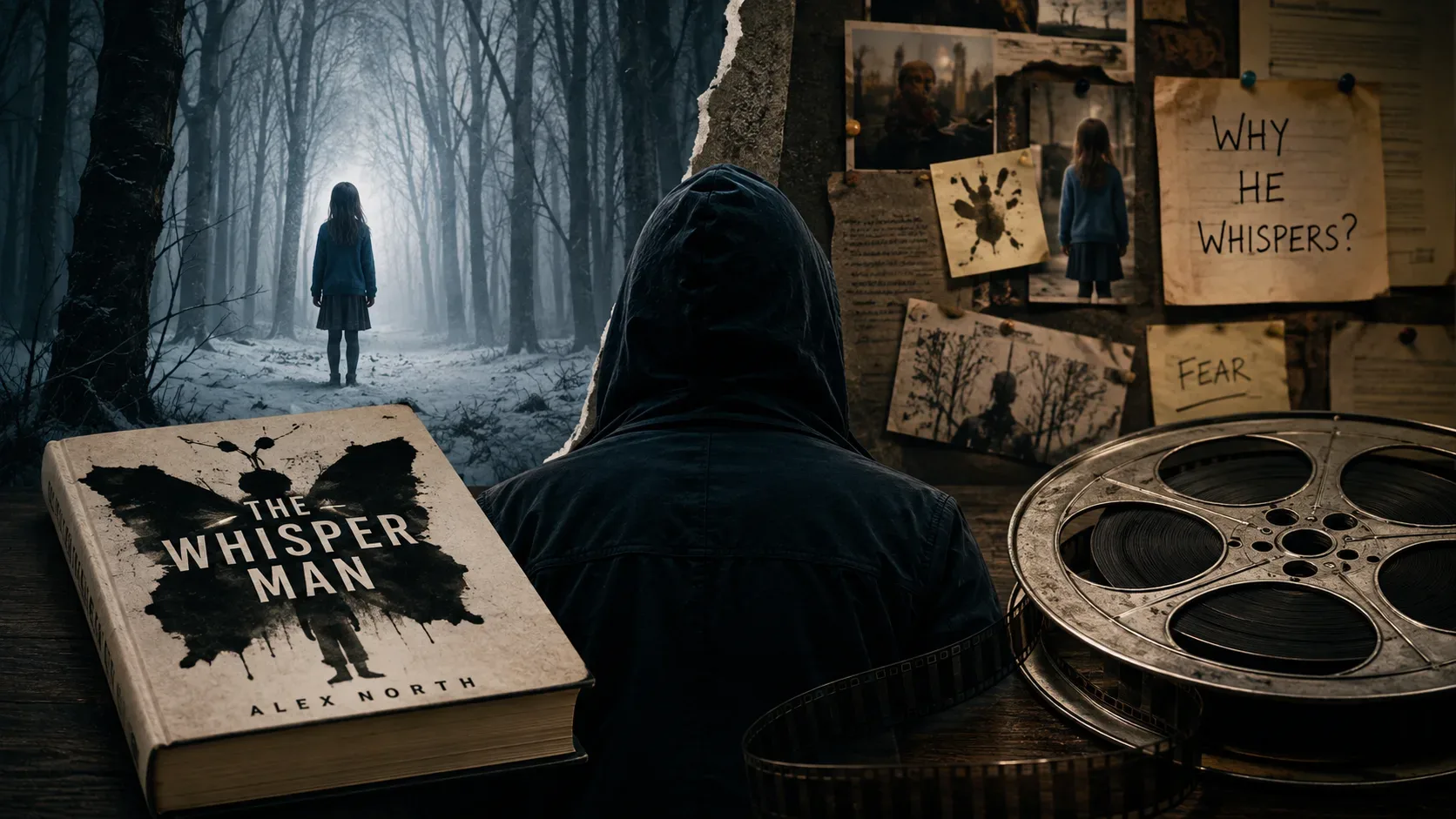
Warning: this article contains spoilers for both the book and the film.
Netflix's The Whisper Man, released on Aug. 28, 2026, does not try to reproduce Alex North's novel scene by scene. The adaptation moves Jake's kidnapping forward, expands Pete's role, removes subplots, transfers the action from the United Kingdom to the United States, and adds new suspense devices such as cassette tapes. The more important question, however, is why those changes were made: they reorganize the thriller so that the repair — or failure — of relationships between fathers and sons remains at the center of the story.
That reading is supported by the people involved. In an interview with Netflix Tudum, director James Ashcroft said what drew him into both the novel and the screenplay was the father-son relationship mirrored across generations. Alex North, meanwhile, told People that he knew changes were inevitable and that screenwriters Ben Jacoby and Chase Palmer preserved what really mattered to him about the book.
The main differences between the book and the movie
| Change | In the book | In the movie | Narrative effect |
|---|---|---|---|
| Jake's kidnapping | It happens near the third act. | It happens much earlier and drives a large part of the plot. | It keeps Tom and Pete together for longer and makes the search for Jake the main engine. |
| Pete Willis | He is still professionally involved in the case and is badly injured during Jake's abduction, taking him out of much of the final search. | He has been retired for years and returns because of his grandson, remaining active through the confrontation. | It expands Pete and Tom's reconciliation and ties the grandfather's arc directly to the rescue. |
| Tom and Pete reconnecting | It happens before Jake is kidnapped. | Tom seeks out his father after Jake disappears. | The crisis forces father and son to work together. |
| Karen Shaw | The mother Tom meets through Jake's school is part of a personal subplot. | The character is removed. | It reduces romantic detours and keeps the focus on the Kennedy-Willis family. |
| Setting | Featherbank is in England. | The action is moved to the northeastern United States. | It localizes the production without changing the central theme, which North sees as universal. |
| Cassette tapes | They are not a central device used by the killer. | Frank and his imitator use recordings sent to the police. | It gives the crimes an audiovisual signature and strengthens the police-thriller atmosphere. |
| The girl in blue | The connection between the figure and Jake's mother is understood earlier. | The reveal is held until the final scene. | It turns the clue into an emotional ending while preserving supernatural ambiguity until the last moment. |
1. Moving Jake's kidnapping forward changes the movie's engine
The most consequential structural change is also one of the few North has discussed directly. In the novel, Jake is kidnapped only near the third act. The film brings that event much earlier. Netflix itself explains that the change gives Pete and Tom more time together as they investigate the disappearance.
North said the decision made sense because the story could be approached in different ways. That distinction matters: this is not merely about making the plot faster. By moving the kidnapping forward, the movie trades some of the novel's gradual build for an urgent question — where is Jake? — and uses that urgency to put Tom in front of the father he has avoided for years.
In other words, the adaptation turns the police search into a form of involuntary dramatic therapy. Tom needs Pete not because he has resolved the past, but because the past is precisely the person who may help him save his son.
2. Pete becomes more than a link to the old case and turns into an emotional co-lead
In the book, Pete Willis is central to the original investigation of the first Whisper Man, Frank Carter, and is still professionally involved when the new disappearances begin. The official Macmillan/Celadon synopsis presents Amanda Beck and Pete as the investigators who need to return to Carter for answers.
In the film, Pete has been retired for years. North himself highlighted that change in an interview with Forbes. Pete returns because Jake, his grandson, has been taken. That shifts his motivation: he is no longer simply a detective haunted by an unfinished case, but a father and grandfather forced to face both the killer from his past and the damage he did to his own family.
Another restructuring strengthens that function. In the novel, Pete is injured during Jake's abduction and spends much of the final stretch in the hospital; in the movie, he remains in the search. As a result, conversations, confrontations, and choices between Pete and Tom are no longer a parallel layer: they are part of the main action.
That adaptation choice is consistent with what Ashcroft told Netflix. Despite the serial-killer trappings, what pulled him into the story was the dynamic between fathers and sons and the possibility of healing old wounds.
3. Removing Karen closes off a side route
The novel includes Karen Shaw, a mother from Jake's school whom Tom begins to get to know. On the night Jake is abducted in the book, Tom leaves his son with Pete while he goes out with Karen. The character does not appear in the movie.
There is no public statement from North or Ashcroft saying specifically, “We removed Karen for this reason.” Any explanation therefore needs to be treated as structural interpretation rather than confirmed fact. The effect, however, is clear: without that subplot, the movie saves screen time and reduces the number of relationships competing with the central conflict among Tom, Jake, and Pete.
That fits the adaptation's broader strategy. The film places less emphasis on Tom possibly rebuilding a romantic life and more on his obligation to rebuild a relationship with his father while trying not to repeat the same patterns of distance with Jake.
4. The cassette tapes are not from the book — and they externalize the horror
One significant addition is the killer's use of cassette tapes sent to investigators. Forbes notes that this pattern of taunting police through recordings is not part of the novel in the same way. Ashcroft told Entertainment Weekly that he was influenced by the disturbing effect of recordings associated with real crimes and by the horrifying banality of hearing an adult exercise power over a child.
The director also gives an in-story explanation for Frank producing and sending the tapes: narcissism and a need for control. In Ashcroft's reading, Frank needs the final word, wants to wound investigators psychologically, and keeps trying to dominate the situation even from prison.
From an adaptation standpoint, the tapes do something cinema often needs: they turn a psychological threat into sound, object, and action. Rather than relying only on memories, reports, or interiority, the movie gives the audience a recurring physical sign of the killer's control.
5. Moving the story from England to the United States does not change the theme, according to North
The novel is set in England; the film relocates Featherbank to the northeastern United States. North told Netflix that he never saw the essence of the story as dependent on a specific location. His interest was in the characters and their relationships.
In the Forbes interview, the author made the same point more broadly: versions of these characters could exist in almost any country because the book is rooted in generational trauma, fatherhood, and what one generation passes down to the next.
This is one of the changes whose stated intention is simplest. The setting changes; the emotional mechanism, in the author's view, does not need to.
6. The girl in blue becomes an emotional final note, not just a clue
Both book and film preserve the apparently imaginary presence that accompanies Jake, but they change when Tom understands its connection to Rebecca, Jake's late mother. Detailed comparisons of the two versions show that the novel provides that association earlier, while the movie holds the visual confirmation until the final scene.
Here the director has given a direct explanation. Speaking to Entertainment Weekly, Ashcroft said he wanted the girl's nature to remain deliberately ambiguous — either a supernatural presence or a manifestation of trauma — and wanted the final reveal to work primarily through emotion. Although the film is mainly about fathers and sons, he said the mother's guiding presence needed to remain in the background throughout.
Moving the reveal therefore changes its function. Earlier, it works as information that reshapes how we understand Jake's perceptions. In the final shot, it works as an emotional reward: Tom finally accepts that there were parts of his son's experience he did not understand.
7. The movie also preserves what North considered essential
The differences are noticeable, but the adaptation does not dismantle the novel. North told People that Jacoby and Palmer captured what truly mattered to him. In the Forbes interview, he compared adaptation to artists making their own version of the same composition: there would be little point in simply repeating the book, because the book already exists.
Elements that remain include Tom and Jake's grief, Frank Carter's history, the mystery of a new threat connected to the old crimes, the unease around imaginary figures, and above all the transmission of trauma between fathers and sons. The famous sequence in which a gloved hand reaches through the door opening also comes directly from the novel, as Netflix has highlighted.
What changes is the distribution of emphasis. A novel can spend more time on detours, interiority, and parallel investigation. A 1-hour-54-minute film has to decide which relationships will be given room to grow on screen. Ashcroft and the screenwriters chose Tom, Pete, and Jake as the dominant triangle.
So why did the movie change so much?
The most accurate answer is not simply “because movies need to be faster.” That explains only part of it. Statements from Alex North and James Ashcroft point to a more specific editorial decision: adapting the thriller around what they see as its core — fathers, sons, inherited trauma, and the possibility of breaking that cycle.
Moving the kidnapping forward puts father and grandfather on the same mission. Keeping Pete active turns reconciliation into action. Removing Karen reduces a side route. The tapes make the killer's control audible and cinematic. Relocating the story tests the universality of the theme. And saving the girl in blue for the ending closes the narrative with the mother's presence while refusing to settle whether she belongs to the supernatural or to Jake's inner world.
That is why the most useful way to compare The Whisper Man with the novel is not to count deleted scenes. It is to look at where the movie moves time, attention, and emotion. North approved that freedom: he said there was no point in recreating on screen what the novel already did on the page, and that the filmmakers' version works as an interpretation of the same story.