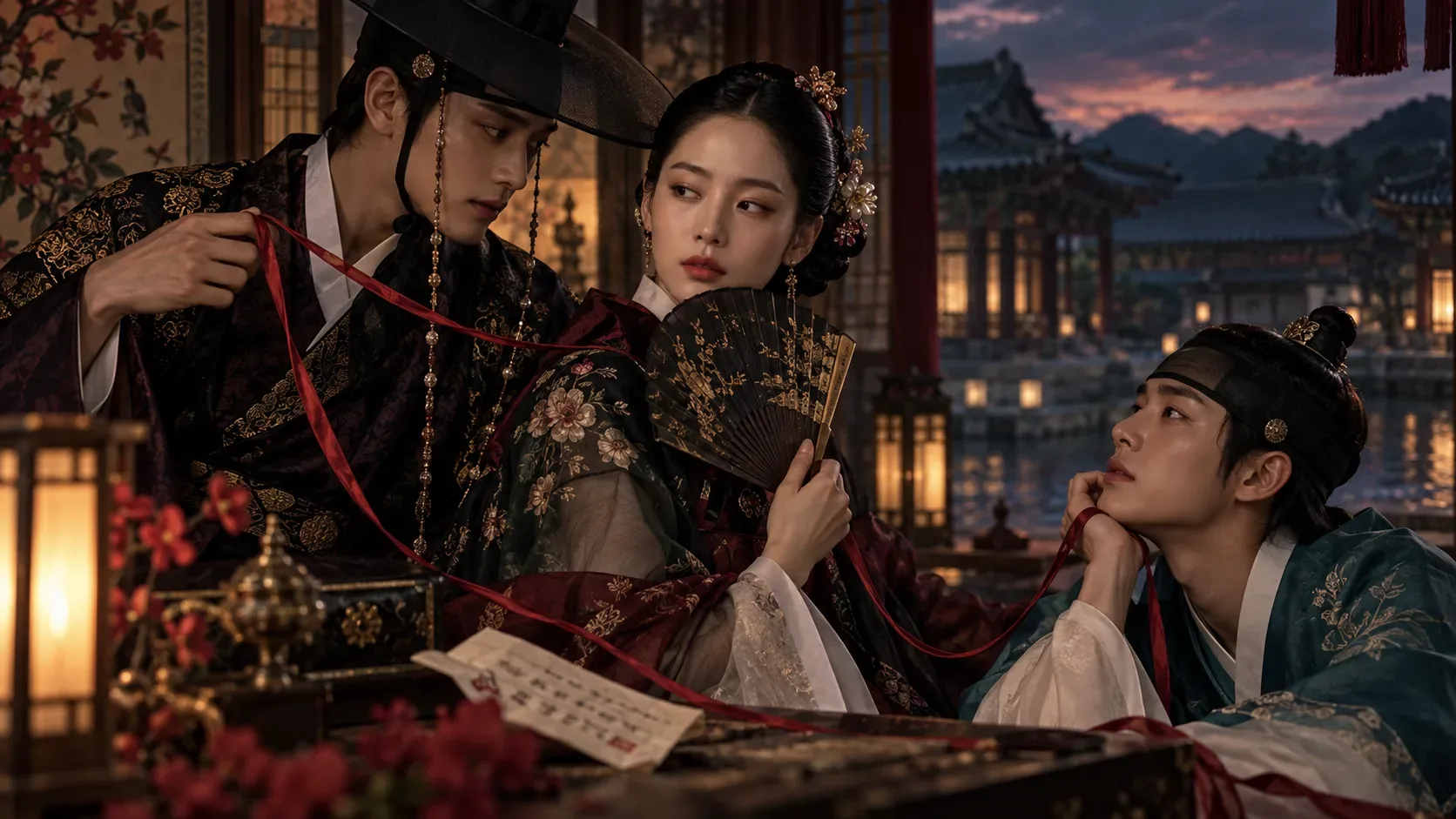
Short answer: The Scandal does more than move Dangerous Liaisons from French aristocratic society to Joseon-era Korea. The adaptation keeps the core engine of Pierre Choderlos de Laclos’s novel — seduction used as strategy, reputation at risk, and people treating feelings as pieces in a game — but reorganizes that conflict within the social rules of Joseon’s elite. Netflix has confirmed a global premiere on September 18, 2026, with Son Ye-jin as Lady Cho, Ji Chang-wook as Cho Won, and NANA as Hui-yeon.
The most useful spoiler-light way to approach it is this: Lady Cho, Cho Won, and Hui-yeon occupy narrative functions that will look familiar to readers who know the Marquise de Merteuil, the Vicomte de Valmont, and Madame de Tourvel, but the series has not been presented as a scene-by-scene transplant. Netflix explicitly describes it as a “reimagining” of the 1782 novel, with a modern sensibility and its own Korean period setting.
What The Scandal adapts from Dangerous Liaisons
Published in 1782, Les Liaisons dangereuses is an epistolary novel: its story advances through letters exchanged among members of the French aristocracy. At the center are Merteuil and Valmont, two manipulators who use seduction, information, and reputation to control other people. Among their most important targets are Madame de Tourvel and Cécile de Volanges.
Netflix preserves the idea of a dangerous game but moves it to Joseon and to Bukchon, an area associated with elite society. In the promotional material, Lady Cho proposes a wager to Cho Won; he is known as Joseon’s greatest playboy, and Hui-yeon, a virtuous young widow, becomes central to the contest. The main trailer also introduces So-ok, a young woman who is expected to become a concubine in Lady Cho’s household.
Source novel vs. series: the safest parallels
| Element | Dangerous Liaisons | The Scandal | How the reading changes |
|---|---|---|---|
| Pair driving the game | Marquise de Merteuil and Vicomte de Valmont | Lady Cho and Cho Won | The dynamic of manipulation and challenge remains, but it now operates within Joseon social conventions. |
| Moral figure put to the test | Madame de Tourvel | Hui-yeon | Hui-yeon is introduced as a young widow, changing the social and moral stakes of scandal compared with the French character. |
| Younger target linked to the initial plan | Cécile de Volanges | So-ok | There is a functional resemblance in the setup, but Netflix has not confirmed a complete one-to-one equivalence between So-ok and Cécile. |
| Elite setting | Eighteenth-century French aristocracy | Joseon high society, with Bukchon as a central setting | Reputation, marriage, gender, and family position are filtered through a different Korean social code. |
| Storytelling form | Novel built through letters | Audiovisual series | Letters remain a dramatic motif — the main trailer opens with a confidential message from Lady Cho — but there is no confirmation that the series reproduces the novel’s epistolary structure. |
The biggest change is the social context, not just the costumes
Moving the story to Joseon changes the meaning of almost every action. In Dangerous Liaisons, Merteuil and Valmont manipulate relationships inside a French aristocracy obsessed with appearances, marriage, and reputation. In The Scandal, Netflix emphasizes from Lady Cho’s introduction that she is a woman whose intelligence and ambition exceed the limits her position places on her.
That detail brings the series close to one of the original’s central tensions — trying to exercise power inside an unequal social system — without reproducing it in the same way. Domestic organization and gender roles in Joseon were deeply shaped by Neo-Confucian norms. Korean cultural sources describe the separation of male and female spaces in traditional elite homes and the growing weight of patriarchal rules on marriage and family life. That gives the adaptation room to turn the seduction game into a struggle over mobility, family duty, and public visibility as well.
An important caution: the material released so far confirms the setting and broad characterization, but it does not establish how far the series will follow the novel’s social critique or how it will resolve its conflicts. That can only be assessed after release.
Lady Cho, Cho Won, and Hui-yeon: who corresponds to whom
Lady Cho and Merteuil’s function
Lady Cho is the clearest parallel to the Marquise de Merteuil. Netflix presents her as the mind that proposes the wager and watches the game unfold. The main similarity is her use of intelligence, self-control, and social perception as instruments of power. The most visible difference is that the series’ publicity makes the tension between Lady Cho’s abilities and the restrictions imposed on women of her era explicit.
Cho Won and Valmont’s function
Cho Won corresponds to Valmont’s archetype: an experienced seducer who trusts his ability to win over someone who appears unreachable. In the trailer, he does not simply accept the challenge; he raises it by proposing Hui-yeon as the target. That change in the wager’s mechanics matters because it suggests the series redistributes initiative between the two players instead of simply copying the order of the novel’s schemes.
Hui-yeon and Tourvel’s function
Hui-yeon is the most obvious functional equivalent of Madame de Tourvel, but with a decisive confirmed difference: she is a young widow. The original builds tension around a virtuous married woman; the series shifts that position to a character whose reputation and autonomy are shaped by a different set of expectations. The conflict between desire and social norms remains, but its historical foundation changes.
So-ok and the echo of Cécile
The trailer introduces So-ok as a young woman who is about to become a concubine in Lady Cho’s household and as the target of Lady Cho’s initial proposal to Cho Won. That function recalls Cécile’s place as a young woman caught in Merteuil and Valmont’s plans. Still, calling So-ok “the series’ Cécile” without qualification would go beyond what Netflix has confirmed. It is safer to describe the parallel as partial and functional.
What the series appears to preserve from the novel
- Seduction as a tool of power: romantic interest is not presented only as romance, but as a way to win a contest.
- Reputation as social currency: the risk is not only emotional; it also involves status, honor, and how each person is seen by the community.
- Competition between strategists: Lady Cho and Cho Won are not framed as passive pieces, but as people testing one another’s limits.
- Desire versus convention: Netflix describes the series as a dangerous love game set in an era where seduction was forbidden or socially condemned.
- Letters and secrets: although an epistolary structure is not confirmed, the confidential letter that opens the main trailer suggests private messages still matter to the intrigue.
What is already clearly different
- Eighteenth-century France → Joseon: the shift in society changes the meaning of marriage, reputation, gender, and scandal.
- Married Tourvel → widowed Hui-yeon: the series changes the social position of the central virtuous figure.
- Cécile → So-ok is not a confirmed equivalence: there are parallels, but So-ok’s household role and connection to concubinage create a different setup.
- Novel of letters → audiovisual storytelling: the book depends on gaps between what characters write, think, and hide; the series has to translate that into performance, editing, mise-en-scène, and dialogue.
- The wager is reorganized: in the released material, Lady Cho proposes So-ok and Cho Won counters with Hui-yeon, signaling that the adaptation reshapes the challenge mechanism.
What cannot yet be said without spoiling or speculating
Netflix’s campaign deliberately leaves open Lady Cho’s full motives, the evolution of Cho Won’s feelings, how much Hui-yeon understands about the game, and what consequences the wager will have. The official materials reviewed also do not provide a complete map matching every character in the novel to someone in the series. Any list that forces exact equivalences beyond the main trio and So-ok risks turning inference into supposed fact.
For a comparison that stays light on spoilers, the best boundary is to stick to the premise, the initial functions, and the confirmed contextual changes.
Do you need to know Dangerous Liaisons before watching?
No. The publicity presents The Scandal as a new reimagining of the novel, not as a continuation of another adaptation. You can enter through the series knowing only the premise: two members of the elite turn seduction into a game, and a third person is drawn into that conflict.
Knowing the book does add another layer. Readers can watch for which functions were preserved, how Merteuil’s power was reworked through Lady Cho, and how the series replaces the fragmented viewpoint of letters with visual language. Viewers who prefer to watch first can read Laclos afterward and compare the structures without needing to anticipate the ending.
When it premieres and where to check official information
The Scandal premieres globally on September 18, 2026 on Netflix. It is directed by Jung Ji-woo and stars Son Ye-jin, Ji Chang-wook, and NANA in the central trio.
For confirmed information only, the most useful references are Netflix’s official premiere-and-character announcement, the main-trailer release, and the full text of Les Liaisons dangereuses on Project Gutenberg. For historical background on Bukchon and Korean elite life, official tourism material and Korean cultural studies help separate real setting from dramatic license.