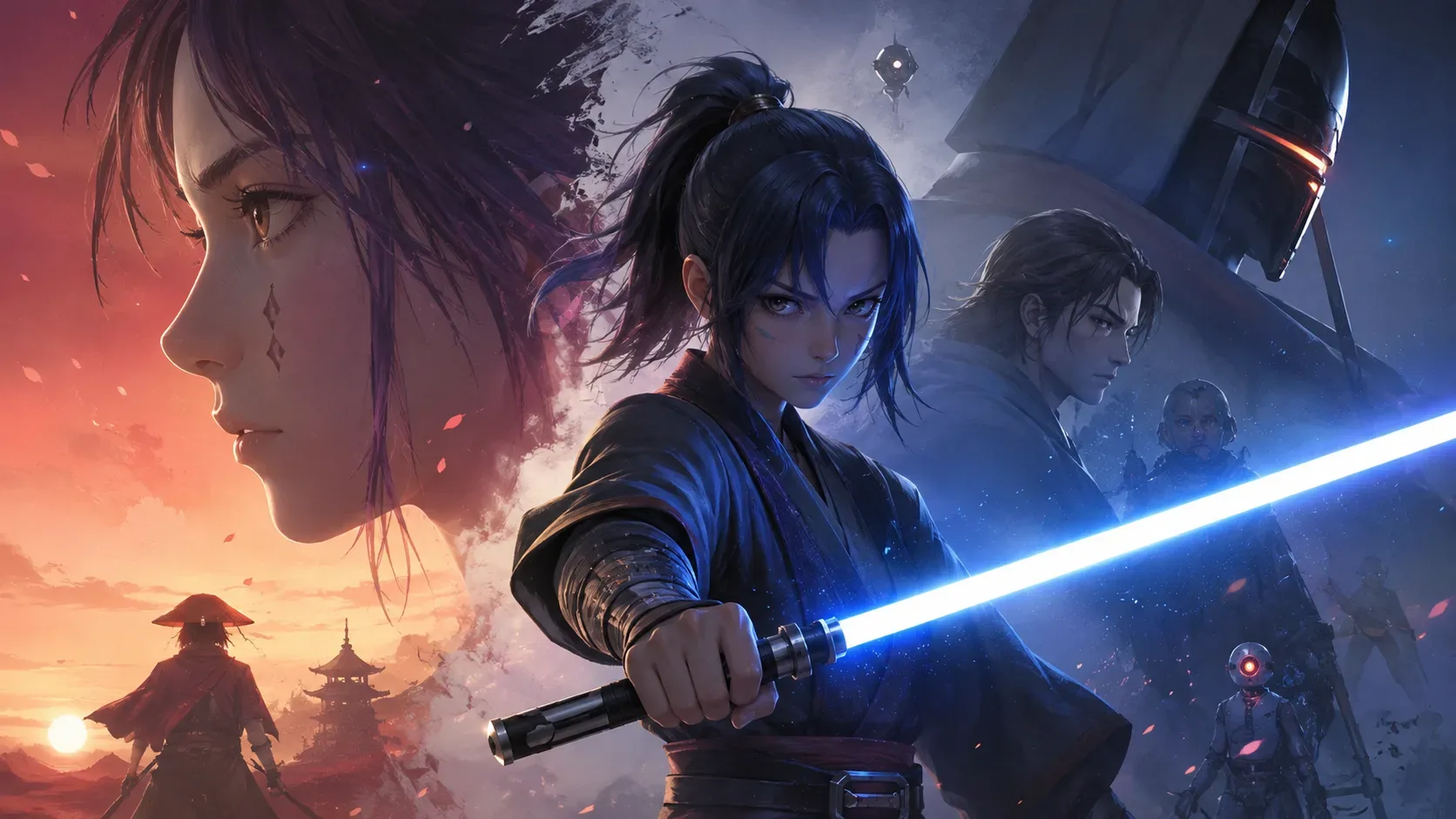
The new series of The Ninth Jedi was born from a single episode of Star Wars: Visions, but it doesn't begin exactly where the original short ends. Before the eight episodes that premiere this Wednesday, August 5, 2026, there is a second short story that acts as a bridge to Kara's new phase.
The essentials, however, fit into a few concepts: the young protagonist is still learning to trust the Force; his father is a strategic player in the attempt to rebuild the Jedi; and in this version of the galaxy, the color of a lightsaber reveals something about whoever wields it. The limited series is a Lucasfilm production with Production I.G and resumes the events of The Ninth Jedi, from 2021, and The Ninth Jedi: Daughter of Hope, from 2025. oilers:** this guide reveals the premise and essential events of the two previous shorts. It does not anticipate events from the episodes of the series released in 2026.
The essentials about The Ninth Jedi in one minute
To start the new series without reviewing everything, remember these five points:
- Kara is the daughter of saber maker Lah Zhima and has a natural connection to the Force, although she still doubts her ability.
- The Jedi disappeared and became almost legendary in this distant version of the galaxy.
- Margrave Juro tries to rebuild the Jedi Order, bringing together people sensitive to the Force.
- Zhima was kidnapped by Jedi hunters, turning her rescue into Kara and her allies' main mission.
- The sabers created by Zhima change color depending on the user's connection with the Force, a rule specific to this story, and not a general rule for the entire franchise. are more important than memorizing planets, names of all adversaries or events in the Skywalker saga.
The correct timeline before the series
| Date | Production | What it adds |
|---|---|---|
| September 22, 2021 | The Ninth Jedi, in Star Wars: Visions — Volume 1 | Features Kara, Zhima, Juro, the disappearance of the Jedi, and color-changing sabers. |
| October 29, 2025 | The Ninth Jedi: Daughter of Hope, third episode of Volume 3 | It shows a later stage of the search for Zhima and delves deeper into Kara's decision to become a Jedi. |
| August 5, 2026 | Star Wars: Visions — The Ninth Jedi | Expands the story into an eight-episode limited series. |
Lucasfilm informs that the new episodes take place shortly after the two shorts. Kara continues her training with Juro, while the small community of apprentices sets out to find Zhima. hes that change the reading of the story
1. The color of the saber is a portrait of the user
In the original short, the sabers produced by Lah Zhima do not have a definitive color. The blade responds to the wielder's connection to the Force.
This rule turns the saber into more than a weapon: it functions as a revealer of intentions. When Kara hands over the sabers to the supposed Jedi summoned by Juro, several blades turn red, exposing that these people are not the allies they claimed to be.
Kara's blade starts out colorless and turns green as she finds confidence and balance. Homen offers an even more important example: initially influenced by the other opponents, he wields a red blade, but manages to break this influence, making the color change to a light purple tone. that, in The Ninth Jedi, red, green, blue or purple should not be read as just permanent uniforms. Color can register conflict, choice and transformation.
Supervising director Kenji Kamiyama explained that the idea came from an interpretation he had when watching the original trilogy: he imagined that the sabers changed automatically depending on their user. Even after discovering that it wasn't like that in traditional continuity, he decided to use the concept in his own vision of Star Wars. story begins after the disappearance of the Jedi
The setting is not that of the Republic, the Clone Wars or the classic struggle between Empire and Rebellion. The plot takes place in the distant future, when Jedi and Sith have disappeared and the ancient Order almost belongs to the territory of legends.
I swear to try to change that. He summons Force users to the Hy Izlan Aerial Temple and promises to deliver sabers as the first step to rebuilding the Jedi. The problem is that his calling also attracts people willing to prevent this rebirth. an established Order changes the central question of the story. Kara is not entering a ready-made institution, with masters, files and well-defined rules. She and her companions will need to decide what it means to be a Jedi as they try to rebuild that ideal.
According to Kamiyama, the series intends to explore precisely situations that do not fit into a simple division between light and darkness. The discussion will not just be about defeating the Sith, but about the limits and contradictions of the Jedi identity itself. is more than the kidnapped father
Lah Zhima is the emotional engine of Kara's journey, but she also has political and strategic importance.
As a saber maker, he masters a rare technique: preparing kyber crystals capable of reflecting each user's relationship with the Force. It was Zhima who produced the eight sabers requested by Juro for the candidates summoned to the temple.
For this reason, her kidnapping should not be understood as a random attack against the protagonist's family. Controlling Zhima means controlling one of the few people capable of producing the weapons needed for a new generation of Jedi. Lucasfilm describes him as the only known maker of this type of saber in that galaxy. character, therefore, brings together the two axes of the story: Kara wants to recover her father, while Juro needs to prevent this knowledge from being used against the return of the Jedi.
Map of the characters that really matter
| Character | Importance | What to remember |
| Lah Kara | Essential | Force-sensitive protagonist. She is brave and skilled, but is still developing confidence and control. |
| Lah Zhima | Essential | Kara's father and maker of special sabers. Your kidnapping starts the main quest. |
| Margrave Juro | Essential | Former Jedi who tries to rebuild the Order and starts to guide Kara. |
| Ethan | Important | One of the few summoned by Juro who truly wanted to follow the Jedi path. Stay with the group. |
| Man | Important | It starts under dark influence, but manages to change direction. It represents the idea that alignment and identity are not set in stone. |
| Gramps | Useful secondary | Pilot droid that transports Kara and then accompanies the group on their mission. |
| 99-99 | Useful secondary | Kara's small droid companion, linked to her life with Zhima and her training. |
| Ceiling | Emotional bridge | Droid found by Kara in Daughter of Men. His relationship with her influences the young woman's decision to follow the Jedi path. |
To follow the new series, it is not necessary to memorize the names of all the fake Jedi found in the temple. Roden, Hanbei and the other infiltrators mainly fulfill the function of demonstrating that Juro's calling has been compromised.
It is also not necessary to study in advance all the new adversaries announced for 2026. The sufficient starting point is to know that there are organized Jedi hunters, interested in preventing the return of the Order and in capturing people linked to the Force.
Juro sends out a call to Force-sensitive people and promises to deliver lightsabers to those willing to help him rebuild the Jedi Order. Seven candidates arrive at the Hy Izlan Aerial Temple, but Juro is apparently not present to welcome them.
Meanwhile, Lah Zhima completes the requested sabers. Kara receives the mission to transport them to the temple, but Jedi hunters attack her home, capture her father and start chasing her.
Kara manages to get to the meeting and hands over her weapons. When candidates activate their sabers, almost all of the blades turn red. The revelation shows that the group had been infiltrated by followers of the dark side.
Juro, who was hiding under a disguise, enters the confrontation. Kara and Ethan fight alongside him, while Homen manages to free himself from the influence of others. In the end, the survivors form the small nucleus that will set out to rescue Zhima and try to rebuild the Jedi. It's less about defeated opponents and more about the formation of this group: Juro as a mentor, Kara as a growing apprentice, Ethan as a sincere ally and Homen as proof that someone can return from the darkness.
Is it necessary to watch Daughter of Hope?
It is not essential to understand the premise, but it is the direct continuation and the best bridge to the series.
In The Ninth Jedi: Daughter of Hope, Kara is separated from Juro while the group is pursued by Jedi hunters. Adrift in space, she encounters Teto, a droid who takes care of an apparently abandoned ship.
The short shifts attention from the revelations and battles of the first episode to Kara's maturation. The experience with Teto forces her to confront fear, loss, responsibility and doubt about whether she is worthy of becoming a Jedi.
Director Naoyoshi Shiotani described this story as the moment when Kara decides for herself that she wants to become a strong Jedi. The 2026 series begins after this maturation, which makes the short especially recommended for those who want to follow the character's emotional evolution. If you have little time, you should prioritize:
- The Ninth Jedi, from Volume 1;
- The Ninth Jedi: Daughter of Hope, episode 3 of Volume 3;
- a new series of eight episodes.
The remaining chapters of Star Wars: Visions present independent stories and are not mandatory preparation.
What can be ignored before watching
A complete marathon of the franchise
It is not necessary to rewatch the nine films of the main saga, The Clone Wars, Ahsoka or other series. Visions was designed to allow studios to develop their own interpretations, without the obligation to connect each story to the larger chronology of the franchise.
Although Production I.G places this narrative after The Rise of Skywalker, understanding the plot depends on general concepts — Jedi, Sith, Force and sabers —, not on specific events in the films. traditional colors of sabers
The important thing is the rule presented by the short itself: the blade responds to the person holding the saber. Trying to rigidly apply explanations from other productions can make the story more confusing.
The names of all infiltrators
The temple conflict establishes that Juro's project is surrounded by enemies. The individual identity of each opponent defeated in the short is not necessary to follow the search for Zhima.
All the technical details of kyber crystals
Just know that Zhima developed a special way of working with crystals and that this knowledge makes her sabers — and the artisan himself — extremely valuable.
What to watch in the new series without looking for spoilers
The eight-episode series allows us to develop issues that the short films only presented. Four points deserve attention from the beginning:
- How Kara defines what it means to be a Jedi, rather than just reproducing a vanished tradition;
- how saber colors are used to show conflict and change;
- how Juro intends to transform a small group into a new Jedi community;
- why different forces in the galaxy want to control Zhima and her technique.
Lucasfilm also indicates that the journey will be one of self-discovery and that Kara will continue training under Juro's guidance as the group searches for her father. The new format should give space to the ideas and character backgrounds that Kamiyama had already developed when he conceived the short as a potentially larger story. reviewing the original short?
Yes. The Ninth Jedi does not just function as a prologue with information that could be summarized in an opening. The way the episode uses the colors of the sabers, hides the characters' identities, and places Kara between confidence and doubt establishes the visual and moral language of the entire story.
The recommended full review is short:
- review The Ninth Jedi to recover the conflict, the rule of sabers and the formation of the group;
- watch Daughter of Hope to understand Kara's emotional stage;
- leave the rest of the anthology for later, if you want to know other interpretations of Star Wars.
The new series was born from a single episode, but its continuity depends on three ideas: the saber reveals the user, the Jedi need to be rebuilt and Zhima is the key to that reconstruction.
Save this guide to consult during the first episodes and follow the editorial series of explainers on premieres, continuations and adaptations.