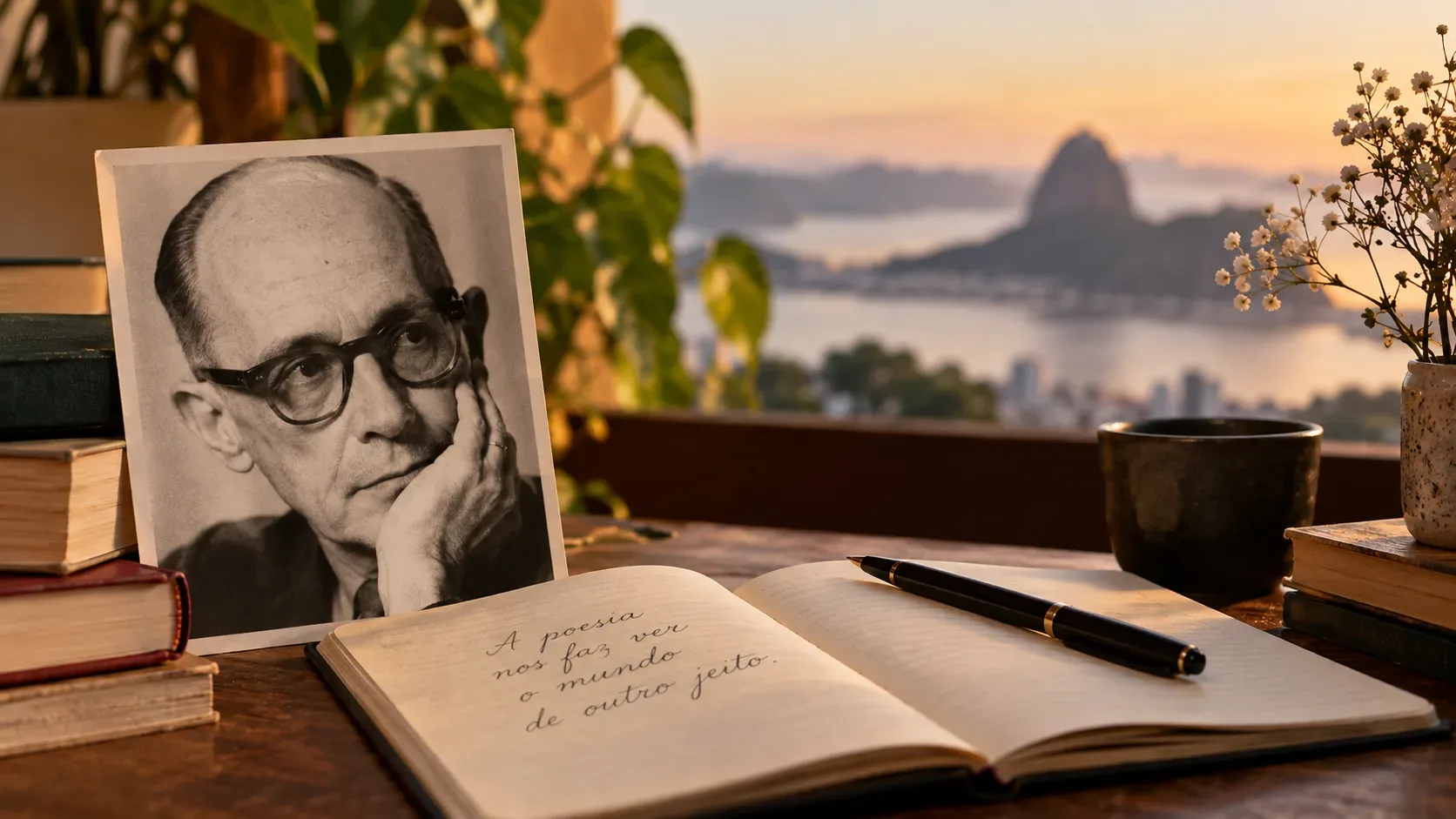
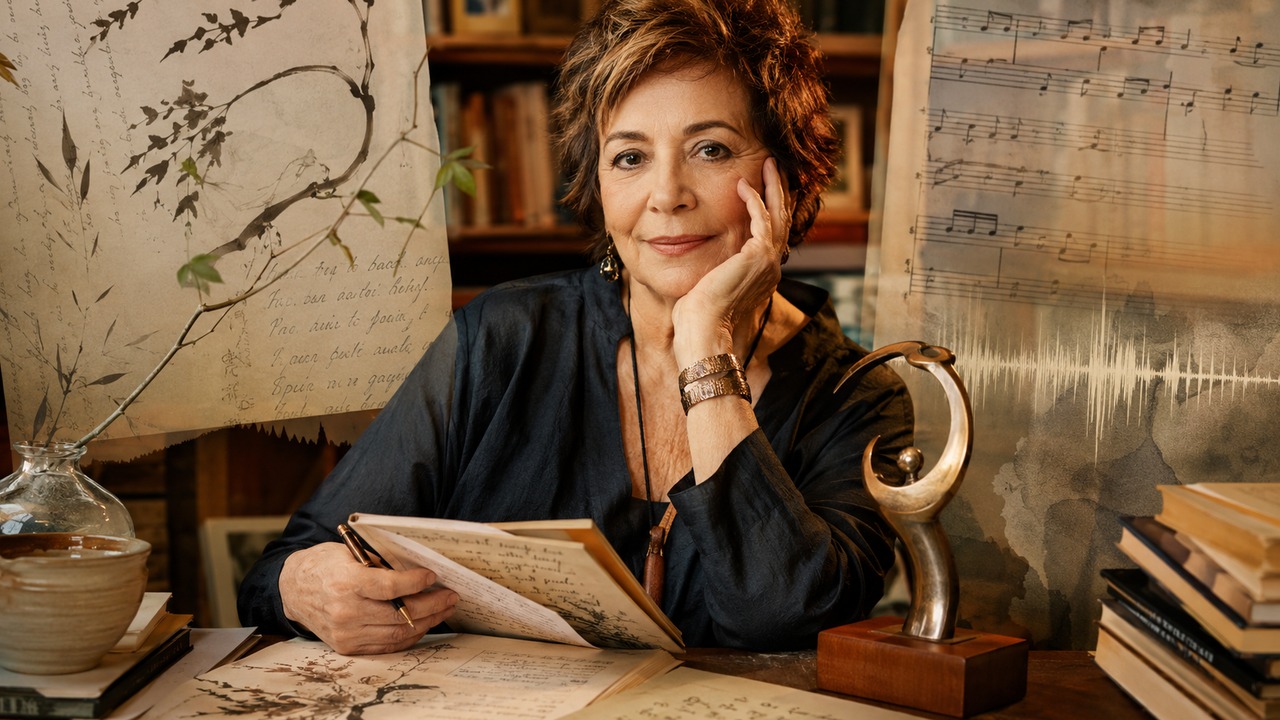
Alice Ruiz receives the Troféu Tradições from the União Brasileira de Compositores (UBC) this Wednesday, August 26, 2026. The ceremony is scheduled for 7 p.m. at Casa de Francisca in São Paulo, with a tribute pocket show under the musical direction of Gustavo Ruiz Chagas and a broadcast on UBC's YouTube channel. It is the sixth edition of an honor dedicated to women who are fundamental to the history of Brazilian music.
The event could be read simply as another recognition of a long career. But in Alice's case, the more interesting question is different: why does a composers' association choose to honor an author whose public identity is also so closely tied to poetry and haiku? The answer appears when we look less at the separation between literature and music and more at the way she works with words: condensation, rhythm, imagery, listening and collaboration.
Why the tribute comes in 2026
Alice turned 80 on January 22. The birthday had already prompted renewed public attention to her work in Paraná. In March, Cândido, the newspaper of the Biblioteca Pública do Paraná, devoted a special issue to the author, with an interview and a timeline of books, translations and albums. That same month, she received Paraná's Medalha de Mérito Cultural in a ceremony at the Library itself.
The Troféu Tradições adds another layer to this cycle of tributes. UBC shifts the focus to musical authorship and to the place of the lyricist. Commenting on the award, Alice drew attention to the loss of visibility of people who write lyrics in the streaming environment and summed up the problem with a direct image: the "lyricist became a ghost." She also stressed that, for women, this invisibility tends to be even greater.
The choice, therefore, does not function only as an 80-year retrospective. It calls attention to a creative profession that often disappears behind the voice of the person performing the song. By honoring Alice, UBC recognizes an author whose work circulates through books, records and other people's voices without losing a highly distinctive verbal signature.
Before she knew the word haiku, Alice was already observing scenes
In the interview given to Cândido in 2026, Alice said that when she was still a child, at age nine, she would go to the back of the house and record scenes from nature. At that point she did not know what haiku was. The association with the Japanese form came later, when she was already an adult and Paulo Leminski recognized in that kind of notation a path close to haiku and lent her books so she could study it.
That biographical detail helps explain why haiku, in her trajectory, does not appear merely as an imported technique or a template for short poems. Before the rule, there was a gesture: stop, notice a scene and try to capture it with few words. Study, translation and sustained practice came later.
The Biblioteca Pública do Paraná records that Alice translated four books by Japanese authors in the 1980s. Her relationship with haiku also included workshops, which began in 1990, and recognition from the Japanese-Brazilian community, which gave her the name Yuuka in 1993. The timeline published by Cândido highlights works such as Hai tropikai, from 1985, Desorientais, from 1996, and Jardim de Haijin, from 2010, showing that this brief form runs through decades of her work.
Concision is not just writing less
Reducing Alice Ruiz's poetry to brevity would mean missing what brevity does. In materials published by the Biblioteca Pública do Paraná, her writing is described as attentive to everyday life, love, femininity, nature and the city, using few words and showing a strong influence from haiku. The decisive point is precision of choice, not simply the length of the text.
In haiku, a small scene can open onto a larger perception. The word does not need to explain everything because imagery, interval and the relationship between elements are part of the meaning. This logic helps us read many of Alice's poems and also explains why her language adapts so well to situations in which rhythm and memory need to work economically.
Concision, in this case, does not impoverish the text. It increases the weight of each term. A displaced word, a pause or a repetition changes the result. It is precisely this microscopic attention to language that creates a natural bridge to song, where syllables, stresses, breathing and melody impose new demands on the verse.
From the page to the song: a passage that began early
Alice's connection with music predates her well-known collaborations. In the same interview with Cândido, she recalls that as a teenager she tried to translate rock songs even without enough command of English. To make them singable, she invented solutions that would fit the meter and melody. Years later, she realized that the exercise had already been a way of training the work of a lyricist.
She began writing song lyrics at around age 26. Her musical path expanded through collaborations with artists from different generations, including Itamar Assumpção, Alzira Espíndola, Arnaldo Antunes, Zeca Baleiro, Chico César, José Miguel Wisnik and Luiz Tatit. Her work also reached the public through performances by names such as Gal Costa, Cássia Eller, Ney Matogrosso, Zélia Duncan and Adriana Calcanhotto.
Her partnership with Itamar Assumpção is central to this path. Material released for the Troféu Tradições records more than 20 songs created by the two over roughly two decades, including Milágrimas, Navalha na Liga and Sei dos Caminhos. More important than the number, however, is the method Alice described to Cândido: in some compositions, she would arrive with a concept or a phrase, Itamar would develop a melodic line, and from that point the rest
of the lyric would be built. Words and music changed each other along the way.
A song lyric is not a poem with a melody pasted onto it
That form of collaboration shows why the relationship between poetry and song in Alice's work cannot be explained as a simple transfer. A poem can be set to music, and that does happen, but the lyricist's work can also be born within the music itself. In that case, the text has to respond to a sound structure that is still being created.
On the page, the poet controls the line break, white space and visual silence. In a song, duration, repetition, breathing, accentuation and performance come into play. The voice can lengthen a syllable, the melody can call for another word, and the chorus can turn repetition into memory. The same author, therefore, works with related but not identical materials.
Alice makes this clear when she distinguishes the experience of poetry, which she describes as more solitary, from musical composition done in partnership. For her, meeting other creators is part of the pleasure of writing lyrics. It is in this movement that her verbal economy encounters another kind of rhythm: not only the internal rhythm of the poem, but the rhythm shared with melody, arrangement and voice.
Poesia para tocar no rádio put the question in its title
In 1999, Alice published Poesia para tocar no rádio, a collection of song lyrics that won the Concurso Blocos de Poesia. The presentation of the work itself, recovered in Cândido's timeline, poses a direct provocation: are lyrics poetry?
The author's career suggests that the question is more productive than a rigid answer. There are poems that remain poems, lyrics that are born for a melody, and texts capable of crossing formats. What remains is a discipline of the word: cutting excess, noticing sound effects, working with imagery and leaving room for readers or listeners to complete the meaning.
The album Paralelas, released in 2005 with Alzira Espíndola, reinforces this coexistence. The project brought together 12 tracks composed over more than 15 years of partnership and also included short poems. Rather than organizing literature and music into separate compartments, the work presents the two practices as neighboring territories, with constant passages from one to the other.
Literary recognition helps measure the reach of the work
UBC's tribute comes on top of a trajectory that already has solid recognition in the literary field. Alice made her book debut with Navalhanaliga in 1980. At the Prêmio Jabuti, Vice-Verso appears among the 1989 poetry awardees, and Dois em Um won first place in the category in 2009.
Dois em Um is especially significant for understanding the continuity of her writing because it brings together work from the 1980s and allows the reader to see, in one volume, experiments with brief poetry, urban language, humor, the body and concision. The chronology prepared by Cândido for her 80th birthday, meanwhile, places haiku books, collections, lyrics and records side by side, as if the very organization of the archive rejected a single-track artistic biography.
In March 2026, when she received Paraná's Medalha de Mérito Cultural, Alice was also celebrated onstage through poems and compositions. That detail anticipates, on another scale, what UBC is doing now: honoring an author through a musical performance without erasing the literary origin of her strength.
The Troféu Tradições reads Alice Ruiz as a whole
The five previous editions of the Troféu Tradições honored Anastácia, Dona Onete, Lia de Itamaracá, Alaíde Costa and Rosa Passos. In 2026, Alice Ruiz's inclusion broadens the award's perspective toward a creator whose presence in music depends, to a large extent, on work with words and collaboration.
For that reason, the award makes more sense when it is not interpreted as a late turn by the poet toward music. Music has always been part of her path, just as haiku and poetry have. What changes is the medium, the way of creating and the relationship with the person receiving the text.
In haiku, the author concentrates a scene. In a poem, she organizes silence, imagery and thought. In a lyric, she negotiates the word with melody and with another person's voice. These practices are not the same, but they share the same attention to what a word can do when it occupies exactly the place it needs to.
This Wednesday's ceremony brings that continuity into focus. At 80, Alice Ruiz receives a trophy from Brazilian music without having to leave literature outside the door. The tribute works precisely because it recognizes that, in her body of work, the page and the song have never been completely separate worlds.