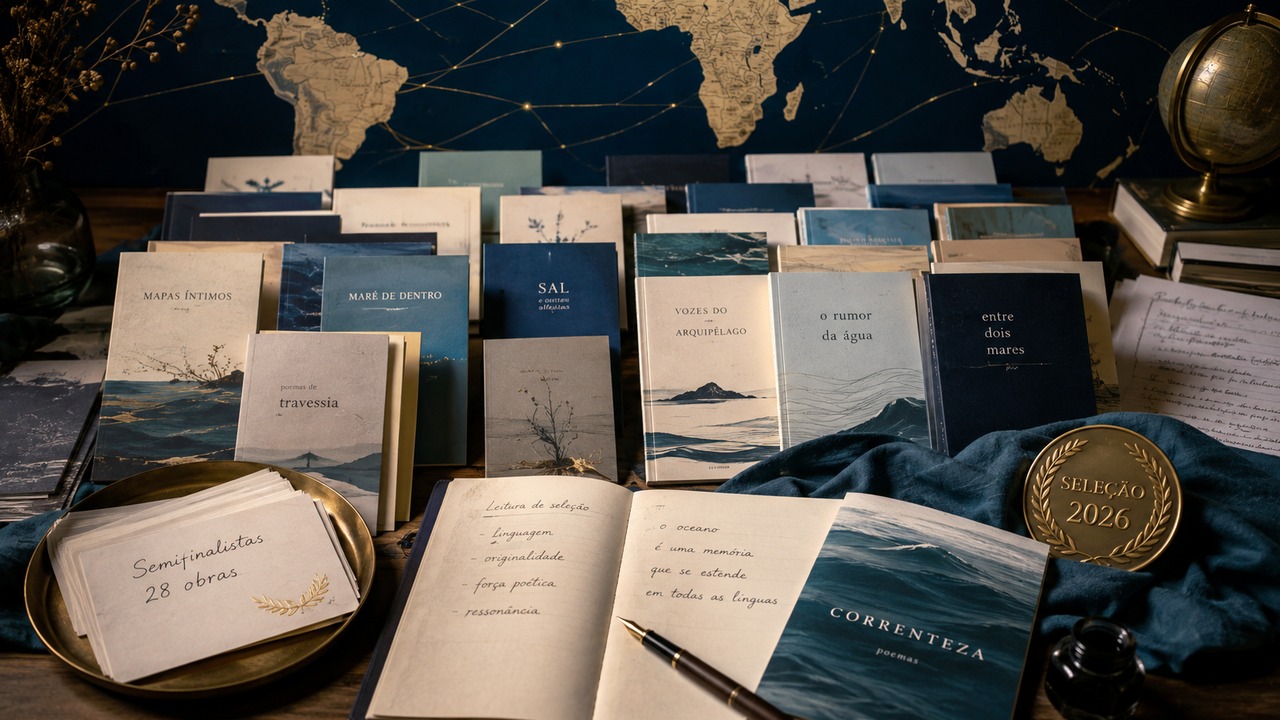
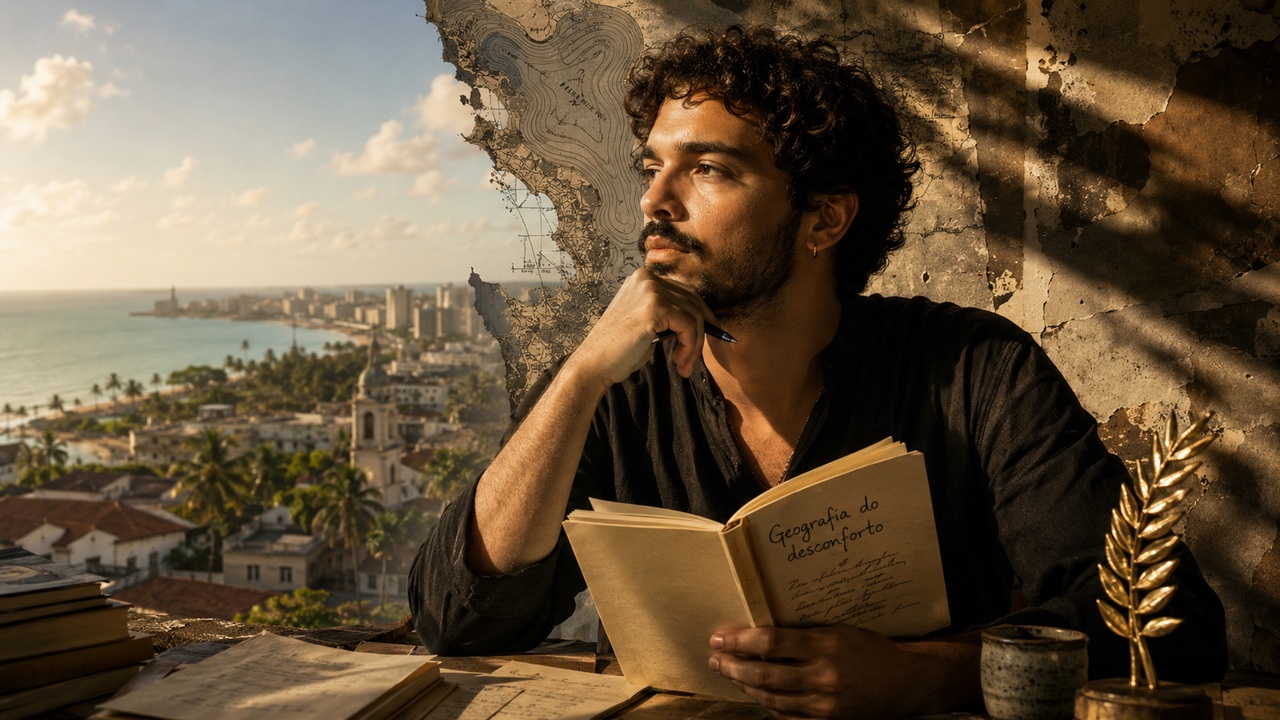
On August 19, 2026, Sesc announced Guilherme de Miranda Ramos, from Maceió, as the winner of the Poetry category of the Sesc Literature Prize with Geografia do desconforto. The result stands out for two immediate reasons: this edition set a record for entries, and poetry was the most competitive category, with 1,203 manuscripts among the 2,969 works submitted in total.
The victory, however, should not be read as the debut of someone who had never published before. Guilherme already had a track record in children's books, chronicles, music and cultural production. The meaning of “newcomer” in the Sesc Literature Prize is more specific: the author must be unpublished in the category in which they compete. This helps explain why a writer with previous books could win precisely with a still-unpublished poetry collection.
There is also an important limit to any analysis at this point. As of August 24, 2026, Geografia do desconforto had not yet been commercially released. What is known about the book's organization and themes comes mainly from the presentation published by Sesc. It is therefore possible to explain the work's proposal, structure and context, but not to make a full critical assessment of the poems as if the volume were already available for complete reading.
Who is Guilherme de Miranda Ramos
Guilherme de Miranda Ramos is 54 years old and is presented by Sesc as a writer, composer and cultural producer from Alagoas, based in Maceió. His work is not limited to literature: he created Intermídia Estúdio de Criação and the Quarentemas project, composes soundtracks for literature, audiovisual works and the performing arts, and also produces his own singles and albums.
In literature, his previous path spans different genres. Editora Matriz's profile lists the children's books Mateu Errante, Mateu Brincante, from 2015, and Estrela Raivosa, from 2017, as well as the chronicle collection Minha Fúria e Outros Demônios. Through Matriz itself, he published A menina e as pipas de papel. The catalog of Imprensa Oficial Graciliano Ramos also lists Minha Fúria e Outros Demônios as a book of chronicles made up of 24 fictional narratives organized between “night” and “day.”
His relationship with writing began early. In presenting the winner, Sesc reported that Guilherme associates his first artistic fascination with a poem he found as a child in a magazine his mother brought home. After that, he became closer to the arts at school and broadened his reading to all kinds of texts. That memory helps place a career formed through accumulation rather than through a sudden entry into the literary circuit in 2026.
How could an already published author compete as a newcomer?
The Sesc Literature Prize regulations distinguish a published career from debut status in a category. The competition requires an unpublished original manuscript and is aimed at authors who have not yet published a book in the genre in which they are competing. Therefore, having released children's literature or chronicles does not, by itself, prevent participation in the Poetry category.
That detail is especially relevant in Guilherme's case. The public record of his career shows books in other genres, while Geografia do desconforto was entered as an unpublished poetry manuscript. The prize therefore works as his entry into the publishing market specifically with a book of poems, not as his first contact with literary publication.
What is already known about Geografia do desconforto
Sesc's official presentation organizes the book into three symbolic territories: blood, asphalt and mirror. The choice of these names gives the volume a clear structure and brings the title close to the idea of cartography: rather than mapping only physical places, the poems move through family relationships, urban experience and conflict with one's own body and identity.
Blood: memory, family and inheritance
In the first part, the focus is on family memories, emotional inheritances, silences between generations, losses and the search for identity. The description released by the prize mentions parents, grandparents and ancestors as part of this investigation. “Blood,” therefore, functions as a territory of origin, bond and transmission, including what a family cannot or chooses not to say.
Asphalt: city, work and inequality
The second part shifts the gaze to the city. According to Sesc, the poems observe workers who are often made invisible and address inequality, the precarization of work, resistance and dignity on urban margins. This is the section in which discomfort is no longer concentrated in intimate memory and also begins to appear in social relations and in the way the city distributes attention, work and recognition.
Mirror: body, time and non-belonging
In the third part, the proposal becomes more existential. The mirror brings together reflections on the body, the passage of time, loneliness, mental health and the feeling of not belonging. The movement through the three sections suggests a progressive widening of the field of observation: from what is inherited, to collective space, and then to the way the subject sees and confronts themself.
Sesc itself describes the book as a cartography of memory and the human condition and says that Guilherme experimented with formats he had previously avoided. Without access to the complete volume, this is where the analysis has to stop. It is not possible to state which poetic forms predominate, how the poems connect to one another or which language resources recur based only on the synopsis.
What the title Geografia do desconforto suggests
The structure in blood, asphalt and mirror allows a reading of the title without turning a hypothesis into fact. “Geography” seems to function as an organizing method: discomfort is distributed across family, urban and inner territories. “Discomfort,” in turn, gathers different experiences, from silence between generations to precariousness in cities, from loneliness to estrangement from one's own body.
This reading is consistent with the official presentation, but it still does not replace the encounter with the poems. Once the book is published, it will be possible to verify whether the idea of cartography appears only in the architecture of the three parts or also in the language, imagery and relationships between the texts.
Guilherme's connection with Maceió and cultural production in
Alagoas Winning the Sesc Literature Prize gives national reach to a trajectory that had already been built in Alagoas. Editora Matriz presents him as a cultural producer from Maceió, and Imprensa Oficial Graciliano Ramos lists his works in its catalog. Estrela Raivosa, for example, is described by Imprensa Oficial itself as a tribute to the Hino de Alagoas, while Mateu Errante, Mateu Brincante is a story in verse published within the state's literary circuit.
That origin helps explain why the description “Maceió poet” matters as more than a simple biographical detail. Guilherme arrives at the national prize after circulating through initiatives, publishers and cultural projects connected to the state. At the same time, Geografia do desconforto should not be reduced to a regionalist book. The available synopsis points to family, urban work, the body, loneliness and belonging, themes that begin from a situated experience but are not limited to it.
Why winning the Sesc Literature Prize matters
The Sesc Literature Prize was launched in 2003 and is aimed at discovering authors making their debut in the categories in which they compete. Poetry entered the prize only in 2024, which makes the 2026 victory part of a still-recent phase for the genre within the competition. This year, Poetry itself drew the highest number of entries: 1,203 manuscripts.
The selection is also more than symbolic publicity. The manuscripts are evaluated without author identification by specialized committees. In 2026, the final Poetry jury was formed by Cida Pedrosa and Edimilson de Almeida Pereira. Guilherme won a national competition in which the evaluation was based on the text, not on the author's public notoriety.
In practical terms, the prize turns an unpublished manuscript into a published and distributed book. Each winner receives R$ 30,000, has the work edited by Editora Senac Rio and enters a distribution circuit that includes bookstores, libraries and Sesc schools. The rules and the announcement for the 2026 edition also provide for winners to take part in literary meetings and events across the country.
This combination explains why the award can change the reach of a career. For Guilherme, it is not simply a matter of adding a prize to his résumé, but of putting a poetry book - his debut category in the competition - into nationwide circulation with an editorial structure already defined.
Is Geografia do desconforto already on sale?
As of August 24, 2026, it was not. Sesc stated that the winners will be presented to the public at a ceremony with a book-signing event at the end of the year. After publication, the books are expected to be sold in physical and online bookstores and distributed through Sesc's network of libraries and schools. The schedule announced for the edition also provides for the authors to take part in talks and roundtables throughout 2027.
There is still no exact commercial release date for Geografia do desconforto in the official information consulted, nor final details such as page count, cover price or definitive graphic design. These points should be confirmed when Editora Senac Rio and Sesc release the finished edition.
What the victory allows us to say now - and what still has to wait
It is already possible to state that Guilherme de Miranda Ramos won the Poetry category of the 2026 Sesc Literature Prize, that the book was selected in a record-setting edition and that the work is organized into three symbolic territories connected to family memory, the city and existential experience. It is also possible to place the author within an earlier trajectory of children's literature, chronicles, music and cultural production in Alagoas.
What still cannot be done rigorously is to treat Geografia do desconforto as a book already read by the public. The synopsis offers the map; publication will reveal the full
route. When that happens, it will be possible to assess how the three territories connect poem by poem and to what extent the experimentation mentioned by the author changes his writing. For now, the significance of the result is clear: an unpublished poetry manuscript from Maceió went through a national selection of 1,203 entries and earned publication, distribution and circulation through the Sesc Literature Prize.