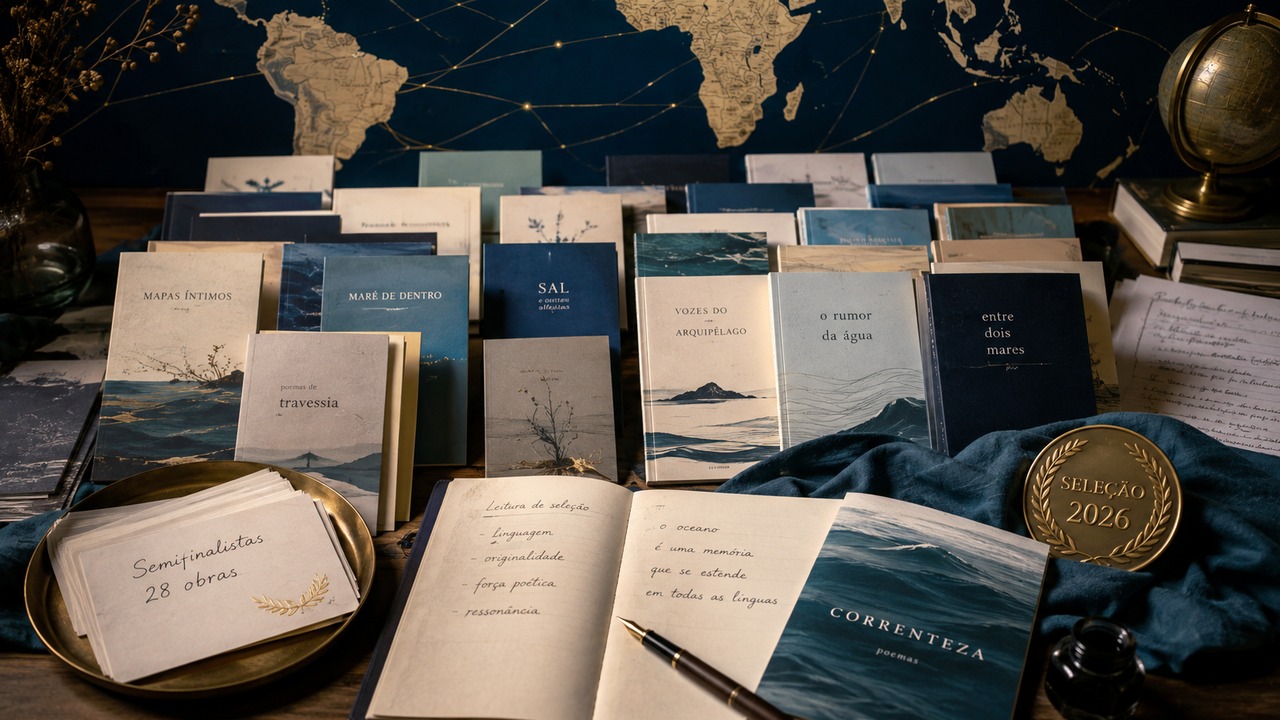
Oceanos 2026 has already selected the 28 books that remain in the poetry competition. The list is part of a group of 54 semifinalists, with 26 prose works and 28 poetry works, chosen after an edition that received 3,086 entries in total. Poetry alone had 1,278 entries. Against that raw total, the 28 semifinalists represent about 2.2% of the works entered in the genre, although the rules provide for a prior qualification stage before the classification assessment.
Below, the poetry selection is organized as a reference base: title, author, publisher and the geographic identification that accompanied the announcement of the list. After the 28 names, the article explains which stage the prize is in, who is evaluating the books now, what the October 12 date means and where to follow the next official updates.
What it means to reach the Oceanos 2026 semifinal
The 2026 rules admit single-author books originally written in Portuguese and published in a first edition, in print or digital form, between January 1 and December 31, 2025. Poetry and prose are evaluated separately.
The prize's formal structure has a qualification stage and, after that, three successive stages of analysis and voting: classification, semifinal and final. The 28 books below have already passed the classification stage and are now in the semifinal stage. This is different from a simple list of entries and it also does not represent a public ranking among the 28 titles.
The official edition page states that, in poetry, the semifinalists correspond to 19 Brazilian authors, five Mozambican authors and four Portuguese authors. The 28 books were published by 25 publishing imprints, showing a selection spread across larger, medium-sized and independent houses.
The 28 poetry semifinalists
The list below preserves the alphabetical order by title used in the public announcement. The identification in parentheses is reproduced as it appeared in the published list, without turning it into an editorial classification of our own.
A parte desejada
Ademir Demarchi; Lambrequim; Brazil - PR.
Antes de dar nomes ao mundo
Adriana Lisboa; Relicário; Brazil - RJ.
As Mãos
Rui Teixeira Motta; Guerra e Paz Editores; Portugal.
Boris e Marina
Alberto Martins; Companhia das Letras; Brazil - SP.
Cavalo partido ao meio
Danilo Villa; Primata; Brazil - BA.
Coisa de nada
Duarte Drumond Braga; não (edições); Portugal.
Corpos da Memória
Helder Macedo; Caminho; Portugal.
Costurar a linguagem
Zacarias Nguenha; Fundação Fernando Leite Couto; Mozambique.
De-estar, entrestrelas
Age de Carvalho; Cobalto Livros; Brazil - PA.
Diáspora não é lar
Nina Rizzi; Pallas; Brazil - SP.
Matriarca cidade
Dalgo Silva; 7Letras; Brazil - CE.
Modos de construção sobre tapumes
Gabriela Sobral; Cachalote; Brazil - PA.
Nada entre dois polegares
João Gabriel Madeira Pontes; 7Letras; Brazil - RJ.
Noite devorada
Mar Becker; Círculo de Poemas; Brazil - RS.
O jardim das oliveiras
Adélia Prado; Record; Brazil - MG.
Para Espantar Horror do Tempo
Ben Jone; Oleba Editores; Mozambique.
Para o Naufrágio do Fogo
Britos Baptista; Gala-Gala; Mozambique.
Porte Étoile
Edimilson de Almeida Pereira; Cobalto Livros; Brazil - MG.
Pote de mel e outros poemas
Leonardo Gandolfi; Editora 34; Brazil - RJ.
Quimera
Prisca Agustoni; Círculo de Poemas; Switzerland-Brazil.
Radiografia das árvores
Ivana Fontes; Aboio; Brazil - SE.
Relógio sem rosto
Carlos Machado; Patuá; Brazil - BA.
Satori na laje
Edson Cruz; EditoRia; Brazil - BA.
Sobre a queda de uma pétala
Adriano Wintter; Bestiário; Brazil - RS.
Terreno
Duarte Scott; Tinta-da-China; Portugal.
Toda manhã era vez
Carla Diacov; Ofícios Terrestres; Brazil - SP.
Tratado das Coisas Sensíveis
Pedro Pereira Lopes; Imprensa Nacional - Casa da Moeda; Mozambique.
Tratado sobre noite
Whaskety Fernando; Mapeta; Mozambique.
How to read the diversity of this list
The presence of 28 books should not be mistaken for 28 identical editorial profiles. The selection brings together authors with very different trajectories and imprints of different sizes. There are names widely known in Brazil, such as Adélia Prado, Adriana Lisboa and Edimilson de Almeida Pereira, alongside poets connected to independent circuits and Mozambican and Portuguese authors who do not always circulate with the same intensity in the Brazilian market.
The way the organization itself summarizes the list helps show its international dimension: 19 Brazilian authors, five Mozambican authors and four Portuguese authors. The published list identifies Prisca Agustoni as Switzerland-Brazil, so it is worth preserving that specific information without trying to reclassify it independently. For following the prize, the important point is that the organization's official poetry count is 19, 5 and 4.
Another useful detail is the editorial dispersion. There are 25 imprints for 28 books. This means the semifinal is not concentrated among a small number of publishers and that readers interested in following the titles will probably need to consult different catalogs and distribution channels, especially for independent editions or books published outside Brazil.
What stage Oceanos 2026 is in now
After the semifinalists are announced, the stage that the rules call the Semifinal Stage begins. The edition's public communication also refers to the group responsible for this phase as the intermediate jury.
In poetry, the jury for this stage is made up of Leopoldina Fekayamãle, from Angola; Francisco Guita Jr., from Mozambique; Fernando Paixão and Natasha Félix, from Brazil; and Maria Antónia Oliveira and Maria João Cantinho, from Portugal.
According to the announcement released with the list, these jurors have until October 12 to assess the semifinalists and choose five poetry books that will move on to the final. The same reduction takes place in prose, from its semifinalist list to five finalists.
There is an important difference between the evaluation deadline and the announcement date. October 12 is presented as the deadline for the jury to complete its work at this stage. It should not automatically be treated as the date when the public will see the list of five finalists. The rules leave the disclosure of results to the decision of the General Coordination.
How the five finalists are chosen
The rules establish that the members of the Semifinal Jury read and evaluate the books assigned to them, awarding scores from 1 to 10, including fractional scores, according to their own literary and aesthetic criteria. These scores are kept confidential by the General Coordination and the Curatorial Team and are not disclosed to the public or to the other jurors.
After the readings and individual scores, the jury meets to seek unanimity on the finalist books. If there is no consensus, an average-score calculation is used. The rules determine that the highest and lowest scores are excluded to establish the ranking; in the event of a tie, the excluded scores may be brought back for a new calculation.
There is also a representation rule: no more than 70% of the books advancing to the next stage may be by authors born in the same country. This provision is relevant to understanding that reaching the final does not depend only on a simple ordering of averages; the rules also seek to preserve the prize's international character.
What happens after the five finalists
The five poetry books chosen at this stage advance to the Final Stage and will be evaluated by a new international jury. The same happens with the five prose finalists.
In the final stage, the goal is to choose one winner in each genre. The rules provide for a search for unanimity; if it is not reached, a scoring system and tie-breaking criteria are applied. The poetry winner and the prose winner each receive a gross prize of R$150,000.
The date and place of the final announcement remain under the responsibility of the General Coordination. Any monitoring calendar should therefore distinguish three moments: the close of the semifinal evaluation, the announcement of the five finalists and, later, the announcement of the poetry winner.
How to follow the selection without relying on republications
The safest route is to start with the official page for the 2026 edition of Associação Oceanos: associacaooceanos.org/edicoes/2026. That is where the organization concentrates information about the edition, semifinalist lists and updates on the stages.
The rules also identify the edition-specific website, premiooceanos2026.associacaooceanos.org, as one of the channels where the final result will be available. Even after entries have closed, that address remains an official reference for edition documents such as the rules.
For readers who want to follow each work's path through the prize, Associação Oceanos also maintains a catalog area at catalogacao.associacaooceanos.org/livros. The page states that the database allows users to consult the genre and the progression of books through stages such as semifinalist, finalist or winner as the data are updated.
It is also worth watching the social profiles linked from the Associação Oceanos website, especially when the organization announces publication dates. Social media, however, works better as an alert; to confirm names, spellings and the competition stage, the main reference should remain the official edition page and the prize documents.
The main point for anyone following Oceanos poetry
At this moment, the most important information is not trying to predict a winner, but separating what has already been decided from what still depends on the jury. The 28 titles above are the 2026 poetry semifinalists. The current stage is expected to reduce them to five finalists. The October 12 deadline refers to the evaluation work, not necessarily to the moment when the result is made public.
That makes the list more useful than a simple announcement story. It works as a reading map of an international Portuguese-language selection: it lets readers locate authors, publishers and countries, follow the move to the final and return to official channels without confusing rumor, republication and confirmed results.