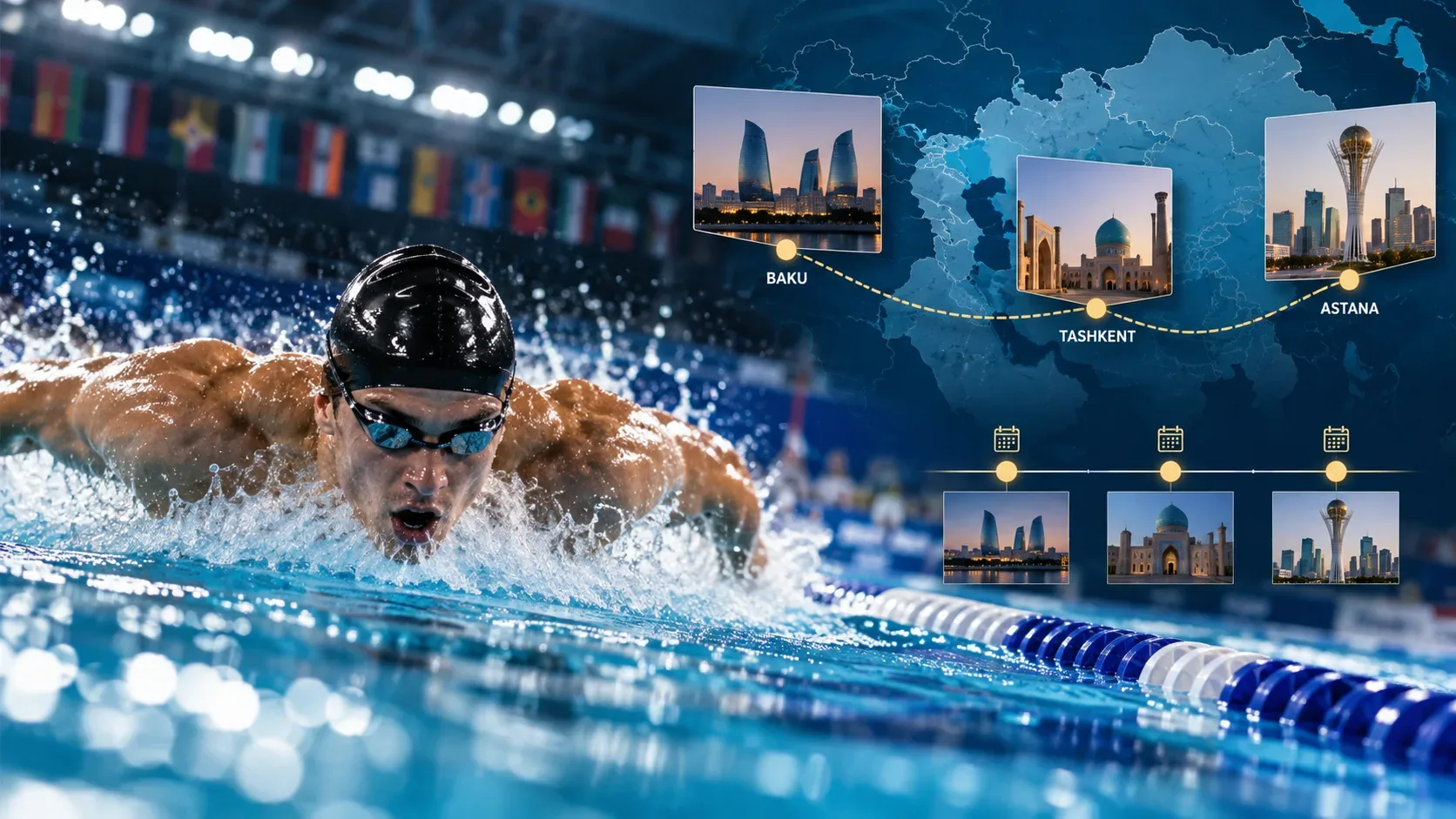
The 2026 Swimming World Cup will be held over three consecutive October stops on the Silk Road Tour: Baku, Azerbaijan, from October 1 to 3; Tashkent, Uzbekistan, from October 8 to 10; and Astana, Kazakhstan, from October 15 to 17. The schedule compresses the circuit into three weeks and provides a competitive lead-in to the World Aquatics Swimming Championships (25m), which will take place in Beijing in December.
2026 Swimming World Cup calendar
| Stop | City | Country | Official dates | Difference from Brasília time |
|---|---|---|---|---|
| 1 | Baku | Azerbaijan | October 1–3, 2026 | Baku is 7 hours ahead |
| 2 | Tashkent | Uzbekistan | October 8–10, 2026 | Tashkent is 8 hours ahead |
| 3 | Astana | Kazakhstan | October 15–17, 2026 | Astana is 8 hours ahead |
The 2026 time zones are stable in all four cities involved: Brasília is UTC−3, Baku is UTC+4, and Tashkent and Astana are UTC+5, with no clock changes during the year. In practical terms, once World Aquatics publishes session times, an event scheduled for 6 p.m. in Baku is 11 a.m. in Brasília; in Tashkent or Astana, 6 p.m. is 10 a.m. in Brasília. The conversion is straightforward, but the official competition page should still be checked close to race day because event and session schedules can be updated.
How the circuit is organized
The 2026 season has three stops, and each one functions as its own meet within the same circuit. Each stop has its own results and prize money, while the full sequence also feeds the overall World Cup competition and performance incentives tied to the complete tour.
That creates two ways to follow the event. The first is stop by stop: who wins a particular race in Baku, Tashkent or Astana. The second tracks consistency across all three weeks: who keeps producing top results, who climbs the overall standings and who can complete a Crown.
World Aquatics says the 2026 edition will offer a total prize pool of US$1.2 million, excluding bonuses for World Records and Crowns. More than 750 athletes from over 50 nations are expected. The men's and women's overall titles are also part of the circuit, which is why following the series standings matters as much as checking the winners from a single city.
What is a Crown?
A Crown rewards dominance in the same event across the tour. In most events, a swimmer must win the same race at all three stops. For the 800m and 1500m freestyle, where the distance events are distributed differently across the stops, World Aquatics defines a Crown as winning two of the three relevant races. Each Crown earns a US$10,000 bonus; the same amount is offered for a World Record, on top of standard prize money.
Why Baku is more than just the opening stop
Baku opens the tour from October 1 to 3 at the Aquatic Palace. The stop has institutional significance because it will be the first World Aquatics event ever held in Azerbaijan. The city, however, already has experience hosting major aquatics and multi-sport competitions.
For anyone following the circuit, Baku establishes the first benchmark of form: opening times, event choices, head-to-head matchups among leading swimmers and the first list of athletes who can begin building a Crown campaign. It also starts to reveal who is treating the World Cup as a primary target and who is using it as preparation for Beijing.
What changes in Tashkent
The second stop runs from October 8 to 10 in Tashkent. World Aquatics notes that it will be the first international swimming competition hosted by Uzbekistan, using the new sports infrastructure at Olympic City.
From a sporting perspective, Tashkent is the confirmation point. A single win in Baku can be one outstanding weekend; repeating it one week later puts a swimmer in genuine Crown contention and strengthens their overall series position. It is also where travel recovery, changes in event programs and workload management begin to matter more.
Why Astana is likely to concentrate the decisions
Astana hosts the final stop from October 15 to 17. It will be the fourth World Aquatics event held in Kazakhstan, following three global water polo tournaments in the country. As the final stop, Astana concentrates the biggest closing storylines: overall titles, Crowns, records and the final outcome of the tour.
For fans, it is the easiest stop to approach with one question: who reaches the final week with something major still at stake? Swimmers who won the same event in the first two cities may complete a Crown; athletes who built strong results earlier can decide the overall standings; and those seeking a qualifying pathway to Beijing have their final opportunity within this circuit.
The new link between the World Cup and the 25m World Championships
World Aquatics has announced a trial wild card system for the 2026 World Aquatics Swimming Championships (25m) in Beijing. A swimmer can earn direct qualification by finishing in the top three of an individual final and also achieving an A standard time at any of the three World Cup stops.
The rule also matters at federation level: each National Federation can add up to three swimmers for Beijing through this mechanism. That gives some finals value beyond the medal and prize money available at the World Cup itself.
What to watch at each stop
- Baku: the first direct matchups, early form, benchmark times and who starts a Crown campaign.
- Tashkent: who can repeat wins, which swimmers adjust their programs and who becomes a serious overall contender.
- Astana: the final Crowns, overall leaders and the last chances to use the tour as a route to Beijing.
How to follow the event in Brasília time
The stop dates are confirmed, but the detailed session schedule should be treated as dynamic information. World Aquatics' official competition pages are the best place to check the program, results and, when available, the option to display times in the viewer's own time zone.
Until the detailed schedule is published, keep the conversion rule in mind: subtract 7 hours from Baku time and 8 hours from Tashkent or Astana time to get Brasília time. Because none of these cities changes clocks during 2026, the gap remains constant throughout the tour.