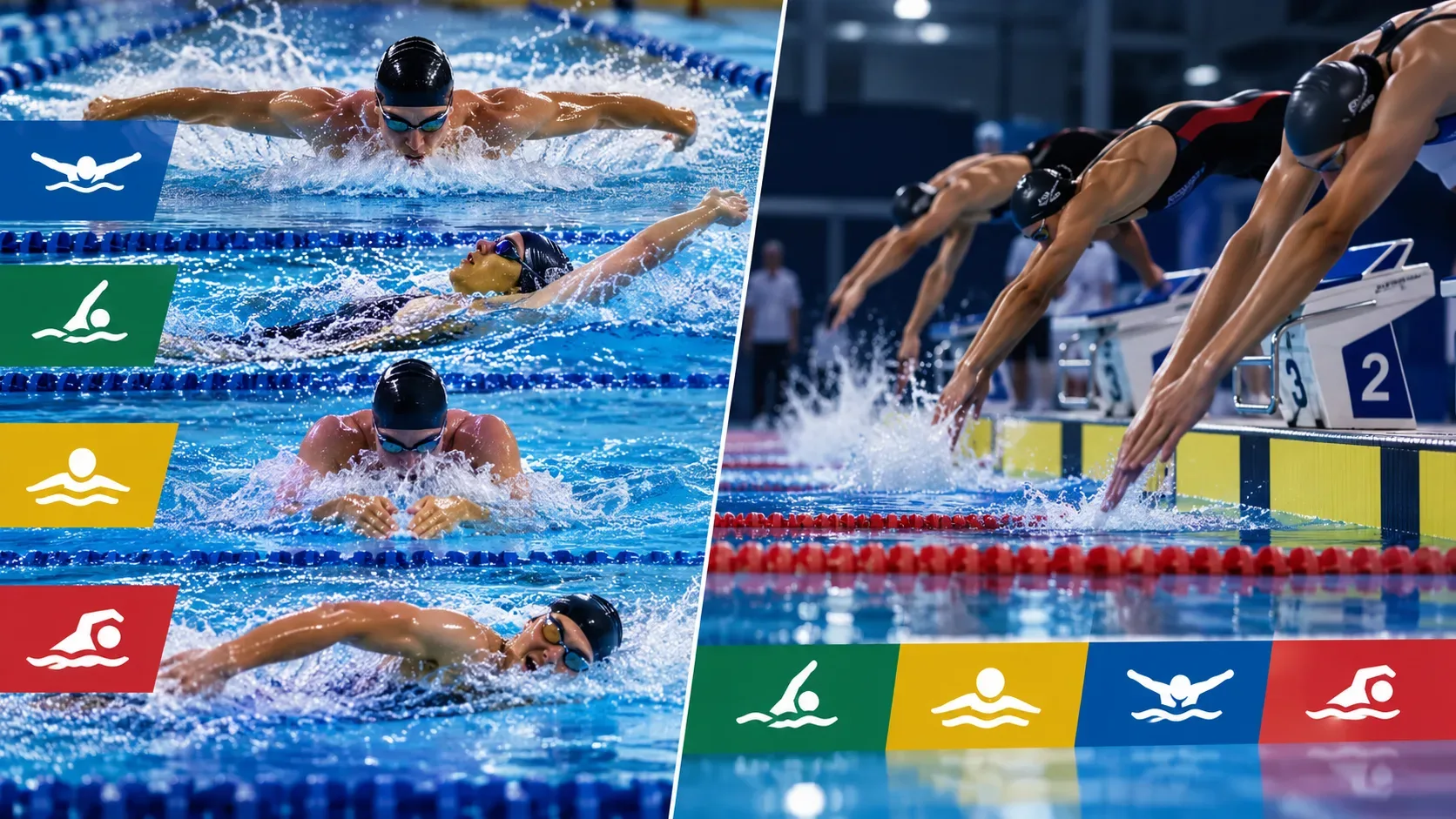
In medley swimming, the stroke order changes because the individual event and the relay are defined differently by the rules. In the individual medley, one swimmer covers four equal sections in the order butterfly, backstroke, breaststroke and freestyle. In the medley relay, four swimmers split the race in the order backstroke, breaststroke, butterfly and freestyle.
The difference is not a simple reversal. It also determines how the race starts and how transitions between legs work. The current rules can be checked on the official World Aquatics swimming rules page and in the Competition Regulations.
What is the order in the individual medley?
In the individual medley, the total distance is divided into four equal parts, in this order:
- Butterfly
- Backstroke
- Breaststroke
- Freestyle
In a 200 m individual medley in a 50 m pool, each stroke therefore covers 50 m. In a 400 m individual medley, each stroke covers 100 m. In a 25 m pool, the number of lengths changes, but each stroke still accounts for one quarter of the total distance.
What is the order in the medley relay?
In the medley relay, each team member swims one complete stroke. The sequence is:
- Backstroke
- Breaststroke
- Butterfly
- Freestyle
In a 4 x 100 m medley relay, for example, each swimmer covers 100 m. In a 4 x 50 m medley relay, each leg is 50 m. The same logic applies to men's, women's and mixed teams when the event uses the medley relay format.
Why does backstroke come first in the relay?
The key point is the start. Backstroke begins with the athlete in the water, holding the starting area, while butterfly, breaststroke and freestyle use a forward start when they open an individual event.
Putting backstroke first gives the relay a single backstroke start. After that, the other swimmers can begin from the block as the previous teammate finishes. If backstroke appeared in the middle of the relay, a relay exchange would have to be reconciled with a stroke whose regulated start begins in the water.
How does the start work in each format?
| Format | First stroke | How it starts |
|---|---|---|
| Individual medley | Butterfly | The swimmer uses a forward start and begins the first quarter with butterfly. |
| Medley relay | Backstroke | The first swimmer starts in the water according to the backstroke start. |
There is no athlete exchange in the individual medley. The same swimmer must finish each section under that stroke's rules and transition to the next one. In the relay, one swimmer's finish releases the next swimmer, subject to the relay exchange rule.
How do exchanges work in the medley relay?
After the backstroke leg, the breaststroke, butterfly and freestyle swimmers wait for their turns on the starting block. The exchange depends on the incoming teammate's touch. In practical terms, the next start must be synchronized with the previous finish, without an early departure that violates the relay rule.
That creates three exchanges: backstroke to breaststroke, breaststroke to butterfly and butterfly to freestyle. The finishing technique of the stroke being completed still matters because the touch must be valid before the team continues.
What does “freestyle” mean on the last leg?
In a medley event, “freestyle” has a specific restriction: on that section the swimmer may not use butterfly, backstroke or breaststroke as the stroke for the leg. In competition, front crawl is the usual choice because it is efficient and fast, but “freestyle” is not a regulatory synonym for front crawl.
This rule prevents the fourth section from repeating one of the three strokes already used and preserves a four-stroke structure.
How can you remember both sequences?
| Event | 1st | 2nd | 3rd | 4th |
|---|---|---|---|---|
| Individual medley | Butterfly | Backstroke | Breaststroke | Freestyle |
| Medley relay | Backstroke | Breaststroke | Butterfly | Freestyle |
A useful memory cue is the start. If it is individual, it starts with butterfly. If it is a medley relay, it starts with backstroke. Freestyle closes both races.
What changes in practice for swimmers and spectators?
Once you identify who starts and which stroke follows, it becomes easier to track splits, exchanges and possible infractions. In the individual event, attention is on one swimmer's transitions among four strokes. In the relay, the three athlete exchanges matter in addition to execution of each stroke.
The official sequence therefore organizes more than the visual order of the race. It connects the technical requirements of each stroke with the starting method and, in the relay, with the mechanics of exchanges.