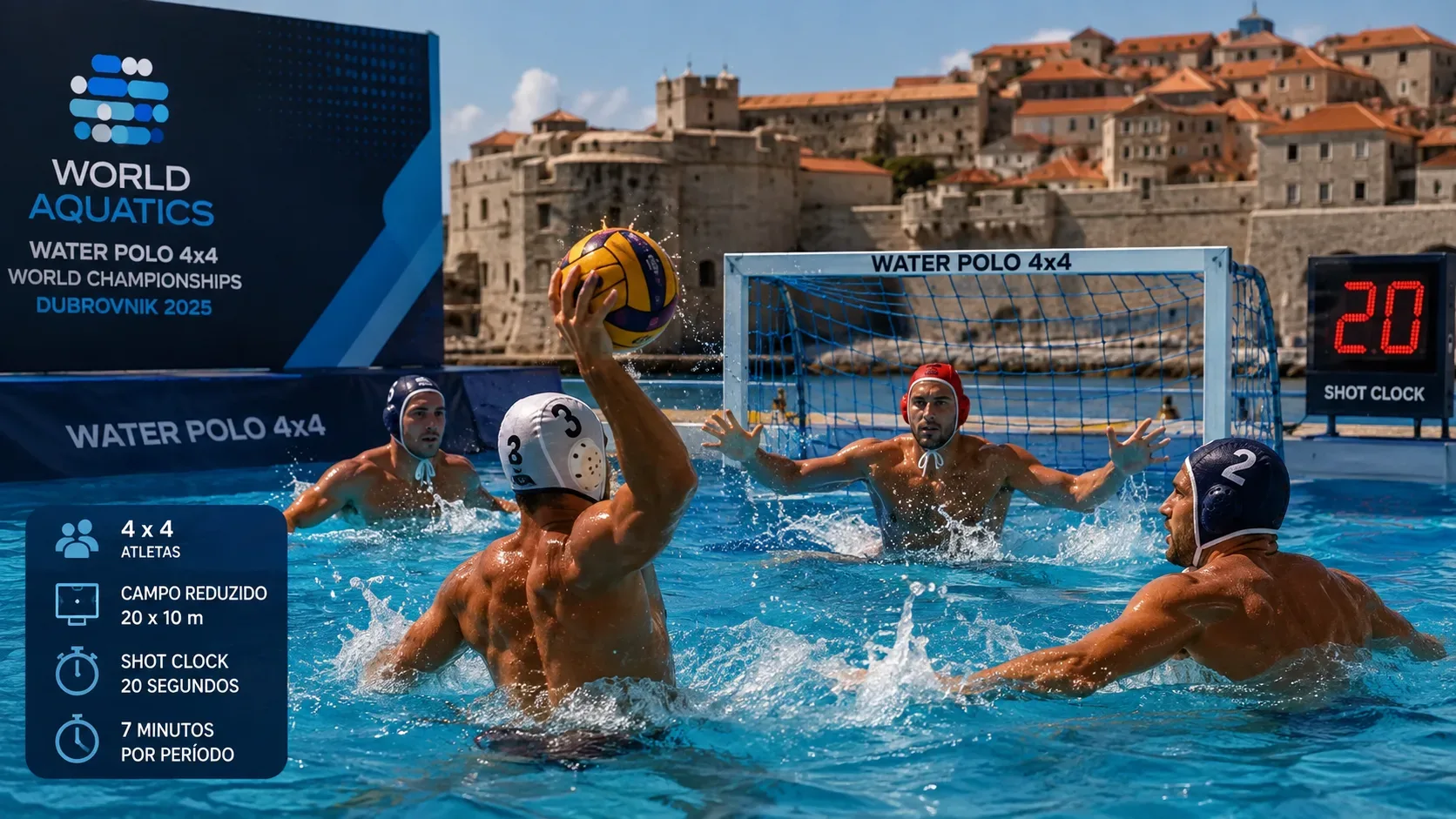
The 4x4 water polo format making its global debut in Dubrovnik is not simply traditional water polo with fewer athletes. World Aquatics itself treats it as a distinct discipline, with specific rules in force since February 2026. At the World Aquatics Water Polo 4x4 Open Championships, held from 31 August to 6 September 2026 in Dubrovnik's historic harbour, the combination of a short field, a 20-second possession clock and set-based scoring changes how the game is read from the opening possession.
The essential rules of 4x4 water polo
The starting point is the official Water Polo 4x4 rulebook. Each team may have between four and eight players for a match, but only four are in the water at the same time: three field players and one goalkeeper. Up to four players may be used as substitutes.
- Field: between 15 and 16 metres long by 10 metres wide, with a minimum water depth of 2 metres.
- Possession: no more than 20 seconds without shooting at the opponent's goal.
- Duration: four periods of five minutes of actual play.
- Sets: each period counts as a set; the first team to win three sets wins the match.
- Tied set: if a period ends level, play continues until a Golden Goal decides that set.
- 2-2 in sets: after all four periods, a penalty shootout decides the winner of the match.
- Two-point goal: a shot taken from the defensive half that enters the opponent's goal is worth two points within the set.
4x4 vs traditional water polo: what actually changes
The most useful comparison is to separate changes in the structure of the game. In international traditional water polo, World Aquatics describes seven players in the water, 28 seconds of possession and four eight-minute quarters; international rules were also updated to shorten the men's competitive field to about 25 metres while keeping a 20-metre width. In 4x4, almost everything is compressed to speed up transitions and decision-making.
| Aspect | Water Polo 4x4 | Traditional format |
|---|---|---|
| Players in the water | 4: three field players and one goalkeeper | 7 |
| Field | 15–16 m x 10 m | About 25 m x 20 m under the current international standard |
| Possession time | 20 seconds | 28 seconds |
| Playing time | 4 periods of 5 minutes of actual play | 4 quarters of 8 minutes |
| How a match is won | First to 3 sets | Highest total number of goals |
| Special scoring | A goal from the defensive half is worth 2 points | A goal is worth 1 point |
The traditional-format parameters above can be checked in World Aquatics' explanation of Olympic water polo for Los Angeles 2028 and its international rules update.
Why sets change the strategy
In 4x4, the goal score in a period is used only to decide that set. That means winning one set by a wide margin does not create a cumulative advantage in the next: the next set starts again at 0-0. The rules also include a “Mercy Rule”: if a team goes eight goals ahead at any point in a period, the set ends immediately and that team is declared the winner of the set.
In practice, this raises the value of every closing phase. A team that loses the first period by many goals can still level the match in sets by winning the second by a single goal. And if a period is tied at the end of regular time, the Golden Goal makes the first successful finish in that set's overtime an immediate decision.
The two-point goal adds risk and reward
Another striking difference is the long-range shot. Under rule 8.7, a goal normally counts for one point, but a shot taken from the player's own defensive goal area — the defensive side of the halfway line — counts for two. On a field only 15 to 16 metres long, this is more than a novelty: it creates a choice between advancing for a more controlled finish or attempting a long ball that can swing a set with one action.
Matches on the opening day in Dubrovnik already showed this option in use, including goalkeepers looking for long-range finishes. For viewers, it is worth watching for the moment when a goalkeeper or field player drops back to prepare that shot and how the defence responds to the risk of conceding two points.
The pace is faster for three reasons
The smaller field and 20-second clock are only part of the acceleration. After a goal, the goalkeeper of the team that conceded restarts play by visibly putting the ball into play from the 2-metre line, without a slower central restart. In addition, 4x4 allows “flying substitutions”: the outgoing and incoming players can make the change through the designated substitution area, touching hands above the water as required by the procedure in the rules.
This combination reduces dead time and encourages counterattacks, quick defensive switches and frequent player changes. World Aquatics has presented WP4 as a format designed to be faster, more flexible and adaptable to urban pools and open-water locations.
Dubrovnik is the first global test of the format
The inaugural championship takes place in Dubrovnik's Old Town Harbour from 31 August to 6 September 2026, with men's and women's competitions. World Aquatics describes the edition as the first global showcase of 4x4 and selected an open-harbour setting to underline the idea of taking the sport to urban and waterfront arenas, not only traditional pools. The event context and official presentation are available in the Dubrovnik announcement.
How to watch
Broadcasting is not a 4x4 rule, but it is part of the experience of this inaugural championship. World Aquatics has said the sessions are available live and on demand on its official YouTube channel. The official “Where to Watch” page provides viewing guidance, while the competition page brings together sessions, videos and tournament updates.
What to watch for to understand a match quickly
- Count sets, not only goals: the objective is to reach three set wins.
- Watch the 20-second clock: it forces short attacks and quick decisions.
- Spot shots from the defensive half: they can be worth two points.
- Expect a Golden Goal in a tied set: the period does not finish without a winner.
- Notice substitutions and restarts: flying changes and the goalkeeper's quick restart keep the flow moving.
In short, Water Polo 4x4 preserves the technical core of water polo — swimming, passing, contact, exclusions, extra-player situations and finishing — but changes the competitive architecture. A short field, four athletes, 20-second possession and set-based victory make the game more compact and less dependent on a cumulative goal advantage. That logic, more than simply “playing with fewer people,” is what defines the new format in Dubrovnik.