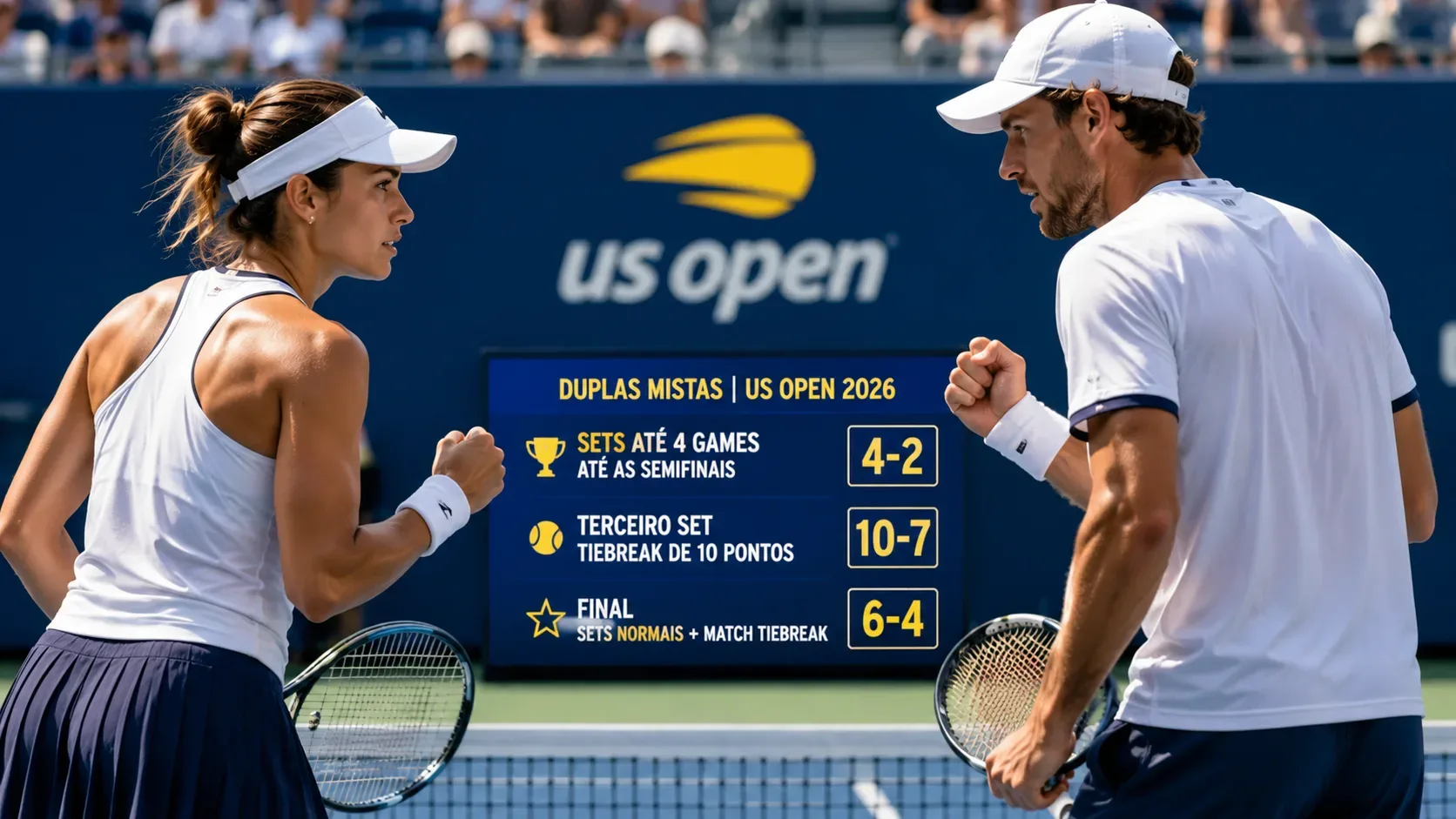
The US Open 2026 mixed doubles format should not be read like a standard singles match. The revamped event uses accelerated scoring: from qualifying through the semifinals, the first two sets are short sets with a four-game target, no-ad scoring and a tiebreak at 4-4; if each team wins one set, there is no conventional third set—the match goes straight to a 10-point match tiebreak. In the final, the first two sets return to six games, while no-ad scoring and the 10-point match tiebreak remain.
The format at a glance
| Stage | First two sets | Set tie | If the match reaches one set all |
|---|---|---|---|
| Qualifying, first round, quarterfinals and semifinals | Short sets: first to 4 games, by a 2-game margin | Tiebreak at 4-4 | 10-point match tiebreak instead of a third set |
| Final | Sets to 6 games with no-ad scoring | Tiebreak at 6-6 | 10-point match tiebreak instead of a third set |
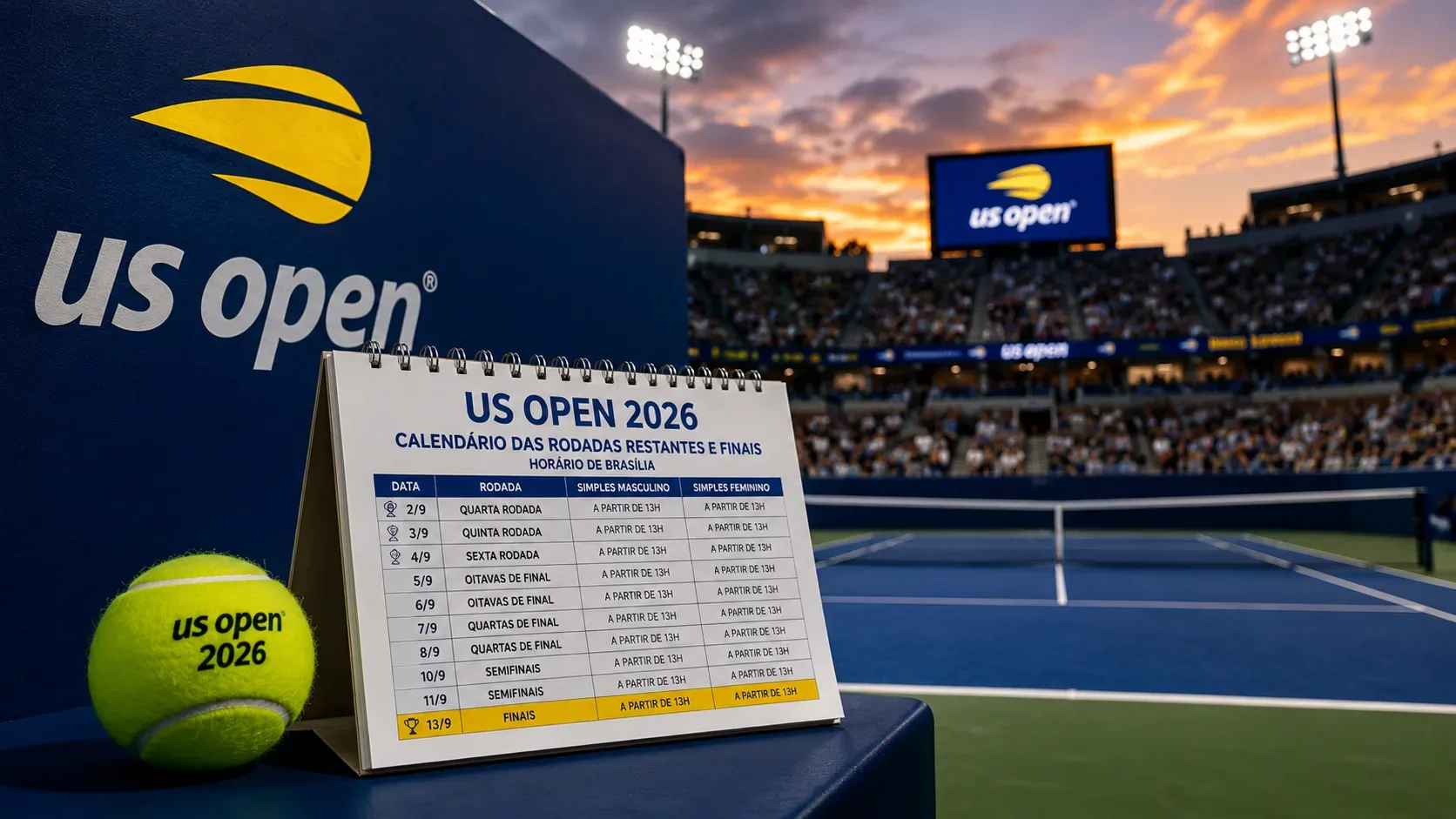
The USTA published this structure for the 2026 championship and scheduled qualifying for Aug. 24, the first round and quarterfinals for Aug. 25, and the semifinals and final for Aug. 26. The compact scoring helps explain how so many rounds could be concentrated into a few days. See the official US Open format.
“Sets to 4” does not mean 4-3 ends the set
This is the detail most likely to confuse anyone reading the scoreboard with singles scoring in mind. In short sets, reaching four games closes the set only with a two-game margin. That means 4-0, 4-1 and 4-2 are complete sets, but 4-3 is not.
At 4-3, there are two immediate paths: the leading team can win the next game and close the set at 5-3, or the trailing team can level at 4-4, sending the set to a tiebreak. That is why scores such as 5-3 and 5-4 appear even though the format is described as “sets to four games.”
The US Open itself provides real examples. In qualifying, Katerina Siniakova/Henry Patten won two matches 4-1, 4-2. In another section of the draw, Erin Routliffe/Lloyd Glasspool advanced 5-4(4), 2-4, [11-9]. In the quarterfinals, Karolina Muchova/Jakub Mensik beat Tommy Paul/Emma Navarro 4-1, 5-3. See the qualifying scores.
When the set tiebreak starts
From qualifying through the semifinals, a set that reaches 4-4 is decided by a tiebreak. On the scoreboard, that set can appear as 5-4, with the tiebreak points shown in parentheses. A score such as 5-4(4), for example, indicates that the set was settled in the tiebreak.
In the final, the threshold changes: the first two sets are played to six games and the set tiebreak comes at 6-6. So the first step in reading a 4-4 or 5-4 score is knowing which round is being played.
The 10-point tiebreak is the third set—not a tiebreak inside one
If the teams split the first two sets, they do not begin a third set made up of games. The deciding component is a match tiebreak. The first team to 10 points wins, provided it leads by two; at 9-9, play continues until one side opens a two-point margin, such as 11-9 or 12-10. International tennis rules define this tiebreak as a replacement for the deciding set. See the 2026 Rules of Tennis.
That is why this part of the score is commonly shown in brackets. A result such as 4-1, 3-5, [10-7] means the first team won the opening set, lost the second and then won the deciding match tiebreak 10-7. A result such as 4-1, 4-2 ends in straight sets and needs no match tiebreak.
No-ad scoring also shortens each game
Another important difference is no-ad scoring. Instead of entering repeated advantage cycles after 40-40, one deciding point is played: whoever wins it takes the game. In mixed doubles, the international rule says that on this deciding point, the player of the same gender as the server receives.
In practice, this limits the possibility of very long games and makes every 40-40 point especially important. Combined with short sets and the match tiebreak, no-ad scoring compresses match length without removing the best-of-three structure: there are still two opening sets and, if needed, a deciding tiebreak that stands in for the third set.
Qualifying, semifinals and final: what actually changes
- Qualifying: eight teams competed for two main-draw spots. The same short-set format used in the main draw through the semifinals already applied there.
- First round and quarterfinals: sets to four games, no-ad scoring, tiebreak at 4-4 and a 10-point match tiebreak if the teams split sets.
- Semifinals: they still use exactly that short format. The Bencic/Cobolli vs. Svitolina/Monfils semifinal finished 4-5(7), 4-1, [10-5].
- Final: the first two sets move to six games, with a tiebreak at 6-6; the third remains a 10-point match tiebreak. Karolina Muchova/Jakub Mensik won the title 6-3, 1-6, [10-6] over Belinda Bencic/Flavio Cobolli. See the official final score.
How to follow the scoreboard without applying singles rules
- Identify the round. Through the semifinals, think short sets; in the final, think six-game sets.
- Do not mentally end a set at 4-3. A two-game margin is required unless the score reaches the tiebreak at 4-4.
- Read parentheses as a set tiebreak. A 5-4(6) score means the set was decided in the tiebreak.
- Read brackets as the match tiebreak. [10-7] or [11-9] is the replacement for the third set.
- Remember no-ad scoring. At 40-40, the next point decides the game, with no advantage.
With those five cues, unusual-looking scores become easy to decode: 5-3 is a valid short-set result, 5-4 signals a set decided by a tiebreak, and [10-6] is not a “third set of ten games” but the deciding match tiebreak.