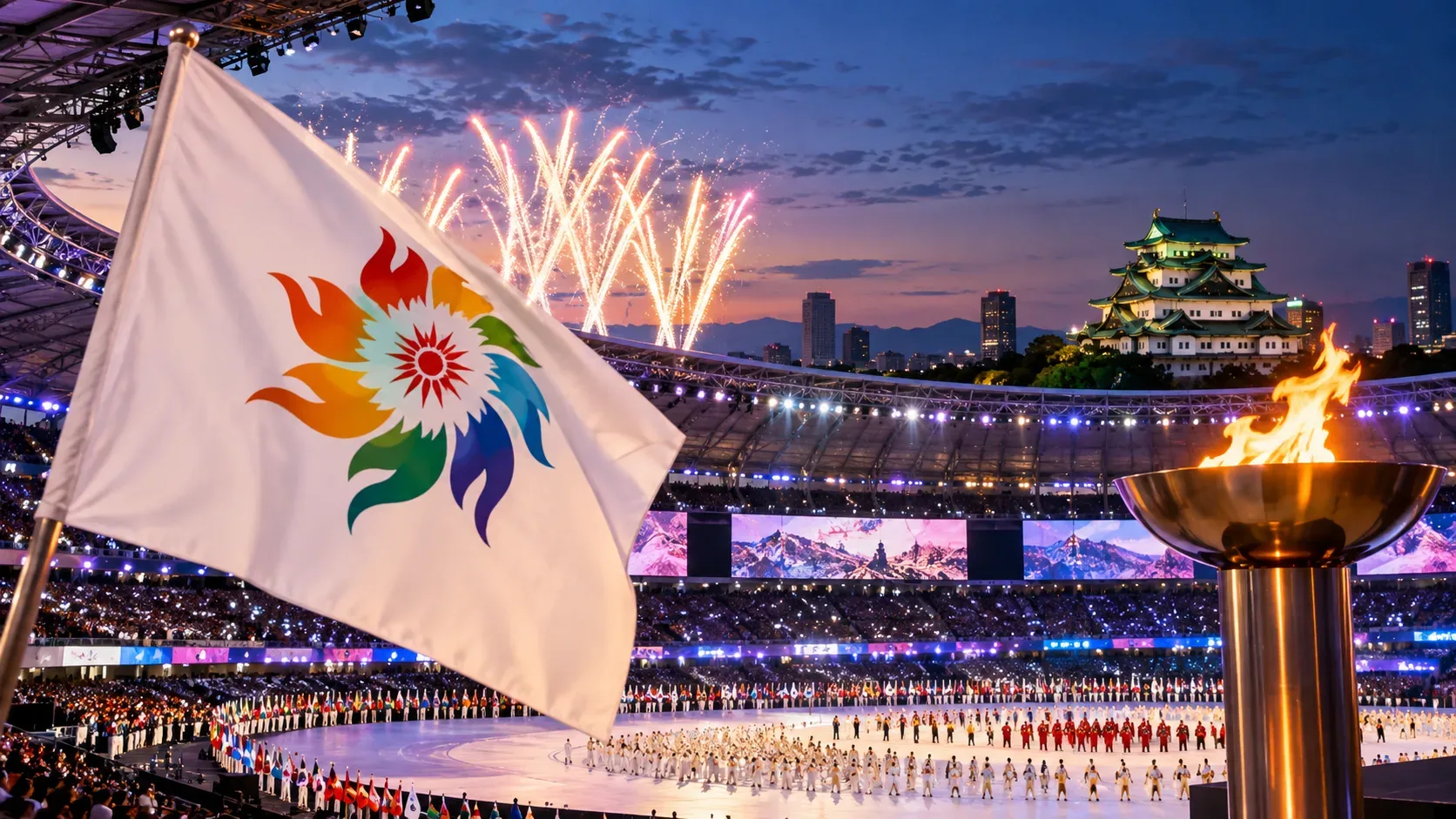
The Aichi-Nagoya 2026 Asian Games officially enter their competition period on Saturday, September 19, with the Games ending on October 4. The opening ceremony is scheduled for 6:00 p.m. in Japan at Nagoya City Mizuho Park Athletic Stadium, which corresponds to 6:00 a.m. Brasília time. There is one important calendar detail: some sports had matches before the formal opening, including basketball, whose programme began on September 10.
2026 Asian Games: quick guide
| Item | Information |
|---|---|
| Official Games period | September 19 to October 4, 2026, 16 days |
| Opening ceremony | September 19 at 6:00 p.m. in Japan, 6:00 a.m. Brasília time |
| Opening venue | Nagoya City Mizuho Park Athletic Stadium in Nagoya |
| Sports programme | 43 sports, 71 disciplines and 469 events in the programme updated on June 16 |
| Competition venues | 54 venues |
| Participation | 45 Asian countries and regions, plus the OCA Refugee Team |
| Closing | October 4 at the same stadium used for the opening |
The current figures of 43 sports and 54 venues appear on the official Aichi-Nagoya 2026 website. The sports programme published by the organisers in June details 71 disciplines and 469 events. The current participant list includes 45 countries and regions plus the Olympic Council of Asia refugee team on the participating NOCs page.
What happens at today's opening ceremony
The opening ceremony takes place at Mizuho Park Athletic Stadium, the main Games venue in Nagoya. For ticket holders attending in person, the organisers published a phased entry operation: identity verification from 1:00 p.m., gates opening at 1:30 p.m., the warm-up stage beginning at 4:00 p.m. and the ceremony starting at 6:00 p.m., all in Japan local time.
There are also specific access rules. The organisers required spectators to register their visitor and ticket information in advance, with the deadline on September 17. Official guidance also states that entry restrictions begin at 4:00 p.m. for operational reasons and recommends arriving early because of identity and security checks. Anyone attending in person should use the official visitor information page as the main reference because operational times can be updated.
Why some competitions started before September 19
September 19 is the official opening date, but it does not mean every sports competition begins that day. Longer tournaments need preliminary rounds before the ceremony. The basketball schedule at Aichi International Arena, for example, records games from September 10, while football also has fixtures before the opening.
This kind of early start is common at major multi-sport events. When checking results and brackets, it helps to separate two references: the official Games period, September 19 to October 4, and the actual calendar for each sport. The official portal provides links to updated schedules and results.
How the overall calendar runs through October 4
The programme is spread over more than two weeks, with each sport having its own competition window. A few examples show how the schedule is staged:
- September 19: opening ceremony and continuation of sports already under way.
- September 20: swimming begins at Tokyo Aquatics Centre, with morning and evening sessions in Japan local time.
- September 23: esports begin at Aichi Sky Expo.
- September 29: track cycling begins at Izu Velodrome.
- October 2: breaking begins at Aichi Sky Expo.
- October 4: final day of the official Games period and closing ceremony.
Because sessions can be adjusted, the daily programme should be checked on the date of interest. Individual venue pages also show gate opening times, competition starts and projected end times.
Which sports are on the 2026 Asian Games programme
The updated programme includes 43 sports. It combines widely known Olympic sports, sports with a long Asian Games tradition and newer additions. Major groups include athletics, aquatics, badminton, basketball, boxing, cycling, football, gymnastics, hockey, judo, shooting, tennis, volleyball, weightlifting and wrestling.
The programme also includes sports with a strong regional presence, such as kabaddi, sepaktakraw, wushu, kurash and jiu-jitsu. Newer or expanded highlights include esports, mixed martial arts, padel, surfing, teqball and virtual taekwondo. The complete current list is available on the official Games sports page.
This range of sports helps explain why the Games cannot fit into a single part of the city. Different facilities are needed, from pools and velodromes to indoor arenas, fields, beaches and exhibition centres.
Editorial map of key venues
| Venue | Location | Main Games use |
|---|---|---|
| Nagoya City Mizuho Park Athletic Stadium | Nagoya, Aichi | Opening and closing ceremonies and athletics |
| Aichi International Arena | Nagoya, Aichi | Basketball and judo |
| Aichi Sky Expo | Tokoname, Aichi | Breaking, BMX freestyle, esports, fencing and skateboarding |
| Tokyo Aquatics Centre | Tokyo | Swimming and diving |
| TOYOTA STADIUM | Toyota, Aichi | Football, including the men's final |
| Izu Velodrome | Izu, Shizuoka | Track cycling |
The official list includes 54 competition venues. Most are concentrated in Aichi and Nagoya, but the event extends to other parts of Japan. Facilities are also used in Tokyo and Shizuoka, as well as Gifu and Osaka, among other locations. That makes it important to check not only the sport but also the city and logistics for each session.
How to follow the opening and the Games
The Olympic Council of Asia says CMG-IMP is the host broadcaster for the Games. Its production plan includes live coverage of 28 sports plus the opening and closing ceremonies, while the other 15 sports are covered through ENG. English commentary is also planned for ten sports and both ceremonies, together with daily highlights. Details are in the OCA's broadcasting plan announcement.
An international feed does not mean the same platform is available in every country. Rights are distributed by territory. In India, for example, coverage appears on Sony Sports and Sony LIV, but those services should not be treated as a global viewing option. As of this guide's update, the official sources reviewed did not identify a specific Brazilian channel for the opening ceremony. For viewers in Brazil, the safest approach is to check official Games channels and any announcements from local rights holders before each session.
For following the event without relying on a broadcast, the official website is the main reference for schedules, results, sports and venues. Olympics.com also maintains editorial coverage and country schedules, including its September 19 schedule page, which is useful for seeing what is already being contested on opening day.
What you need to know to follow from day one
- Treat September 19 as the official start and October 4 as the closing date.
- For the opening ceremony, use 6:00 p.m. in Japan and 6:00 a.m. Brasília time as the reference.
- Do not be surprised by results dated before September 19, because some sports started earlier.
- Use the sport-specific schedule, not only the overall Games dates, when planning what to watch.
- Confirm the venue for every session because the 54 locations are spread across Aichi, Nagoya and other parts of Japan.
- For broadcasts, verify availability in your territory because media rights are not global.
Editorial update: information reviewed on September 19, 2026. Competition schedules, session times and venue access operations can change, so official pages should be checked before travel or specific sessions.