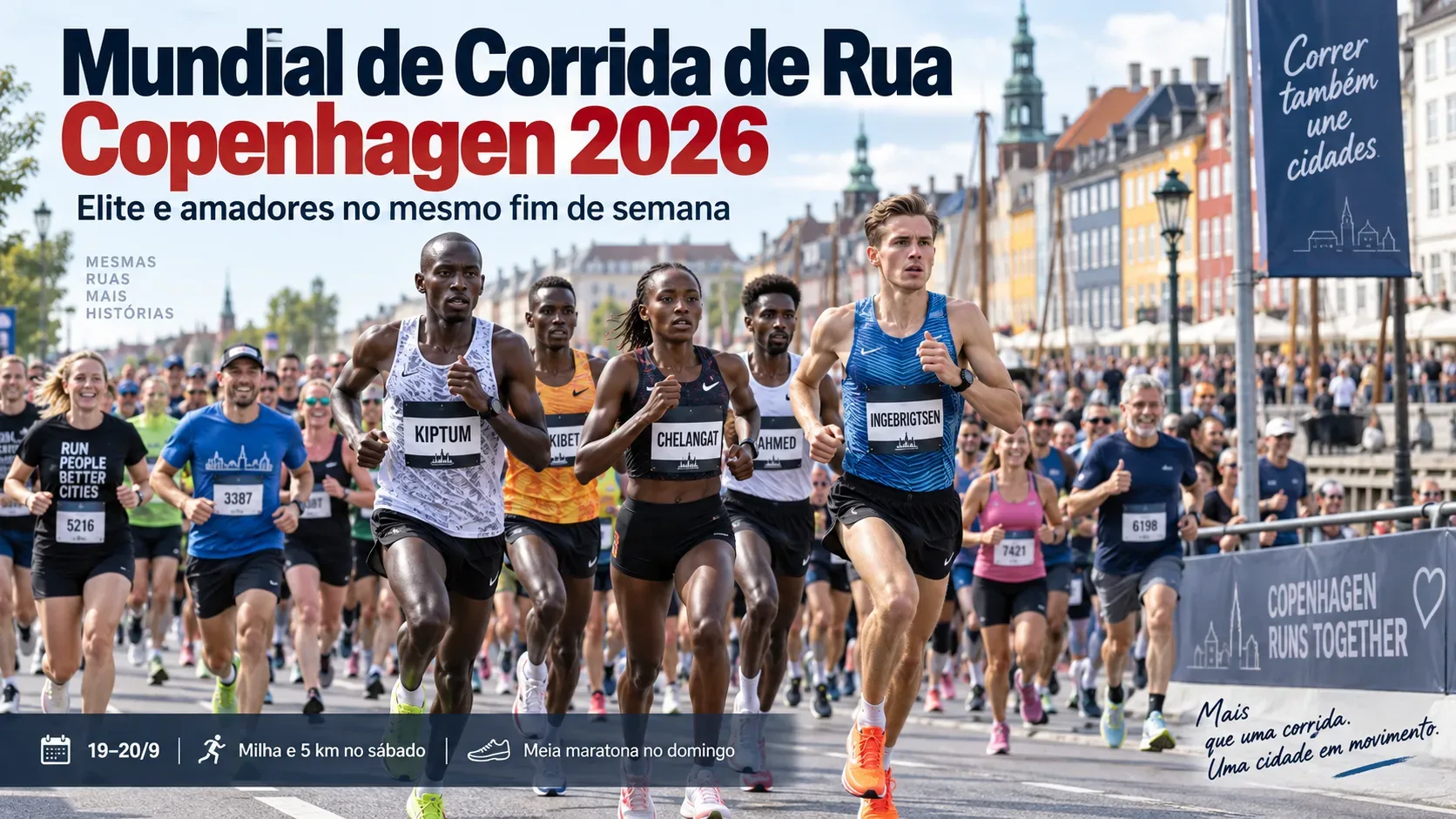
The World Athletics Road Running Championships Copenhagen 26 take place in Copenhagen, Denmark, on 19–20 September 2026, with an unusual feature for a world championship: all three programme distances — the road mile, 5km and half marathon — combine top-level championship racing with mass participation on the same weekend. That does not mean everyone competes in the same category. Championship elite athletes start first; Elite B and C fields follow; then mass-race runners enter in organised start groups.
For spectators, the format makes it possible to watch the fight for world titles and then see the same city and courses filled by thousands of recreational runners. For participants, the main differences are how they qualify or enter, when they start and the competitive status of their field — not the distance itself.
How the weekend is divided
| Distance | Day | Elite A | Elite B+C | Mass race | Time limit |
|---|---|---|---|---|---|
| One mile (1.609 km) | Saturday, 19 Sep | Women 10:10; men 10:30 | 10:35 | From 10:36 | 1 hour |
| 5km | Saturday, 19 Sep | Women 14:10; men 14:40 | 14:41 | From 14:42 | 1.5 hours |
| Half marathon | Sunday, 20 Sep | Women 09:10; men 09:45 | 09:46 | From 09:47 | 3 hours |
The times above are the official local Copenhagen times. Organisers say mass participants are assigned start groups according to expected finish time, so an individual runner's actual start may depend on the allocated group. The time limit is measured by net time: it starts when the runner crosses the start line, not when the first gun goes off. The main reason for the limits is the restricted period for which roads may remain closed.
Elite A, Elite B+C and the mass race are different fields
The official Elite B and C page explains that Elite A consists of athletes selected by their national federations to represent their countries at the World Championships. Elite B is for international runners who met performance standards set by the organisers, while Elite C is for Danish sub-elite runners. B and C have their own start after Elite A and before the mass race.
Applications for the B and C fields closed on 15 February 2026. General participants follow a different process: the mass races are open to runners of different ages and abilities, with start placement driven mainly by expected pace or finish time. In other words, “elite and mass runners on the same weekend” describes shared races and courses, not one undifferentiated start.
Who competes for world titles — and who receives a finisher medal
World Athletics published the final championship entry lists on 5 September with 496 athletes from 85 federations, plus the World Athletics Athlete Refugee Team. Individual world titles are contested in the women's and men's road mile, 5km and half marathon, for six individual titles in total.
The medal system makes the distinction clear as well. Organisers say world championship medalists receive gold, silver and bronze, while every participant who completes one of the three distances receives a finisher medal. Taking part in the mass event therefore gives recreational runners access to the championship setting and the same distances, but it does not automatically make them athletes entered in the official world-title competition.
The scale of mass participation
Copenhagen 26 is designed for a total capacity of up to 65,000 public participants: 10,000 in the one mile, 20,000 in the 5km and 35,000 in the half marathon. That scale helps explain the staggered starts and the use of expected finish times to form groups.
Official material stresses that mass runners cover the same distances and courses used by the world's leading athletes. The event structure turns the sequence of starts into part of the spectacle: first the elite championship, then the public field taking over the streets of Copenhagen.
What mass-race participants need to know
- No general age limit: the FAQ says the one mile, 5km and half marathon have no age limit; participants under 18 may run with permission from a parent or guardian.
- The time-limit clock is individual: 1 hour for the mile, 1.5 hours for 5km and 3 hours for the half marathon, counted from each runner's start-line crossing.
- Start groups depend on expected pace: organisers use predicted finish time to place runners and improve course flow.
- Pace groups are available for 5km and the half marathon: the FAQ confirms pacers for those two distances, but not for the one mile.
- Entry status differs by distance: as checked on 16 September 2026, the official site listed entries for the one mile and 5km as open, while the half marathon was sold out, with options linked to the official resale/waiting-pool system.
How to follow the event without mixing up the starts
Saturday morning is for the one mile and Saturday afternoon for the 5km. In each block, Elite A women start first, then Elite A men, followed by B+C and the mass race. On Sunday, the same sequence is used for the half marathon. If you are following only the world-title competition, the Elite A times are the key reference points; if you want the scale of public participation, the following minutes mark the transition into the mass race.
This separation also avoids a common misunderstanding: sharing the course does not mean sharing the exact same starting position, classification or eligibility for championship medals. The event is built to bring the two audiences together without erasing the difference between an official world championship field and recreational participation.
Where to check official updates
Operational details can still be adjusted, and organisers explicitly say the FAQ is updated as race weekend approaches. Confirm start times, groups and limits in the official Copenhagen 26 FAQ and the mass timetable. The split between Elite A, B and C is described on the Elite B & C page. The final championship entry lists and the explanation of championship and finisher medals help distinguish elite competition from open participation.