Nando Reis left Titãs in September 2002 after a deadlock over preparations for the band’s next album. That is the best-documented immediate reason in statements from the time: he did not want to follow the proposed schedule and said he could not give the new project the level of commitment it required. But the explanation does not end there. In his 2002 statement itself, Nando already linked that period to the impact of the deaths of Marcelo Fromer and Cássia Eller; in later interviews, he added exhaustion, difficulties with the group’s collective dynamics, frustration at repeatedly holding minority positions, and the feeling that his songs were finding more room outside Titãs.
So the answer most faithful to the sources is not to choose between “schedule,” “grief,” “solo career,” or “internal conflict.” What emerges is a chronology: the concrete trigger was the disagreement over the next album; personal losses, exhaustion, his own projects, and older tensions help explain why that disagreement became a rupture.
What Nando Reis said when he left Titãs in 2002
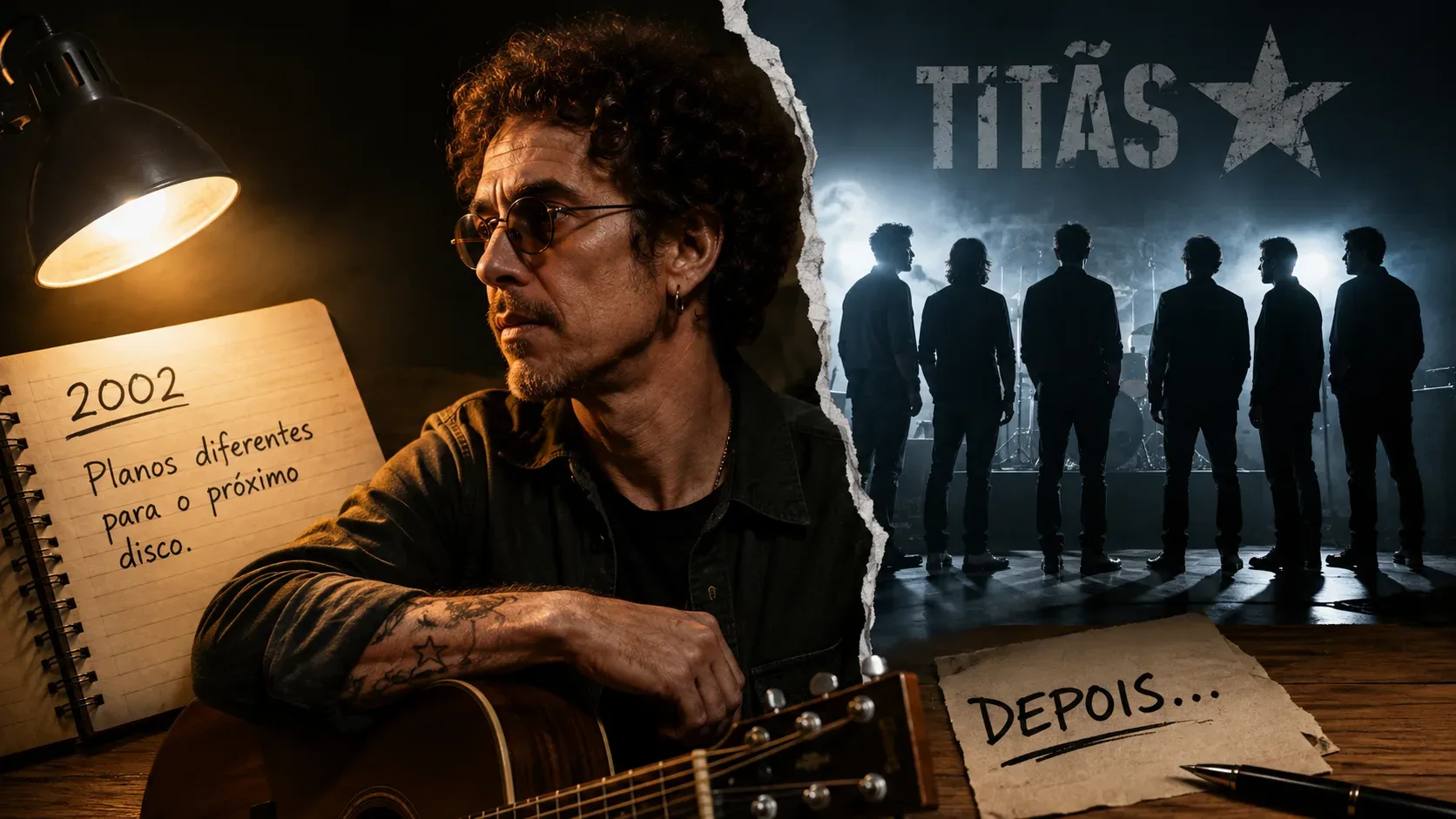
The departure was announced publicly on September 9, 2002. In the statement reproduced at the time by outlets such as Whiplash and CliqueMusic, Nando described the reason as an “incompatibility of thought” regarding preparations for the next album. He said the work would require total commitment and that, for personal reasons, he could not provide it.
That text matters because it was written at the moment of the departure, not years later. Nando also stated that the deaths of guitarist Marcelo Fromer, a member of Titãs, and Cássia Eller, his friend and musical partner, had profoundly affected the way he saw life. Even so, he distinguished that emotional shock from the formal reason he gave for leaving: the disagreement over what the band would do next.
Interviews from 2002 made the deadlock more specific
In the days and months that followed, Nando made the explanation more concrete. In an October 2002 interview published by Imirante, he said he tried to postpone the new CD because Titãs’ schedule would clash with the release of his solo work in early 2003. When the postponement was not accepted, he preferred to leave. In the same conversation, he noted that his style also differed from the band’s and that not everything he wrote fit the collective repertoire.
Another interview from November 2002, preserved by Sampi/Jornal da Cidade, reinforced the issue of time and priority. Nando explained that a band the size of Titãs had to be placed first; once he realized he no longer wanted to prioritize it above every other possibility, leaving became a consequence of that choice.
Those two contemporary statements help avoid an overly abstract reading of “incompatibility.” A practical decision was at stake: enter another cycle of rehearsals, studio work, release, and touring with Titãs, or make real room for other projects and for his own life.
Grief for Marcelo Fromer and Cássia Eller was already present — and gained more weight in later accounts
Marcelo Fromer died in 2001, and Cássia Eller also died that year, a few months later. In February 2002, before the break with Titãs, Nando was already speaking to Folha de S.Paulo about how both losses had been absorbed into his life and work. Grief therefore did not appear as a retrospective invention: it was a public element of that period.
What changed over the years was the level of detail. In testimony to the Museu da Pessoa, Nando described the end of the tour as a period of exhaustion and said he did not feel able to go straight back into the studio. In that account, Marcelo Fromer appears as a particularly important figure in his personal balance inside Titãs; without his friend, living and working within the group became harder for him.
In 2012, looking back on the period in an interview with Folha, Nando again associated the departure with road fatigue, with writing a great deal for the band while recording relatively little of it, and with the impact of the two deaths. The retrospective account does not erase the dispute over the next album; it helps explain why he reached that dispute with little willingness to give in.
In 2026, Nando added the feeling of exclusion and the difficulty of the band’s “democracy”
On August 1, 2026, on Desculpa Alguma Coisa, on Canal UOL, Nando revisited the subject from another angle. He said it was difficult to function in a band with no formal leader, where decisions were made collectively and his position was often in the minority. Looking back, he described frustration and the feeling of being “excluded” or insufficiently considered.
He also said that just as he was becoming more confident as a songwriter, many of the songs he wrote did not find a place in Titãs’ project. At the same time, his compositions were gaining major exposure in his own recordings or through other artists. According to his 2026 account, that contrast fed competitiveness, resentment, and an increasing need to find other outlets for his work.
This layer is broader than the 2002 statement. It is less about the schedule for one specific album and more about how Nando came to interpret his place inside the group. It is a memory articulated 24 years later and should be read as such: valuable for understanding his subjective experience, but not an automatic replacement for statements recorded at the time of the split.
So did he choose to leave, or was he pushed out?
The sources support a cautious answer. The September 2002 statement used consensual language: given the incompatibility and the level of commitment Nando said he could not provide, leaving at the start of preparations for the new work was presented as the better course. In interviews later that same year, he said he preferred to leave when the band did not accept postponing the album.
In his later Museu da Pessoa testimony, however, Nando dramatized the deadlock as a conversation in which he said he would not go into the studio and was told that, in that case, he was out. That makes it understandable that some accounts summarize the episode as a kind of dismissal. But there is little value in forcing one label. Taken together, the sources show a deadlock without agreement: the band decided to move into the next cycle; Nando decided he would not take part in it; the outcome was his departure.
Was the solo career a cause or a consequence?
It was both, in different senses. Nando already had a solo career and his own records before leaving Titãs, and in 2002 he explicitly said he needed time for projects that did not fit the schedule of a large band. The desire to work outside the group therefore contributed to the decision.
At the same time, leaving Titãs created the space that turned his solo career into his main professional activity. Nando Reis’ official biography records the 2002 departure and follows the subsequent consolidation of that path. Years later, the paths crossed again: Nando took part in Titãs’ 30th-anniversary show in 2012 and in the classic-lineup reunion tour in 2023. The reunion does not erase the conflicts he described around 2002, but it shows that the professional break did not remain an absolute separation.
A timeline helps reconcile accounts that may seem contradictory
| Period | What Nando emphasized | How to interpret it |
|---|---|---|
| September 2002 | Disagreement over preparations for the next album and inability to provide total commitment. | This is the immediate and formal reason presented at the time of the departure. |
| October–November 2002 | Schedule conflict with solo projects, a wish to postpone the new CD, and artistic differences. | This explains what the “incompatibility” in the public statement meant in practical terms. |
| Later accounts, especially 2012 | Exhaustion, grief for Marcelo Fromer and Cássia Eller, and a loss of balance inside the band. | This explains the personal state that reduced his willingness to continue at the same pace. |
| August 2026 | Frustration with majority decisions, a feeling of exclusion, competitiveness, and limited room for his songs. | This adds a long-term interpretation of the group’s internal dynamics. |
So what is the best answer to “why did Nando Reis leave Titãs?”
If the question requires one short sentence, the answer is: Nando Reis left because he clashed with Titãs over the timing and process of preparing the next album and no longer wanted to keep the band as his absolute priority in that context.
If there is room for the full answer, it should add that the deadlock came after a period of severe personal loss, touring exhaustion, growth in his songwriting career outside the group, and discomfort with how decisions and repertoire were defined. In 2026, he also made more explicit feelings of exclusion and competition that had not appeared with the same emphasis in the 2002 statement.
The accounts do not need to be treated as mutually exclusive. The contemporary statement is the strongest evidence for identifying the trigger for the departure; later testimony is useful for reconstructing the emotional, creative, and relational conditions that gave that trigger its weight. That distinction makes it possible to understand the split without reducing it to a single cause and without turning later memory into a document from 2002.