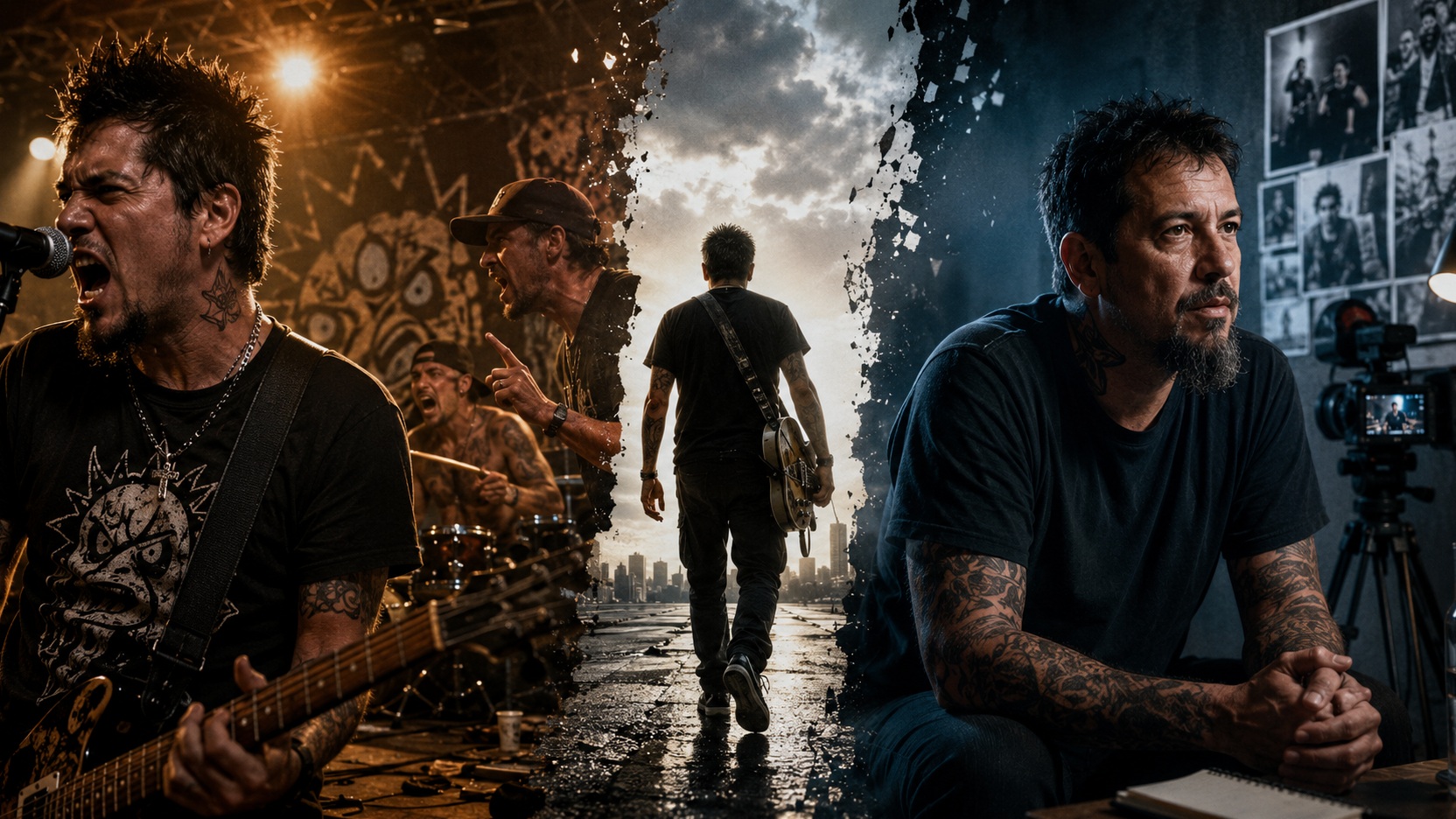
The most repeated explanation for Rodolfo Abrantes' departure from Raimundos is simple: he converted to Christianity and left the band. This sentence summarizes part of what happened, but it does not account for the chronology or the versions left by those involved. In June 2001, Rodolfo publicly insisted that religion was not the direct cause of the decision. Twenty-five years later, Andar na Pedra - A História do Raimundos brought together testimonies, files and memories that made the rupture much more complex.
The bottom line is that there is no single, isolated reason. Contemporary documentation shows an artistic dissatisfaction that Rodolfo said he had been carrying for years, combined with the desire to give up drugs, the feeling that the band no longer represented who he wanted to be and the distance between the members. The 2026 documentary adds layers that were barely visible in 2001: pressure of fame, fear and physical exhaustion, conflicts with Digão, a family crisis in Canisso that would have affected Rodolfo and a much harsher reinterpretation of the lifestyle associated with the group's heyday.
What happened in June 2001
The departure was confirmed on June 13, 2001. The following day, Folha reported that Warner and the agency responsible for the shows had confirmed the dismissal and that, at that first moment, the other members did not intend to replace Rodolfo. The coincidence between the rupture and the recent religious conversion caused the press to treat faith as an immediate explanation.
Rodolfo himself contested this reading a few days later. In an interview published by Folha on June 22, he stated that he had wanted to do something different since the mid-1990s. He said he was dissatisfied with the direction of Raimundos, with the transformation of a band that he associated with hardcore and irreverence into a work structure marked by commercial commitments, and with the fact that it occupied a large public space without saying what at that time he considered important.
In the same interview, he explained that he was not happy with what he sang or what he did. He also said that stopping using drugs allowed him to look at his life in a different way. The conversion, therefore, appeared in the 2001 report as part of a larger personal change, but Rodolfo denied that a church had ordered his departure or that the decision was simply a consequence of having become evangelical.
The 2001 version was less religious than popular memory
The association between conversion and rupture was so strong that, over time, it became a kind of automatic response. But the 2001 interview is more ambiguous. Rodolfo said that faith had done him good and that he had given up drugs, but he insisted that his dissatisfaction with the band was old.
He also described Raimundos as a game that had grown, become a profession and began to demand an image with which he no longer identified. An example used by the musician himself was Reggae do Manêro, a track he considered a joke and whose promotion as work music symbolized, for him, the distance between what he wanted to do and what the commercial machine expected from the group.
Another important detail is that, at that moment, Rodolfo denied that there were decisive fights. When asked directly about friction between the members, he stated that they were not fighting and described the problem more as a lack of coexistence: each one went on with their own lives and they practically only met when it was time to play.. This statement is one of the parts that gains new meaning when compared to reports from 2026.
What Rodolfo started to say in the following years
The public narrative was not frozen in 2001. Over time, Rodolfo began to speak more harshly about his own past. In 2014, in an interview published by specialized media, he stated that he regretted the lyrics he had written in Raimundos and described the phase before the conversion as a period of intense drug use and deteriorating health. This formulation contrasts with his speech from 2001, when he said he had no regrets about the band and did not treat the songs as something he wanted to completely separate himself from.
The change does not necessarily mean that one of the versions is false. People reinterpret experiences, especially when they talk about them decades later. What changes is the weight given to each component. In 2001, Rodolfo emphasized artistic autonomy, unhappiness and freedom to compose. Years later, the moral and spiritual incompatibility with the repertoire and lifestyle of the period began to occupy a much more central place.
In 2020, when talking about the breakup, he recognized another point that did not appear with the same force in the first interviews: the abrupt way in which he left. He said he would leave Raimundos anyway, but that, if he could redo the process, he would prepare his teammates before making the decision. The observation helps to explain why leaving became a lasting wound, even when Rodolfo's personal reason remained, for him, legitimate.
What Andar na Pedra added in 2026
Andar na Pedra - A História do Raimundos premiered on Globoplay on March 19, 2026, with five episodes. The project was directed by Daniel Ferro and brought together Rodolfo, Digão, Fred, family, friends, team members and archive material. Canisso, who died in 2023, appears through interviews recorded before his death and collection records.
The documentary does not present the exit as the result of a single moment. It reconstructs a sequence of wear. The pressure of fame and routine appears as an important part of the collapse. Rodolfo reports difficulty dealing with exposure and privacy, in addition to a period in which he lost weight, found lumps all over his body and feared he was seriously ill. The production also associates this moment with conversion and abandonment of drugs.
There is a necessary caution here: when the documentary presents religious reports about a possible cure, this must be understood as an experience and belief narrated by those involved, not as medical proof of diagnosis or cure. The relevant editorial data is that Rodolfo interpreted that period as a radical turning point and began to see both his own life and the band differently.
The biggest contrast between 2001 and 2026 is in internal conflicts
In 2001, Rodolfo said that there were no fights linked to his departure. In 2026, the documentary places conflicts and competition within the band as an important part of the context. Digão reports that he noticed Rodolfo differently at the end of 2000. The series also reconstructs a show in Petrópolis in which a crisis with security and the public ended in an argument between the two.
According to the report presented in the production, Rodolfo would have exploded at Digão after the show was interrupted and threatened to expel him if something similar happened again. Rodolfo himself, looking back, describes that moment as an accumulated outburst, linked to ego, competition for space and the feeling of living two incompatible lives: one during the week, marked by the new faith, and another on the weekends, within a routine that he no longer wanted to maintain.
The series also presents a family crisis in Canisso as an episode that would have deepened Rodolfo's frustration. This part needs to be read as a retrospective report from people close to us and not as proof that a single event caused the departure. The documentary value lies in showing that, for those who lived through history, personal, moral and emotional tensions were mixed with professional fatigue.
What was already known in 2001
It was already public that the conversion had taken place months before leaving and that Rodolfo had stopped using drugs. It was also public that he was dissatisfied with the repertoire, with the image that the band projected and with the pressure to repeat a formula that he considered limiting. He said he wanted to continue in hardcore, but write lyrics that he thought were more meaningful.
It was also known that coexistence had deteriorated into distancing. Rodolfo stated that the members hardly saw each other outside of shows and that the band, in his perception, had lost part of the friendship that had sustained the beginning of the project. This fact already made the rupture greater than a simple exchange of religious belief.
What the 2026 documentary really adds
The main new feature is the density of the context. Instead of just listening to Rodolfo explain why he left, the series confronts different people's memories and links the decision to specific episodes. The viewer sees the pressure of fame, drug use, health-related fears, the changes brought about by sobriety, the tension with Digão and the impact of the group's personal conflicts.
Director Daniel Ferro explained that he held dozens of hours of individual conversations and treated the interviews as a way of comparing versions. This matters because the series doesn't just depend on Rodolfo's memory. Even so, it remains a retrospective reconstruction: its participants speak decades after the facts, with relationships, values and interpretations already transformed by time.
What remains interpretation
It is not possible to reduce the rupture to a formula such as “it was religion” or “it wasn’t religion”. Faith played an obvious role in changing Rodolfo's life, but, according to his own contemporary account, it was added to a previous dissatisfaction. Likewise, the conflicts shown in 2026 help explain the environment, but do not prove that a specific fight was the decisive cause.
The weight of each factor also remains interpretive. For Alexandra Abrantes, sobriety allowed Rodolfo to see his own situation clearly. For Rodolfo in 2001, the main issue was not wanting to continue with a project with which he no longer identified. For the Rodolfo of 2026, Raimundos appears as a symbol of a set of choices and values from which he wanted to move away.
These readings are not identical, but they can coexist as phases of the same rupture. The documentary changes the question from "what was the motive?" to "how did various processes accumulate until exit became inevitable for him?".
So, why did Rodolfo Abrantes leave Raimundos?
The most faithful answer to all the sources is that Rodolfo left because a personal transformation made a dissatisfaction that already existed unsustainable. He wanted another artistic direction, he was unhappy with the band's repertoire and public image, he had stopped using drugs, he was going through emotional and physical exhaustion and he began to consider it incompatible to continue representing a lifestyle that he no longer accepted for himself.
The 2026 documentary adds that this process took place within an environment with competition, arguments, frayed relationships and personal episodes that increased the feeling of rupture. In this sense, religious conversion is not a false explanation, but neither is it sufficient on its own. It worked as part of a turning point that changed the way Rodolfo saw drugs, lyrics, conflicts and his own identity within Raimundos.
The biggest change between 2001 and 2026 is in the degree of frankness about internal attrition. In the contemporary version, Rodolfo minimized the fights and separated his faith from the reason for leaving. In subsequent reconstruction, conflicts appear clearly and spiritual transformation receives much greater moral weight. More than replacing one story with another, Walking in Stone exposes what the 2001 explanation left out and shows why
a seemingly sudden rupture had been years in the making.