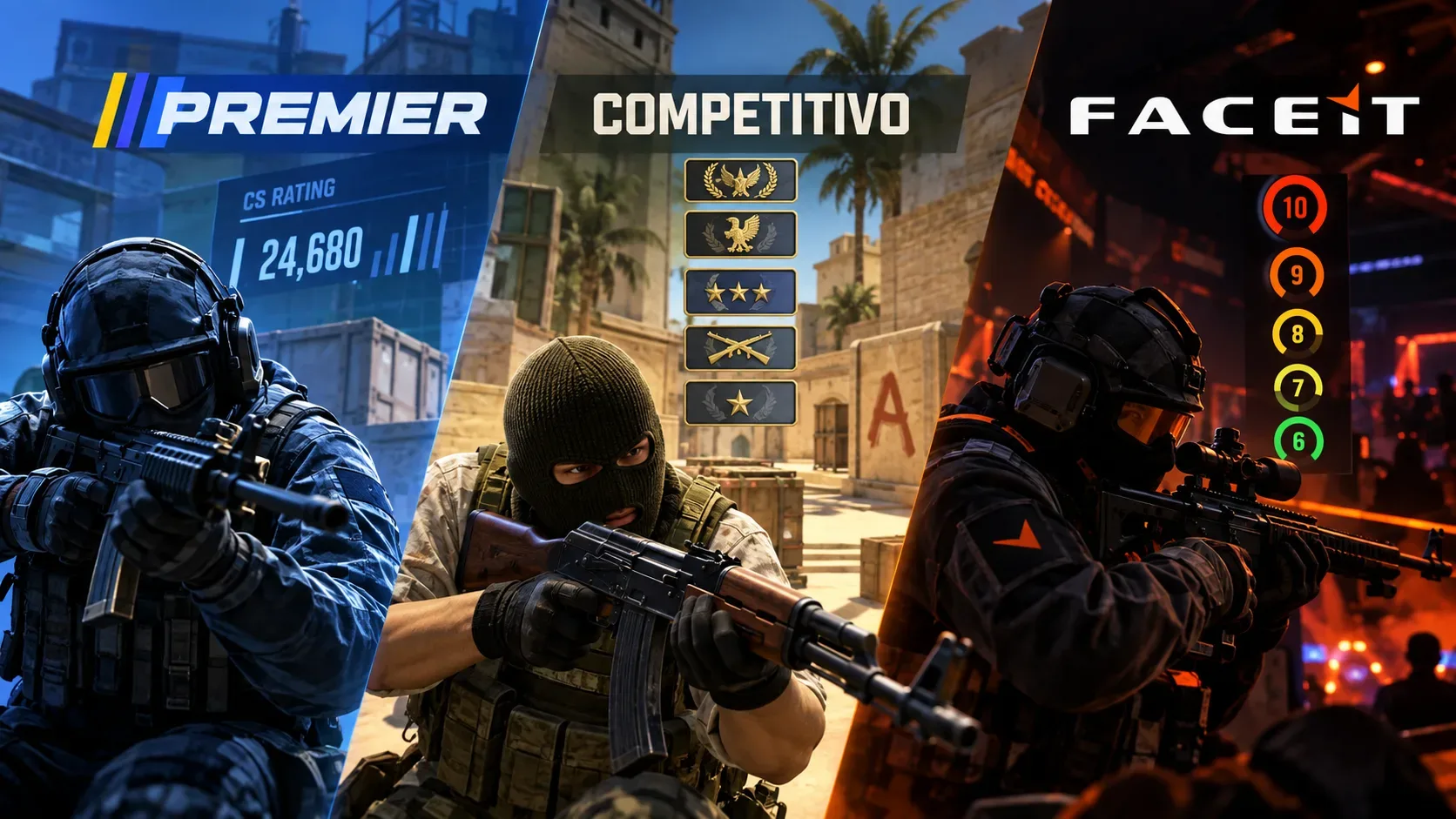
Premier, Competitive, and FACEIT all put you into Counter-Strike 2 matches with similar core objectives, but their progression systems are different. Premier is Valve's official queue centered on CS Rating and a competitive map pool. Competitive keeps separate Skill Groups for each map. FACEIT operates outside Valve's official matchmaking and uses its own Elo and levels. Progress in one queue therefore does not automatically become progress in the others.
Differences at a glance
| Queue | Operator | Ranking | Maps | Typical use |
|---|---|---|---|---|
| Premier | Valve | CS Rating, with global and regional leaderboards | Valve-defined competitive pool, with pre-match selection | Official progression through one numerical rating |
| Competitive | Valve | Per-map Skill Group | Players queue through the maps available in Competitive | Practice and build a separate rank on specific maps |
| FACEIT | FACEIT | Elo and Skill Levels from 1 to 10 | Platform-defined pool and rules, with preferences and voting | External ecosystem with its own matchmaking, requirements, and progression |
Premier: one numerical rating for Valve's official queue
Valve presents CS Rating as a visible performance measure tied to Premier. It also determines placement on global and regional leaderboards. Unlike per-map Competitive ranks, Premier concentrates progression in one numerical rating.
Premier uses a map-selection process before the match. This is a changeable field: on September 22, 2026, Valve changed the process so one team picks one map, the other picks two, the first team picks one more, and one of those four maps is randomly selected for the match. Because season rules and pools can change, official update notes should be checked before treating this flow as permanent.
The pool changes too. Valve rotates maps through seasons and updates. The durable distinction is that Premier uses Valve's current competitive pool and its own selection step, while the exact maps and selection procedure require review after updates.
Competitive: ranking is separate for each map
Competitive uses a different progression model. Valve maintains underlying matchmaking values and Skill Groups per map. In January 2026, for example, it adjusted the underlying per-map values and expired existing Skill Groups until players earned the required number of wins again.
This changes how a rank should be read. A player can hold one Skill Group on one map and a different group on another. In practice, the mode suits players who want to focus on particular maps without turning all performance into one CS Rating.
The Competitive catalog can also gain or lose maps. In August 2026, Valve added community maps to Competitive, Casual, and Deathmatch. A fixed map list should therefore not be treated as a permanent rule.
FACEIT: its own Elo and levels 1 through 10
FACEIT is external to Valve's official matchmaking. In CS2, it assigns players an Elo rating and a Skill Level. Its documentation lists levels 1 through 10 and places level 10 at 2001 Elo and above; the top 1,000 level 10 players receive Challenger status. These thresholds can be updated by the platform.
Elo changes through wins and losses, with the amount gained or lost linked to the team's perceived chance of winning. For new users who meet minimum requirements, FACEIT can also use a recent Premier rating as part of initial placement. That does not merge the systems: after placement, FACEIT progression follows the platform's own Elo.
How maps work on FACEIT
FACEIT lets players configure map preferences before queuing. Its general map documentation says CS2 players must keep at least five maps selected. Deselected maps should not enter the pool used for the pre-match vote. The available pool can still change by season. In 2026, for example, FACEIT held a community vote to add a map to Season 8 matchmaking.
This is another area that needs periodic review: minimum selected maps, the current pool, and voting rules are controlled by FACEIT, not Valve.
Standard, Super Match, and Premium Match are different
FACEIT also has match types. Standard Match is the default and is open to free players and subscribers. Super Match adds restrictions involving party composition and Elo spread and can offer verification or experience filters. Premium Match has a higher entry bar and, according to documentation updated in November 2025, requires a subscription, verification, and Veteran status, while also being limited to specific regions.
These details are especially changeable. Subscription requirements, verification, party-size limits, maximum Elo differences, and regional availability should be checked in FACEIT Support when choosing a queue.
Which queue matches each goal?
- Premier: for tracking one official Valve rating, playing the current competitive pool, and comparing your position on CS2's own leaderboards.
- Competitive: for focusing on specific maps and maintaining a separate rank on each.
- FACEIT: for external Elo progression, platform-specific levels, and matchmaking options managed by FACEIT.
There is no continuous conversion among the three progression systems. CS Rating, per-map Skill Groups, and FACEIT Elo are separate indicators maintained by different systems.
What to verify before you queue
Four items age faster than the conceptual comparison: the Premier map pool, Premier's map-selection process, the maps available in Competitive, and FACEIT match-type requirements. For current details, use the Counter-Strike 2 update notes, the official CS2 page, FACEIT's Elo documentation, its Maps FAQ, and its Match Types FAQ.