
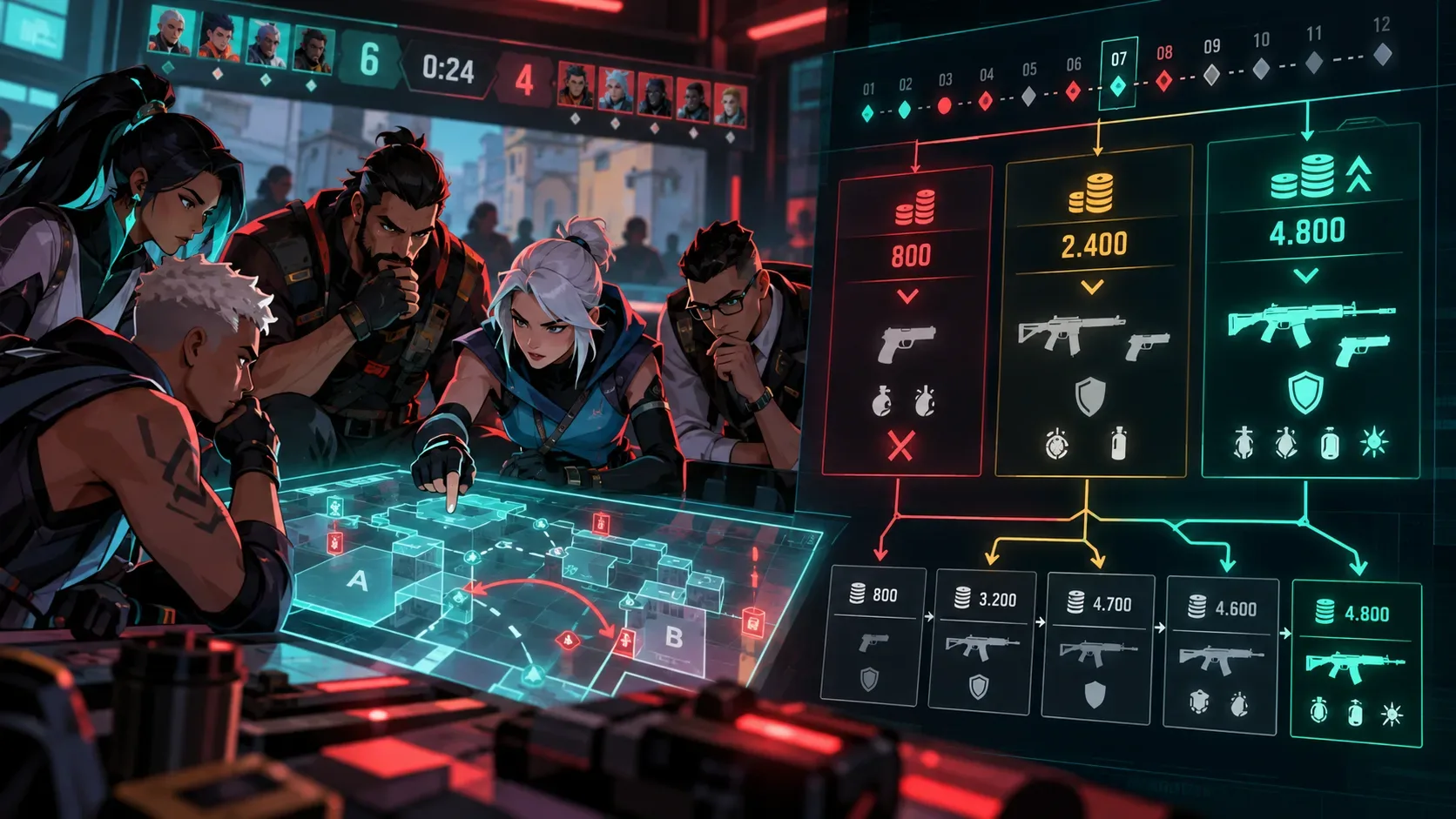
In VALORANT, the difference between an eco, a half buy, and a full buy is not a fixed list of weapons. The useful question is different: how much can the team spend now without taking away the kit it actually needs next round? That calculation should be made as a team, because five coherent purchases are usually more valuable than one isolated Vandal surrounded by four broke teammates.
What changes between an eco, half buy, and full buy
| Buy type | Goal | Practical signal | Risk to the next round |
|---|---|---|---|
| Eco | Preserve credits for a stronger purchase later. | Spend nothing or very little, only if “Min Next Round” remains high enough. | Low. |
| Half buy | Improve the chance of stealing the round without giving up the planned purchase afterward. | Spend only the surplus above the reserve required for the next round. | Controlled. |
| Full buy | Enter the round with the composition's full fighting power. | An appropriate primary weapon, armor, and essential utility for the role. | This is the round in which saved credits should become combat power. |
| Force buy | Maximize the current round even at the cost of the following economy. | The team buys while knowing that a loss will leave several players below their target kit. | High and intentional. |
The most important distinction is between a half buy and a force buy. If you buy a Sheriff, a cheaper weapon, partial armor, or utility and still preserve what you need for the next round, that is a half buy. If the purchase cuts into that reserve and forces the team into a weak following round after a loss, the decision has become a force.
The economy numbers that actually matter
In the standard Unrated and Competitive economy, the current credit table lists 800 credits at the start of each half, 3,000 for a round win, 1,900 for the first consecutive loss, 2,400 for the second, and 2,900 from the third onward. Each kill awards 200 credits, and planting the Spike grants 300 credits to each attacker. The bank cap is 9,000 credits. Riot lowered that cap to 9,000 in Patch 0.50, and the rule remains documented in current references.
The cost of a full buy depends on the Agent and on equipment carried over from the previous round. As a current baseline, Patch 13.06, published on September 22, 2026, placed the new Warden in the same 2,900-credit rifle tier as the Vandal and Phantom. Adding one of those rifles to 1,000-credit Heavy Armor creates a 3,900-credit floor before abilities. Required utility varies by Agent, so 3,900 should not be treated as a universal full-buy number.
That is why two players with 4,100 credits can be in different situations. One may already have key utility or inexpensive abilities; another may need several utility purchases. The correct target is the cost of a functional role kit, not just the rifle price.
Use “Min Next Round” as a safety lock
VALORANT's shop includes the “Min Next Round” information. Riot added more economic detail to that indicator in Patch 1.11 specifically to support decisions about saving equipment or contesting the round. Instead of memorizing a rule such as “always save below 2,000,” use the value shown in the client as the operational limit.
The process is simple: first define how much each player needs next round. For someone planning to use a 2,900-credit rifle with Heavy Armor, start at 3,900 and add the utility that is actually required. Then check “Min Next Round.” If a purchase now makes that number fall below the target, it is consuming the future buy. If it remains at or above the target, there is room for a half buy.
Decision tree for choosing the buy
- Is there a next round where economy matters? If it is the last round of the half, the final regulation round with no continuing economy, or a situation where losing ends the map, saving credits loses value. Spending can be much more aggressive.
- Can most of the team afford a complete kit now? If yes, synchronize the full buy. Avoid having two players save while three spend everything without a clear tactical reason.
- Is the team below a full buy, but does “Min Next Round” already guarantee the target kit? If yes, eco or half buy. Current spending should fit inside the surplus without breaking the reserve.
- Can a partial purchase meaningfully improve the current round without breaking the reserve? Strong pistols, cheaper weapons, partial armor, and specific utility can form a coherent half buy.
- Does buying now push several players below their target kit next round? Then it is a force buy. Do it because the current round has exceptional value, not out of impulse.
Three fictional scenarios
| Scenario | Economic reading | Most coherent decision |
|---|---|---|
| All five players can buy a primary weapon, armor, and essential utility now. | The team has already reached its target kit. | Full buy. Synchronize the purchase and use the economic power in the same round. |
| The team is poor, but every player sees enough in “Min Next Round” for the target kit if they spend only a little. | There is limited surplus above the future reserve. | Eco or half buy. Spend only the surplus that does not pull the target below its floor. |
| Only a few rounds remain, a loss may end the map, and saving would leave the team eliminated with unused credits. | The value of the current round is greater than the value of the reserve. | Coordinated force buy. The next-round economy risk is acceptable because there may not be another opportunity. |
A fourth case deserves attention: after winning a round with cheaper weapons, replacing everything with rifles immediately is not always necessary. Keeping surviving equipment can create a bonus round, where the team contests the round at reduced cost and tries to damage the opponent's economy. The point is not to “buy cheap by tradition,” but to use the value already carried over without wrecking the credit curve.
Mistakes that break the next round
- Buying individually without checking the other four players. One rifle does not turn an uncoordinated purchase into a full buy.
- Treating 3,900 as a universal rule. That covers a 2,900-credit rifle and 1,000-credit Heavy Armor, but not Agent-specific utility.
- Confusing a half buy with spending almost to zero. A half buy is limited by the future reserve. If the reserve disappears, it has become a force.
- Ignoring carried equipment. Surviving weapons and armor change how much must be spent next round.
- Forcing just because the score looks bad. The score matters, but it must be combined with the number of rounds left and the real cost of losing the next buy.
A practical rule for calling the buy in a few seconds
Before the barrier drops, ask three questions: what is the target kit for next round, what does “Min Next Round” show for each player, and how much can we spend without falling below that target? If the answer is “nothing,” eco. If there is limited surplus, half buy. If the kit already fits now, full buy. If the team chooses to spend while knowing it will break the next round, it is a force buy and the team should consciously accept that risk.
Costs and rules can change in future updates. To verify the live state of the game, check the Patch 13.06 notes, the official Arsenal, the Patch 1.11 notes, the Patch 0.50 notes, and the current VALORANT Wiki credits table.