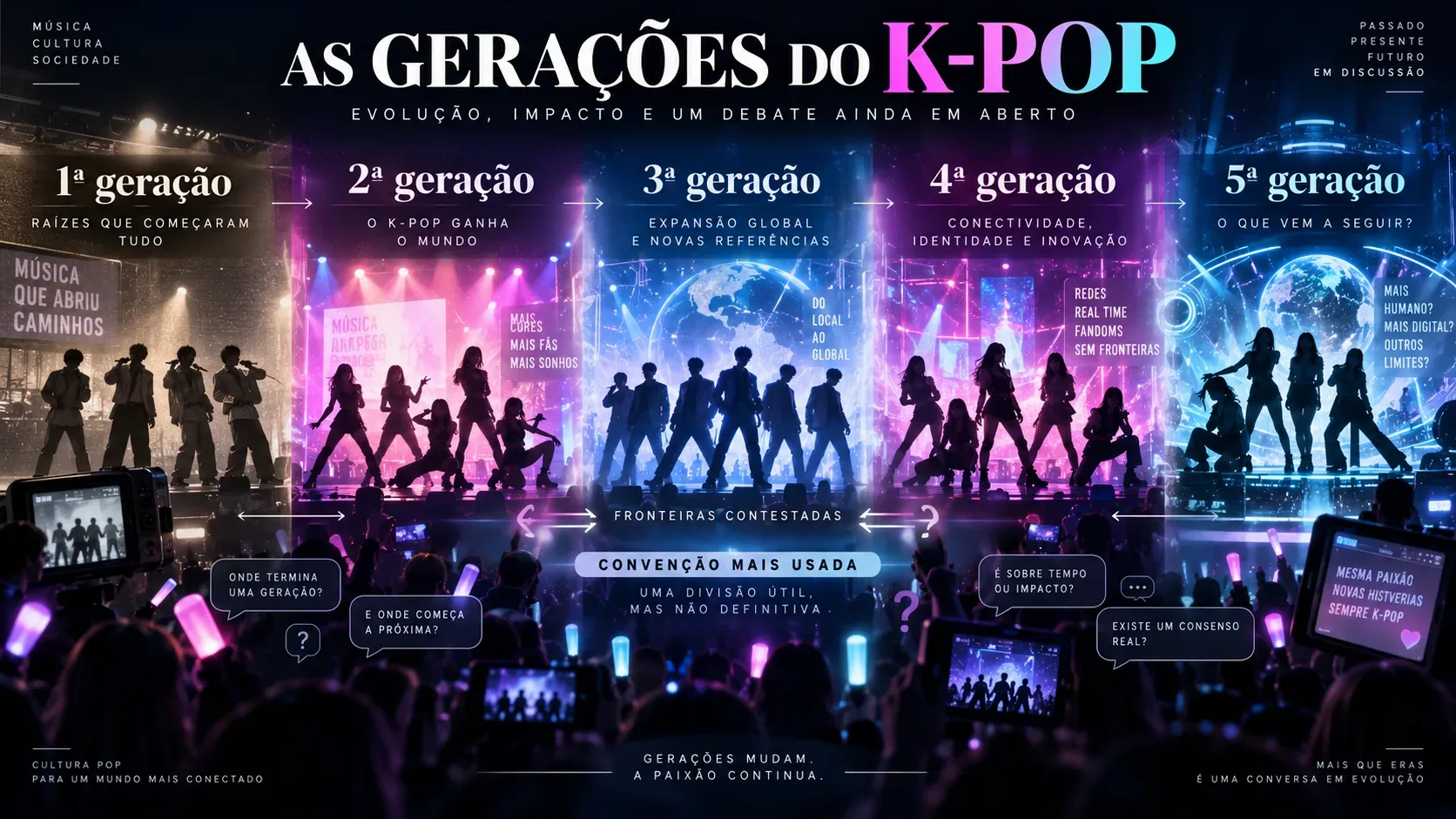
K-pop “generations” are not defined by an official authority or by a single calendar accepted across the industry. They work as a convention used by the press, entertainment companies, TV programs, critics, researchers and fandoms to group artists who debuted in similar contexts. That is why the most useful question is not “what is the correct date for each generation?” but “what changes made enough people perceive a new phase?”.
Who defines K-pop generations?
No one does it alone. There is no South Korean music industry body that publishes an official table stating where the 1st, 2nd, 3rd, 4th or 5th generation begins and ends. Koreana, published by the Korea Foundation, summarizes the logic by noting that there are no formal rules or standards for proclaiming a new generation. The label tends to gain traction when a cluster of groups shows noticeable differences in composition, market, concept, message and ways of operating.
In practice, classification emerges from an informal negotiation among several actors. Companies and broadcasters may introduce a new label as a positioning tool. The press starts adopting it if it becomes useful for describing a wave of debuts. Fans test, reject or consolidate the term in everyday discussion. Critics and researchers then try to explain which changes actually distinguish one phase from the previous one.
This helps explain why two serious sources can use different boundaries without either one necessarily being “wrong.” A generation is a model for reading history, not a legal or technical category.
A useful timeline from the 1st to the 5th generation
The table below presents a practical convention that is widely used. The dates are approximate and should be treated as orientation, not as rigid rules.
| Generation | Reference window | What usually marks the phase | Representative examples |
|---|---|---|---|
| 1st | 1990s to early 2000s | Formation of the modern idol model, organized fandoms, group rivalries and the early expansion of Korean youth pop culture. | Seo Taiji and Boys as a decisive precursor; H.O.T., Sechs Kies, S.E.S. and Fin.K.L as landmarks of the idol system. |
| 2nd | Mid-2000s to early 2010s | A stronger Asian Hallyu wave, heavy presence on variety shows, expansion into Japan and other markets, and the growth of touring. | TVXQ, Super Junior, BIGBANG, Girls' Generation, Wonder Girls, SHINee and 2NE1. |
| 3rd | Early 2010s to around 2017/2018 | Simultaneous growth in Korea and abroad, YouTube and social media becoming more important, global fandom at a much larger scale and stronger international competition. | EXO, BTS, Red Velvet, MAMAMOO, TWICE and BLACKPINK. |
| 4th | Around 2018/2019 to 2022 | Debuts designed for global audiences from the start, performance-centered culture, digital platforms, short-form video, fan platforms, highly defined concepts and adaptation to the pandemic period. | Stray Kids, ATEEZ, TOMORROW X TOGETHER, ITZY, aespa, IVE, LE SSERAFIM and NewJeans are frequently associated with this phase by different sources. |
| 5th | Label spreading from 2023 onward | A new wave of rookies promoted as a distinct generation, renewed and hybrid in-person experiences, global strategies from debut and greater diversification of formats, markets and fandom-related properties. | ZeroBaseOne became a central case in popularizing the label; other rookies debuting from 2023 onward began to be presented by media and companies as 5th generation. |
The most sensitive part of the table is the beginning. Korea.net highlights Seo Taiji and Boys, who debuted in 1992, as a key force in transforming Korean popular music and in paving the way toward the modern idol system. Koreana, meanwhile, uses H.O.T., which debuted in 1996, as a reference point for the first K-pop idol group. The difference shows that “the origin of modern K-pop” and “the start of the first idol generation” are closely related questions, but not identical ones.
What actually changes from one generation to another?
Debut year is simply the easiest marker to see. The changes that sustain a generational label usually appear across several layers at once.
1. Technology and discovery channels
The 1st and 2nd generations depended far more on television, radio, CDs, fan clubs and variety shows. The 3rd grew alongside YouTube, Twitter and global digital distribution. The 4th was born in an environment where social media, short-form video, livestreaming and fandom platforms were already part of the launch plan. The 5th inherits all of that as basic infrastructure and seeks differentiation through community formats, hybrid events, continuous content and global reach from the beginning.
2. Target market
In the earlier phases, international expansion often followed consolidation in Korea. Over time, Japan, China, Southeast Asia, the Americas and Europe stopped being only expansion markets and began to influence casting, language, promotion and scheduling from debut. Koreana itself uses international expansion as one of the keys for distinguishing the 2nd, 3rd and 4th generations.
3. Concept, narrative and group identity
Generations also reflect changes in how groups build identity. That includes styling, music videos, lore, messages, connections between albums and the way members are introduced. These shifts do not happen on the same day, which is why a group on the boundary between two eras can share characteristics with both.
4. Fandom relationship and business model
Fandom moved from being simply an audience to becoming part of an ecosystem of pre-orders, voting, streaming, events, memberships, apps, merchandise and proprietary content. A 2026 South Korean academic study devoted specifically to distinguishing the 4th and 5th generations proposes three dimensions for analysis: sociocultural context, concept and narrative strategy, and marketing and globalization strategy.
Why is the 4th-to-5th generation boundary so disputed?
Because the “5th generation” label began circulating before there was broad agreement that a historical break had actually occurred. In July 2023, the Korea JoongAng Daily noted that there was no rock-solid demarcation and highlighted that Mnet's Boys Planet had promoted ZeroBaseOne as a “5th Generation K-pop Boy Group.” The newspaper itself treated the question as an open debate.
The usage continued to spread. In 2024, for example, The Korea Times covered UNIS's debut in an article that already used “5th-generation K-pop” in the headline and reported the group's ambition to become a representative name of that generation. This shows how a term can move from positioning language into normal music coverage through repetition.
At the same time, academic discussion still recognizes the ambiguity. The 2026 study cited above says highly involved fans perceive a mixture of discourses and blurry boundaries between generational marketing and structural change. The authors nevertheless identify meaningful differences: they associate the 4th generation with an environment more strongly shaped by non-face-to-face communication, advanced technology, fantasy narratives and strong focus on initial album sales; for the 5th, they identify greater emphasis on hybrid communication with the return of offline activity, more realistic growth narratives, localized launches for different markets and diversification of merchandise and licensing. This is a research framework proposed by the authors, not a binding definition for the entire industry.
So is 2023 the official start of the 5th generation?
No. It is more accurate to say that 2023 became a practical marker because that was when the label gained major visibility with ZeroBaseOne and began being repeated by companies and media. That is different from saying there is an official date.
Some classifications place 2022 groups at the end of the 4th generation. Others see those same debuts as early signs of the next phase. The reverse also happens: artists launched in 2023 can be treated as aesthetic and commercial continuations of the 4th. When change is gradual, the border never works like a calendar flipping at midnight.
Why do labels such as “1.5 generation” appear?
Because the community itself recognizes that large boxes do not explain every transition. Koreana, for example, describes artists such as Shinhwa, Jewelry and BoA as part of a “1.5” phase between the first and second generations. This kind of subdivision tries to recognize artists who debuted during a transition and experimented with practices that only became dominant later.
These intermediate labels can be useful for historical discussion, but they also reinforce the central point: if the boundaries were official and objective, there would be less need to create so many transition categories.
How to interpret a generation label without turning it into false certainty
- Check the source. A company may use “new generation” as promotional positioning. A researcher may use sociocultural criteria. A fan may use only debut year.
- Look for the criterion, not only the number. The classification becomes more useful when it explains technology, market, fandom, aesthetics and business model.
- Accept overlap. Boundary groups can carry practices from two eras at the same time.
- Do not turn examples into an official list. Saying that a group “represents” a generation does not mean everyone agrees with the classification.
- Use generations as a map. They help organize K-pop history, but they do not replace analysis of a specific group, company or period.
What is the safest convention to use?
For a general reading, it is reasonable to treat the 1st generation as the formation of idol K-pop in the 1990s and early 2000s; the 2nd as the period of Asian expansion and multifunctional idols in the 2000s; the 3rd as the phase of simultaneous internationalization and digital explosion in the 2010s; the 4th as the consolidated global and digital generation that emerged around 2018/2019 and crossed the pandemic; and the 5th as the label that gained traction from 2023 onward.
This timeline is useful precisely because it comes with a caveat: the dates are approximations. What gives generations meaning are shifts in context, technology, strategy and fandom culture. The boundaries remain debated because those changes do not all happen at the same time.