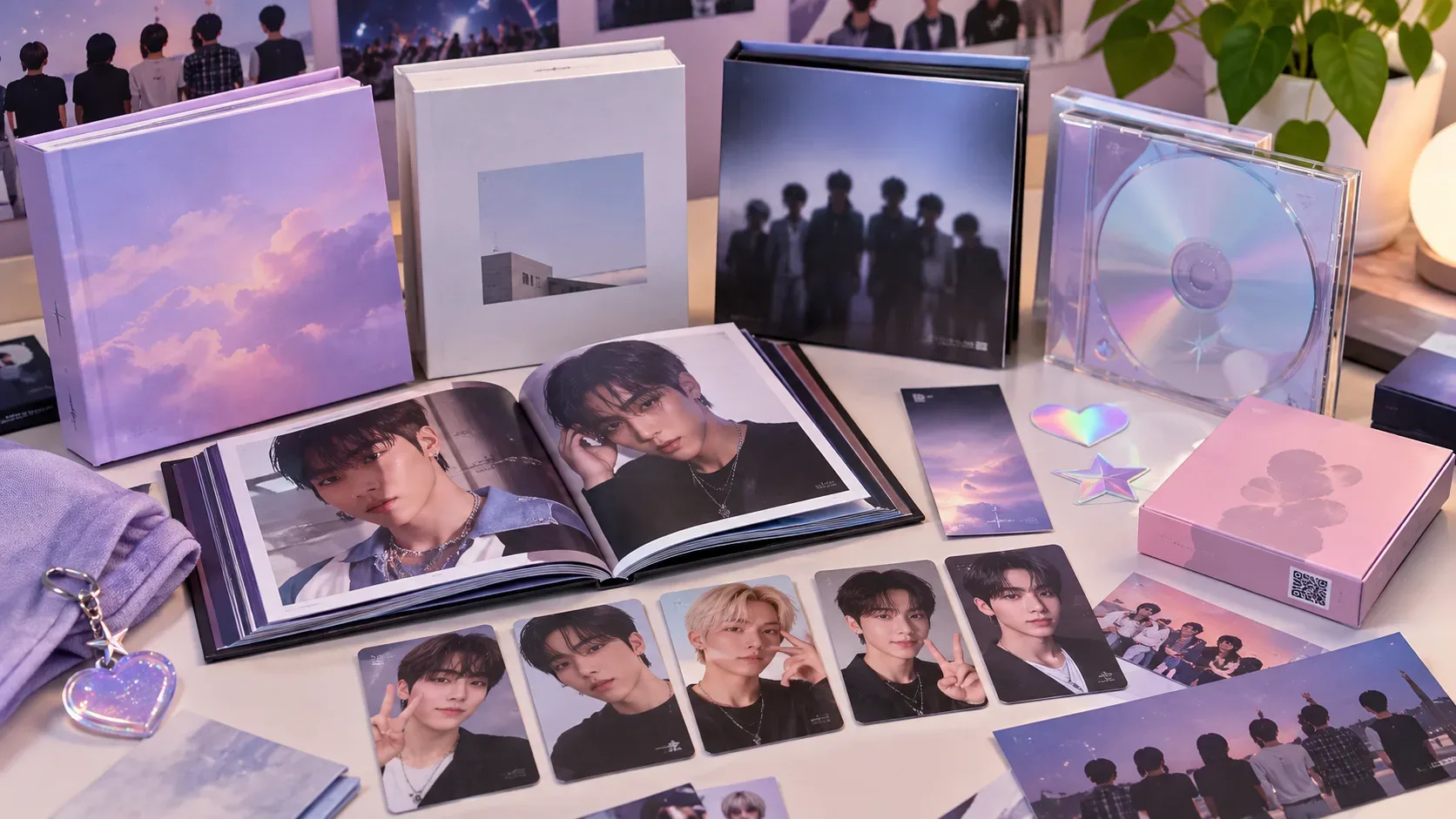
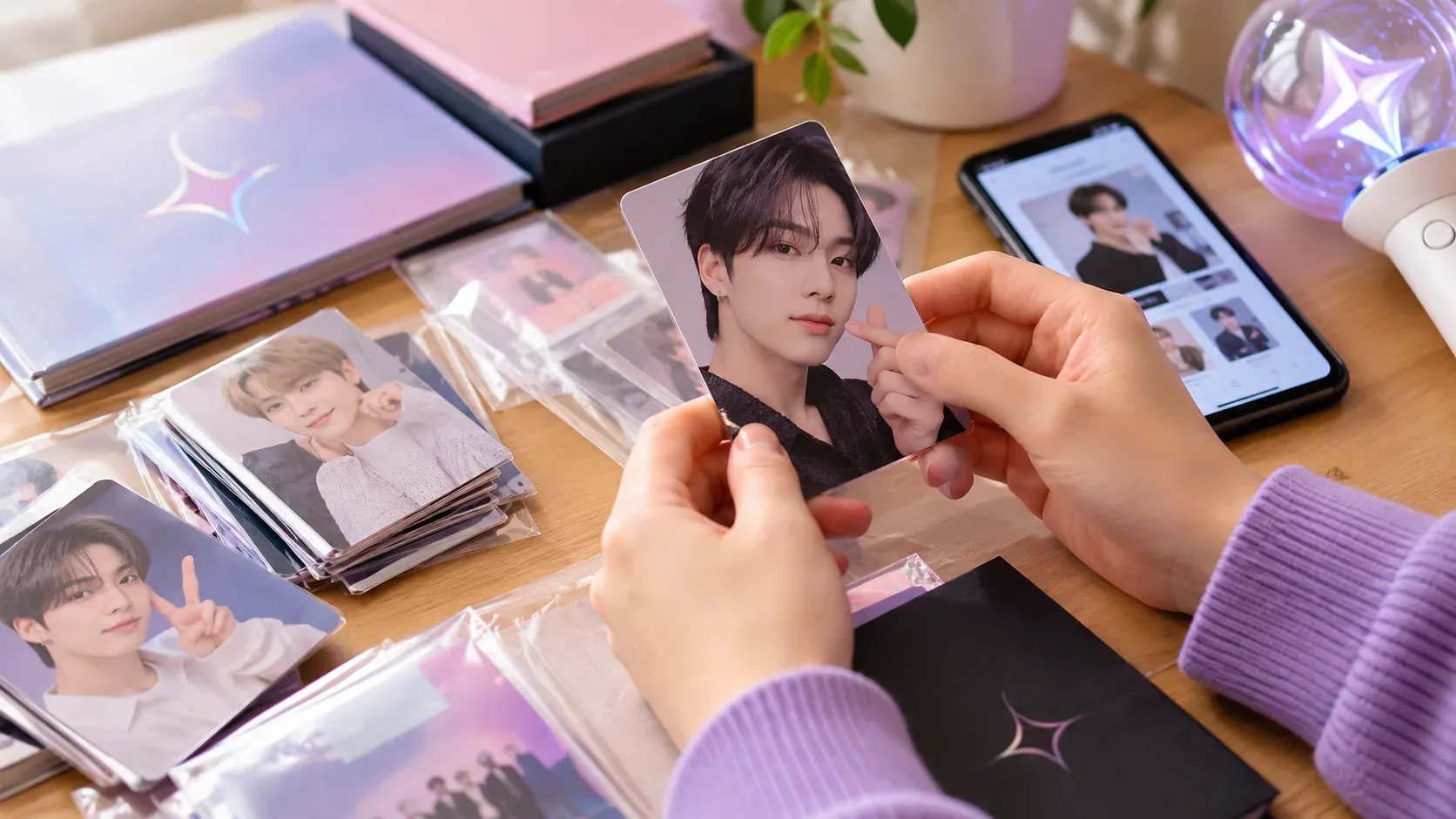
Before trading a photocard, the most useful question is not only “is it official?”. The first step is to identify exactly what the card is supposed to be: which release, which album version, which member, which store or event, and which distribution method. An album-inclusion card, a pre-order benefit and a lucky draw card may use similar photos, but they come from different distribution rules. That provenance trail is what lets you check whether the trade description makes sense.
It is also important to separate provenance from authentication. An official announcement, a purchase record and clear photos can support the origin story of a card, but none of those elements works as an infallible certificate on its own. A safer check combines the official catalog, the terms of the event or pre-order, images of the item, and the history provided by the person offering the trade.
Photocard, POB and lucky draw are not the same thing
Photocard is the broad term for a collectible photo card. It may be a regular album inclusion, part of a special edition, merchandise, or a promotional benefit. The word alone does not identify the source.
POB is the collector abbreviation for pre-order benefit. The key point is that the benefit depends on the terms of a specific pre-order. In an official Weverse Global notice for AHOF's RUN TO YOU mini album, the store separated gifts by format: the PHOTOBOOK version came with one type of unreleased photocard, while the DIGIPACK version came with another. The example shows why “album POB” is incomplete without the store and eligible version.
Lucky draw is a benefit tied to a specific promotional event. Rules may vary by store, period, quantity purchased, and album version. In an official Weverse Lucky Store event for YEONJUN, only products named in the notice were eligible, and the number of lucky draws changed depending on whether the purchase was a random copy or a set. “Lucky draw” therefore describes an event mechanic, not a universal card edition.
Start with the card's identity, not its appearance
When you receive a trade offer, build a minimum identification record before comparing visual details. The order below reduces confusion between cards from the same comeback that belong to different stores or versions.
| Question | What to record | Why it matters |
|---|---|---|
| Which release? | Group or soloist, album or product name, and approximate release date. | Narrows the catalog and prevents mixing eras. |
| Which version? | Photobook, digipack, QR, platform, member ver., or another official label. | Inclusions and benefits can change by format. |
| What source? | Album inclusion, POB, lucky draw, fansign event, or merchandise. | Determines which official document to consult. |
| Which store or event? | Platform, retailer, or event name and, when relevant, round or phase. | Different benefits can exist for the same album. |
| Which member or unit? | Member name, unit, or group photo. | Lets you check the correct set of possible cards. |
| What condition? | Scratches, dents, edge wear, pressure marks, and other visible changes. | Authenticity and preservation are separate questions. |
Use the official notice as an eligibility catalog
The strongest source for identifying the card is the announcement or product page that describes the exact sale. Look for the version name, number of photocards, whether the item is random, the benefit period, and any exclusions.
The official RUN TO YOU PHOTOBOOK product page, for example, lists a 55 x 85 mm photocard among the regular album contents and says images differ by version. The pre-order notice for the same release separately describes photocards given as Weverse Global pre-order gifts. Comparing the two helps prevent an album-inclusion card from being mislabeled as a store POB.
For lucky draws, also find the eligible-product list. A card can belong to the same era and artist but not to the same event. If the official page says certain versions did not participate, a card described as part of that lucky draw needs to fit that rule.
Reference images help, but they are not a certificate
After confirming the correct category, compare the card photo with images published by the store, label, or artist. Check the pose, crop, outfit, background, back design, logos, and any text that the official source actually shows. If there were several event rounds, confirm that the image belongs to the stated round.
Do not turn small physical details into absolute rules when the official source does not document them. Color, contrast, cut, gloss, thickness, and finish can be difficult to judge from photographs and can be affected by lighting, camera settings, compression, and wear. Fan-made templates can be useful as an index for locating a series, but they should lead back to the original announcement whenever possible.
One discrepancy is not enough to declare a card fake. The safer approach is to document the inconsistency and seek more evidence, especially the store page, the back of the card, and the purchase history.
Purchase proof supports provenance, but has limits
If the card is advertised as a POB or lucky draw, ask for evidence that fits that distribution. This may be an order screenshot, receipt, store email, or another record showing the store, date, eligible product, and quantity. Personal information and sensitive numbers can be redacted.
Purchase proof is especially useful for checking time consistency. A POB should be associated with the announced pre-order period, and a lucky draw with a compatible promotional window or event. It can also support that the person bought an eligible product from that store.
However, a receipt does not authenticate a loose card by itself. The same person may have bought several versions, traded cards later, or received items from other people. Treat the receipt as one part of the provenance chain, not a definitive certificate.
Card condition should be negotiated separately
Even a genuine item can have scratches, pressure marks, dents, edge wear, or other imperfections. Ask for front and back photos in good light and, for higher-value cards, a short video tilting the card to reveal surface marks. Agree on acceptable defects before the trade.
Store policies do not replace the agreement between collectors. An official BABYMONSTER lucky draw notice, for example, says that some small manufacturing defects are not eligible for exchange or refund in that event. This shows that a store can apply its own tolerance for defects. In a fan-to-fan trade, condition should still be disclosed clearly regardless of the commercial rule used in the original sale.
Checklist before accepting the trade
- Write the full card name: artist, release, member, version, store, and benefit type.
- Find the official product page or campaign notice.
- Confirm that the album version was eligible for that pre-order or lucky draw.
- Check how many cards existed in the series and whether the benefit was random, a set, or tied to a specific purchase.
- Compare front and back with available official images without relying on one printing detail.
- Ask for a current photo of the card with an agreed identifier, such as username and date, without exposing personal data.
- For POBs and lucky draws, ask for proof showing store, period, and eligible product, with sensitive information hidden.
- Record scratches, dents, pressure marks, fading, or edge damage before deciding trade equivalence.
- Agree on packaging and shipping, preferably using a sleeve and rigid protection appropriate for the card.
- If the origin still does not match the official announcement, do not treat the doubt as resolved only because the photo looks right.
Practical example: do not confuse an inclusion with a POB
Suppose someone offers an “AHOF RUN TO YOU Weverse POB PHOTOBOOK”. The check starts with the official pre-order notice. Weverse Global states that one random PHOTOBOOK copy received one unreleased selfie photocard A, while the PHOTOBOOK set received three random A cards. For DIGIPACK, the benefit was a B photocard, and the set had a different rule.
Then the PHOTOBOOK product page shows that the album itself also contained a regular 55 x 85 mm photocard and a unit photocard. That means at least two card categories are connected to the same release: album inclusions and external pre-order benefits. If a card is described as a POB, its image and provenance should point to the promotional set, not only to the album era.
Practical example: check the lucky draw round
For an offer described as “YEONJUN NO LABELS: PART 02 lucky draw”, the album name is still not enough. The notice for the second Weverse Lucky Store specifies which formats could participate and how many draws were provided per purchase. It also states that products outside the list were not eligible. The event round therefore becomes part of the card's identity.
This method avoids vague descriptions such as “official”, “rare”, or “store benefit”. A verifiable description is more specific: artist, era, version, store, event type, and round when applicable.
Warning signs that justify more checking
- The card is advertised as a POB, but the person cannot name the store.
- The cited version does not appear among the eligible products in the official notice.
- The purchase proof has a date that does not fit the stated campaign.
- The person refuses to show the back or avoids disclosing visible damage.
- The listing claims a benefit was identical across all stores without a source supporting that claim.
- Authenticity is defended only by color, thickness, corners, or one cutting detail treated as a universal rule.
None of these signs proves counterfeiting on its own. They indicate that the origin is not documented well enough yet for a confident trade.
The goal is to document origin, not invent an infallible test
For photocards, POBs, and lucky draws, the strongest check is documentary and contextual. First identify the edition and distribution mechanic, then compare the physical item, and finally assess provenance and condition. The more specific the card description is, the easier it becomes to verify whether it matches the corresponding official announcement.
If a primary source for that store or event round cannot be found, record the gap instead of filling the story from appearance or fandom memory. For higher-value trades, it is reasonable to delay the deal until the correct notice or additional provenance evidence is available.