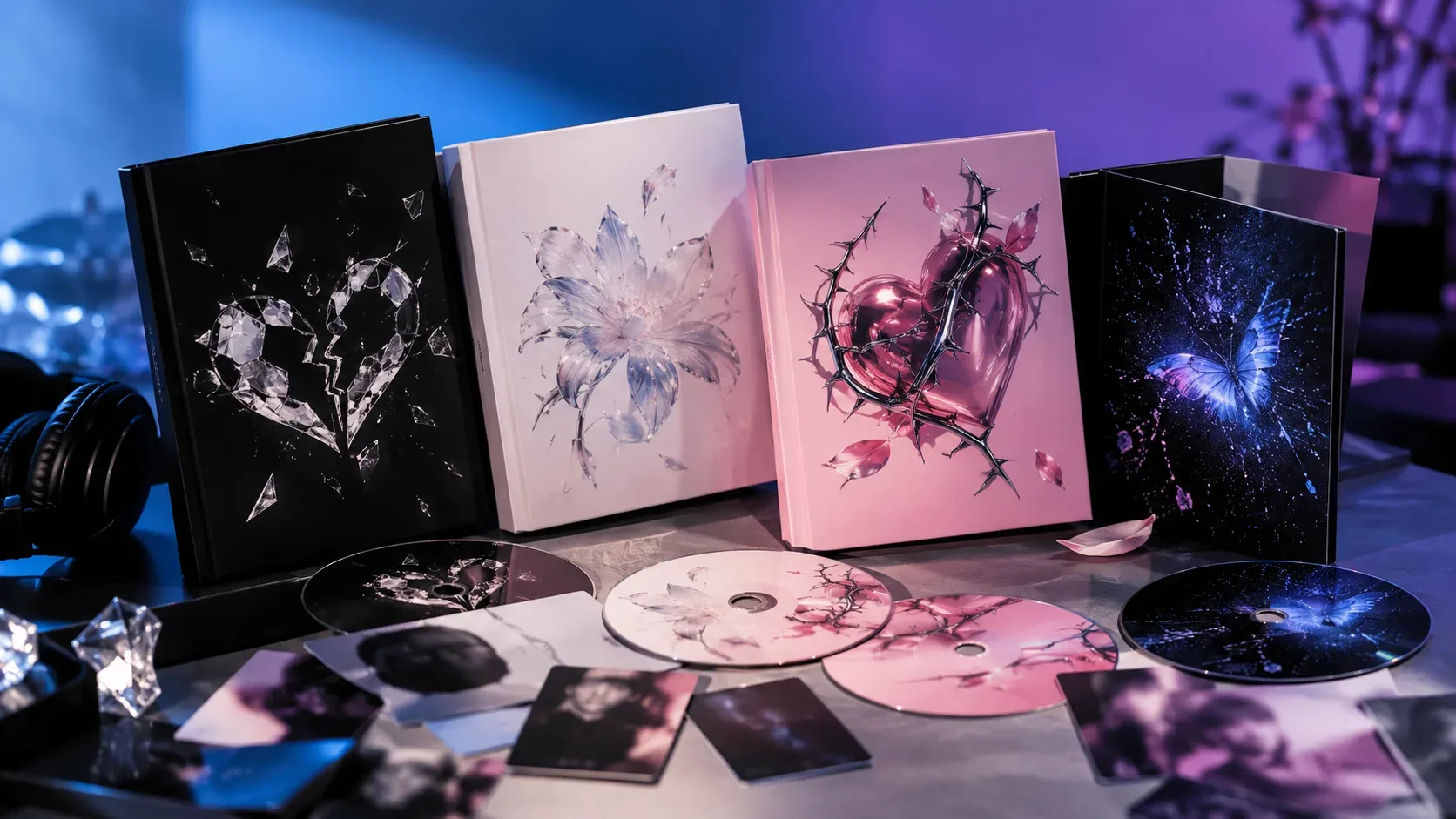
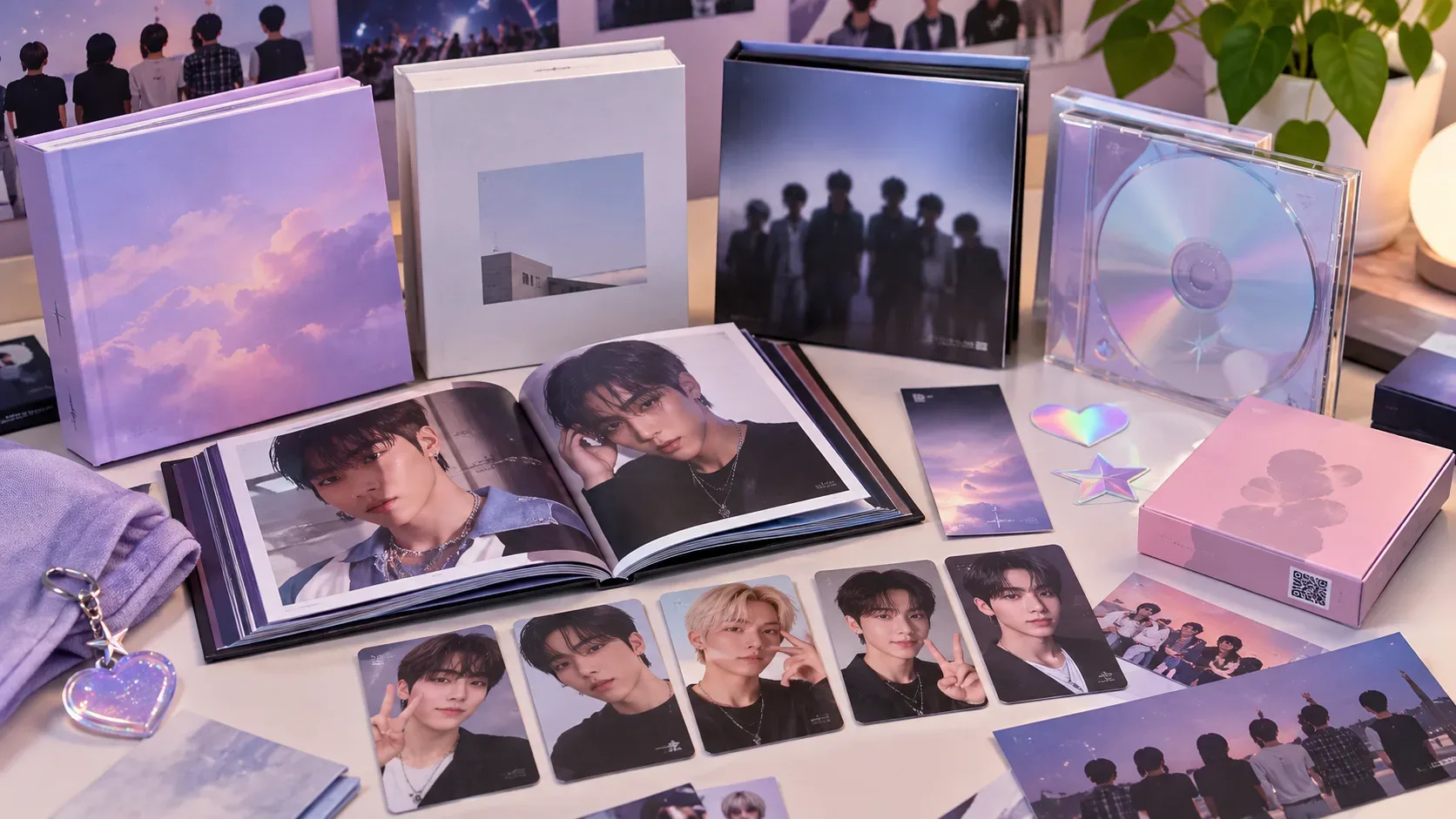
A single comeback can appear in stores as a photobook version, digipack, jewel case, member version, platform album, POCA, Weverse Albums and several concept names. At the same time, each listing may include long component lists, random photocards, pre-order benefits and store-specific gifts. The impression that there are dozens of different albums comes from the fact that these layers are presented together even though they do not mean the same thing.
The simplest way to understand the system is to separate four concepts: format, version, inclusion and promotional benefit. Format describes how the physical product is presented and, in some cases, how the audio is accessed. Version identifies a specific visual or member edition. Inclusions are the items inside the package. POBs and other promotional benefits depend on the retailer, period or campaign.
Why does one album get multiple versions?
In K-pop, the physical album works at the same time as a music carrier, photobook and collectible object. A label can therefore release the same repertoire in different packages and visual concepts. Pocabase, for example, had cataloged thousands of versions across thousands of albums in September 2026 and described several editions for one release as common. That figure is a snapshot of its own database, not a total count of the market. Source: Pocabase.
Multiple versions serve different functions. They let labels distribute alternate photo shoots and designs, create member-specific editions, offer more compact formats or products without a conventional CD, and expand the collectible component. There is also a commercial dimension: physical charts record eligible units sold within their networks and rules. Hanteo Chart, for example, says its album ranking tracks physical sales aggregated from thousands of retailers. When fans buy more than one edition, each eligible unit can therefore enter the relevant count. This does not mean that everyone buys multiple copies or that every chart uses the same methodology. Source: Hanteo Chart.
Format and version are not the same thing
Format is the product family. Version is a specific edition within that family. A release can have three standard versions with different concepts and, at the same time, five individual digipacks, one for each member. It may also have a platform edition with its own variants.
| Term | What it usually describes | What can vary |
|---|---|---|
| Standard or photobook | Larger physical edition, usually with a CD and photobook | Cover, photo shoot, posters, photocards and other printed items |
| Digipack | More compact paperboard packaging for a CD | Often available as member covers or member editions, with less printed material |
| Jewel case | Traditional plastic CD case | Cover, booklet and collectible items may differ between editions |
| Platform album | Physical product that often replaces the CD with a card, QR, NFC or another digital access mechanism | App or platform used, type of card, photocards and other inclusions |
| Member version | Visual edition dedicated to one member | Cover, photos and some member-linked inclusions |
The names do not form a universal standard. “Platform”, “POCA”, “Nemo”, “Weverse Albums” and other terms can refer to similar ecosystems or products, but they should not automatically be treated as perfect synonyms. The official listing for each release is the best reference for checking whether a CD is included, which app is required and what comes in the package.
What is a platform album?
Platform album is a practical category for physical editions in which audio or digital content is accessed through a code, QR, NFC or compatible card instead of relying on a conventional CD. The product can still include packaging, photocards, stickers and other physical items.
An official TOMORROW X TOGETHER notice from 2026, for example, describes a “Weverse Albums ver.” with a card holder, user guide, QR card, photocard and stickers. In another release, Weverse listed a “Platform Ver.” with a QR mini card and photocards. These examples show why the component list is more reliable than assuming every platform album works the same way. Source: Weverse, TXT and Source: Weverse, STAYC.
Photocard: album inclusion and random selection
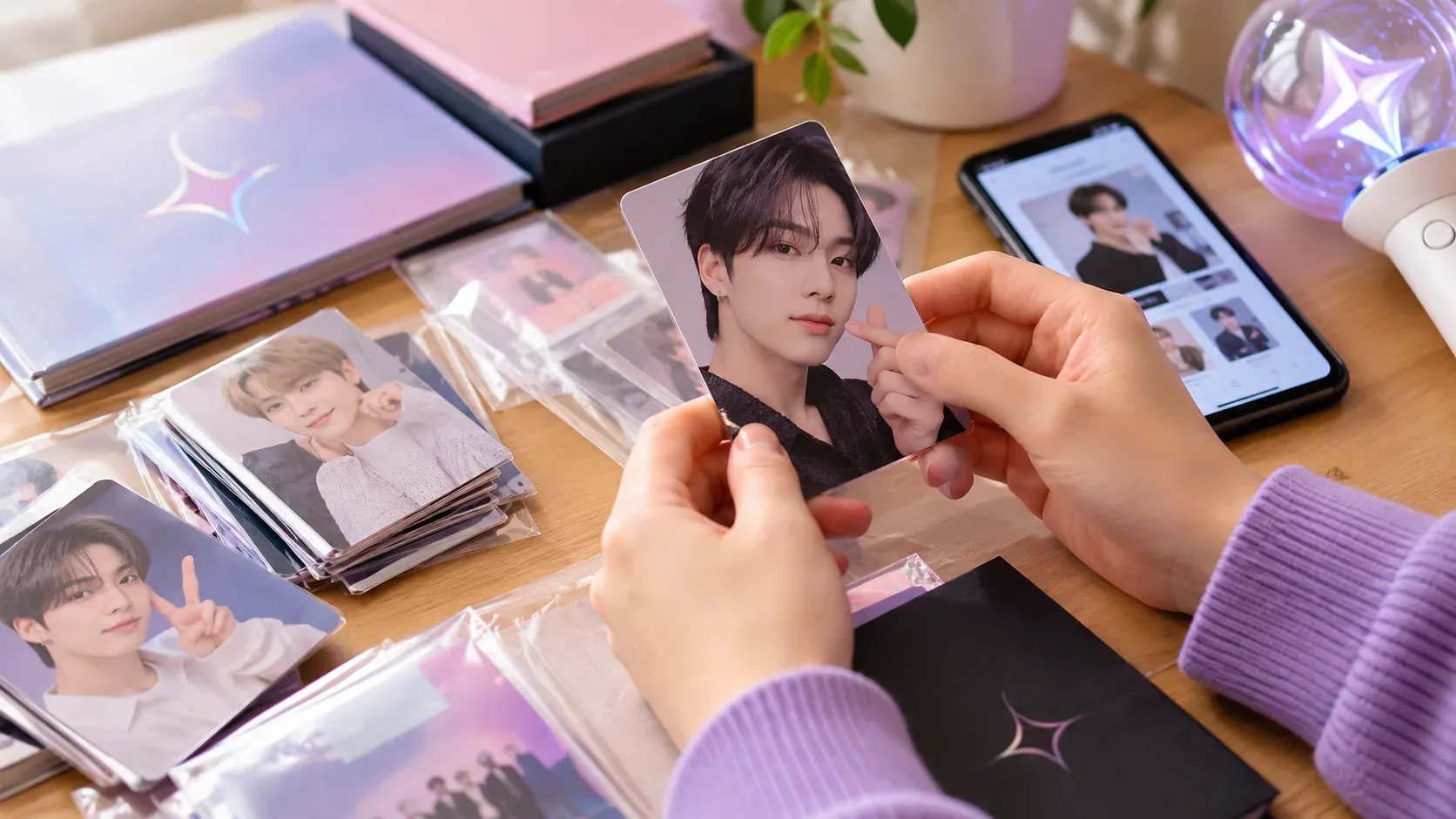
A photocard is a collectible photo card that may be included inside the album. Many releases use formulas such as “random 1 out of 6”, meaning the buyer receives one card from six possible cards in that set. Other releases may include a complete set or different pools of cards depending on the version.
The word “random” matters because two identical copies of the same version can contain different photocards. This creates the idea of the “pull”, the result found when opening the package. It also explains why a listing should be read in two steps: first, how many cards are included; then, how many possible cards they are selected from.
Photocard is not a synonym for POB. A photocard can be a regular album inclusion, a pre-order benefit, a store gift, an event item or part of another campaign. The distribution method is what defines the category.
What is a POB and why does it change by store?
POB stands for pre-order benefit. It is an extra item offered during a promotional window defined by a retailer, platform or campaign. It is often an exclusive photocard, but it can also be a sticker, photo, mirror, postcard or another gift.
The key point is that a POB should not be confused with the standard list of items inside the album. Weverse, for example, publishes notices where album contents are separated from “special gifts” offered to pre-order customers. In one 2025 case, the notice explicitly stated that the special gifts were available only for purchases made during the pre-order period. Source: Weverse, AHOF.
This is why the same album can generate different POBs across several stores. The physical edition is the same or belongs to the same version family, while the promotional extra depends on where and when the purchase is made. That layer is one reason photocard checklists for a promotion era can be much larger than the number of cards included directly inside the albums.
POB, first press and store exclusive: three different things
- POB: an extra linked to pre-ordering and usually to a specific channel.
- First press or first-print benefit: an item included in some or all copies of the first production run. It can disappear when the initial stock is exhausted even if the album is still sold by the same store.
- Store exclusive or event benefit: a gift tied to a retailer or campaign, but not necessarily limited to the pre-order window.
Commercial definitions can vary from one listing to another, so the seller's wording and published conditions matter more than an informal fandom rule. If a listing says “first-print only”, for example, it describes the production run. If it says “special gift for pre-order customers”, it describes a pre-order condition.
How to read an album listing without mixing the layers
A product page becomes easier to understand when read in this order:
- Identify the format: standard, digipack, jewel case, platform or another family.
- Check how many versions exist: concept A/B/C, member versions, random version or set.
- Confirm the audio medium: CD, QR, NFC, card or app.
- Read the fixed inclusions: photobook, lyric book, stickers, postcards and other items that always accompany that edition.
- Read the random inclusions: look for wording such as “random 1 of 6” to understand how many you receive and how large the pool is.
- Separate external benefits: POBs, store gifts, event benefits and first-press items should be treated as additional conditions.
A simple map of the ecosystem
The chain can be summarized as music release → formats → versions → inclusions → random items → promotional benefits. A platform album is a format. A digipack dedicated to a particular member is a version within a format. A photocard can be an inclusion. A POB can be another photocard distributed by a retailer during pre-order.
This separation also helps explain why the number of “versions” cited by fans and stores does not always match. Some people count only editions with different packaging. Others include member versions, platform formats and retailer-exclusive variants. Without defining the counting rule, two different numbers can be describing the same release.
What actually changes between editions?
In general, the core music of a regular release remains the same across physical versions. What changes is the object: design, photos, size, presence or absence of a CD, digital access method, quantity of printed materials and photocard pool. Exceptions exist, including regional bonuses or special editions, so the published tracklist remains the definitive source.
For any specific release, the safest approach is to avoid deductions based only on the version name. Check the official or distributor listing, separate internal inclusions from external benefits and note exactly what is random. Once those layers are separated, the apparent confusion of dozens of options becomes a readable system of formats, editions, inclusions and promotional campaigns.