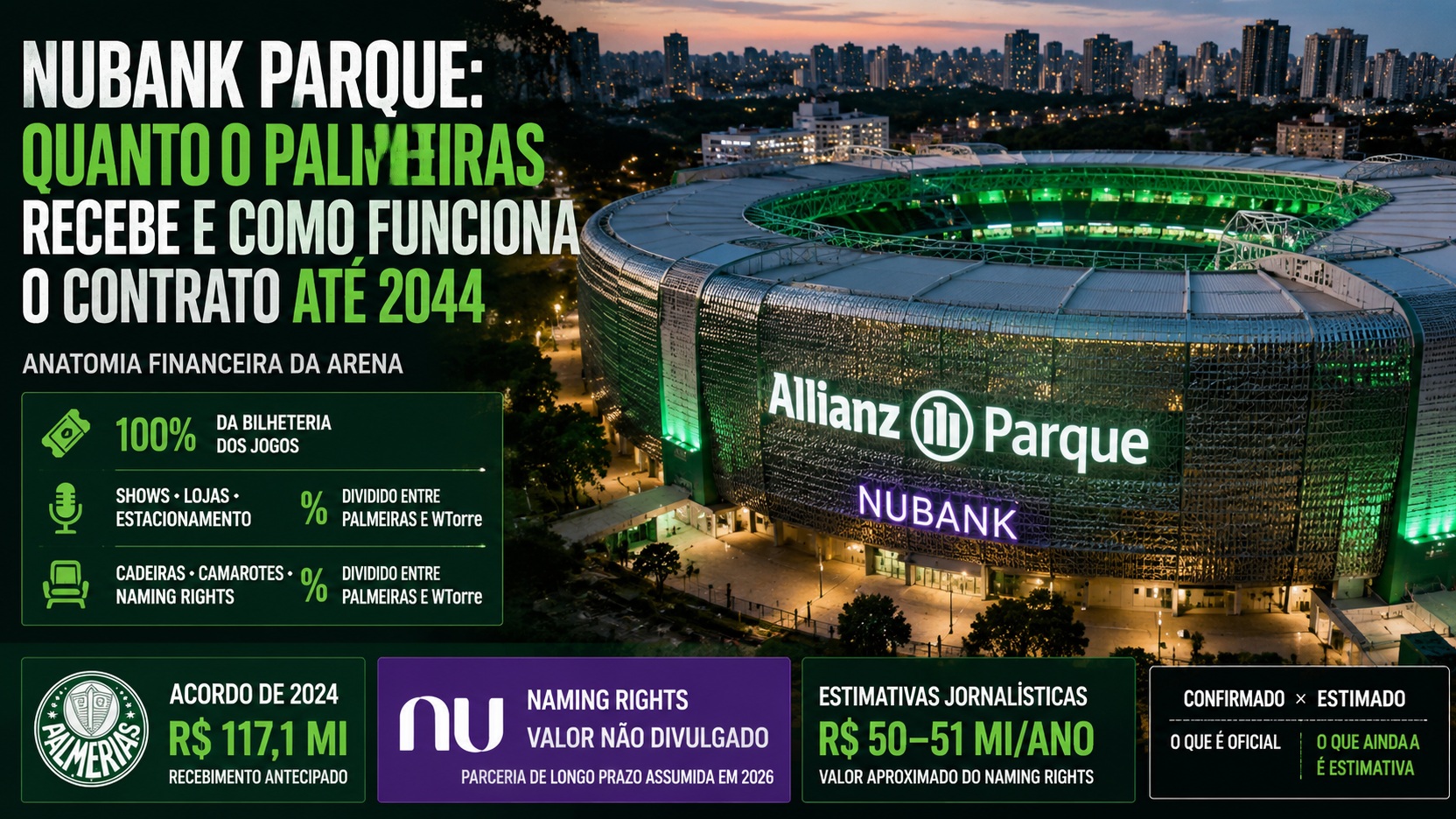
The central answer is simpler than it seems: Palmeiras does not receive the full money from Nubank Parque's naming rights. As long as the surface rights granted to Real Arenas, a company belonging to the WTorre group, are in force, the commercial exploitation of the arena follows the rules of the 30-year contract started in November 2014. Today, the club is entitled to 15% of the revenue from naming rights. The box office for Palmeiras games, on the other hand, is entirely the responsibility of the club.
The short answer: today, 15% of the naming rights belong to Palmeiras
Nubank announced in April 2026 that it acquired the naming rights to the arena in a long-term partnership signed with WTorre. The bank's official communication confirmed the commercial relationship and, in May, the name Nubank Parque, chosen in a popular vote. The value of the contract, however, was not officially disclosed by Nubank or WTorre.
Reports from ge and ESPN point to an annual value close to R$50 million to R$51 million and indicate that the bond should cover the remaining period of the surface right, until 2044. These numbers are journalistic estimates, not values confirmed by the parties.
Applying the current contractual percentage of 15% to this range, Palmeiras' share would be approximately R$7.5 million to R$7.65 million per year. This account is useful for understanding the order of magnitude, but should not be treated as guaranteed official revenue, because the price, payment conditions, possible adjustments and the exact basis of incidence have not been made public.
Why is WTorre negotiating the name of a Palmeiras stadium?
The key to understanding the arena is to separate ownership from exploitation. The stadium belongs to Palmeiras, but the club granted the right to the surface of the land
for the partner to explore the venture for 30 years. Palmeiras' official page records that the transfer was approved in 2008, that the contract with WTorre was signed in 2010 and that the arena reopened in 2014 had the work, estimated by the club at around R$630 million, paid for by the partner.
From the first event held in November 2014, the 30-year term of the surface deed began to count. Palmeiras' financial statements record this structure and indicate that exploration of the surface by Real Arenas will continue until November 2044.
Therefore, until the end of this period, commercial properties in the arena can be negotiated by the surface company. This is what happened with Nubank: the naming rights negotiation was conducted by WTorre, not Palmeiras. The club, however, receives the share provided for in the deed.
The arena has different recipes and each one follows a rule
The most common mistake when looking at Nubank Parque is treating all collections as if they were going into the same box. Don't go in. The contract separates income from Palmeiras games from revenue from commercial exploitation of the arena.
Game box office: 100% goes to Palmeiras
Since its inauguration, ticket revenue from Palmeiras games belongs entirely to the club. This does not mean that all revenue generated within the stadium on match day automatically belongs to Palmeiras, because chairs, boxes and other commercial properties have their own rules. But the game's box office, itself, is not shared with the WTorre.
This difference helps to understand why income figures from matches cannot be directly compared with what the club receives from shows, parking, stores or naming rights.
Shows, shops, snack bars and parking: Palmeiras receives 30% today
The first group of commercial revenues includes the rental of the arena for events and the exploitation of areas such as stores, snack bars and parking. Palmeiras' percentage grows every five years.
In the first five years of operation, the club's share was 20%. Between the fifth and tenth year, it rose to 25%. Since November 2024, when the arena completed ten years, the percentage is 30%.
If the contractual ladder continues without change, the share rises to 35% between November 2029 and November 2034, to 40% between November 2034 and November 2039 and to 45% in the last cycle, from November 2039 until the end of the surface right in 2044.
The remainder of the revenue remains on the commercial exploitation side of the arena. This should not be confused with net profit of WTorre or any future operator, because costs, taxes, contracts with suppliers and other obligations of the operation may still come from this portion.
Chairs, boxes and naming rights: Palmeiras receives 15% today
The second group has lower percentages. It includes the rental of chairs and boxes and the naming rights of the arena.
In the first five years, Palmeiras was entitled to 5%. From the fifth to the tenth year, 10%. Since November 2024, the share is 15%.
The next change is scheduled for November 2029, when the share increases to 20%. In November 2034, it rises to 25%. In the last cycle, from November 2039 and until 2044, it reaches 30%.
It is on this second ladder that the Nubank contract comes into play. Therefore, the current percentage used to calculate the Palmeiras share is 15%, not 30%.
How much Palmeiras actually receives from Nubank Parque
The question "how much does Palmeiras receive from Nubank?" needs two answers: one contractual and one estimated.
The contractual answer is confirmable: Palmeiras is entitled to 15% of the naming rights revenue at this stage of the surface agreement. This percentage is public in reports that detailed the deed and was reaffirmed when Nubank took over the name of the arena.
The answer in reais is not yet official. Nubank described the partnership as long-term, but did not disclose the price or deadline in its public statements. ge estimated around R$51 million per year and ESPN published an estimate close to US$10 million annually, also without confirmation from the parties.
If the annual value is really between R$50 million and R$51 million, the 15% slice corresponds to something between R$7.5 million and R$7.65 million per year at the current stage. When the club's percentage increases to 20%, 25% and 30% in subsequent cycles, the portion also increases, as long as the base of the naming rights contract remains the same or is readjusted upwards.
The R$117.1 million agreement in 2024 was not a check for R$117.1 million
In October 2024, Palmeiras and Real Arenas ended a dispute that had been going on for years over transfers of the arena. The club's official statement reported a financial balance of R$117.1 million.
Of this total, R$50.1 million was paid in cash. The remainder was made up of concessions and arena properties, in addition to the implementation of the new Gol Norte Sector. A ge report detailed that the agreement also involved periods without charging the club for the use of boxes and the Avanti store, the removal of rent and condominium fees from the museum until the end of the contract and the opening of Gol Norte to expand around a thousand seats.
Therefore, saying that Palmeiras "received R$117.1 million in cash" distorts the agreement. The total value combines cash and economic benefits evaluated within the negotiation.
The 2024 agreement also did not transfer the commercial exploitation of the arena to Palmeiras. He ended the disputes, adjusted uses and charges and normalized the transfers provided for in the deed, maintaining the logic of increasing percentages until 2044.
2025 numbers show why arena accounts can be confusing
Palmeiras' 2025 financial statements recorded R$72 million under the heading "Surface contract - Arena". At first glance, this number may seem like the total amount of money transferred by WTorre that year, but the explanatory note makes an important separation.
Of the total of R$72 million recognized in accounting, R$19.387 million corresponds to the annual amortization of revenue linked to the activation of the stadium. Another R$52.613 million is related to the transfer percentage provided for in the public deed.
This distinction is essential. Accounting revenue from the surface contract, current commercial transfer and game box office are different things. Adding everything up without separating the natures produces numbers that seem contradictory, even though they are measuring different boxes.
Confirmed x estimated
What is confirmed
It is confirmed that Nubank purchased the naming rights in partnership with WTorre and that the name Nubank Parque was chosen in 2026. It is also confirmed that WTorre, through Real Arenas, holds the right to explore the surface until November 2044 and that Palmeiras retains 100% of the box office from its games.
The current transfer ladder is also confirmable: 30% to Palmeiras in revenue from events, stores, snack bars and parking, and 15% in revenue from chairs, boxes and naming rights. The 2024 agreement worth a total of R$117.1 million, with R$50.1 million paid in cash, was officially announced by the club.
What is still an estimate
The price of the Nubank contract has not been officially published. The R$50 million to R$51 million per year appear in journalistic investigations. The exact duration of the naming rights was also not detailed by Nubank in its announcement, although reports indicate a link until 2044, compatible with the end of WTorre's surface rights.
For this reason, the account of R$7.5 million to R$7.65 million per year for Palmeiras must be presented as an estimate derived from a journalistic value, and not as a confirmed contractual line.
What changes by 2044
The contract was designed to transfer a greater portion of commercial revenues to Palmeiras as time passes. The club has already crossed the first two steps and has been, since November 2024, in the third cycle.
In November 2029, participation in events, stores, snack bars and parking should increase from 30% to 35%, while chairs, boxes and naming rights increase from 15% to 20%.
In November 2034, the shares rise to 40% and 25%, respectively. In November 2039, they reach 45% and 30%, remaining that way until the closure of the surface in 2044.
The logic is simple: as the end of the partner's exploration period approaches, Palmeiras participates in an increasing portion of the revenue generated by the venture.
And what happens in 2045
The surface right ends in November 2044. From then on, control and management of the arena returns entirely to Palmeiras, unless the club decides to enter into a new partnership.
This changes the decision center. The current model, in which WTorre negotiates properties such as naming rights and transfers a share to the club, ceases to exist with the end of the deed. New commercial contracts now depend directly on Palmeiras or on a structure that the club hires to operate the arena.
This is why 2044 is more important than the simple end date of a contract: it is the legal limit of exploration granted to the partner.
Does the possible entry of BTG change this division?
In August 2026, UOL and Band reported that BTG Pactual had an agreement in place to take over the operation of Nubank Parque in partnership with WTorre, which would have a minority stake. Until August 22, the negotiation was still described as not formalized and without public confirmation from the companies.
The reports state that a possible change of operator does not change the surface right or the percentage of revenue guaranteed to Palmeiras. In other words, who controls the business operation may change by 2044, but it does not automatically change how much the club is entitled to receive from each property.
So who makes money from Nubank Parque?
At Palmeiras games, the club takes over the ticket office. In the commercial exploitation of the arena, the money is divided according to the nature of the revenue and the stage of the contract. Today, Palmeiras receives 30% from revenues such as shows, stores, snack bars and parking, and 15% from seats, boxes and naming rights.
In the case of Nubank, the contract was signed with WTorre. If the estimate of R$50 million to R$51 million per year is correct, Palmeiras' current installment is close to R$7.5 million to R$7.65 million annually. The number is an estimate, not an officially released value.
Until 2044, the club's percentages increase in stages. After the closure of the surface right, Palmeiras returns to full control of the management and
starts to directly decide how to exploit the arena and its commercial properties.