Palmeiras and Santos will compete in the quarter-finals of the 2026 Copa do Brasil with an important change in the offside check: the line will no longer need to be manually positioned by the VAR in the normal flow of analysis. The system automatically identifies the moment of the pass, the relevant players and the position used to determine whether or not the attacker was advanced.
This does not make arbitration automatic. The VAR continues to participate in the checking, validates the result produced by the technology and maintains responsibility for situations in which the rule requires human interpretation. The CBF confirmed on August 6 that the semi-automatic offside will be used in all quarterfinal games and informed that the stadiums involved are equipped.
Palmeiras and Santos reached the stage before the draw scheduled by the CBF for August 11th. Palmeiras eliminated Fortaleza, while Santos went through Remo.
What changes in a tight offside
In traditional VAR, an important part of the checking time can be consumed in choosing frames and manually positioning the references used to compare attacker and defender.
With SAOT — an acronym in English for semi-automatic offside technology —, several of these tasks are transferred to the optical tracking system contracted by the CBF from Genius Sports.
The practical sequence of a tight bid looks like this:
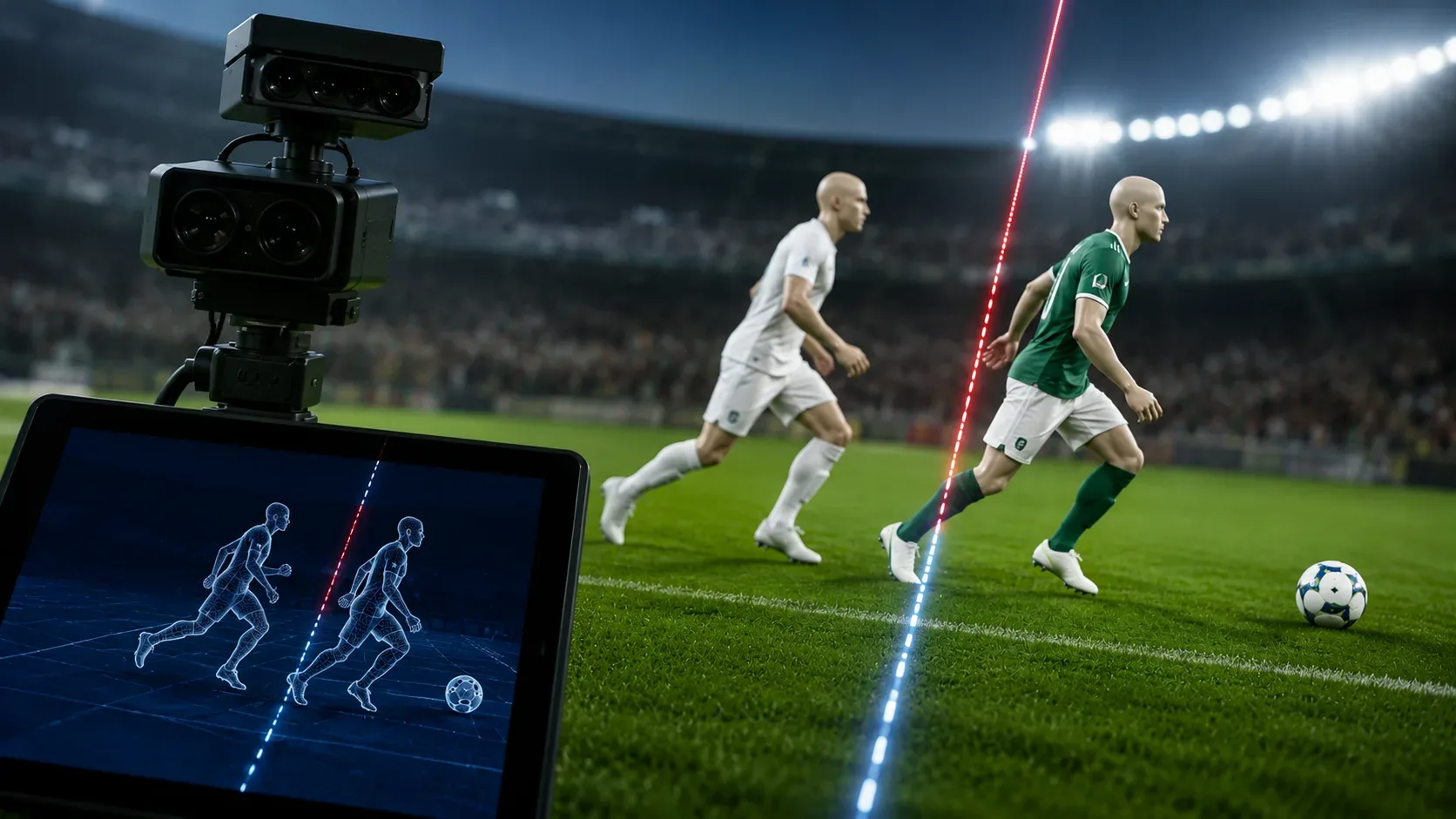
- The cameras follow players and the ball. The system creates a three-dimensional representation of what happens on the field based on data captured around the stadium.
- The technology identifies the relevant point of the pass. The software automatically selects the moment used to compare positions.
- Relevant attacker and defender are identified. The system calculates the players' body position and generates the virtual plan used to check the offside.
- The result reaches the VAR team. Video referees validate the information produced by the technology.
- The decision is communicated to the field. Once the analysis is confirmed, the referee informs the decision and a 3D representation can be produced to explain the bid to the public.
This is why “semi-automatic” is a more accurate description than “automatic deterrent”. The machine takes over geometric tasks that previously required manual intervention, but arbitration remains within the process.
Semi-automatic does not mean automatic referee
| Situation | What the system does | What continues with arbitration |
|---|---|---|
| Moment of the pass | Automatically identifies the relevant touchpoint | VAR validates the point presented |
| Player position | Tracks the bodies and generates the virtual reference | VAR checks the result |
| Offside line | It is produced automatically | Does not need to be redesigned in normal operation |
| Active participation in bidding | Provides the player's objective position | Referees evaluate situations that require interpretation |
| SAOT failure | The automated flow is no longer used | VAR can return to manual tracing |
The distinction matters because being in an offside position is not, in itself, an infraction. According to IFAB Rule 11 for 2026/27, the player must also be involved in active play under conditions stipulated by the rule, such as touching the ball, interfering with an opponent or obtaining an advantage in certain situations.
Imagine, for example, an attacker a few centimeters in front of the second-to-last defender when his teammate makes the pass and then receives the ball. The geometric part — moment of the pass, body position and comparison between players — is precisely where the system tends to take over the work that previously involved manual design.
Now imagine another move: the attacker is advanced, does not touch the ball, but appears in front of the goalkeeper. Knowing that he was in an offside position is an objective question. Deciding whether it clearly obstructed vision or interfered with the goalkeeper's ability to play the ball requires application of the rule by the referee. Rule 11 itself treats these situations as part of the assessment of interference with an opponent.
The same goes for certain defense contacts. Determining whether there was a deliberate play by the defender or just a deflection can change the application of the offside and involves criteria set out by the IFAB, such as control of the ball, distance, speed and time to coordinate the movement. Technology helps reconstruct the bid; it does not eliminate this interpretation.
Does the system used by the CBF have a chip in the ball?
No. This is a point where different versions of semi-automatic offside can cause confusion.
The solution used by the CBF is provided by Genius Sports and works mainly through optical tracking with cameras installed in the stadiums. According to the company's explanation to the press after the Brazilian debut, the ball used in this system does not need a chip to determine the moment of the pass: high-frequency images are used to locate this point.
This is different, for example, from the implementation used by FIFA in the 2022 World Cup, which combined tracking cameras with a sensor inside the ball. Therefore, just saying that “the semi-automatic deterrent uses a chip” generalizes different technologies.
In Brazil, Genius reports that its system uses mesh-type tracking, capable of collecting thousands of points on each player's surface and reconstructing events in three dimensions. CBF hired the company to use the technology in both the Brazilian Championship and the Copa do Brasil.
What if the technology is unable to analyze the bid?
There is contingency. According to the guidelines released at the debut of the system in the Brasileirão, if the semi-automatic offside cannot be used, the arbitration can return to the manual VAR lines method.
If a fault is identified before the match, it is expected to notify the teams and the broadcast. If it appears during a check, the operator reports the unavailability and the conventional procedure can be used.
There may also be rare situations in which players or the ball itself are partially obscured in the images. The CBF explained that, in these cases, the VAR can check adjacent frames to ensure that the selected contact point corresponds to the correct moment. This does not mean freely redrawing the line: it is a validation of the data generated by the system.
Therefore, technology should not be treated as a guarantee of an “end of errors”. It reduces manual steps in position determination and creates a more standardized technological basis, but remains subject to technical contingencies and human interpretations provided for in the rules.
Santos has already seen the system work in the Brasileirão
For Santos fans, the technology is not completely new. The official debut of semi-automatic offside in Brazilian football took place on July 25, 2026, at the start of the 20th round of the Brasileirão, and Santos x Chapecoense, in Vila Belmiro, was among the first two games to use the system. The entire round featured the novelty.
In the quarterfinals of the Copa do Brasil, however, the change takes on another weight: any tight impediment could directly interfere in a round-trip eliminatory clash.
For Palmeiras and Santos, the practical effect is the same regardless of the opponent defined in the draw: the technology will measure and produce the reference automatically; the arbitration will validate the result and continue to decide the interpretative elements of the rule.
What to watch out for during the broadcast
When a tight impediment arises in the quarterfinals, three questions help you understand what happened:
- The debate is just about who was further ahead at the time of the pass? This is the part where SAOT takes over a lot of the technical work.
- Is there discussion about interference with an opponent, active participation or deliberate play by the defense? There continues to be an interpretation of arbitration.
- Did the old manual line drawing appear again? This may indicate the use of the contingency procedure provided for system unavailability.
The 3D image presented after the decision serves to make the players' position more understandable to the public. It is a representation of the data used in the analysis, not a new referee deciding the bid.
The point to remember during the Palmeiras and Santos games is simple: the line continues to exist, but is no longer drawn manually in the normal procedure. Human decision also continues to exist.
Keep this guide to consult in the tight quarterfinals and follow the coverage of São Paulo clubs after the draw on August 11th.