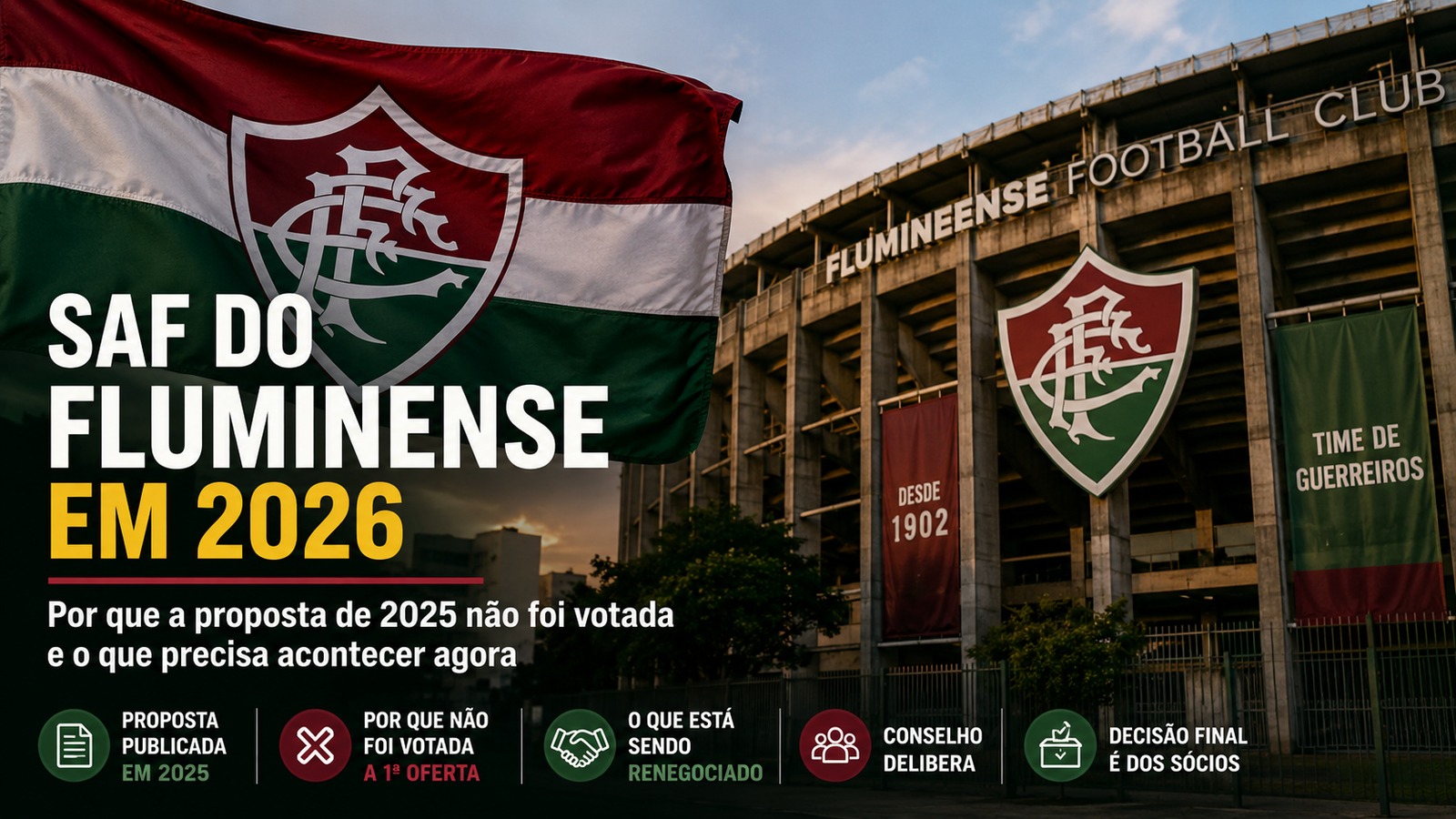
Fluminense's SAF has not yet been approved. On August 15, 2026, the process continues to be negotiated with Lazuli Partners and LZ Sports, and the first proposal presented in September 2025 did not reach the final vote of the partners. What seemed, last year, to be a path of presentation to the Council, waiting for the election and subsequent voting has changed phase: the new management decided to reopen economic and contractual points before asking the club for a decision.
This solves the main confusion that appears in searches. The 2025 proposal existed, was officially received, presented to the Deliberative Council and published in full by Fluminense. But presentation was not approval. The document served as a basis for negotiation, and the current board awaits a reformulated offer before resuming the political and corporate rite.
What happened to the proposal presented in 2025
Fluminense received an indicative proposal from LZ Sports, a company in the Lazuli Partners group, on September 8, 2025. On the same day, the document was presented to the Deliberative Council; The club then published the full text on the Transparency Portal.
The letter provided that the investor would control the future Fluminense SAF through a capital contribution. Taking as a reference a net debt of R$871 million on December 31, 2024, the proposal attributed to football a pre-investment value of R$1.131 billion. After discounting this debt, it reached an equity of R$260 million. With a contribution of R$500 million, the initial participation calculated for the investor was 65.8%, while the association would have 34.2%.
This percentage, however, was not fixed. The proposal itself provided for an adjustment according to the net debt determined at the closing of the transaction. If the debt were to decrease, the investor's share could also decrease; if it increased, participation could increase, respecting the limits set out in the document. Therefore, the financial picture of the club at the time of closure was a central part of the account.
The contribution of R$500 million would also not be entirely upfront. The published design predicted R$250 million at closing and another R$250 million within two years. Furthermore, the document estimated R$6.412 billion in investments and expenses by SAF itself over ten years, reaching the total announced value of R$6.912 billion for the transaction and business plan.
It is important to separate these two figures. The R$6.9 billion was not a single check given to Fluminense. The investor's capital contribution was R$500 million; the rest corresponded to the business plan designed for ten years, with items such as professional football payroll, athlete acquisitions, player training, infrastructure and royalties for the association.
Why the vote was pushed until after the election
When the proposal was presented, Fluminense was just a few months away from the November 2025 presidential election. At that time, the announced intention was not to hold a decisive vote before choosing the new president. The political justification was simple: the transformation of football into SAF would change the club's structure for many years, and the management elected for the next three years would need to directly participate in this decision.
The process was then interrupted during the election period. Mattheus Montenegro won the November 29, 2025 election and assumed the presidency in December. Shortly after the election, he said that the issue could move forward again, but he already signaled that there were points in the offer that should return to the negotiation table.
From then on, the problem was no longer just a calendar. The question is no longer “when will Fluminense vote on the September proposal?” and became “which proposal does Fluminense intend to take to a vote?”.
Why the first offer was not voted on in 2026
On August 4, 2026, Mattheus Montenegro gave the clearest update so far: the club continued negotiating to improve the proposal and was awaiting a new offer. The declared objective is to increase the initial contribution and review other points of the contract before presenting the project to the Council again.
This means that the first offer was not stopped just because of bureaucracy. It was no longer treated as a ready-made text that would go directly to the ballot box after the election. The new board chose to renegotiate the economic equation and contractual protections.
One of the reasons is that the 2025 offer was tied to the club's debt and valuation. The 2025 financial statements, published in April 2026, showed record revenue exceeding R$1 billion and a surplus of R$51.5 million, but also debt in the region of R$1 billion according to the metric released by the club. Excluding amounts payable for investments in players, Fluminense reported a debt of R$812 million. As the proposal defined closing net debt broadly and provided for an audit to adjust equity participation, the new financial picture requires new negotiation, not a simple cosmetic update.
In addition to the value of the initial check and the valuation, Montenegro had already indicated that the club wanted to discuss the investment planned for the ten years and the consequences if the commitments were not fulfilled. In August, he also stated that he intends to make public, before any vote, central documents of the operation, such as the investment agreement and the shareholders' agreement.
The 2025 proposal was not an already closed purchase contract
Another point that changes the reading of the process is in the document published by Fluminense itself. The September 2025 letter was expressly non-binding regarding the consummation of the SAF. It said that there was no obligation to close the transaction and that the deal would depend on the negotiation and signing of definitive documents.
The proposal was also formally valid for 30 days, although specific clauses, such as confidentiality, exclusivity and forum, had their own treatment. Therefore, it is not correct to imagine that there is, in August 2026, an old contract just waiting for the partners to vote. What exists is a negotiation process whose public reference is the 2025 proposal and which now needs to produce a new version accepted by the parties.
The old text already provided for a series of conditions before closing: creation and structuring of the SAF, approval by the club's governance bodies, legal, accounting, operational and financial due diligence, negotiation of definitive documents, investor approvals, absence of legal and regulatory impediments and obtaining consent from third parties when necessary.
What needs to happen now
First, the renegotiation needs to end
The step immediately prior to any new institutional round is for Lazuli Partners and LZ Sports to present an offer that Fluminense's management considers capable of following. The most visible point is the initial contribution exceeding the R$500 million foreseen in 2025, but the discussion is not limited to that. Valuation, contribution schedule, debt treatment, investment obligations, penalties, governance and definitive documents also enter the equation.
Until this reformulated offer is closed at a sufficient level, there is no new proposal ready to be voted on. Therefore, any meeting date announced before this stage must be treated as an expectation, not as a stage already called.
Then, the new proposal returns to the Deliberative Council
Montenegro stated that, once negotiations are concluded, it intends to hold another meeting of the Deliberative Council to present the new proposal. This stage is different from the meeting in September 2025, which served to present the first design and clarify doubts.
The Council is an important institutional step, but it does not replace the final decision of the partners. Fluminense itself has already officially clarified that the board does not have the power to approve the transformation alone: the decision rests with the Members' Assembly after analysis by the Deliberative Council.
Commissions must analyze the terms before making a final decision
Management also indicated that it intends to work with committees of advisors and partners to examine the business. The function of these bodies is to allow valuation, governance, financial obligations, association protection and contractual risks to be discussed before the decisive vote.
This detail matters because a SAF is not limited to the percentage sold. A shareholders' agreement defines who appoints directors, which decisions require a joint vote, which rights remain with the association and under what conditions the stake can be diluted or negotiated. The investment agreement, in turn, establishes contributions, deadlines, obligations and collection mechanisms. It is in these documents that the economic promise gains legal consequences.
The documents must be known to the partners
In August 2026, Montenegro stated that it intends to open the operation documents before any vote. If this commitment is fulfilled, the debate will not be restricted to the summary presentation of values. Partners will be able to compare the new offer with the proposal published in 2025 and see what has actually changed.
For the fan, the most useful points to monitor will be the new value and schedule of the contribution, the share that will remain with the investor and the association, the debt base used in the calculation, the investment obligations over the years, the penalties for non-compliance and the governance of the future company.
The final decision remains with the partners
Even if the board, investors, committees and Council arrive at a design considered satisfactory, the SAF is not born automatically. Fluminense has already declared that the final decision to create and sell control of SAF rests with the Members' Assembly.
It is this vote that separates a negotiated proposal from an effectively authorized transformation. Until this assembly takes place and approves the operation, saying that “Fluminense
became SAF” is anticipating a result that does not yet exist.
What changed between the expectation of 2025 and the reality of 2026
In September 2025, the simplest public reading was: proposal presented, election in November, vote later. This sequence was not wrong as expected at that moment, but it became incomplete with the passage of time.
After the election, the new management did not inherit the first offer as a closed package. He chose to reopen negotiations. The 2025 balance sheet changed the financial picture used in the discussion; management began seeking a larger initial check and valuation adjustments; and definitive contracts still need to reflect conditions considered acceptable by the club and investors.
Therefore, the current stage is not “delayed voting”. It is a “new proposal under construction”. This difference explains why news from 2025 that talked about voting right after the election coexists, in 2026, with the information that Fluminense is still awaiting a revised offer.
Where is Fluminense's SAF today
On August 15, 2026, the status of the process can be summarized objectively: the SAF was not approved; the proposal published in September 2025 served as an initial basis and did not reach the final vote; Fluminense continues negotiating a better version with Lazuli Partners and LZ Sports; the president intends to re-present the new design to the Deliberative Council; there will be institutional analysis and dissemination of documents; and the final decision will remain in the hands of the partners.
The next really relevant milestone, therefore, is neither buyer speculation nor a voting date. It is the publication or presentation of the new proposal. Only from this will it be possible to measure whether the contribution, valuation, shareholding, guarantees and governance have changed enough for the club to progress from the negotiation stage to the deliberation stage.