When a birth certificate does not appear in a civil-registration search, a baptism register may be the best next lead — especially for older periods. That does not mean a civil record never existed, nor does it mean a religious certificate automatically replaces a civil certificate in present-day procedures. It means that, for historical and genealogical research, a baptism can document birth, parentage, locality, and family relationships that help reconstruct the path to other sources.
The most efficient method does not begin with a name in a search box. It begins with place + period, moves to the identification of the relevant parish or diocese, continues through the available catalog and images, and ends with a transcription of the original image and a complete source reference. This order prevents a common mistake: treating “no result in the index” as equivalent to “no record exists.”
Why baptism can be decisive when a birth record is missing
In Brazil, church records played a central role for centuries. The Brazilian Institute of Geography and Statistics (IBGE) notes that, until the end of the Empire, baptisms, marriages, and deaths were recorded by the Catholic Church; the state organization of civil registration advanced during the nineteenth century. Decree No. 10,044 of September 22, 1888, for example, set January 1, 1889 as the date when the civil-registration regulation for births, marriages, and deaths would take effect throughout the Empire.
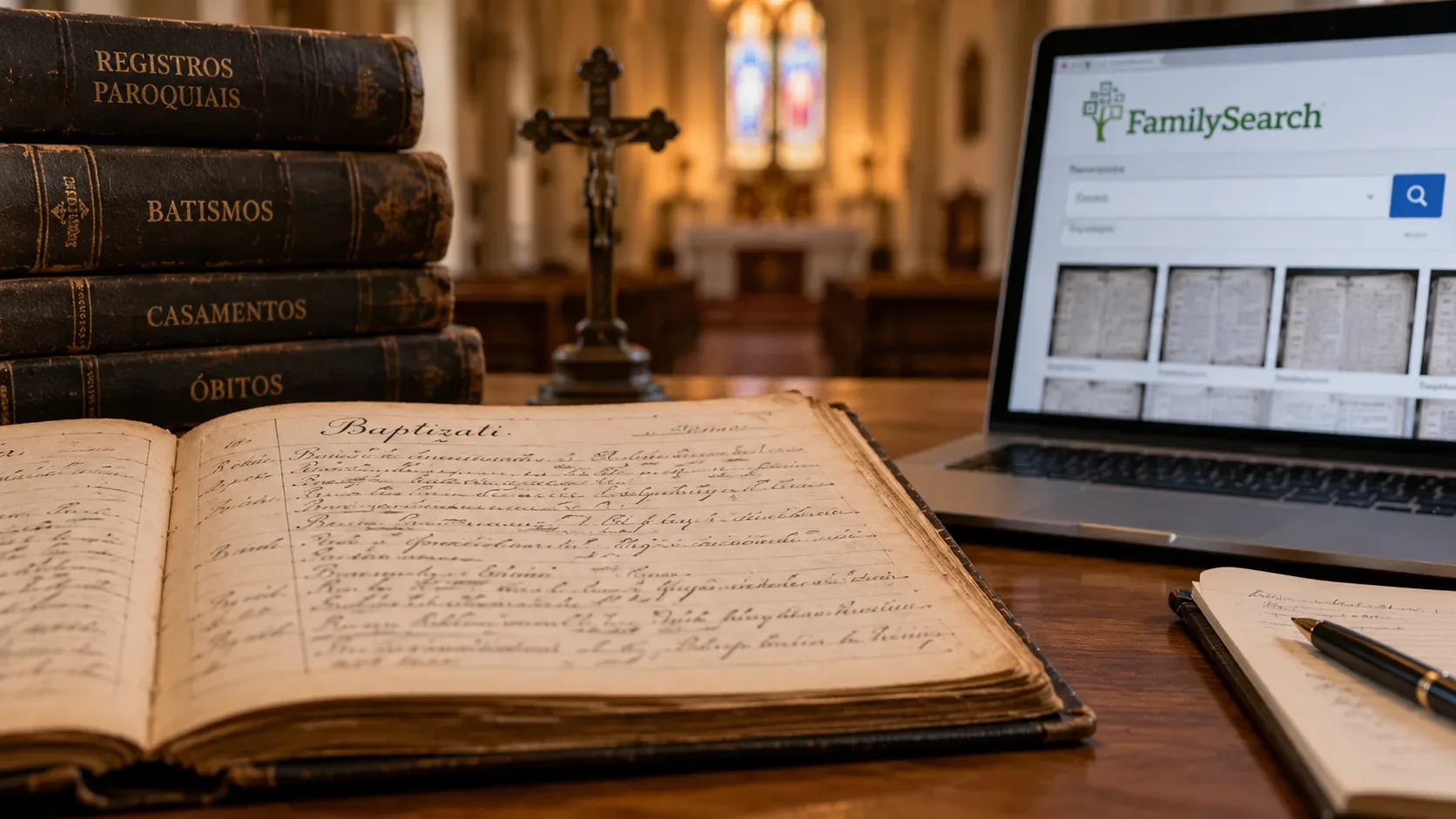
For people born before civil registration became consolidated — and also in places where coverage was irregular or late — a parish entry can therefore be an essential source. FamilySearch states that Brazilian baptism records can include the date and place of baptism, date of birth, the child’s name, and the parents’ names; many collections also include godparents and other remarks. The exact information varies by parish, period, and register.
One caution matters: date of birth and date of baptism are not the same thing. Many entries include both; others give only the sacrament date. When transcribing, preserve exactly what the document says and do not turn a baptism date into a birth date by assumption.
Start with place and period, not with the name
Online indexes encourage name searching, but parish registers were organized by jurisdiction and chronology. Before searching, build a minimal research profile with the probable locality and a time window. If the exact year is uncertain, start with a two- to five-year range and widen it later.
| What you know | How to use it |
|---|---|
| Town, district, estate, or village | Determine which parish served the place at the time and which neighboring parishes existed. |
| Approximate year of birth | Select the relevant baptism volumes and image range. |
| Parents’ names | Confirm identity and work around variations in the child’s name. |
| Known siblings | Identify the parish used by the family and narrow the search period. |
| Later marriage or death record | Recover birthplace, age, parentage, or another clue that points back to baptism. |
Check historical place names as well. A village may once have belonged to another municipality; a chapel may have depended on a mother parish; civil and ecclesiastical boundaries changed. The useful question is: who recorded baptisms for that place in that year?
Parish first; diocese or archdiocese when necessary
After identifying the locality and period, look for the parish that served the area. If it still exists, ask whether it holds the older registers and provide as much context as possible: name, parentage, approximate year, locality, and, if known, siblings or godparents.
If the parish no longer has the volume, ask whether the books were transferred to the chancery, diocesan archive, or archdiocesan archive. This is a real possibility: several FamilySearch collections identify parishes, dioceses, or archdioceses as the original custodians. Do not assume, however, that every diocese follows the same archival system; practice varies by place and period.
When contacting an ecclesiastical archive, request a targeted verification rather than an open-ended genealogy search. “Baptism of Maria, daughter of João and Ana, probably between 1878 and 1882, in the X area” is far more searchable than a name alone.
Use FamilySearch in three layers: Records, Catalog, and Images
FamilySearch offers different search paths, and they are not equivalent.
1. Records: useful, but dependent on indexing
The Records search finds names that have been indexed. It is fast and should be tried, but it does not end the investigation. The Brazil, Baptisms, 1688–1935 collection, for example, is described by FamilySearch itself as a partial index and does not include images of the original records. Not appearing there therefore does not demonstrate that the parish book or entry does not exist.
2. Catalog: discover what exists for the place
The FamilySearch Catalog acts as a guide to record groups. It can be searched by place and includes church registers, books, microfilms, and digital images. Catalog entries indicate whether a group is online, indexed, image-only, on microfilm, or subject to viewing restrictions.
For baptisms, a place search is often more important than a surname search. Look for the town or historical jurisdiction and open categories related to church or vital records. Read the catalog notes as well: they may identify parishes, date ranges, film or DGS numbers, and access limitations.
3. Images: where research continues when there is no index
FamilySearch explains that collections marked for image browsing may be available even without an index. In those cases, books are grouped by browse points such as locality, parish, record type, and period.
This changes the reasoning. Instead of asking “does the name appear?”, you ask “is the correct book digitized, and can I reach the likely page?”. That is the difference between searching an index and researching a source.
Why a negative name search does not prove the baptism is absent
There are many reasons a real record may not appear in a name search:
- the book may not have been indexed;
- the index may cover only part of the parishes or years;
- the name may have been mistranscribed;
- spelling may vary, including surnames, compound given names, and abbreviations;
- the child may appear with only one given name or without the surname used in adulthood;
- the searched date may be offset from the actual birth or baptism;
- the family may have used a neighboring parish;
- images may be restricted or not yet available online;
- the book may survive only locally or, in some cases, may have been lost.
FamilySearch itself recommends examining the original record images when available because they can contain information and clues not present in indexed data. That principle is especially important for parish records.
How to browse an unindexed register without reading from page one
Open the correct image group and first determine its internal logic. Inspect the first and last pages, look for a title page, internal index, or separators between books. Many volumes are chronological; others contain multiple items digitized in sequence.
- confirm the parish, record type, and date span;
- check for a handwritten index at the beginning or end of the volume;
- if the book is chronological, estimate where the target year should fall;
- jump through the images in blocks until you approach the period;
- then move page by page;
- look for known siblings as well, because they help confirm the family group;
- record the image number, page or folio, entry number, and DGS/film when shown.
This approach is more reliable than repeating dozens of name variants in a database that may never have indexed that volume.
Spelling, parentage, and godparents are search tools
Spelling is not stable in old records. Test phonetic variants and abbreviated forms, but do not rely only on the target person’s name. Parents and godparents work as additional identifiers.
If “Francisca de Souza” does not appear, for example, search combinations involving the father, mother, or siblings. An index may have read “Sousa” as “Souza,” omitted a second given name, or assigned the entry to the wrong locality. In the image, the combination of parentage, place, date, and godparents may show that it is the correct person even when the indexed text is imperfect.
Once you find the image, transcribe before interpreting
Do not save only a screenshot or the indexed name. Make a faithful transcription and separate literal reading from modern interpretation.
A useful reference should include, whenever possible:
- parish and diocese/archdiocese name;
- record type: baptisms;
- date span or volume identifier;
- entry date and, if stated, birth date;
- folio, page, or entry number;
- image number and DGS/film;
- URL or repository identifier;
- names as they appear in the original, including godparents and relevant marginal notes.
Marginal notes deserve attention. Some later registers received annotations about marriage, name changes, or other events. They are not present in every record, but they can connect different stages of the same person’s life.
If the baptism still does not appear, widen the search in a controlled way
Do not widen everything at once. Change one variable at a time:
- expand the date window;
- test neighboring parishes or the mother parish of the region;
- search for siblings, then return to the target person;
- use marriage and death records to confirm birthplace and parentage;
- check whether confirmation, marriage, or burial books refer back to the baptism;
- search spelling variants of the parents, not only the child;
- consult the Catalog even when Records search shows nothing.
Keep open the possibility that the civil record exists in another office, under a different spelling, or as a delayed registration. Parish research complements civil research; it should not be used, without further evidence, to conclude that a birth was never registered by the state.
Practical workflow: from place and period to transcription
- Place + period: establish where the family was and a range of years.
- Parish/diocese: identify the ecclesiastical institution that served the place at that time.
- FamilySearch Records: try the name search with variants and parents’ names.
- Catalog: search the locality and identify books, films, DGS numbers, and date ranges.
- Images: open unindexed or partially indexed collections and browse the correct book.
- Original: confirm parentage, dates, place, godparents, and any marginal notes.
- Transcription: copy the relevant text faithfully and record the complete source reference.
- Correlation: compare the baptism with marriage, death, siblings’ records, and any civil record.
The core idea is simple: an index is an entry point, not a perfect inventory of everything that survives. Once the search moves from a name to the combination of place, period, parish, catalog, and original image, many “missing records” turn out not to be missing at all — only not yet located.