When you know an ancestor's name but do not know the exact date of death or the registry office, requesting a certificate immediately is often premature. The first goal is to locate the death record entry: determine the place, the period, and which registry office or archive may hold it. Only then does it make sense to request the certificate.
Death records have a difficulty of their own in genealogical research. A person may have been born in one city, spent most of life in another, and died in a third place, sometimes during medical treatment, travel, or a move to be closer to children. For that reason, the search works better when it starts from the latest clues about the person's life and builds a corridor of possible locations instead of looking only at the place of birth.
Before the certificate, locate the record
There is an important difference between locating a record and requesting a new copy of the certificate. The official Meu Registro platform offers, for Civil Registration, both certificate ordering and certificate-location services. The Registro Civil portal itself also distinguishes a search, intended for people who do not know where the record was made, from a request for a second copy.
This distinction helps avoid spending time and money on requests sent to the wrong registry office. In genealogical research, the most efficient path is to gather enough information to identify the record and its custodian. Once the registry office, book, page, entry number, or registration number appears, the documentary stage becomes much more objective.
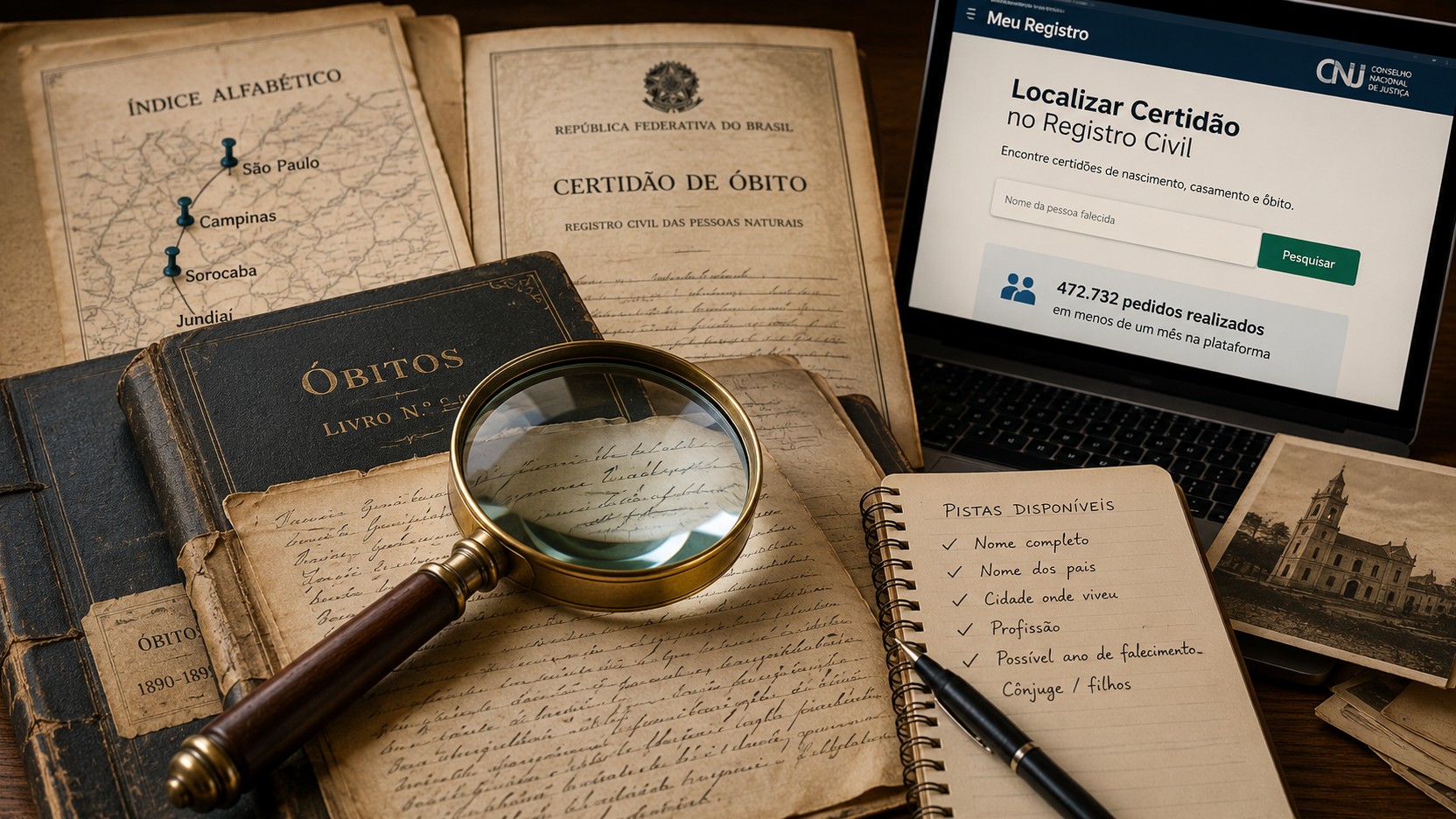
The Meu Registro platform was launched on June 22, 2026, as the new interface for the Sistema Eletrônico dos Registros Públicos. On July 10, the Conselho Nacional de Justiça reported 472,732 document requests on the platform, of which 288,540 had already been fulfilled. This volume shows the scale of the digital registry service, but it should not be interpreted as the number of genealogical searches or death certificates.
Start with the clues that actually narrow the search
Record the name and every known variation
Write down the full name as it appears in the most reliable sources, along with plausible variations. Surnames can change order, particles such as de, da, and dos may appear or disappear, and indexing of old manuscripts may contain different spellings. If a name search does not work, that does not mean the record does not exist.
The names of the spouse, parents, and children are often as useful as the deceased person's name. In cases involving people with the same name, these relatives are the elements that help distinguish one person from another.
Create a time window, even if it is broad
You do not need to know the day of death to begin. Look for a dated source in which the person was still alive and a later one in which the person is already described as deceased. Children's marriage records, probate files, grandchildren's baptism records, newspapers, resident lists, immigration documents, and family notes can help establish limits.
If the last reliable evidence is from 1938 and the first unequivocal mention of the death is from 1946, you have already turned a search with no date into an eight-year window. That reduction completely changes how you search books and indexes.
Map the latest known locations
The city where the person was born is a clue, but it should rarely be the only one. Give more weight to the last known place of residence, the place where the spouse and children lived, nearby cities with hospitals, charitable hospitals, or cemeteries used by the family, and districts that at the time belonged to a different administrative jurisdiction.
Today, Brazil's Lei de Registros Públicos allows a certificate to be issued by the registrar of the place of death or the deceased person's place of residence when death occurs outside the domicile. In historical periods, the rules and territorial organization were different. The practical point remains: do not assume the death was registered in the city where the person was born or lived the longest.
Search in geographic circles
First circle: last known residence
Start with the city or district where the ancestor appears in the most recent documents. Check whether there was more than one Civil Registration office and whether the territory was divided, renamed, or incorporated into another municipality. A modern place name may not correspond to the jurisdiction that existed during the period being researched.
If you find digitized books, look first for the alphabetical indexes inside the volume itself. Many old books have an index at the beginning or end, and the image of that index may be more useful than a global name search.
Second circle: where close relatives lived
When the first circle fails, follow the children, spouse, and other relatives with whom the person probably remained in contact. Older people often moved into the homes of children or relatives. This possibility is especially relevant when the last known residence was rural and the next generation already appears in a larger city.
Third circle: cities of medical care and burial
A clue involving a hospital, charitable hospital, nursing home, cemetery, or funeral can shift the search to another municipality. A modern death record includes, among other elements, the place of death and the place of burial; older records vary in completeness, but those two points can help reconstruct the person's final path.
Use Meu Registro when the registry office is unknown
Meu Registro provides the service "Localizar Certidão no Registro Civil" (Locate Certificate in the Civil Registry) for birth, marriage, and death certificates. It is suitable when the researcher already has information about the registered person but does not know with confidence where the record is held. The interface may request additional filters depending on the service and type of search, so it is worth arriving at the platform with as much organized information as possible.
The Código Nacional de Normas do foro extrajudicial provides that any interested person may search the indexes of the Registros Civis das Pessoas Naturais, subject to the fees established by state legislation. For a death certificate, the same rule states that no application or judicial authorization is required for issuance in any of its modalities.
In practice, use electronic search as one layer of the investigation, not the only one. Very old archives may be incompletely indexed, may have been transferred, may contain different spellings, or may require consultation by book and locality.
When a name search fails, switch to a locality search
FamilySearch and other historical archives become more useful when you stop asking "where is So-and-so?" and start asking "which death books exist for this locality and this period?"
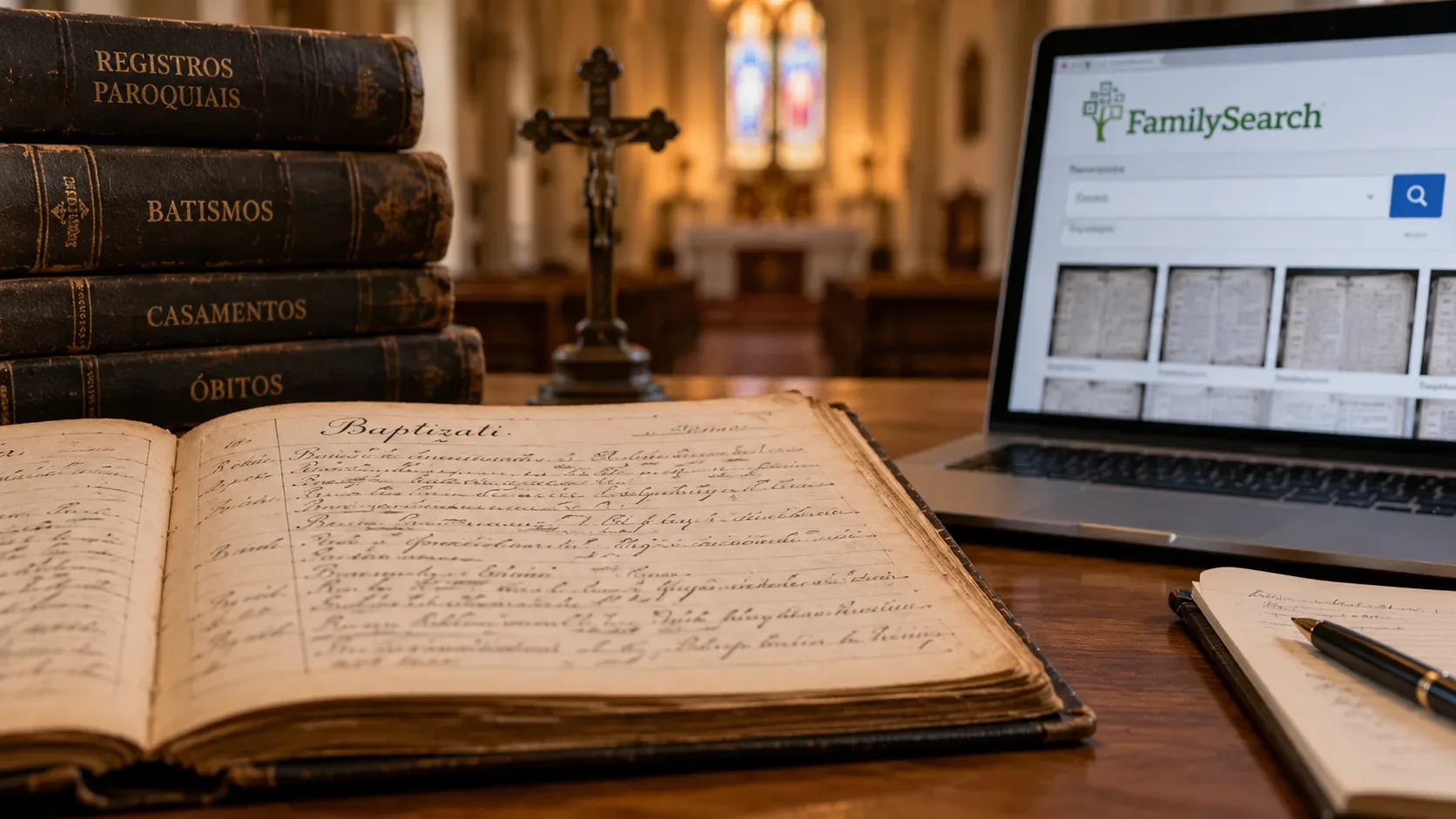
FamilySearch maintains Brazilian civil registration collections, and coverage varies by state, municipality, and period. Some collections are indexed and allow name searches. Others consist only of digitized images. In those cases, you need to browse the books as if you were looking at the physical volume.
Search the collection for the place before insisting on the name
In FamilySearch, locality searches show collections, catalogs, and image sets related to that place. The platform's own help recommends exploring every possible jurisdiction, such as country, state, and subordinate localities, because a record may be classified at a different level than expected.
This matters when the present-day municipality did not exist in the year of death or when a district was transferred between municipalities. Searching only under the modern name can hide the correct collection.
In unindexed books, look for the internal index
FamilySearch guidance for unindexed collections is to examine the first and last images for an index, see whether the book is arranged alphabetically or chronologically, and use thumbnail view to locate changes of volume or period.
When you find a surname in the index, write down the page, entry, or sequence number. Then go directly to the record entry. This method is usually much faster than going through the images one by one.
Record the complete reference before leaving the image
When you locate a digital record, note the locality, the name of the registry office or producing institution, the type of book, the period, the book or film number, the page or folio, the entry number, and the image group number when available. These details allow you to repeat the discovery and help the current registry office locate the act.
FamilySearch also recommends consulting the original image whenever possible because it may contain information that does not appear in the indexed data.
If the registry office disappeared, look for the successor archive
An old registry office may have been abolished, deactivated, renamed, or had its archive divided. That does not mean the records disappeared. In July 2026, CNJ Provimento 237 established criteria for certificates from records belonging to incorporated archives and expressly addresses abolition, deactivation, and division among successor registry offices.
If an old source gives the name of a registry office that no longer exists, first search the state Tribunal de Justiça and Corregedoria-Geral da Justiça. Look for acts reorganizing registry offices and information about archive transfers. When necessary, ask the current registry office or the Corregedoria which unit received the books from the former office.
This step is decisive in searches that seem to end in a dead end. The historical name of the registry office identifies the origin of the record; the successor office identifies who may hold the book today and issue the certificate.
For deaths before 1889, change strategy
Decreto 10.044, dated September 22, 1888, determined that the Regulation of Civil Registration of births, marriages, and deaths would take effect throughout the Empire on January 1, 1889. For that reason, in a search before this national reference point, it is not safe to assume there will be a civil register book similar to those used later.
For earlier periods, parish death and burial books, cemetery records, brotherhoods, charitable hospitals, and other religious or local sources may be more productive. FamilySearch has Brazilian collections that reach periods before 1889, including death collections, church records, and cemetery records, but availability and access vary greatly by place.
If the person died near the transition between 1888 and 1889, search both worlds. A religious record may provide the date and locality needed to find the civil entry, and a civil register book may point to details that are useful when returning to parish sources.
How to know whether you found the right person
The name alone is not enough when there are people with the same name. Compare approximate age, place of birth, marital status, occupation, residence, parents' names, spouse's name, children, and place of burial. The Lei de Registros Públicos provides for several of these elements in a modern death record, although older records may contain less information or use different forms.
Consider the consistency of the whole set. An age that differs by two or three years can be compatible with an old record; completely different parents, an incompatible spouse, and a residence with no connection to the family are much stronger signs that it is a different person.
When there is doubt between two candidates, look for a second document that connects the death to the family: a child's marriage record, probate file, newspaper notice, cemetery record, marginal annotation, or another contemporary source.
When to request the certificate
Request the certificate when you have a sufficiently strong combination of name, locality, and period, preferably accompanied by a reference to the record. If you already know the book, folio, entry, or registration number, provide those details in the request.
For genealogical research, it may be useful to ask the registry office which certificate format best reproduces the content of the old record. An inteiro teor (full-content) certificate can be relevant when details of the record are essential, but procedures, costs, and the form of request should be confirmed with the registry office or on the official platform.
Avoid repeatedly paying for exploratory requests in several localities if you have not yet built a geographic hypothesis. Narrow the search first; issuance comes afterward.
An example of the reasoning
Imagine that you are looking for Joaquim Pereira, born in the interior, and you only know he was alive in 1941. In a 1950 document, a son is already described as the son of the late Joaquim Pereira. The family remembers that this son lived in the state capital.
The first search window is 1941 to 1950. The first circle is Joaquim's last known city. The second is the capital where the son lived. In each place, you check the official Civil Registration system and historical collections by locality. If the name does not appear in the digital index, you browse the books for the period. If the registry office cited in an old book no longer exists, you identify the successor office.
When you find an entry with a compatible age, the correct spouse, and recognizable relatives' names, you record the book, folio, and entry and only then request the certificate. The problem that began as "I do not know the date or the registry office" ends with a verifiable reference.
What to do when nothing appears
A negative search on a website does not prove that no record exists. Before concluding that the death was not registered, check alternative spellings, widen the time window, test neighboring localities, look for unindexed collections, confirm the municipality's administrative history, and investigate whether the archive was incorporated into another registry office.
If there is still no result, the question changes. Instead of "where is the certificate?", investigate "which contemporary source can indicate where and when the death occurred?" A clue in a probate file, newspaper, cemetery, church, or a child's document may be enough to reopen the registry search.
The most efficient method is to accumulate small certainties. Name, relatives, time window, last address, burial place, and book reference may look like weak clues in isolation. Together, they turn a nationwide and nearly impossible search into a small set of records that can be checked.