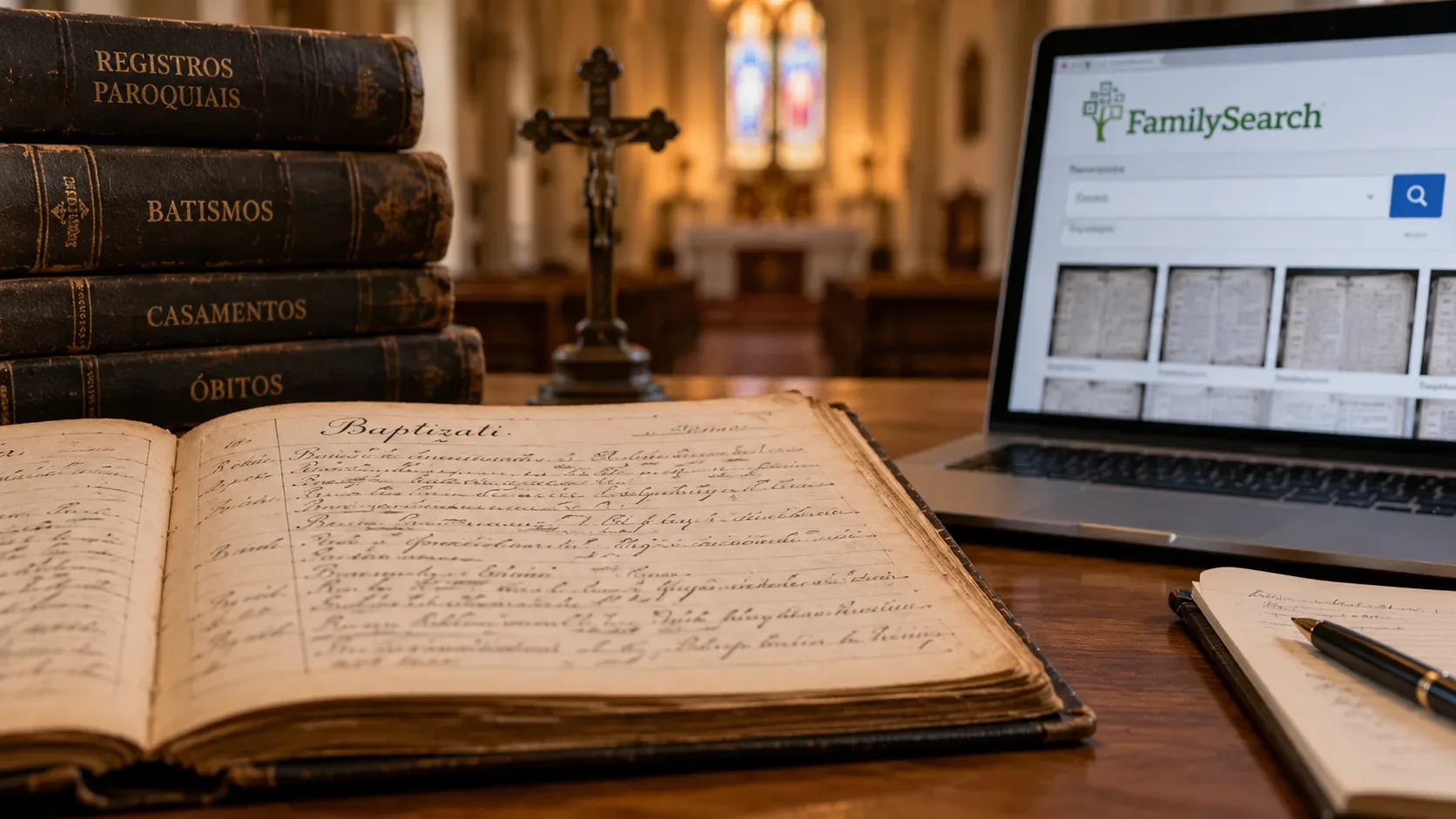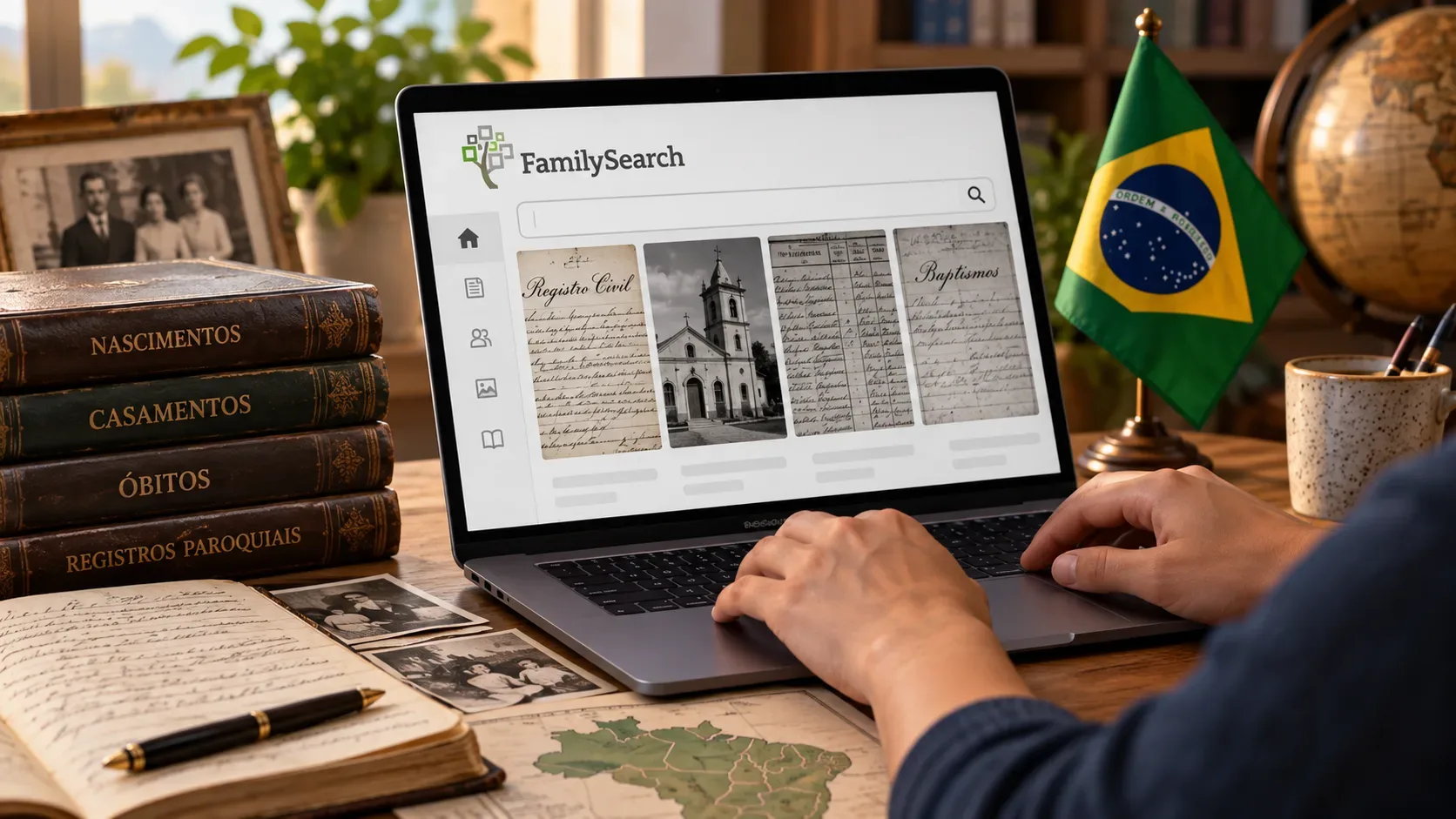
An old baptism record can provide more clues than the name of the baptized person. To use the document effectively for genealogy, separate what comes from an index from what appears in the original entry, record the place precisely, and treat different spellings of a name as variants to test rather than automatically as different people. Godparents deserve special attention because they may appear in the original text even when they are absent from the searchable index.
The first step is to distinguish an index from the original image
The Brazil, Baptisms, 1688-1935 collection used in this article is an index of selected Catholic baptisms from various localities in Brazil. FamilySearch itself states that the collection does not include images of the original records. This means a search result is a transcription or structured data derived from a source, not a complete reproduction of the parish register page.
This distinction changes how the result should be interpreted. An index is excellent for locating names, dates, parents, and places, but it may omit information that was in the book and can reproduce reading errors or simplified spellings. FamilySearch recommends consulting the image of the original record when it is available in a related collection or catalog because the image can contain additional information that is not present in the indexed data.
Extraction model for an old baptism record
When you find a promising result, first copy what is visible in the index and clearly mark the source of each piece of information. Then, if you locate the image of the entry, make a second extraction from the manuscript. A simple model prevents transcription, interpretation, and inference from being mixed together.
| Field | What to record | How to interpret it |
|---|---|---|
| Name of the baptized person | Index spelling and, separately, the spelling in the original | Differences may result from handwriting, historical spelling, or indexing |
| Date of baptism | Day, month, and year exactly as shown | Do not confuse it with the date of birth |
| Date of birth | Record it only if the source states it | Some entries give both birth and baptism; others give only baptism |
| Place | Parish, district, municipality, chapel, or other available indication | The place of baptism should not automatically be treated as the place of birth |
| Parents | Full names, descriptions, and residence if stated | Use the parents' names to confirm identity and search for siblings |
| Godparents | Names, marital status, spouse, residence, or relationship only when written | They may indicate a social or family network, but kinship should not be assumed |
| Source reference | Collection, film, DGS, book, folio, page, or image number when available | These details help you relocate the entry and distinguish records of namesakes |
| Notes | Abbreviations, corrections, alternate names, and uncertain readings | Keep uncertainty visible instead of filling in a word without evidence |
Where to look for godparents
In the national index collection used as the starting point, common fields include the child's name, sex, date and place of baptism, date of birth, and parents' names. Because this collection does not provide the original image, the absence of godparents from a search result does not prove that they were absent from the entry.
In Brazilian Catholic Church collections that include images, FamilySearch states that baptism records may contain godparents' names, along with the date and place of baptism, birth information, legitimacy, and parents' names. Therefore, when a genealogical question depends on godparents, look for the image or a corresponding parish or regional collection before concluding that the information does not exist.
When reading the manuscript, look for formulas equivalent to “godparents were,” “godparents,” or wording used by the priest. Transcribe the names as they appear. If the text also states a spouse, title, status, residence, or relationship, record those elements in separate fields. Do not turn a shared surname, geographic proximity, or a recurring godparent into proof of kinship. Those signs are clues for further document searches.
How to interpret place without mixing events
Baptism records can mention more than one place. There may be the place where the sacrament was celebrated, the place of birth, the parents' residence, a chapel attached to a parish, or an older territorial designation. The index collection allows searches by place and life events, but the researcher needs to preserve the specific meaning of each field.
If a result shows only one place associated with the baptism, record it as the place of baptism. Record a place of birth only when the source identifies it as such. In the original, also note the book heading, parish name, district, and annotations that locate the page. This is especially important where civil and ecclesiastical boundaries changed over time.
Name variants: how to search without losing the person
Historical spellings, abbreviations, omitted compound names, and indexing errors can change how a name appears. FamilySearch advises trying spelling variants and nicknames, adding or removing middle names, and starting with fewer fields before narrowing a search. When spelling is uncertain, the search also accepts wildcards: an asterisk to replace one or more letters and a question mark to replace exactly one letter.
In practice, preserve three layers: the spelling found in the index, the spelling you read in the original image, and variants used only for searching. Do not silently “correct” the historical document. If the index says “Manoel” and the image appears to say “Manuel,” keep both forms with their source. Then test searches using the parents' names, only one surname, and broader date and place ranges.
Searching relatives is particularly useful when the name is common. The tool itself allows you to add a father, mother, or other person to the criteria. A coherent combination of parents, date, place, and siblings is usually stronger evidence of identity than name similarity alone.
How to try to reach the original entry
Because Brazil, Baptisms, 1688-1935 is an index without original images, open the record details and note all available source information. FamilySearch explains that the document information area can include microfilm, digital folder, image, page, reference, and other details useful for locating the source.
When a film number or Digital Genealogical Society image group number is available, use the FamilySearch Catalog or Historical Images search to look for the corresponding set. In some collections, a camera icon allows image browsing; in others, viewing restrictions apply or no digital image is accessible. FamilySearch's official instructions also recommend using date, place, item, page, and image number to navigate when a direct link is not available.
Another possibility is to look for a regional or diocesan collection with images. FamilySearch maintains Catholic collections for Brazilian states and dioceses in which digitized content can be browsed. The existence of a regional collection does not guarantee that the desired parish, period, or book is included, so coverage must be checked case by case.
How to validate that the record belongs to the right person
Do not confirm identity only because the name and year appear to match. Compare the set of clues: parents' names, place, date, siblings baptized in the same parish, recurring godparents, and book references. If the image and index differ, treat the image as evidence of what is actually written and keep the indexed form as a search clue.
Errors can also exist in the historical document itself. A practical approach is to transcribe what the source says and record any interpretation or form considered correct separately. This preserves the evidence trail and avoids erasing the very variants that may be useful in future searches.
Reading checklist
- Identify whether you are viewing an index, a transcription, or an image of the document.
- Copy the name, parents, dates, and place without merging different fields.
- Look for godparents in the original when the index does not show them.
- Record the spelling exactly as it appears and keep variants in a separate field.
- Use parents, siblings, place, and date ranges to test identity.
- Note film, DGS, book, folio, page, or image number whenever available.
- Mark uncertain readings and do not fill gaps without evidence.
The genealogical value comes less from one isolated name and more from the combination of context, relatives, godparents, location, and documentary reference. For the indicated collection, the index works as an entry point. When the question depends on details such as godparents or handwritten spelling, the next step is to locate, when possible, the image or source book.
Sources and references
- FamilySearch: Brazil, Baptisms, 1688-1935
- FamilySearch: View the record or image for more information
- FamilySearch: Search Instructions for Historical Records
- FamilySearch: Search Tips for Historical Records
- FamilySearch: document information in Historical Records
- FamilySearch: Brazil, Rio de Janeiro, Catholic Church Records, 1616-2017