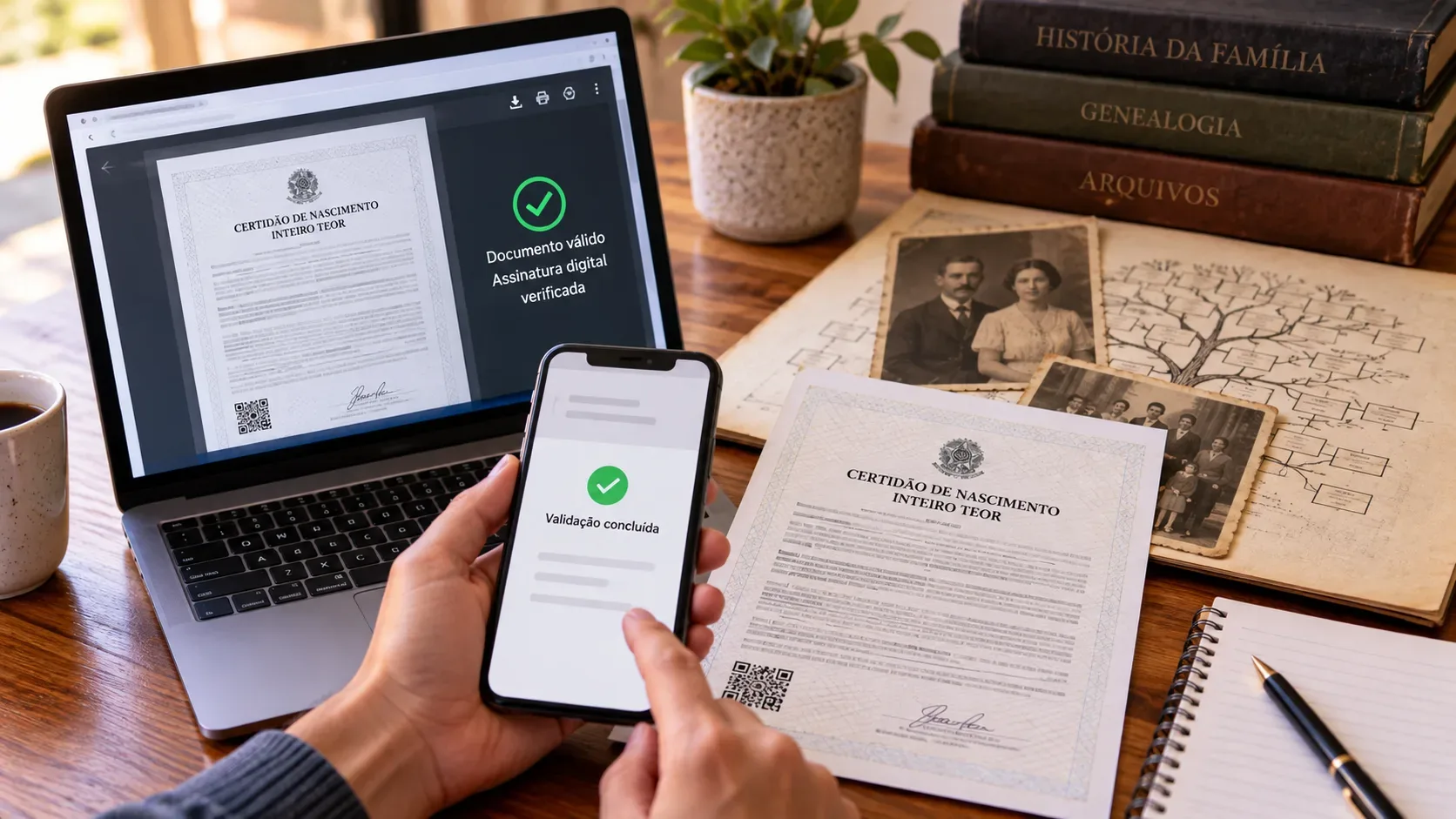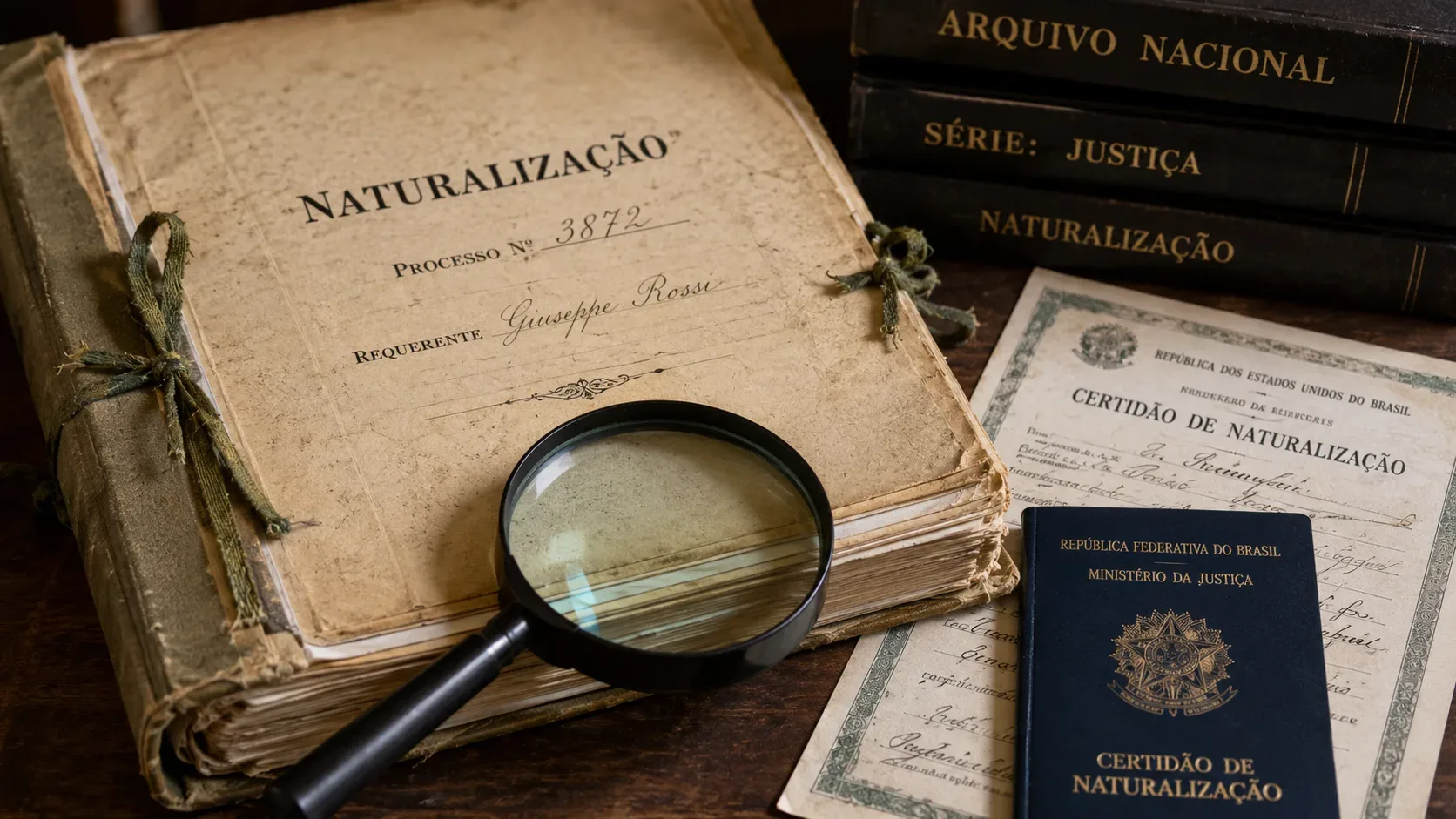
If your goal is to reconstruct the life of an immigrant ancestor, start by looking for the historical naturalization file, not the certificate. The file is the set of documents created around the application for Brazilian citizenship and may include petitions, attachments, opinions and administrative decisions. A positive or negative naturalization certificate, by contrast, is a document issued by Brazil’s Ministry of Justice and Public Security stating whether a naturalization record was found. They are different records, serve different purposes and are obtained through different channels.
Historical file or certificate: what is the difference?
| What you are looking for | What it is | Where to request it |
|---|---|---|
| Historical naturalization file | A documentary dossier created during the naturalization application, with records that may reveal biographical and administrative information about the immigrant. | Brazilian National Archives, for records in its custody and research guidance. |
| Positive or negative certificate | A document stating whether the Ministry of Justice found a naturalization record for the person searched. | Ministry of Justice and Public Security, currently through its certificates/DataNaturalização service. |
The Brazilian National Archives explains that a naturalization file is the set of documents submitted by an immigrant to request Brazilian citizenship and that only foreigners who wished to become Brazilian initiated this process. Therefore, failing to find a file should not automatically be treated as legal proof that the person was never naturalized.
What information to gather before requesting a search
To search the nominal naturalization indexes, the National Archives asks for the foreigner’s full name, parentage and, if possible, year of birth and death. The more precise the identification, the lower the risk of confusing namesakes or missing a record because of a spelling variation.
- full name used in Brazil and in the country of origin;
- father’s and mother’s names, when known;
- year or approximate date of birth;
- year of death, if the person is deceased;
- spelling variants, Portuguese adaptations, abbreviations and surnames used in different records;
- place of residence in Brazil and the approximate period when naturalization may have occurred, as supporting details.
These last items do not replace the data requested by the National Archives, but they help organize the research and distinguish people with similar names.
Where to look for the historical file
The National Archives provides access and research services for its holdings both in person and through its Remote Service Module. SIAN, the National Archives Information System, should also be checked to see whether digital material is available and to obtain references for records that have already been described.
For naturalization files, the longstanding official guidance is to submit a focused request with identifying details about the foreign national. If the file is located, you can then request access or reproduction under the archive’s rules. The National Archives states that reproductions may be requested in person or through the Remote Service Module.
Watch the dates: official pages do not use the same chronological cutoff
There is an important discrepancy between pages of the National Archives itself. Its institutional FAQ says the agency holds naturalization documents from the nineteenth century through 1974. The Foreigners’ Entry page, however, says the National Archives holds naturalization files from 1823 to 1959 and directs later files to the competent office of the Ministry of Justice.
Because these two official instructions do not match, it is not prudent to turn 1959 or 1974 into an absolute cutoff on your own. For a case around that period or later, use the date only as a routing clue: ask the National Archives to confirm whether it holds the historical file and, if you need legal proof of naturalization or non-naturalization, use the Ministry of Justice.
When to use the Ministry of Justice certificate
If your question is “did this person become a Brazilian citizen?” and you need a formal answer, the correct route is the naturalization certificate service of the Ministry of Justice and Public Security. The service reports whether the result is positive or negative and can be used to search your own name or that of third parties.
The Ministry’s current page says you can enter up to five name variations. This is especially useful in genealogy because the same immigrant may appear with an adapted surname, abbreviated given name or different spelling. If no match is found, the system issues a negative result for the variants supplied and provides for a request for supplementary analysis.
Why an immigrant registration file may not appear separately
Sometimes a researcher finds the naturalization file but cannot find the immigrant’s registration dossier. The National Archives explains that the foreigner’s identity registration file was often incorporated into the naturalization file. A missing separate registration dossier may therefore mean that it is inside the naturalization case file itself.
What to do when the name does not appear
Before concluding that no file exists, review the person’s identification. In genealogical research, small spelling differences can separate records that belong to the same individual.
- confirm parentage in birth, marriage or death records;
- list name and surname variants found in Brazilian and foreign records;
- compare birth and death dates and place of residence;
- send the National Archives a request with as many reliable identifiers as possible;
- if the purpose is to prove naturalization or non-naturalization, repeat the relevant name variants in the Ministry of Justice certificate service.
A negative archive search is not the same as a negative certificate
This distinction prevents the most common mistake. A statement that no file was located in the archive searched describes the outcome of a documentary search. A negative naturalization certificate, on the other hand, is issued by the competent office of the Ministry of Justice after checking its databases. For legal, citizenship or formal procedural purposes, do not treat an unsuccessful archive search as an automatic substitute for the certificate.
A practical route to the right document
- Define the purpose. If you want to understand the history and inspect the application documents, look for the historical file. If you need to prove whether naturalization occurred, request the certificate.
- Build an ancestor profile. Full name, parentage, birth, death and name variants are the most useful details.
- Check the National Archives. Search SIAN and use the Remote Service Module for a focused research or reproduction request.
- Use the Ministry of Justice when needed. Use the certificate service for the formal positive or negative result and include relevant name variants.
- Read the entire file. If it is found, check attachments, opinions and any immigrant registration documents incorporated into the dossier.
The genealogical value comes from separating two questions: “what records survived from my ancestor’s naturalization application?” and “is there an official record that this person became Brazilian?”. The first is an archival research question; the second requires the certificate issued by the competent authority.