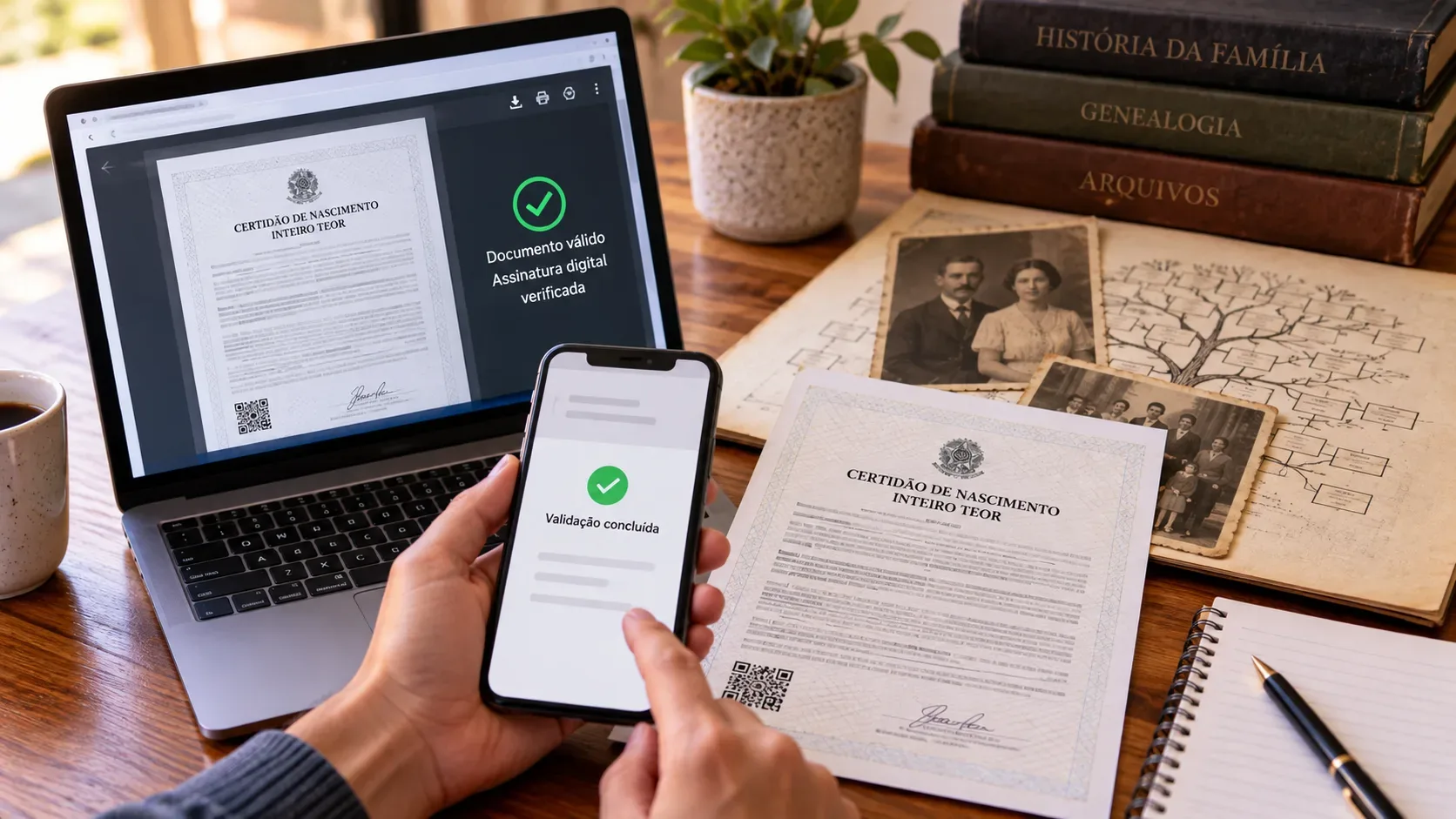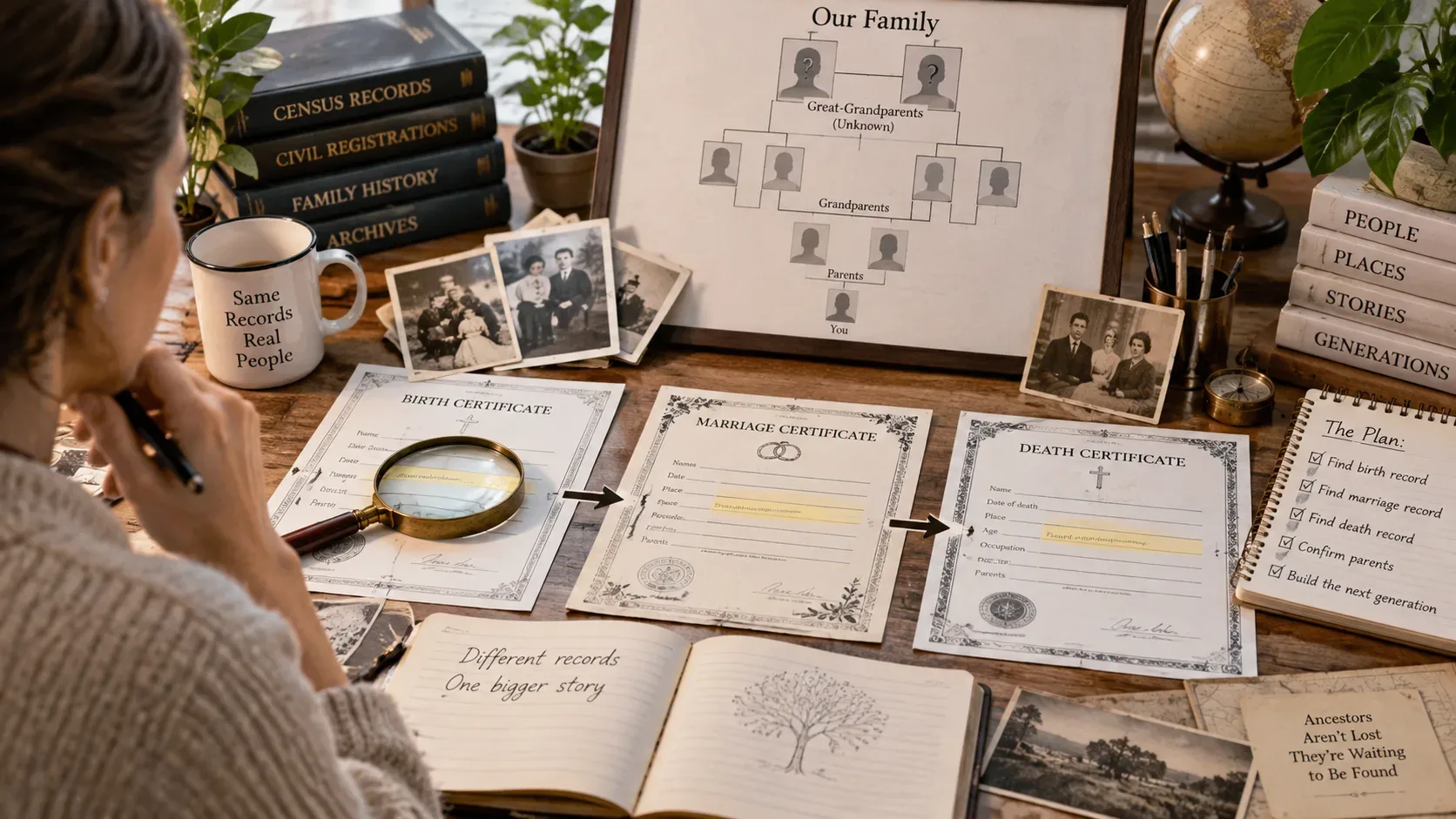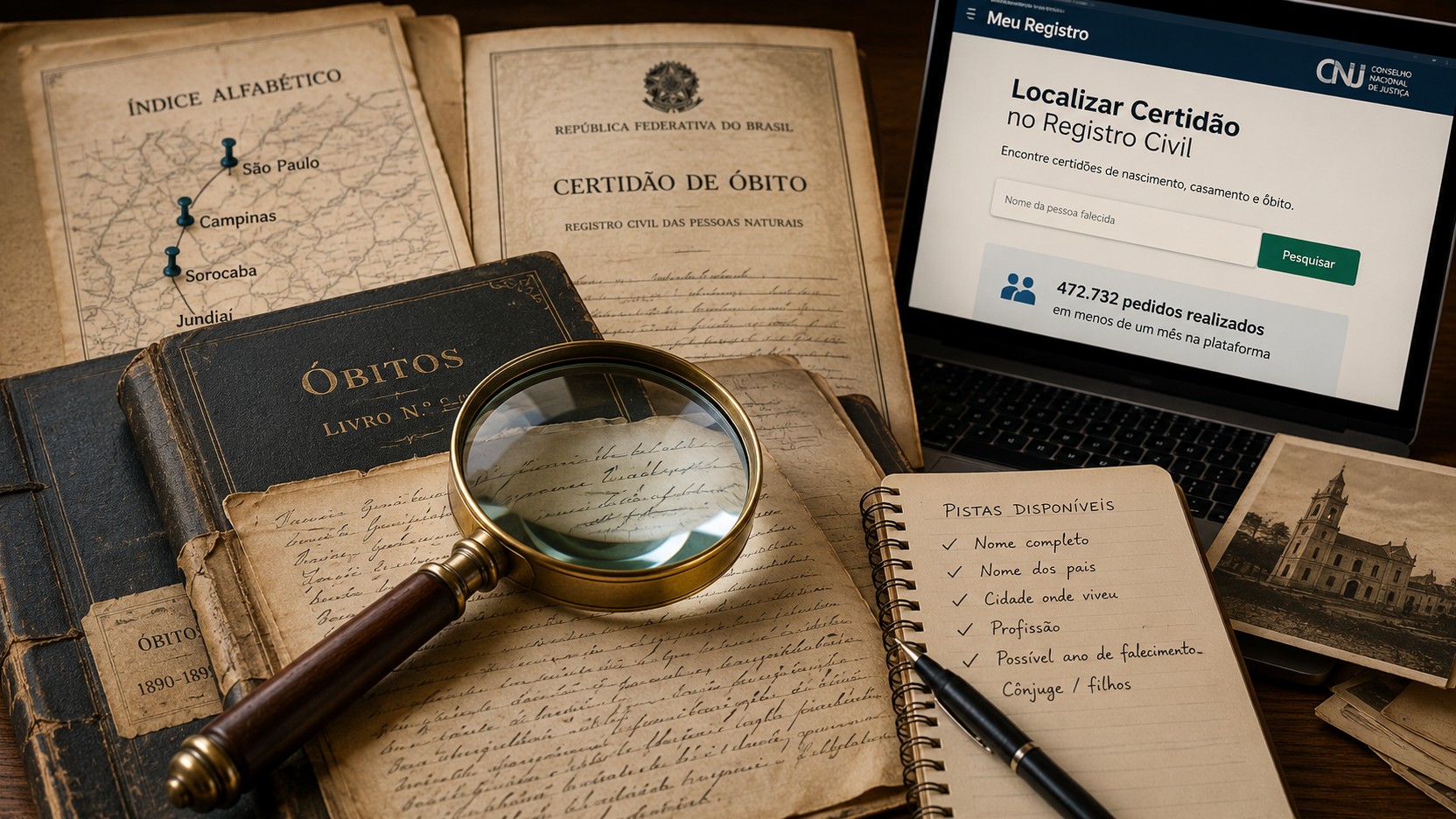
Short answer: for genealogical research in Brazil, a brief certificate (certidão de breve relato) is usually the best first request when the goal is to confirm a basic civil event — birth, marriage, or death — and obtain the standardized data from the record. A full-content certificate (certidão de inteiro teor) becomes worth the extra cost when the research depends on the complete wording of the entry, annotations or amendments, a discrepancy between documents, or a detail that does not appear in the summarized version.
The logic is simple: do not request the longest document “just in case.” First define the genealogical question you need to answer. Brazil’s National Code of Rules issued by the CNJ states that a brief certificate contains only the information required by law and regulations; additional information in the record, annotations, or later amendments must be sought through a certificate answering specific questions or through a full-content certificate. The Public Records Law also provides for certificates in full, in summary, or as a report based on specific questions.
Which one should you request? A decision table by research goal
| Research goal | Most efficient first request | When to move up to full content or a reproduction |
|---|---|---|
| Confirm name, date, and place of birth, marriage, or death | Brief certificate | If there is a discrepancy, missing information, or a need for context not shown in the summary |
| Confirm parentage and locate the record at the registry office | Brief certificate | If parentage is incomplete, there is a relevant later change, or sources conflict |
| Obtain registration number and book, page, and entry references | Brief certificate, as a rule | Request full content only if you need the complete entry, not merely its registry location |
| Investigate different spellings, ages, places, or names that do not match across documents | Full-content certificate or certificate by specific questions | Consider a reproduction of the entry when reading the original may clarify the transcription |
| Review the history of amendments or changes to the record | Full-content certificate | A reproduction can help when the form and placement of annotations matter to the research |
| Citizenship, consular, or administrative proceeding | The format required by the receiving authority | Do not replace a formal requirement with a genealogical preference; confirm before ordering |
| Search only to see “what else might be there” | Start with the brief certificate if basic facts are still missing | Move to full content when you have a concrete question that justifies the extra detail |
What the brief certificate provides — and where it stops
The brief certificate is the standardized certificate used to present the information that legislation and regulations require for that type of civil record. CNJ Provision No. 149/2023, in its rules on data protection in the Civil Registry, establishes broad access to information in the books through brief certificates and states that this format must contain only the information prescribed by law or regulation.
For genealogists, this means the document may be enough to build the backbone of a family tree: identify the person, link parents or a spouse when the applicable model includes those fields, establish dates and places, and, in current certificates, use the registration number to locate the entry. The national regulation updated by CNJ Provision No. 182/2024 standardized new certificate models and keeps the registration number as a mandatory element.
The limit appears when the question depends on something outside the standardized fields. In that situation, ordering another copy of the brief certificate will normally not create new information: you need to change the type of request.
When full content genuinely adds genealogical value
A full-content certificate reproduces the complete content of the civil record, subject to access and data-protection rules. In genealogy, it is especially useful when the wording of the entry itself may resolve a question. Older records, for example, may contain information whose presence and format vary with the period, the type of act, and local registry practice. It would therefore be inaccurate to promise that every full-content certificate will include occupation, residence, age, witnesses, or other details: the gain depends on what was actually entered in the book.
There are four situations in which the upgrade often makes sense:
- Document discrepancy: surnames spelled differently, conflicting dates, or places that change from one source to another.
- Kinship not yet demonstrated: when the summary is not enough to connect two generations and the full wording may contain additional clues.
- Registry history: when later amendments and annotations are part of the question, such as name changes, marital-status changes, or corrections that may appear in the record.
- External requirement: when a consulate, court proceeding, or administrative body expressly requires a full-content certificate or a particular form of reproduction.
Full content or a certificate by specific questions?
If you already know exactly which information is missing, a certificate answering specific questions may be more targeted than requesting the entire record. Law No. 6,015/1973 provides for a certificate “as a report, according to questions,” and the CNJ states that additional information from the record, annotations, or amendments may be supplied through specific questions or full content, subject to the applicable rules.
For genealogy, the question can be precise: “what birthplace was declared for the parents?”, “is there a later annotation of marriage or a name change?” or “what information does the record contain about a particular family link?” The registry office can advise whether the requested information can be supplied through questions and what requirements apply. When the data are restricted, sensitive, or confidential, a request by questions receives treatment similar to a full-content request.
When to ask for a copy or reproduction of the entry
A reproduction becomes useful when it is not enough to know what the registry office certified: you want to inspect the original way in which the entry was written or digitized. The Public Records Law provides that a full-content certificate is extracted by reprographic or electronic means, and the Official Civil Registry Portal describes full content as a complete and faithful reproduction of the original record, including information, amendments, annotations, and history found in the book.
In historical research, an image of the entry can help verify a difficult spelling, an abbreviation, the sequence of annotations, or a detail that may have been transcribed uncertainly. That does not mean a reproduction is always better: old handwriting can be difficult to read, while a textual certificate may be more practical for everyday use. If the uncertainty lies in the reading of the book itself, ask the registry office which form of full content or reproduction is available and appropriate for your goal.
An important point: access is not the same for every type of information
Access to brief certificates is broad, but full-content certificates may face restrictions when sensitive data are involved. Under Provision No. 149/2023, civil-registry certificates, including full-content ones, requested by the data subjects themselves, their legal representatives, or attorneys with special powers may be issued without authorization from the permanent supervising judge. When a third party requests a certificate containing sensitive data, issuance may depend on authorization from the competent court. After the death of the person to whom the sensitive data relate, direct-line relatives may receive such certificates without judicial authorization under the national rule.
This matters in genealogy because a record being old or historically interesting does not automatically remove privacy rules. If the registry office asks for proof of kinship, a power of attorney, or authorization, the requirement may arise from the specific content of the record, not simply from the format you selected.
How to spend less without losing the important clue
- Define the question before ordering. Do you need to confirm an event, prove kinship, resolve a spelling, or read the full registry history?
- Use the brief certificate as the first layer when you only lack basic civil data.
- Keep the registration number and the book, page, and entry references. They make later requests easier and help distinguish people with the same name.
- Compare it with what you already have. Move to full content only when a concrete gap or formal requirement appears.
- If the question is specific, ask about a certificate by questions. It may be more focused than requesting the whole entry.
- If the uncertainty is in the original writing, ask about reproduction. It is particularly useful when paleography or fidelity to the original form matters.
- For citizenship or official use, check the receiving authority’s requirement before paying. The genealogically “most complete” document is not necessarily the administratively correct format.
A practical rule for genealogical research
If your question can be answered by the basic fields of the certificate, request a brief certificate. If the answer depends on the full wording, amendments, an inconsistency between sources, or a detail omitted from the summarized model, request a full-content certificate or consider a certificate by specific questions. And when the problem is the reading or fidelity of the original record, ask what form of reproduction is available.
This sequence keeps full content from becoming an automatic purchase and keeps the research evidence-driven: first the document that is sufficient; then, only if needed, the more detailed document.