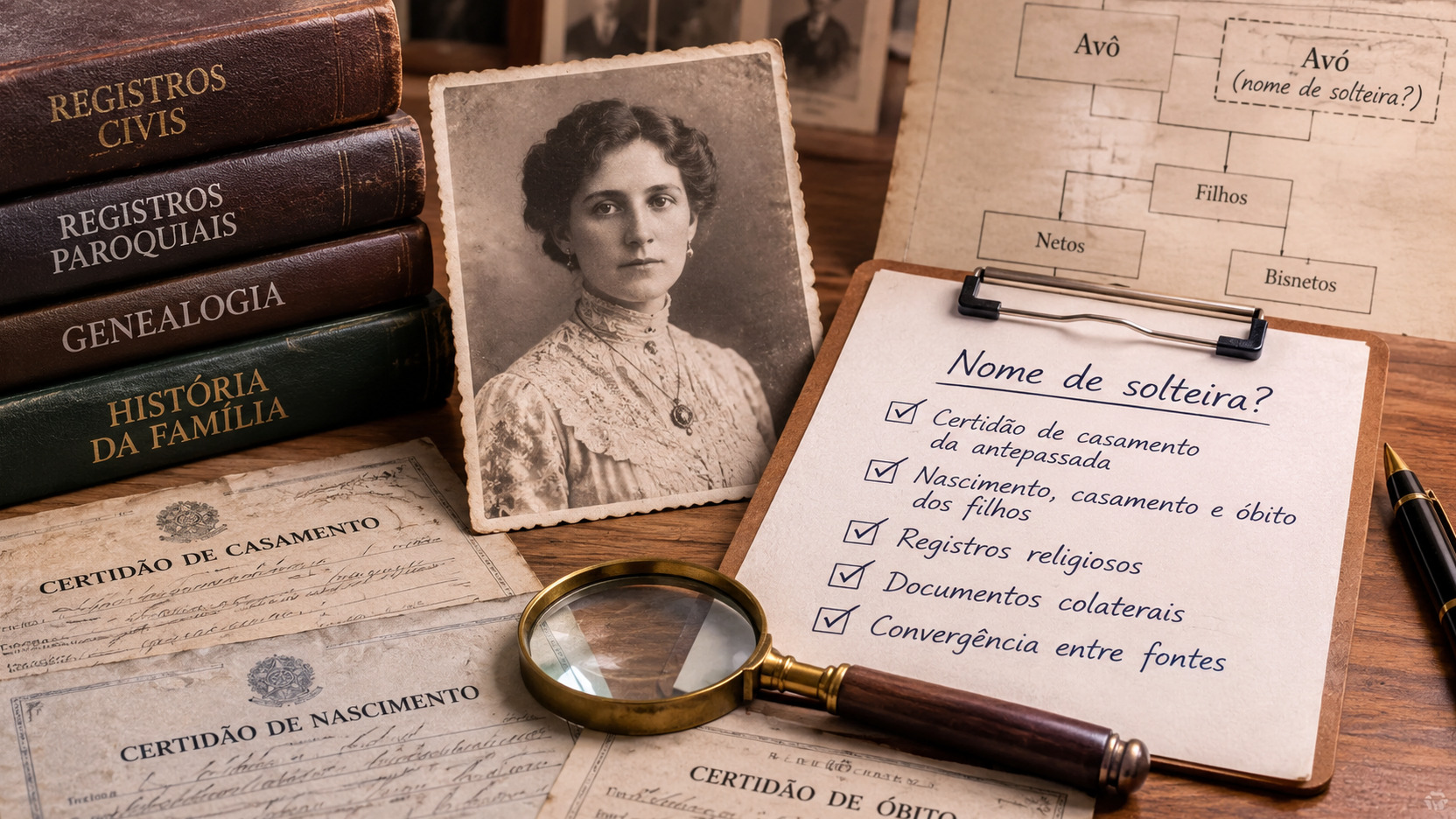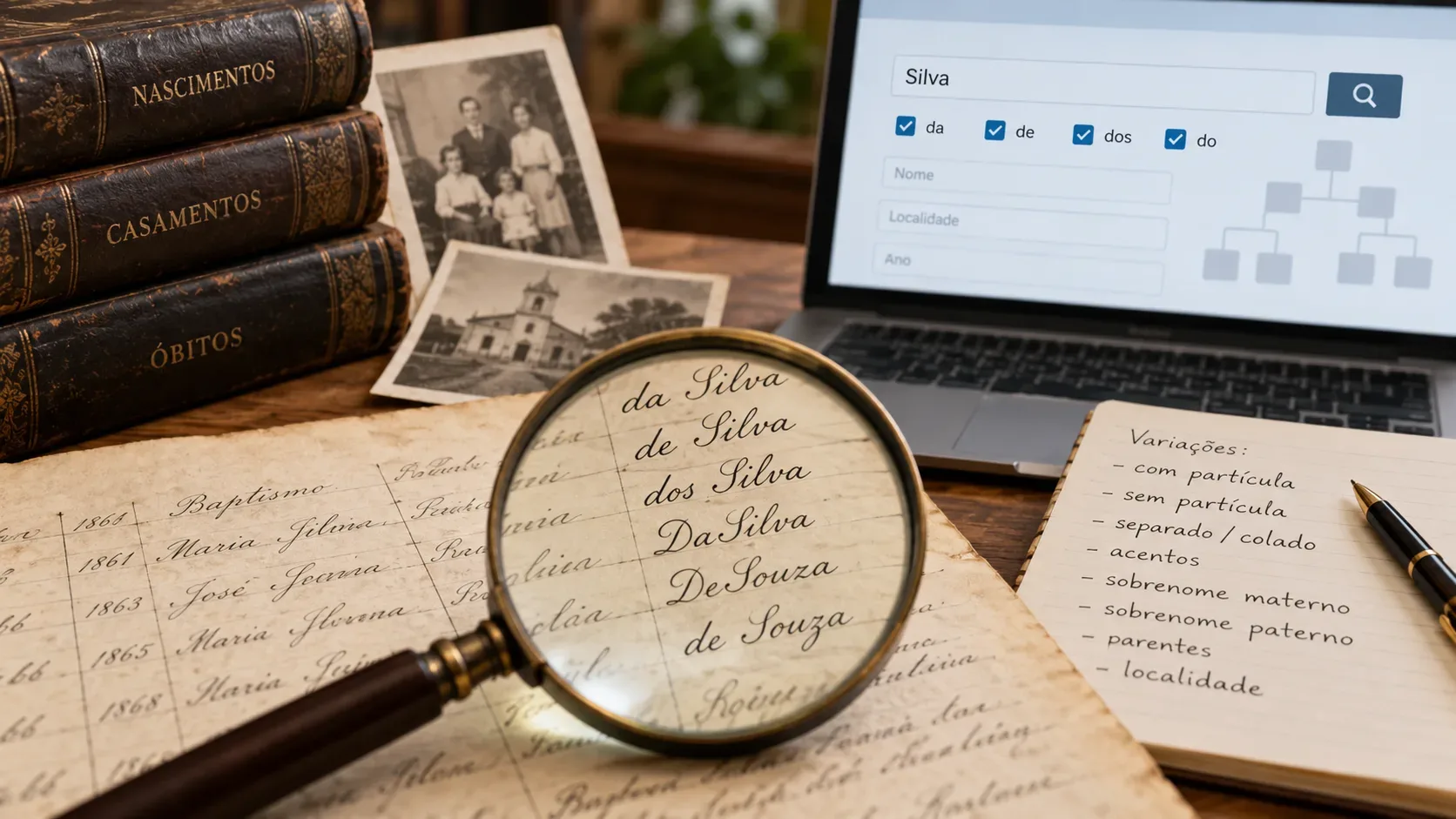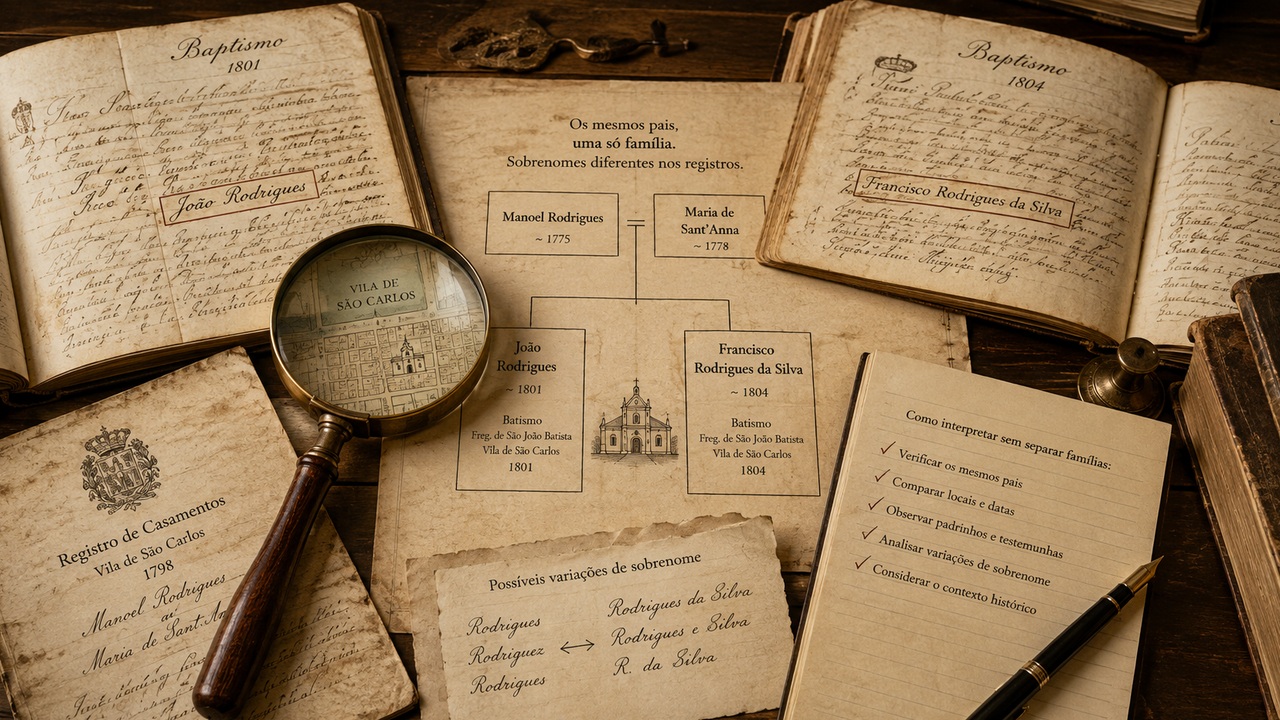
Finding two children of the same couple with different surnames is not, in itself, a sign of an error in the registry nor proof that they are from different families. In much of the Portuguese-Brazilian world of the Modern Period and the colonial period, surnames did not follow the relatively predictable formula that today's reader usually expects. One brother could use his father's surname, another could use his mother's or ancestor's surname, and another could appear in certain documents with just his first name. The most important point for genealogical research is changing the question. Instead of first asking if the surnames match, ask if the documents describe the same kinship network. Parents, spouses, location, chronology, godparents, witnesses, offices and other ties can form a much stronger chain of identification than the similarity between two name endings.
Why brothers could use different surnames
Historian Ana Lunara da Silva Morais, in a study published in 2025 on eight families of the nobility of the land of Pernambuco between the 16th and 18th centuries, summarizes a decisive difference between that universe and the contemporary system: there was no general rule that forced the child to receive a fixed combination of maternal and paternal surnames in the order expected today. Transmission could use names used by parents, grandparents and, in certain contexts, spiritual godparents. Cases of full brothers, that is, children of the same father and mother, without even a surname in common were frequent in the historical studies cited by the author. Here, "nickname" is used in the historical sense and in Portuguese of Portugal, equivalent to what we call a surname in Brazil. This difference in vocabulary matters because many academic texts on Portugal and Portuguese America use "nickname" to designate the family name, not an informal nickname. The logic was also two-sided. Maternal ancestry did not automatically disappear from the names of descendants. Depending on the family, social position, marriage alliances and choices made throughout life, a surname linked to the mother, grandparents or another branch could be selected or combined with others. This does not mean that any name could be chosen at random. It means there were more possible paths of transmission than a modern reading tends to admit.
The surname might not even appear at baptism
Another frequent problem is comparing documents produced at different times in life as if they all recorded the same nominal form. Morais observes that, both in the Kingdom and in Portuguese America, it was customary to find baptisms in which the individual appeared only with their first name. The surname used later may appear in marriage, death, license, inventory, process, deed or other record. Therefore, a child noted only as "Francisco" on a baptism record should not be discarded because decades later a "Francisco de Almeida" appears getting married in the same parish. The connection needs to be demonstrated, but the absence of the surname in the first document is not, in isolation, a contradiction. The reverse also requires care. A person can be registered in different ways over time. In an example discussed by Morais, Diogo Cavalcanti de Albuquerque, son of Maria de Vasconcelos Albuquerque and Miguel Alves Lobo, would have initially been called Diogo Alves Lobo and later started using Cavalcanti de Albuquerque. The author interprets the change as possibly related to the appreciation of a lineage with greater social projection. The case shows why the form found in a single document should not be treated as an immutable nominal identity.
Different spelling, choice of surname and false relationship are different problems
Before assembling the tree, it is useful to separate three situations that appear the same on the search screen, but require different treatments.
Spelling variation
A clerk could write the same name in different ways, especially in times of less standardized spelling, with abbreviations, Latinizations, phonetic forms and variable spellings. In this case, the difference is mainly in the writing of the same name. The solution is to compare the record set and not require letter-by-letter identity.
Different selection of surnames
Here the difference is real: two brothers can use different nominal components, although they belong to the same couple and the same phratry. One can reproduce a paternal nickname; another, maternal; another, a conjugation; another, a grandfather or grandmother's name. This is precisely the type of situation that historical research on Portuguese-Brazilian naming practices documents.
Homonymy or presumed kinship
The opposite error also happens. Two people can have the same first and last name without being the same person or close relatives. In places with a repetitive nominal repertoire, coincidence can be misleading. Therefore, a different surname does not automatically break up a family, just as the same surname does not automatically create a relationship.
What historical numbers show and what they don't show
The available data helps to measure the size of the problem, but needs to be read within the scope of each study. They do not authorize a universal rule for all of colonial Brazil. In Morais' study, the universe is made up of 497 members of eight nobility families from the land of Pernambuco. In this specific group, half of the individuals analyzed used their father's nickname; 9% used their mother's nicknames; 16% had conjugations, mainly of their parents' surnames, but also involving ancestors; and around 8% fully recovered their grandmother's or grandfather's surnames. The composition of the sample itself matters: they are elite families selected for their economic and social continuity, not a snapshot of the entire Pernambuco population. The same article resumes a survey by Nuno Gonçalo Monteiro based on the São Paulo genealogy from the 16th to 18th centuries. Among approximately 3,800 legitimate descendants of 645 couples with two or more children and known surnames, only 8.2% shared the same combination of surnames between siblings; in more than three-quarters of cases, there was not even a common surname. This result is impressive, but it also has a twist: it derives from a specific genealogical corpus, linked to families registered by a lineage work, and not from a census of all the inhabitants of São Paulo. The comparison with Pernambuco reinforces caution. In the eight Pernambuco families studied by Morais, the average number of members with surnames that were the same or similar to the family's main surname was 55%, varying from 45% to 70% depending on the lineage. A set may show strong dispersion between siblings; other, greater repetition of familiar names. The difference is not a problem with the studies: it is precisely evidence that naming practices changed according to group, period, location and family strategy.
How to reconstruct a phratry without depending on the surname
The best solution is to treat the phratry, the set of brothers, as a documentary hypothesis to be done
tested by several links. The historical methodology of nominative crossing starts from the same challenge: deciding whether references found in different sources belong to the same person or the same family network. The name is a clue, not the entire proof.
Parents and affiliation
When two records report the same father and mother, this agreement usually carries much greater weight than a difference in surname between the children. Still, it is necessary to consider abbreviations, incomplete names, second marriages and variations in the way the parents themselves appear in the documents. If a child's baptism certificate only has the child's first name, keep the parents' names exactly as they appear. Then, look for marriage, death and other records in which the adult person can be identified by surname. The connection is strengthened when the affiliation reappears in a coherent way.
Locality and parish
The same parish, town, farm, mill, neighborhood or municipal term can approximate two occurrences. But location alone is not enough, especially when there are homonymous families. The value increases when the place matches parents, compatible dates and other ties. It is also necessary to monitor changes in jurisdiction. A family can remain in the same physical space while the name of the parish, municipality or district changes. The researcher must compare historical geography, not just the current administrative label.
Chronology
Dates are a powerful filter. Birth, baptism, marriage, birth of children and death must form a biologically and historically plausible sequence. A difference of two or three years in the stated age may occur in old documents; A chronological impossibility, however, requires reopening the identification. When comparing siblings, also note the interval between births, the length of the parents' marriages and possible widowhood. A child assigned to a couple after the confirmed death of one of the spouses is a much stronger warning than the simple absence of a common surname.
Spouses and children
The spouse is an important anchor to accompany an individual into adulthood. A name that changes form between marriage, children's baptisms and death can be recognized by the repetition of the same husband or wife, the declared filiation and the location. Your children's names can also help. Repetitions of grandparents', uncles' and godparents' first names were frequent in different contexts and may indicate network continuity. Alone, however, these repetitions do not prove kinship, because the repertoire of names could be very concentrated.
Godparents, godmothers and witnesses
Friendship and testimony are especially useful clues when the surname leaves doubt. Baptism records can reveal godfathers and godmothers; weddings and notarial acts can bring witnesses. When the same people reappear at different family events, a social network is formed that helps distinguish homonyms and bring relatives closer together.. Demographic and historical research with parish records explore precisely this type of intersection. An ABEP study on baptisms in São Gonçalo in the 19th century, for example, showed how filiation, godparents, owners and inventories could be combined to rebuild family nuclei. The example belongs to another social group and another century, but
illustrates the methodological principle: identification gains strength when several independent relationships converge.
Office, condition, property and neighborhood
Expressions such as captain, tailor, farmer, widow, freedman, slave, plantation owner, resident of a certain farm or owner of a certain property can separate people with the same name. These qualifiers should be read in historical context and not as permanent labels, but rather function as points of comparison. In inventories, deeds and processes, properties, condominiums, heirs and debt relationships can create connections that sacramental records do not show. In Morais' Pernambuco study, the reconstruction of families combined genealogies with baptisms, marriages, deaths, Holy Office processes, qualifications, favors, land records, inheritances and other documentary types. It's a good reminder that the safest tree rarely grows from a single documentary series.
Form of surname
Only after organizing the previous links is it worth asking what the nominal form adds. The surname can indicate a lineage, a choice of ancestry, an alliance or just one of the forms used by that person. In some cases, the difference is decisive; in others, it is secondary. Treat exact coincidence as favorable evidence, not as an absolute requirement. And treat divergence as a point to be explained, not as a separation sentence.
A practical matrix for deciding whether two records belong to the same family
A simple way to organize the analysis is to classify the clues by their identifying power and the possibility of chance coincidence.
Strong evidence
Compatible affiliation in independent documents, repeated association with the same spouse, coherent chronological sequence and explicit connection in an inventory, will or marriage are signs of high strength. When several of them agree, a surname disagreement loses weight.
Intermediate evidence
Same parish, same godparents or witnesses, similar occupation, neighborhood and repetition of collateral relatives help to confirm a hypothesis, especially in combination. Isolated, they can occur in more than one family.
Weak evidence when alone
Same surname, same first name or geographic proximity without affiliation are search clues, not proof. In indexed databases, the spelling may have been normalized, abbreviated or incorrectly transcribed, which reduces the value of a purely textual correspondence. The safest decision is cumulative. If two supposed brothers have the same parents, appear in the same area on compatible dates, and share recurring godparents or witnesses, the surname difference is perfectly explainable in many ancient contexts. If the parents differ, the chronology is impossible and there is another person with the same name in the same locality, the hypothesis of kinship must lose strength, even if the surname is identical.
A hypothetical reading example
Imagine a couple documented as Manuel Rodrigues and Ana de Almeida. A baptism registers
a son named José Rodrigues; another, a few years later, records Francisco de Almeida. The modern reading may suggest two families, but the historical analysis begins by checking whether the two seats point to the same couple, the same parish and a compatible chronology. If Francisco's marriage later declares the same filiation and a witness is José Rodrigues himself, the difference in surname becomes an explicable piece of the family's nominal history. If, on the contrary, Francisco's marriage declares him the son of another couple and places him in a different location, the apparent maternal surname is no longer a sufficient explanation. The example is hypothetical, but the method is real: you don't decide on the name alone; it is decided to converge the documentation.
The historical period changes expectations
The closer the research approaches the 19th and 20th centuries, the more important it is to observe the transformation of registration practices and the progressive civil formalization of names. This did not occur all at once or identically in all regions. Therefore, transporting a contemporary rule to the 17th or 18th century often produces genealogical false negatives. It is also not correct to make the opposite move and assume that any name variation is acceptable at any time. Each document needs to be interpreted within its period, institution and social group. A practice documented among Pernambuco elites should not be automatically attributed to enslaved, indigenous, freed, peasant or urban populations in other regions. Research into these groups can reveal their own logic, in addition to differences imposed by the way authorities and clerks registered them.
The rule that avoids separating relatives by mistake
Surname is evidence, not a boundary. For old Portuguese-Brazilian records, the safest question is: how many independent relationships connect these people? If the documents converge in affiliation, place, time, spouses and social network, maintain the hypothesis of the same family even with different surnames. If the only connection is the last name, look further. And when strong evidence conflicts, record the doubt rather than forcing the tree. This stance solves two errors at the same time. Avoid separating legitimate siblings just because they used different nominal choices and avoid combining homonyms just because the names sound the same. In historical genealogy, the family is reconstructed through documented relationships; the surname is one of these relationships, never the only one.