If the family tree goes back to a grandmother or great-grandmother known only by her married name, the safest way is not to guess the surname from the husband's family. The task is to reconstruct the identity she used before marriage and check whether different records point to the same nominal form. This requires treating each document as a piece of evidence, because names may appear abbreviated, with different spellings, with an omitted surname or even with the husband's surname in records made many years after the marriage.
The best investigation begins with the ancestor's own marriage. The Public Records Law currently provides that the marriage record identifies the spouses and their parents and records the name that the person starts to use as a result of the marriage. Current national certificate models also distinguish the name at the time of qualification from the name used after marriage. For genealogy, this separation is valuable because it helps to see the transition between the previous identity and the form adopted in married life. In historical documents, the content and form vary depending on the time, place and practice of the registry office, so the image or content of the record must prevail over an assumption based on the modern standard.
First principle: don't look for an isolated surname, look for the same person at several events
The objective is not to find any woman with the same first name and a plausible last name. Before searching for the birth name, consider the elements that already identify the person: name by which they became known, spouse's name, municipality or parish, approximate period of marriage, names of some children and, when possible, age or place of birth. This data works as anchors to separate homonyms.
When a result looks promising, confirm the set. A Maria married to Joaquim in the same city could be her ancestor, but confidence increases greatly when the record also matches the parents, age, profession of the spouse, residence or names of the children. Reliable genealogy depends more on this coherence between relationships and events than on a single surname coincidence.
The Brazilian investigation protocol
Step 1: Locate your own ancestor's marriage
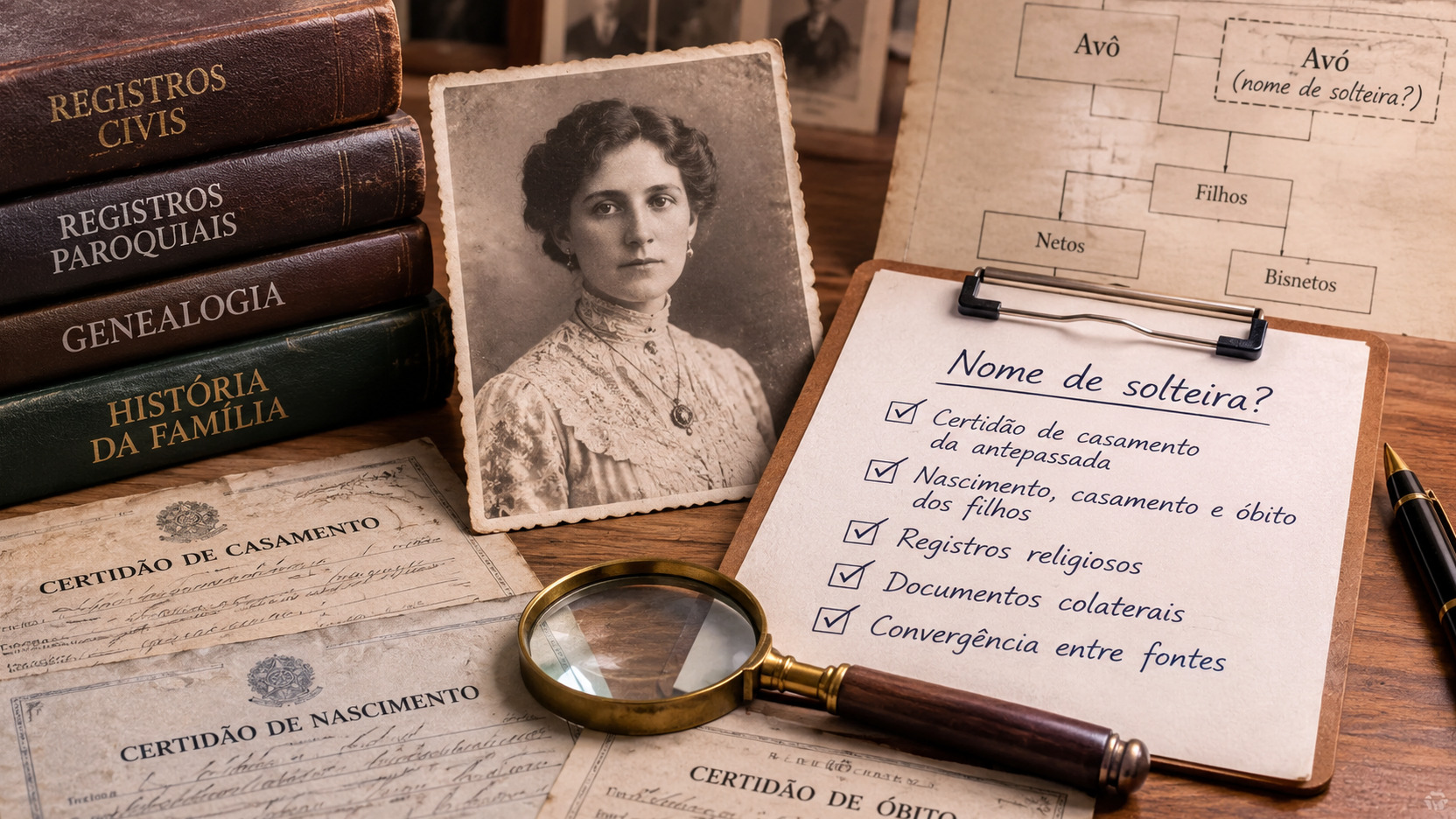
First look for the civil or religious marriage record of the woman whose identity you want to reconstruct. Marriage is often the best starting point because it brings together the two spouses at a specific event and often brings the researcher closer to the name used before the union. Current legislation requires data on spouses and parents in the civil registry, in addition to the name resulting from the marriage, but old records may contain information in a different order, length or spelling.
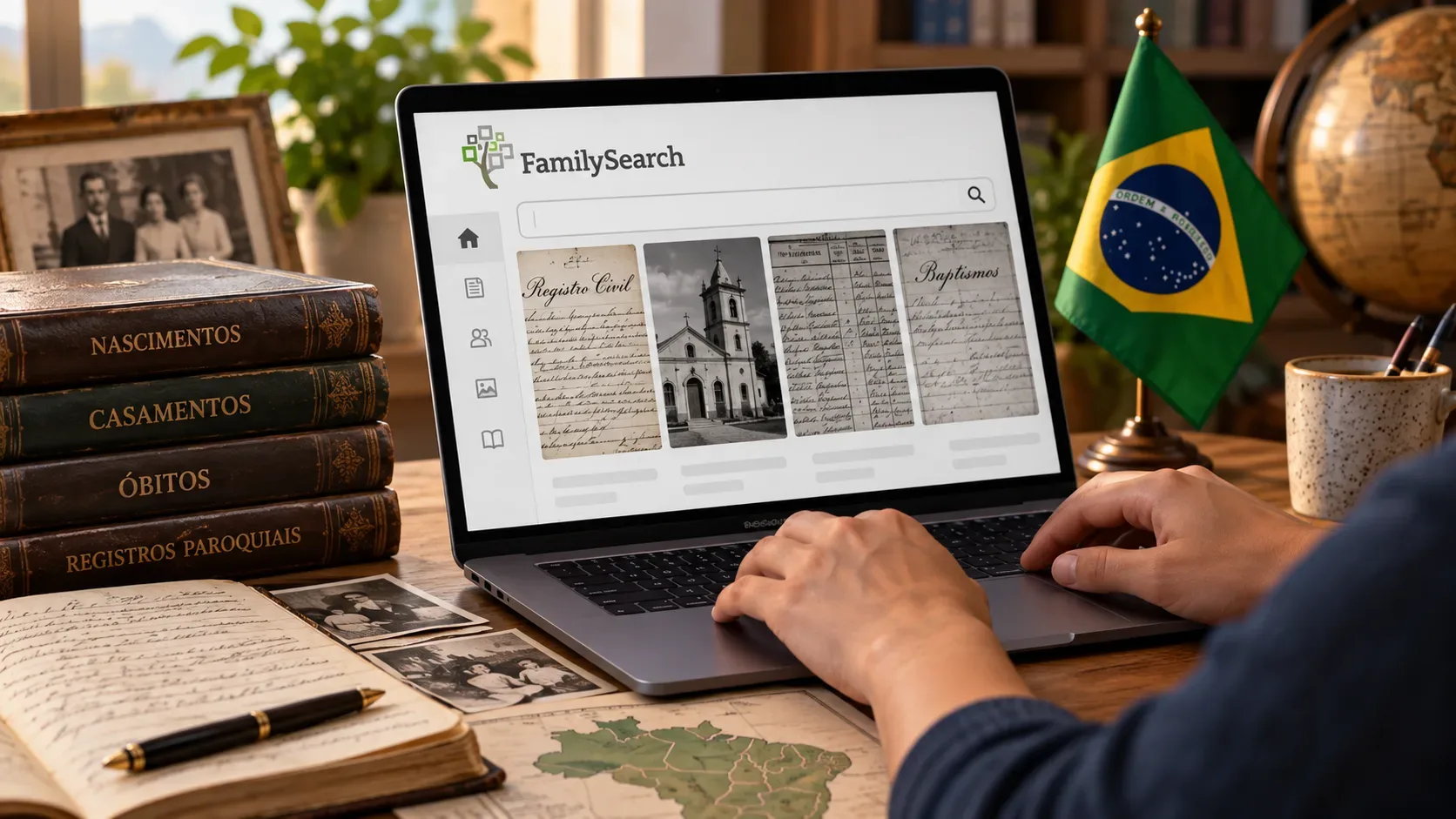
If you only know her married name, also search for her first name without a surname, combining it with her husband's name, location and age range. In indexed databases, make variations with and without middle names. FamilySearch itself recommends reducing or changing search elements, using spouse as a relationship, and testing different spellings, as indexes may contain transcription and estimation errors.
When you find an index, try to see the image of the original document. An index is a gateway, not the last word. The image may show a surname that was misread by the indexer, a second part of the name omitted from the form or an affiliation that resolves the doubt between two similar women.
Step 2: If the marriage does not appear, go down to the children's records
The absence of marriage does not end the research. Go to the children's events and look for the mother in birth, marriage and death records. The current Public Records Law determines that the birth certificate contains the names of the parents and also the names of the paternal and maternal grandparents. This explains why the birth of a child can connect three generations at once, although the contents of ancient records are not uniform.
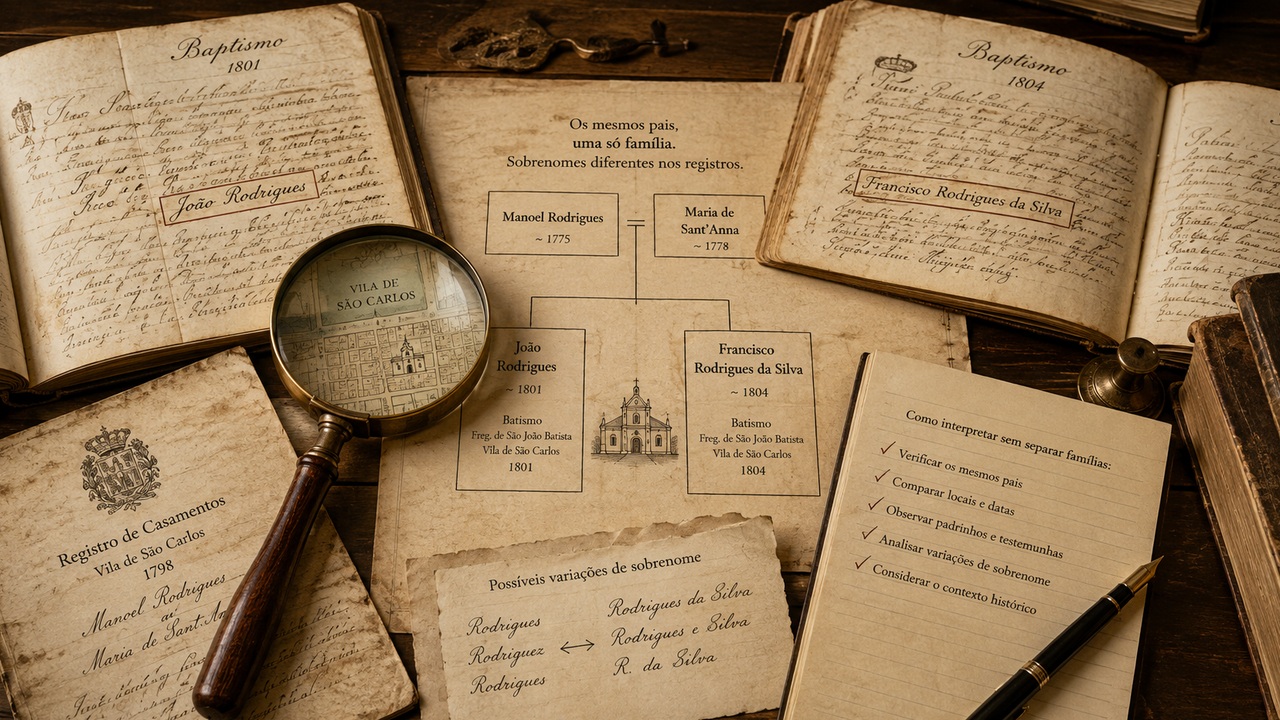
Don't choose just one child. Compare several, preferably in different years. On a certificate, the mother may appear as Maria da Silva; in another, Maria de Oliveira Silva; in a third, just Maria Oliveira. The repetition of Oliveira in independent records may reveal a strong clue that was hidden when she started using her husband's surname.
FamilySearch explicitly suggests searching for spouse or child death records when trying to find a woman's maiden name. This strategy is useful because the mother's name may reappear in these events, but the death deserves more caution: the information is declared by someone else and can be produced decades after the birth and marriage.
Step 3: use religious records when civil records don't work
If the period researched precedes the civil registry available in that location, or if there are gaps in the civil records, look for parish books. Church collections may include baptisms, marriages, and deaths or burials. FamilySearch advises that, for times before civil registration began in a given area, church records should be used as an alternative.
In a child's baptism, the mother may appear with a different form of name than that used on the civil certificate. In a religious marriage, affiliation, place of birth, previous marital status and witnesses may arise. These details help not only discover a surname, but confirm that you are following the same woman.
Religious records also require contextual reading. The parish priest could abbreviate names, Latinize forms, omit parts considered unnecessary or repeat a spelling that had become local custom. Record what is written, but do not transform a single parochial form into a definitive conclusion without comparison.
Step 4: proceed to family collateral documents
When the hotline does not provide an answer, expand the search to the ancestor's brothers, husband's brothers, parents, godparents, witnesses and other close relatives. A sister's marriage may bring the same parents with a fuller maternal surname. The death of the father or mother can confirm the family of origin. An immigration record, naturalization record, inventory, or other historical document may provide parentage or an earlier nominal form.
This lateral movement is especially useful when the woman almost always appears by her married name. Instead of trying to force her document to reveal what it doesn't contain, you rebuild the family around her and look for the last name in events in which another relative was the main character.
The National Archives maintains consultation systems and collections that can complement the registry offices, and has already developed cooperation with FamilySearch for digitization and access to sets of civil records. Coverage, however, is not homogeneous throughout Brazil. Before concluding that a record does not exist, check whether it may be in a registry office, state or municipal archive, diocesan archive, parish, SIAN or digital collection that has not yet been indexed.
Step 5: record each noun form exactly as it appears
Create a search record for each document. Note the date and place of the event, date of registration when there is a difference, type of document, woman's name exactly as it appears, name of the
spouse, parents' names, person who declared the information, whether you saw the original image or just an index and the reference that allows you to return to the source.
Don't normalize too soon. If one document says Joaquina Maria de Jesus and another says Joaquina de Jesus Pereira, preserve both forms. Particles such as de, da and dos can appear or disappear. A surname can change position. The spelling may vary between phonetically close versions. The normalized form should be a later conclusion, never a filter that erases the original evidence.
This discipline also avoids a common mistake in collaborative trees: replacing the unknown name with the husband's surname just to fill in a field. FamilySearch advises that when a woman changes her surname after marriage, her birth surname is used as her primary name and that other versions can be registered as variations. If the surname at birth is not yet known, it is better to remain uncertain than to invent a way.
Step 6: Rate the strength of the evidence
The strength of a document depends on how close it is to the fact you want to prove, who provided the information, how much time has passed and how much the record individualizes the person. An original document produced close to the wedding that identifies the woman, spouse and parents tends to be stronger than a transcript made decades later. A record can be official and still contain human error; Therefore, official does not mean infallible.
Use three working levels: strong, intermediate and weak. This classification is not a permanent note of the document type. The same type can change levels depending on the case. A death certificate with parents informed by a child who knew them can be very helpful; A death certificate with incomplete fields and a declarant without family ties may have little weight for the surname at birth.
Step 7: only complete when independent sources converge
The safest conclusion arises when at least two truly independent sources point to the same family of origin and no relevant evidence creates a serious contradiction. Independence matters. Two online trees that copied the same index are not two sources. A current certificate and a modern transcript of the same seat also derive from the same original record.
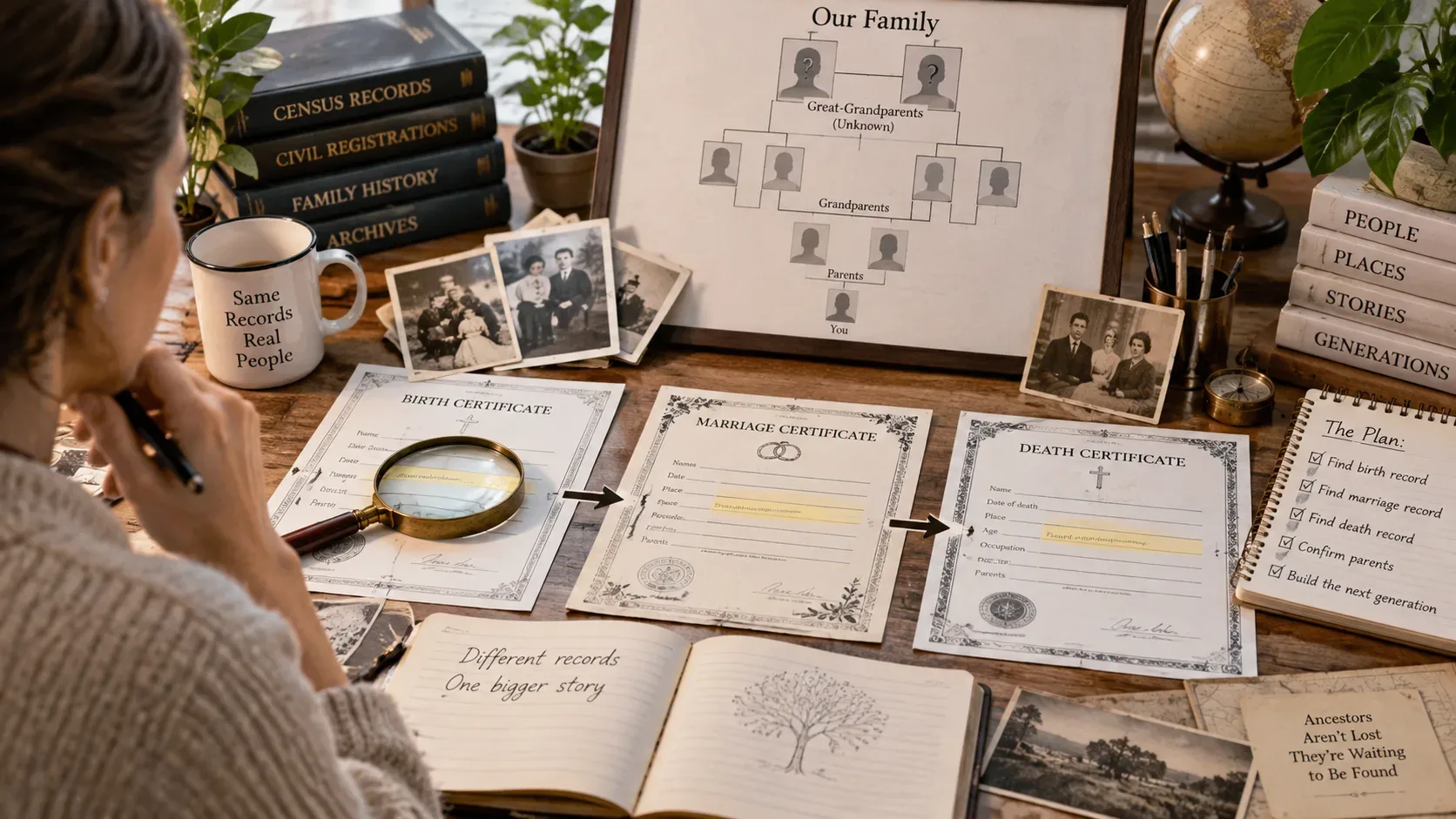
Look for convergence between different events: the woman's own marriage, birth of a child, marriage of a sister, baptism or other document that identifies the parents. If two or three different pieces repeat the same surname and the other family data match, the hypothesis gains strength.
If there is a conflict, do not choose the prettier or more frequent version. Ask which document is closest to the event, who provided the data, if there are homonyms, if a surname was omitted, if there was a second marriage or if the spelling has changed. The conflict is a sign that the research still needs a source that disambiguates.
Practical matrix: document, possible disclosure and risk of error
Own ancestor's wedding
What it can reveal: name used before or at the time of qualification, name adopted after marriage, parentage, place of birth, age or date of birth and identity of the spouse. Risk of error: low to intermediate when the original seat is available and other data matches; greater when working only with an index, a very brief certificate or a record that is difficult to read.
Birth of own ancestor
What it can reveal: name given at birth and parentage, making it one of the best references for identity of origin. Risk of error: generally low when the original record is found and matches the expected parents and locale; there may be spelling variations and late registration.
Birth or baptism of children
What it can reveal: mother's name, father's name and, in current civil records, also grandparents. In series of several children, it allows observing which maternal surname is repeated. Risk of error: intermediate, because the form of the name can vary between events and between who declares or writes the record.
Children's wedding
What it can reveal: filiation of the groom or bride and, often, parental names at a later stage in the mother's life. Risk of error: intermediate. It's a good source of comparison, but it's already a generation removed from the birth of the ancestor.
Death of ancestor, spouse or children
What it can reveal: spouse, parents, children and other relationships. Current death registration legislation provides for data on marital status, spouse and parents, but the person providing the information may be a relative, administrator, doctor, priest, neighbor or other person expected to declare the death. Risk of error: intermediate to high for surname at birth, especially when the information is late or the declarant had little knowledge of the family of origin.
Religious records
What it can reveal: baptism, marriage, filiation, godparents, witnesses and community ties, depending on the book and the time. Risk of error: variable. They are essential in periods and locations with limited civil coverage, but abbreviations, historical spellings and parish practices can alter the nominal form.
Collateral documents
What it can reveal: surname of parents and siblings, place of origin and family connections that do not appear in the main document. Risk of error: intermediate when the relationship is well demonstrated; high if the connection between the person in the document and the ancestor is only presumed.
Online trees, transcripts, obituaries and family accounts
What they can reveal: clues, alternative spellings, names of relatives and paths to new documents. Risk of error: high when they do not point to the original source. Use them to generate hypotheses, not to end the investigation.
When to request a more complete certificate
A short certificate may not reproduce all the elements available on the seat. The Public Records Law allows certificates in full, in summary or in a report depending on the requirements, and the current CNJ rules standardize certificate models. For genealogical research, when the common route does not clarify affiliation, previous name or relevant endorsements, it is worth asking the registry office which modality can reproduce the necessary content and which access rules apply to the record in question.
The official Civil Registry portal allows you to request duplicate birth, marriage and death copies. For very old documents, locating may require identifying the responsible registry office, consulting incorporated collections or resorting to archives and historical collections. The fact that a name does not appear in an online search does not prove that the record never existed.
An example of convergence without guesswork
Imagine a great-grandmother known in the family as Maria Souza, wife of Antônio Souza. The marriage has not yet been found. At the birth of the first child, the mother appears as Maria Ferreira; in the marriage of a daughter, such as Maria Ferreira de Souza; upon her husband's death, as Maria F. Souza; and in the marriage of a possible sister, the parents are the same as those who appear in another family document.
The conclusion should not simply be that Ferreira was her maiden surname because it appeared once. The set needs to show that Maria Ferreira and Maria Souza are the same person and that Ferreira is linked to her family of origin. If the sister's marriage, Maria's baptism or other parental records also point to Ferreira, the hypothesis becomes much more solid. If a second Maria Ferreira married to another Antônio appears in the same region, the research needs to go back to the dates, parents and locations before finalizing the identity.
What to do when no document closes the response
Keep the surname as unknown or provisional and record the hypothesis separately. Note what has already been discarded, which registry offices and parishes have been searched, which year ranges have been looked at, and which alternative names have appeared. This journal avoids repeat searches and helps someone else review their thinking.
It is also worth expanding the time window. Weddings may have taken place in a neighboring municipality, baptisms may have been in the parish of a parish other than the subsequent residence and migrant families may have registered children in several locations. Research the couple as a unit and follow the sequence of their children. Often the birth name emerges not from a perfect document, but from the consistent repetition of small clues in different records.
The stopping point is simple: you don't need absolute certainty about every spelling variation, but you do need enough evidence to explain why a particular surname belongs to that specific woman's birth identity. When marriage, filiation and independent records of relatives converge, the tree stops relying on a hunch and starts to have a documentally defensible conclusion.