You have a great-grandfather's name, an approximate date and perhaps the state where he was born, but you don't know the registry office. The most common mistake is to treat the name of the registry office as the first piece of information that needs to be discovered. In genealogical research, it is almost always more efficient to first reconstruct two things: the likely time of birth and the jurisdiction that served that place at that time. After that, the search universe becomes much smaller.
The path also changes depending on the date. Civil registration of births, marriages and deaths began throughout Brazil on January 1, 1889. For earlier periods, especially in Catholic families, parish baptism books may be the main source or the only one that survives. For later periods, civil registration takes priority, but parish books, marriages, deaths and other documents continue to be useful for discovering the correct location and confirming identity.
Start with what you know, not with the missing registry
Before opening any website, transform the scattered information into a small research sheet. Record the name as it appears in the most reliable source you already have, the spelling variations, the year or interval of birth, the state, municipality, district, town or farm mentioned, names of parents, spouse and siblings, in addition to the places where the person married, had children or died.
The objective is not to fill in all the fields. It’s about discovering which information has the power to reduce the search. A common name and an approximate year are almost never enough. The mother's name, a small district, the spouse's name or profession can separate homonymous people.
If you only have an age stated at marriage or death, convert it to a range, not an exact year. A person recorded as being 62 years old in 1935 may have been born in 1872 or 1873, and the stated age itself may contain error. Working with a window of a few years is safer than forcing precision that the source does not provide.
First cut: was the birth before or after 1889?
Before 1889, look for the parish along with any civil clues
The national civil registration regulations came into effect on January 1, 1889. This does not mean that it is impossible to find earlier civil records in certain localities, but it does mean that you should not assume that a birth from 1860 or 1875 is in a modern registry office.
For Catholic families, registering baptism is usually the first alternative. It can provide the child's name, parents, godparents, place of residence and, in many cases, date of birth. Read the original seat. Do not automatically transform the date of baptism into a date of birth: some entries contain both dates, others record only the ceremony.
The search unit, in this scenario, stops being just the municipality and starts to include the parish or parish. A family could live in a village that today belongs to another municipality, but at that time was served by a church located in the seat of a neighboring parish.
From 1889 onwards, civil registration became the main target
For births after the national start of civil registration, first search the local civil registration books. Still, do not restrict your search to the current name of the municipality. The district could belong to another municipality, have another name or not even exist as an autonomous unit at the time of birth.
It is also worth keeping parish records as a parallel source. A baptism can reveal the family residence, the full name of the parents or godparents and allow you to return to the civil registry with better criteria. When two independent sources point to the same person, the risk of confusing homonyms decreases.
When the place of birth is vague, go back to an event in the person's life
If you don't know where the person was born, first look for where they appear as an adult. Marriages and deaths are especially useful because they can inform birthplace, age, parentage, marital status, residence or name of the spouse. The quantity and quality of this data varies depending on the season and content, so treat each piece of information as a clue to be confirmed, not as an isolated truth.
A marriage can transform vague information like "born in Minas Gerais" into a municipality. A death may add the name of the parents. The birth of a child can show where the family lived just a few years later. When you put these events together in chronological order, you begin to see the geographic corridor through which the family moved.
If marriage and death give different locations, do not choose one of them out of preference. Check whether one refers to birthplace, another to residence, or whether there has been a change of name and territorial limits. Divergence is a signal to research further, not to dismiss a source outright.
Find out the historical jurisdiction before choosing the repository
The current name of the city could be a trap. Brazilian municipalities were created, dismembered, renamed and had districts transferred over time. IBGE maintains material on the evolution of territorial division and municipal history pages that help to reconstruct these changes.
In practice, the correct question is: to which municipality, district, parish or district did this place belong on the approximate date of birth? If the city was only emancipated in 1950 and your ancestor was born in 1910, the registration was probably produced under the previous jurisdiction.
Do a search with both names when there is a change of toponym. If a district was separated, also search in the municipality of origin. And when using the FamilySearch Catalog, search at the territorial level that created the record, because the catalog organizes many sets by jurisdiction.
Use the Civil Registry when the search is already narrow enough
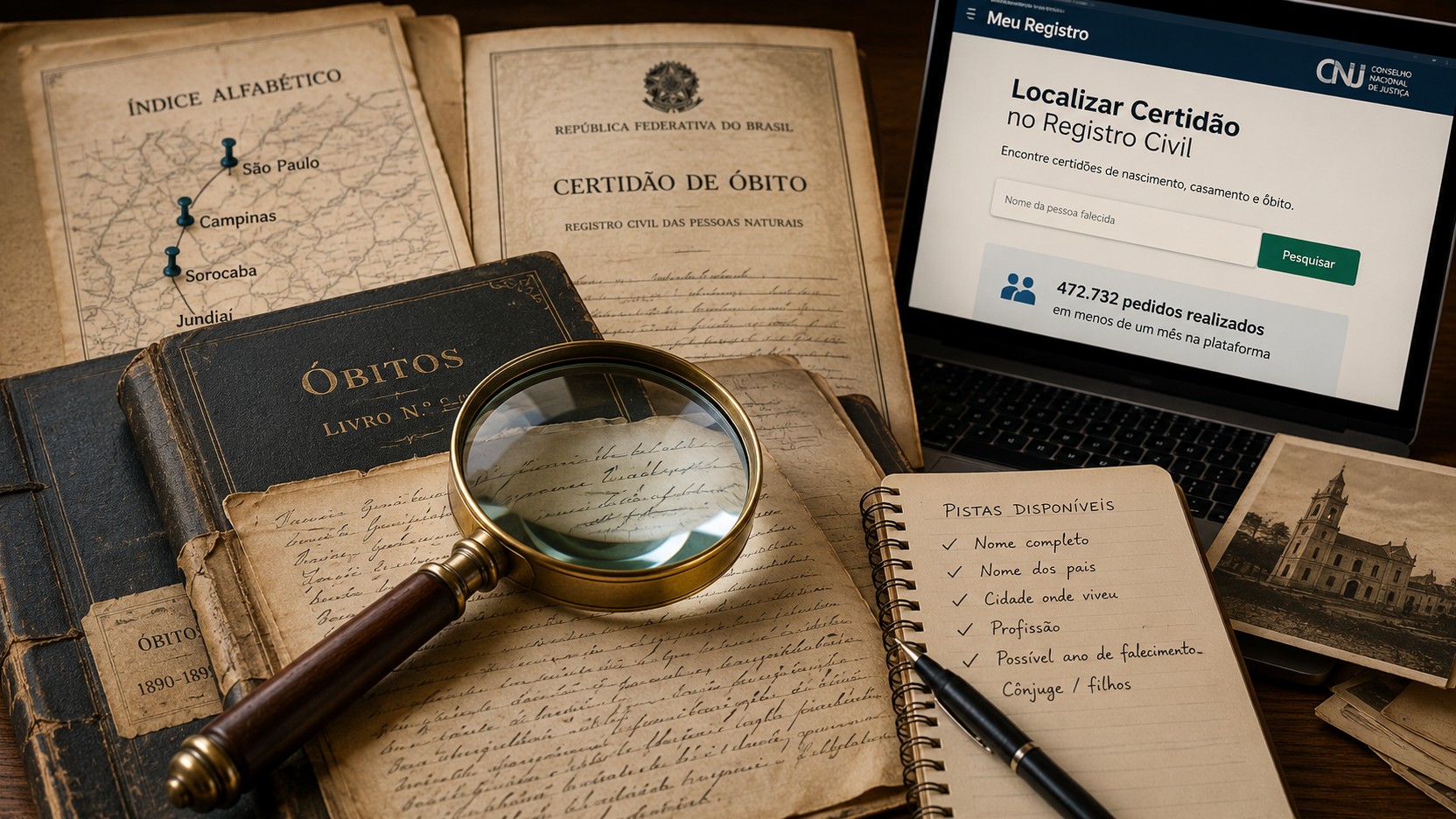
The official website RegistroCivil.org.br offers the certificate search service for situations in which the person does not know where the registration was made, in addition to allowing you to locate notary offices and request duplicates. The service's own guidance highlights that the more information is provided, the greater the chance of location.
So the portal works best after you've done the basic genealogical work. Instead of just sending "José da Silva, born around 1910", try coming up with something like "José Antônio da Silva, son of Manuel da Silva and Rosa Ferreira, born between 1908 and 1912, probably in a certain municipality or district".
If you find the registry office or district, go from the location stage to requesting the certificate. For administrative use, citizenship, rectification or other formal procedure, confirm which type of certificate and which format the recipient institution requires. An image found in a historical collection is excellent for research, but should not be automatically confused with a newly issued official certificate.
In FamilySearch, searching by name is just one of the doors
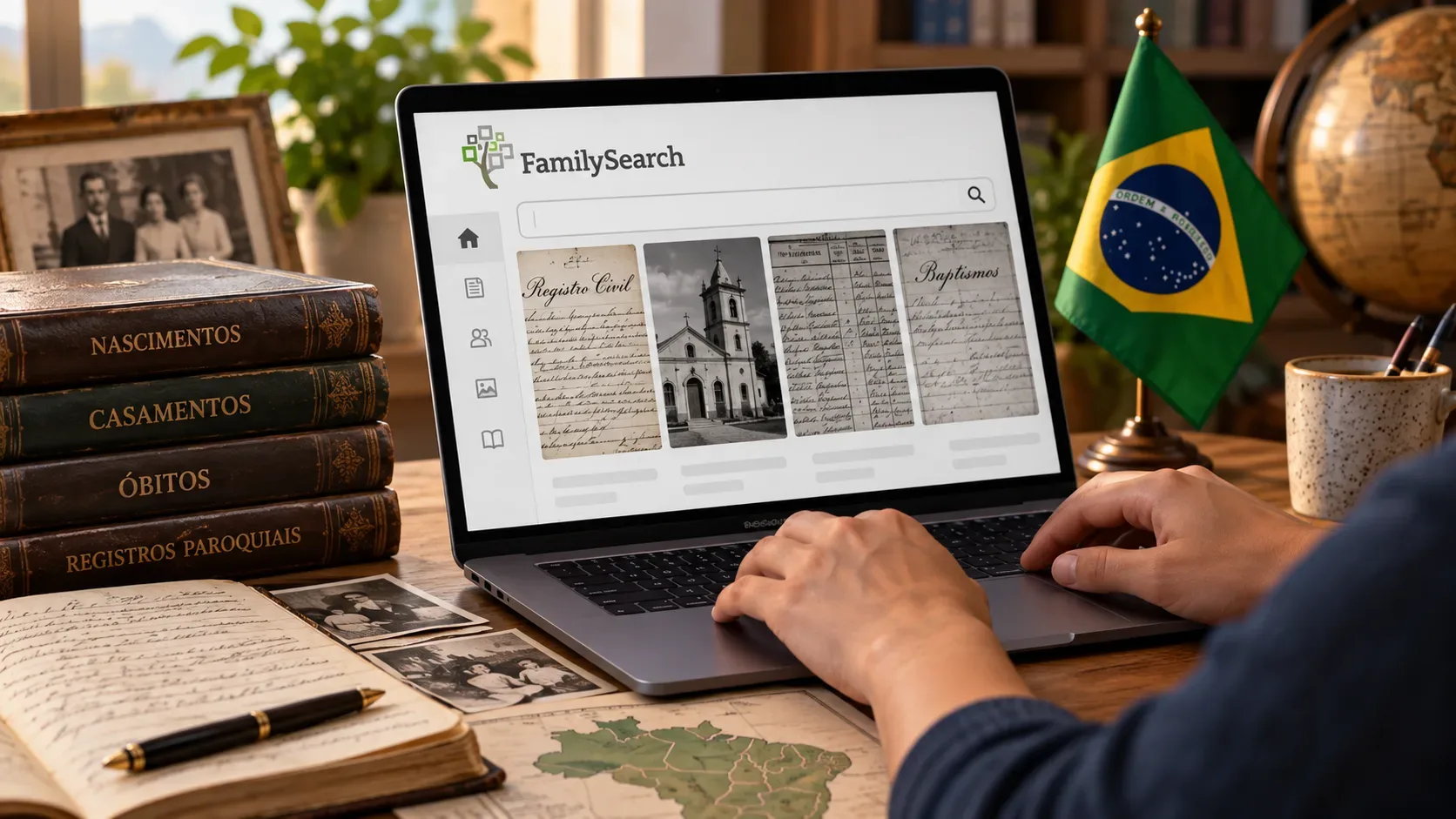
An unsuccessful search for name does not prove that the record does not exist. FamilySearch maintains indexed collections, image-only collections, and partially indexed sets. Many books need to be browsed manually.
After searching by name, change the strategy to location. In the Catalog, search for the state, historic municipality and subordinate places. Look for civil records, parish records, indexes or digitized books. The camera icon indicates available digital images; Some collections may have access restrictions set by the collection custodian.
The Historical Images area also allows you to search for sets by location, date and type of event. In non-indexed books, proceed using the logic of the book itself. Look for alphabetical indexes at the beginning or end, identify the date range, note book, sheet, term and image numbers and compare nearby records. Siblings registered in the same registry office or baptized in the same parish may be easier to locate and reveal where to look for the main ancestor.
When you find an indexed result, open the original image whenever it is available. The index is a transcription created to facilitate searching and may abbreviate names, omit details or contain reading errors. The seat image shows the complete context and often provides clues that do not appear in the index.
When FamilySearch doesn't help, think about who keeps the collection
Not every Brazilian book is online, and not every collection is in the same place. Parish records may remain with the parish, curia or diocesan archive. Civil books may be held in the responsible registry office, in a successor office or, in specific cases, collected in public archives.
The National Archives provides consultation of documents held by SIAN and has historical sets of civil records, including digitized collections from Rio de Janeiro in cooperation with FamilySearch. This does not mean that the National Archives concentrates the country's civil records. It is one repository among many, and its usefulness depends on whether the collection sought is in its custody.
State and municipal public archives, archives of curia, dioceses, parishes and local memory centers can also be decisive. When you reach out, be specific. Enter the person, date range, historical location, affiliation and the type of book you are looking for. Vague requests are much more difficult to fulfill.
Collateral documents can reveal the notary's office without mentioning the notary's office
When the birth remains invisible, research the family around it. The parents' marriage may indicate where the couple lived before the birth. The baptism of a brother can reveal the parish. The death of one of the parents can confirm the birth of the family. Inventories, passenger lists, immigration records, military documents, and newspapers may add a town, farm, district, or surname variation.
The best collateral document is the one that reduces the search space. News saying only that the person was a “mineiro” helps little. A marriage that identifies the parents and the parish of origin can completely change the search.
Also look for siblings. Families often use the same registry offices, parishes and networks of godparents for several years. If the ancestor doesn't appear by the expected name, the birth of a sibling may open the right book and allow you to browse a few pages earlier or later.
How to know if you've found the right person
The same name is not enough. Compare parentage, age, spouse, profession, residence, siblings, godparents and chronology. Ask if that person could have been in that place on that date and if the family ties are repeated in other sources.
Give more weight to a coherent set of evidence than to an isolated coincidence. A record with a small difference in spelling may be correct if the country, location and chronology coincide. On the other hand, a name spelled exactly as you expected may belong to another family.
Also record the reference of the document found. Book, page, term, circumscription, parish, digital image and access URL must be included in your research notes. This
allows you to return to the source, request a certificate later and show someone else how you arrived at the conclusion.
Located seat is not the same thing as an issued certificate
In genealogical research, you may first come up with a photograph or scan of the original book. This is the seat located: the historic entrance where the event was recorded. It is enough to read, transcribe, compare and advance the genealogy.
A certificate is a document issued by someone who has the authority and custody to certify that record. If your purpose is just to reconstruct the family tree, the seat image can solve the research step. If you need to present the document to an authority or institution, you will normally have to find out which agency or custodian body can issue the appropriate certificate and check the requirements of that procedure.
This distinction avoids a frequent mistake: finding an image on FamilySearch and concluding that you already have the official duplicate, or, conversely, spending on certificates before being sure that the seat belongs to the correct ancestor.
If nothing appears, change one variable at a time
Enlarge the date first. Then test alternative spellings of the first and last name. Then remove middle names, search for parents' names, search for siblings, and check neighboring counties or previous jurisdiction. If there is evidence of birth before 1889, go back to the parish books. If the place changed its name or was dismembered, redo the search using the historical name.
Also consider late registration. The date the certificate was drawn up may be after birth, and this may shift your expectation of where to find it in the book. In old research, a few days, months or years of difference should not end the investigation when other family ties remain coherent.
Avoid changing name, date, location and affiliation at the same time. If you change all the variables, you lose the ability to understand why a search started to work. Genealogical research improves when each attempt leaves a trace of what was tested.
A simple decision tree to get you from scratch
If you know the municipality and approximate year, first check the historical jurisdiction of that date. If the birth is after January 1, 1889, search for civil records on FamilySearch by location and on the Civil Registry portal; if it is earlier, give priority to parish records, without ignoring any local civil records.
If you know the state, but not the municipality, look for marriage, death, birth of children and other events that may reveal birthplace or residence. When a municipality appears, confirm if it already existed with that name in the period searched.
If you only know the name and family, research the closest relatives. A sibling, spouse, or parent may have left a more complete record. Use this new information to get back to the main person.
If you find the book but don't find the name in the index, browse the images in the date range and look for siblings, spelling variations, and neighboring records. If you find an image of the seat, write down the complete reference and only then decide whether you need to request an official certificate.
The central point is to change the question. Instead of "which registry office has my ancestor's birth date?", ask "which institution registered people from that place, in that period, and which subsequent documents can lead me to it?". This change transforms a vague, national search into a local, chronological, and documentable investigation.