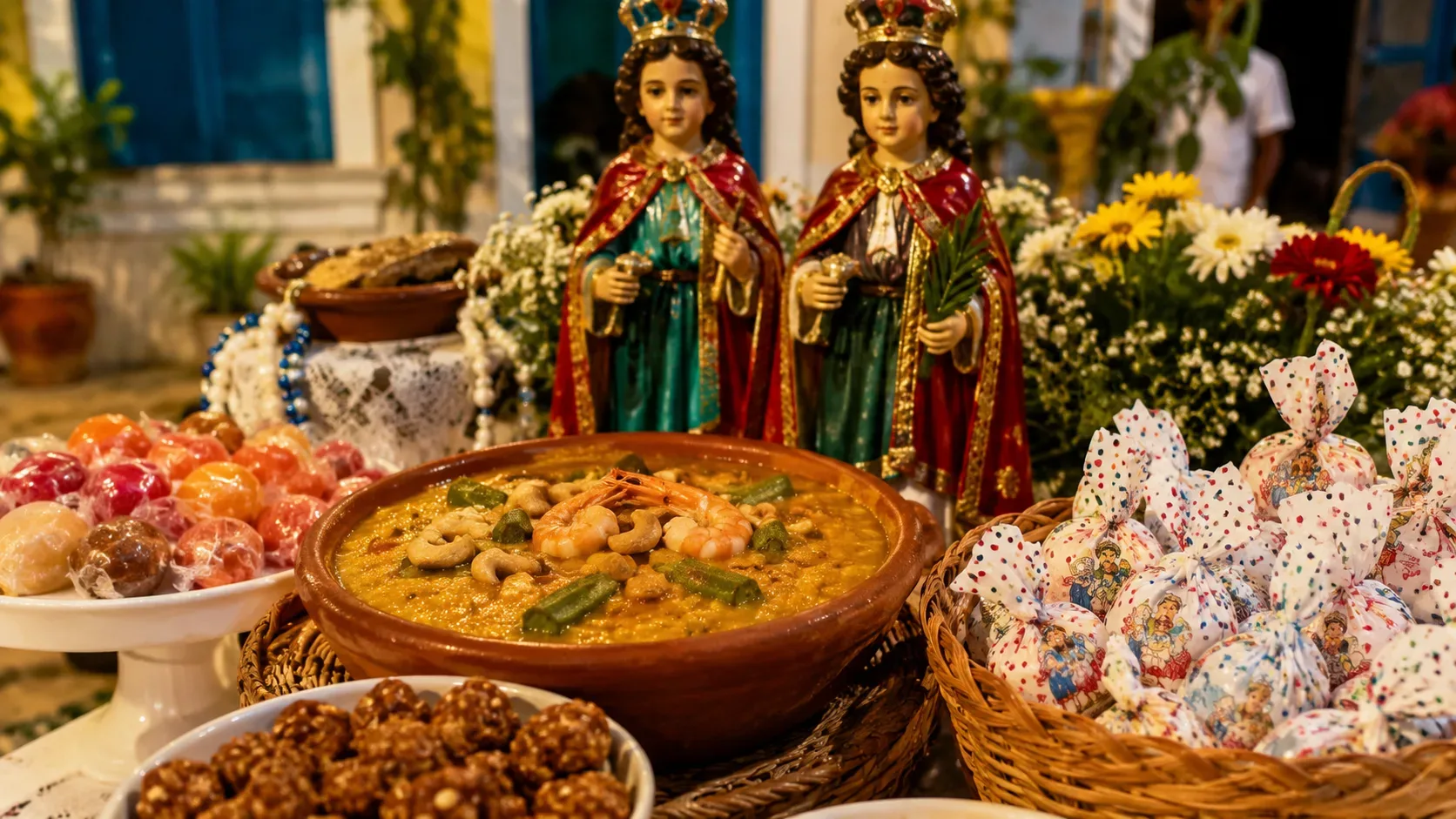
In September, talking about Cosmas and Damian in Brazil can mean different things depending on the region, family, and religious tradition. In Bahia, caruru is one of the strongest markers of the celebration; in Rio de Janeiro, handing out bags of candy became especially prominent. In Afro-Brazilian temples, Catholic homes, and family festivities, names such as Cosmas and Damian, Ibeji, Erês, Children, or ibejadas may appear close together — but that does not make all these concepts the same religious entity.
September 27 is a powerful popular date — but it is not the only reference
In Brazil's popular devotional calendar, September 27 became strongly associated with Cosmas and Damian, caruru, and candy. In Bahia, the state's own heritage recognition uses that date as a landmark for the celebrations. In the calendar of saints currently presented by the Vatican, however, Saints Cosmas and Damian appear on September 26. The two references coexist because an official liturgical calendar, popular devotion, and Afro-Brazilian traditions do not necessarily follow the same historical logic.
This one-day difference is a good example of the care the subject requires: the Brazilian celebration cannot be explained only through the Catholic calendar, just as the presence of Catholic saints in Afro-Brazilian contexts does not mean that every tradition interprets these figures in the same way.
Cosmas and Damian: the Catholic layer of devotion
In Christian tradition, Cosmas and Damian are venerated as martyrs and appear together as saints. In Brazil, popular devotion to the pair became strongly associated with children, vows, food sharing, and household and community festivities. This popular religiosity developed in dialogue with local settings and, in many regions, came into contact with Afro-Brazilian practices.
For that reason, when a family offers food or candy “to Cosmas and Damian,” the specific meaning of the offering should be understood from the perspective of those who hold the celebration. For some, it is Catholic devotion; for others, the festivity belongs within Afro-Brazilian repertoires; for many families, historical references intersect in their own ways.
Ibeji: historical correspondence is not automatic equivalence
Ibeji is connected, in Yoruba and Afro-Brazilian traditions, with the sacred dimension of twins. In Brazil, the presence of paired twins encouraged a historical correspondence between Ibeji and Saints Cosmas and Damian. Sources from the Government of Bahia itself describe this rapprochement when explaining why devotion to the saints took on a distinctive form in Afro-Bahian culture.
But “correspondence” is more precise than saying “they are the same thing.” The meaning of Ibeji belongs to African-derived religious systems, with their own concepts, rites, and relationships. Cosmas and Damian belong to Christian tradition. The historical encounter between these references produced syncretisms, associations, and shared forms of devotion, but it did not erase differences of origin or create a single theology valid for every temple, church, or family.
There are also practitioners and religious houses that prefer to stress distinctions and reject simplistic explanations of syncretism. It is therefore safer to speak of historical and ritual connections whose interpretation varies by tradition.
What about Erês? Why the term should not be used as a synonym
Erê is another concept often mixed together with Ibeji and Cosmas and Damian in quick explanations. Anthropology of Afro-Atlantic religions shows, however, that Ibejis, Erês, and other figures linked to sacred childhood form a complex field of relationships. In different branches of Candomblé and Umbanda, the terms may designate distinct religious realities, and usage varies among houses and lineages.
In Umbanda, for example, references to the Children or ibejadas as a distinct spiritual line are common. In Candomblé contexts, Erê may have meanings different from those attributed to Ibeji. The formula “Erê = Ibeji = Cosmas and Damian” may work as a popular shortcut, but not as a rigorous religious definition.
Caruru: dish, vow, ritual obligation, and community gathering
In Bahia, “Cosmas and Damian caruru” can mean more than the okra dish itself. In many celebrations, the word names the broader meal, rite, and gathering. Okra cooked with palm oil and other ingredients may be accompanied by dishes such as vatapá, black-eyed peas, acarajé, abará, chicken xinxim, and other foods, depending on the household, region, and family tradition.
There are also carurus connected to vows or ritual obligations, in which preparing the food fulfills a devotional commitment. In some traditional forms, seven children eat first; in others, boys and girls participate together, serving practices are adapted, or the sequence is different. Research on Bahia also records songs, prayers, clapping, and samba in certain carurus — but not every caruru contains all these elements.
This variety matters because cultural heritage is not a frozen recipe. A tradition remains alive precisely because families and communities transmit, reinterpret, and adapt it without losing its ties to memory, faith, and belonging.
Candy: an important practice with different regional weight
Handing out candy, coconut sweets, peanut sweets, lollipops, and other treats is another widely known part of Cosmas and Damian festivities. In Rio de Janeiro and neighboring municipalities, research by the National Museum/UFRJ shows that the “Cosmas and Damian candy bag” became a defining form of celebration: children move through the streets to receive sweets, while adults maintain vows, family memories, and networks of reciprocity.
In Bahia, sweets can also be present, but caruru occupies an especially strong place in the imagination and practice of the feast. This helps explain why there is no single “Brazilian Cosmas and Damian celebration.” There are local repertoires: in one place, handing out candy may be the central gesture; elsewhere, preparing and serving caruru; elsewhere still, mass, household prayer, Afro-Brazilian ritual, samba, food, and family gathering may be combined.
What Bahia's heritage recognition protects
In 2024, the Government of Bahia officially registered the Feast of the Caruru of Saints Cosmas and Damian in Bahia as Intangible Heritage in the Special Registry Book of Events and Celebrations. Decree No. 23,103, dated September 26, 2024, also registered the traditional Caruru of Saints Cosmas and Damian in the Special Registry Book of Knowledge and Ways of Making.
The books maintained by Bahia's Institute of Artistic and Cultural Heritage (IPAC) continue to list caruru in both categories. That is significant: the state recognizes both the collective celebration and the know-how associated with the food. Registration does not require everyone to practice the feast in the same way, nor does it turn one religious interpretation into an official rule. It recognizes the cultural importance of a plural manifestation transmitted by communities across different Bahian territories.
How to discuss the celebration without erasing differences
A respectful explanation can follow four simple precautions:
- Distinguish origin from correspondence: Cosmas and Damian are Christian saints; Ibeji belongs to African-derived traditions. Their historical rapprochement does not erase that difference.
- Do not turn Erê into an automatic synonym: the term has its own uses and varies across Candomblé, Umbanda, and different religious houses.
- Recognize regional variation: caruru is especially prominent in Bahia; candy bags have great strength in Rio de Janeiro; other places combine practices in their own ways.
- Listen to the people who hold the feast: the best way to understand the meaning of a rite, food, or name is to ask how that family, temple, church, or community understands it.
The central point: layers can coexist without being identical
Caruru, candy, twin saints, Ibeji, Children, and childhood memories can meet in the same season and even in the same celebration. That encounter is part of the feast's historical richness. The problem begins when proximity is presented as total equivalence.
Understanding Cosmas and Damian in September requires working with layers: Catholicism, Afro-Brazilian traditions, popular religiosity, cuisine, vows, childhood, family memory, and heritage. They intersect, but retain meanings of their own. That combination — without erasing differences — helps explain why the celebration remains so strong.
Sources for further reading
- Government of Bahia — recognition of the Caruru of Saints Cosmas and Damian as intangible cultural heritage
- IPAC — Special Registry Book of Events and Celebrations
- IPAC — Special Registry Book of Knowledge and Ways of Making
- National Museum/UFRJ — Doces Santos: devoções a Cosme e Damião
- Revista de Antropologia — overview of research on saints, candy, and children
- Vatican News — calendar of saints for September 26